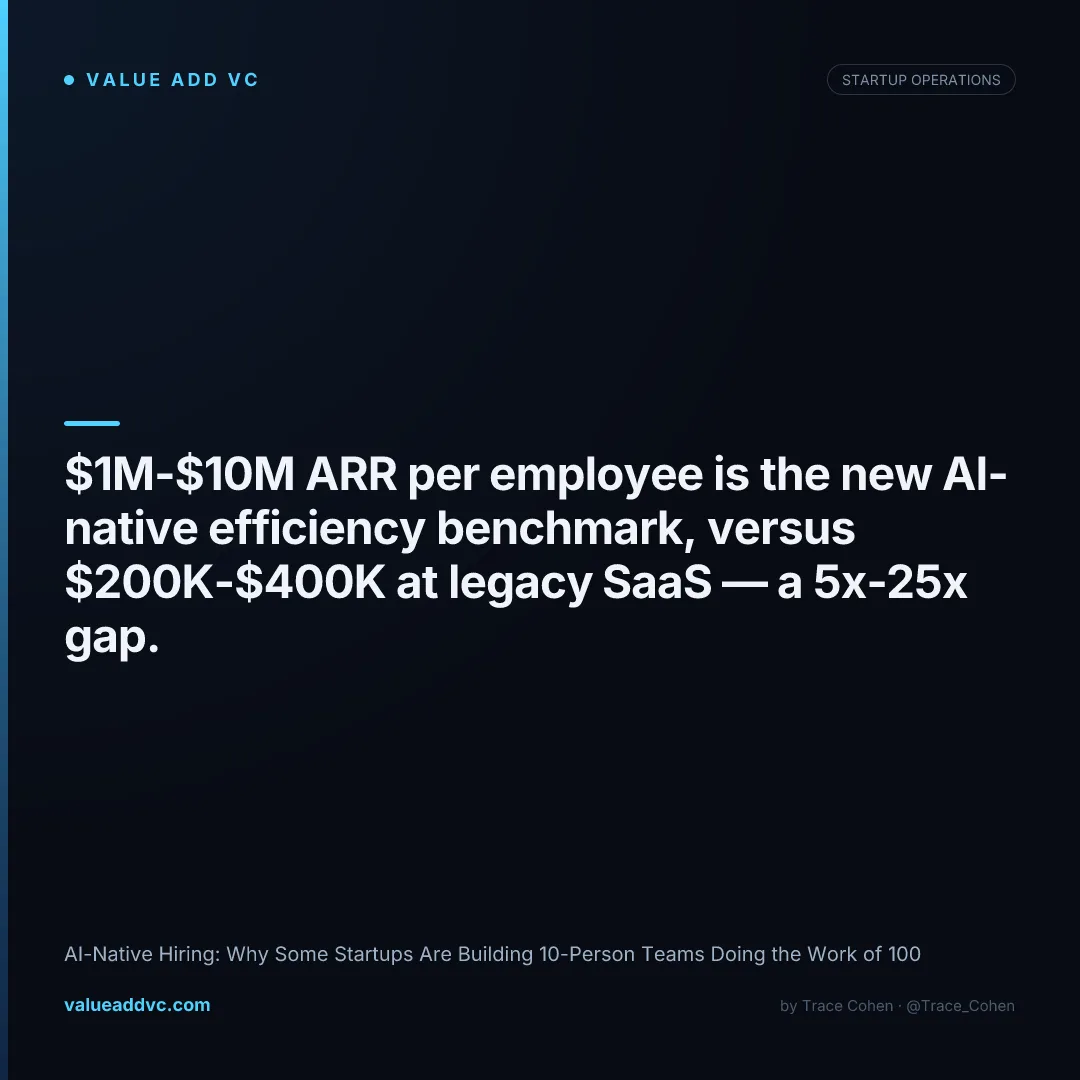
AI-native startups are running on $1M-$10M of ARR per employee — 5x to 25x the $200K-$400K that legacy SaaS produces — which is how a 10-person team now ships and sells what used to take 80-100 people.
The gap isn't about working harder or hiring "10x engineers." It's a structural shift in which work still needs a human attached to it.
AI-Native Startup Hiring Efficiency, Explained
AI-native startup hiring efficiency is the practice of building a company around AI agents from day one so that revenue per employee rises 5x-25x above traditional software norms. Instead of hiring a support team, an SDR team, and a QA team, the founders deploy agents to absorb that high-volume work and keep total headcount under 15-25 people through $10M+ ARR. The benchmark shifts from how many people you employ to how much each person produces.
The 2021 playbook said growth required headcount: more reps for more pipeline, more support for more tickets, more engineers for more features. The 2026 playbook says the opposite — adding people often slows an AI-native team down, because each new hire adds coordination cost while AI tooling adds output without it. You can watch the divergence directly in tech hiring data: total roles posted by software startups are down while revenue per company is up.
Revenue Per Employee: AI-Native vs Legacy SaaS
The cleanest way to see the 10-people-doing-the-work-of-100 effect is revenue per employee by company type. The table below compares representative benchmarks — public figures are approximate and reported, but the spread is the point.
| Company / Type | Approx. ARR | Headcount | ARR / Employee |
|---|---|---|---|
| Anysphere (Cursor) | ~$500M | ~200 | ~$2.5M |
| Midjourney | ~$300M | ~40 | ~$7.5M |
| Agent-first seed startups | $1M-$5M | 8-15 | $1M-$5M |
| Typical AI-native Series A | $10M | 20-30 | $350K-$500K |
| Legacy SaaS at scale | $100M+ | 600-900 | $200K-$400K |
| Median venture-backed SaaS | varies | varies | ~$250K |
The early-stage AI-native numbers look almost unfair — and they partly are, because agent-first companies front-load efficiency before sales complexity, security reviews, and enterprise support drag the ratio back toward $300K-$500K per head. But even the "normalized" AI-native Series A still runs leaner than legacy SaaS by a wide margin.
What the 10-Person AI-Native Team Actually Looks Like
A 10-person team doing the work of 100 isn't ten generalists doing everything. It's a deliberate shape: a small core of high-judgment humans, each multiplied by agents that own the repetitive layer of their function.
3-4 Engineers
First-draft code, tests, and docs come from AI; humans architect, review, and own the hard 20%
2-3 Go-to-Market
Agents handle SDR prospecting and outreach; humans close, negotiate, and run named accounts
1-2 Product / Design
AI generates mockups and copy variants; humans set taste, priority, and roadmap
1-2 Founders
Strategy, fundraising, hiring, and the judgment calls no agent should make
The functions that vanish from the org chart are the ones that used to need the most bodies: a 60-90 person support, SDR, QA, and junior-dev layer collapses into agent infrastructure that one or two humans supervise. That's the literal arithmetic behind "10 doing the work of 100" — and it's why the $300B outsourcing industry is being forced to rewrite its own math.
Which Roles AI-Native Hiring Eliminates — and Which It Doesn't
Not every job compresses equally. The pattern is clean: high-volume, low-judgment work goes to agents first, while work that requires taste, accountability, or relationships stays human and gets paid more.
Compressing 40-70%
- ✕ Tier-1 customer support reps
- ✕ SDRs and outbound prospecting
- ✕ Manual QA and test writers
- ✕ Junior / first-job developers
- ✕ High-volume content writers
Still Hired Aggressively
- ✓ Senior engineers who direct AI output
- ✓ Founder-level GTM and closers
- ✓ Designers with strong taste
- ✓ Domain and regulatory experts
- ✓ Forward-deployed / solutions engineers
The uncomfortable second-order effect is the entry-level pipeline. If junior roles compress 40-70%, the traditional on-ramp that turned a 22-year-old into a senior operator narrows. AI-native teams are quietly betting they can hire fewer, more senior people and skip the apprenticeship layer entirely — a bet that works for the company and creates a real problem for the industry. You can see the early footprint of this in layoffs data, where role mix is shifting faster than total counts.
Why Staying Small Is an AI-Native Fundraising Advantage
Capital efficiency moved from a nice-to-have to a primary diligence metric. A startup that reaches $5M ARR with 12 people has a fundamentally different financial profile than one that reaches $5M with 70 people — lower burn, faster path to default-alive, and a net burn multiple that underwrites cleanly.
Concretely: at ~$200K fully loaded cost per head, a 12-person team burns roughly $2.4M a year, while a 70-person team burns roughly $14M. To hit the same $5M ARR, the lean team is near breakeven and the heavy team needs to raise again at a worse multiple. That's why AI-native teams routinely command premium valuations — the math is visible on the SaaS valuations dashboard, where revenue multiples now correlate tightly with efficiency, not just growth rate.
The trap is treating "small" as the goal. Small is a byproduct of leverage, not a strategy. Teams that under-hire to look efficient stall on the work AI still can't do — enterprise security reviews, complex sales, regulated compliance — and quietly cap their own growth. For teams hiring globally to maximize leverage, platforms like Deel handle international payroll and compliance so you can add contractors in any market without a local entity.
The metric that matters is no longer how many people you hired.
It's how much each one produces — and AI-native teams are proving $1M+ ARR per employee is the new floor, not the ceiling.
Track hiring and efficiency trends on the Tech Hiring Dashboard at Value Add VC. Originally published in the Trace Cohen newsletter.
Latest from the Pulse
Get VC data most people never see
— 100% free
Weekly benchmarks, valuations, and fund data. Join 5,000+ investors. No spam.