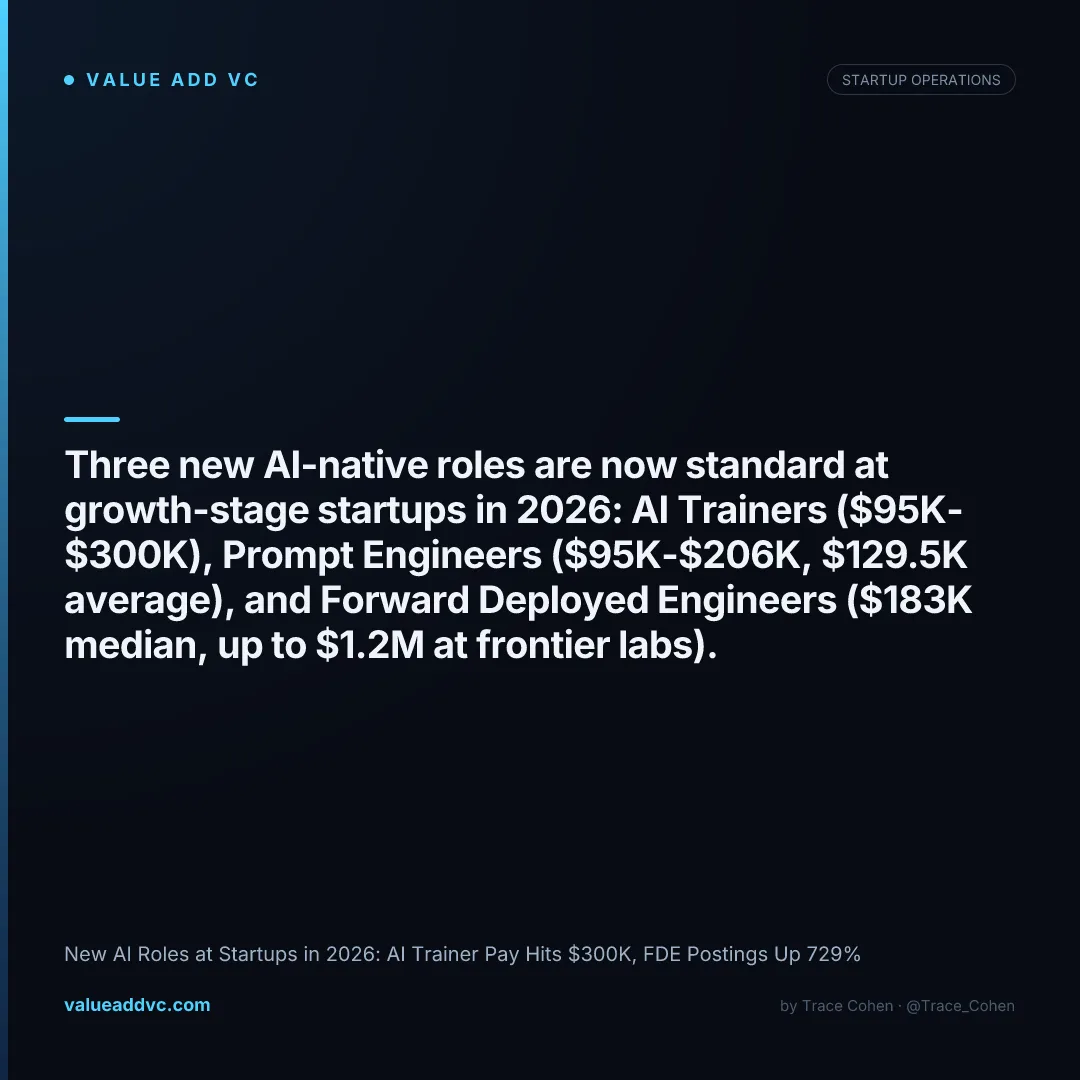
Forward Deployed Engineer job postings grew 729% in the twelve months through April 2026, and the role now carries a $183,000 median salary — up to $1.2M in total comp at frontier AI labs.
That's the short answer. The longer answer is that AI didn't just create one new job title, it created an entire compensation ladder that didn't exist three years ago. AI Trainers now earn $95,000 to $300,000 depending on seniority, with domain specialists like doctors and lawyers clearing $250 to $1,000 an hour on platforms like Surge AI. Prompt Engineers, once dismissed as a 2023 fad, average $129,500 in the US. And a small in-house team covering AI Engineer, AI Product Manager, and AI Trainer roles now costs a startup $400,000 to $650,000 a year fully loaded. If you're building a 2026 headcount plan and still treating these as one-off contractor line items, you're underpricing your own org chart.
What new AI roles are startups hiring for in 2026?
Startups are now hiring for four AI-native roles that barely existed as job titles in 2023: Forward Deployed Engineers, who embed with customers to ship AI systems into live workflows; AI Trainers, who build and curate the data — RLHF, eval sets, red-teaming — that fine-tunes models; Prompt Engineers, who have folded into broader AI/product engineering rather than staying standalone; and Model Ops hires, who manage evaluation pipelines and deployment once a model moves past prototype.
The comparison table below breaks out what each role actually costs, because "we're hiring an AI person" now spans a compensation range from $14-an-hour contract labeling to $1.2M in total comp at a frontier lab — and founders building a fundraising budget need to know which end of that range they're actually planning for.
The highest-paying new AI roles at startups in 2026
| Role | Typical 2026 pay | Where you find them |
|---|---|---|
| RLHF contractor (general) | $14-$22/hr | Scale AI, Outlier, DataAnnotation |
| RLHF contractor (CS/coding specialist) | $50-$65/hr | Scale AI, Surge AI |
| AI Trainer (full-time IC) | $95K-$180K | Anthropic, OpenAI, Mercor-sourced roles |
| Prompt Engineer | $95K-$206K ($129.5K avg) | Series B+ startups, enterprise AI teams |
| Senior AI Trainer / domain expert | $200K-$300K salary, or $250-$1,000/hr | Surge AI (medical, legal, VC/C-suite experts) |
| Forward Deployed Engineer (startup) | $160K-$292K | Series B+ AI startups, Palantir ($205K-$486K avg $238K) |
| Forward Deployed Engineer (frontier lab) | $385K mid-level, $610K staff, $1.2M principal | OpenAI, Anthropic |
Figures are 2026 estimates blended from Recruiting From Scratch's Forward Deployed Engineer compensation reports, Perspective AI's 2026 FDE Compensation Report (1,200 FDEs surveyed), Mercor's AI Trainer and freelance-AI-training salary data, NetCom Learning and KORE1 prompt engineer salary guides, and Surge AI/Scale AI published contractor rate cards. Ranges reflect total cash unless noted as hourly; equity is excluded from base ranges above.
Forward Deployed Engineers: the fastest-growing new AI role at startups
The Forward Deployed Engineer model — an engineer who sits inside a customer's workflow and ships product directly into it rather than waiting for a sales-to-support handoff — was Palantir's signature hiring pattern for two decades before every AI startup copied it in 2025-2026. The number that should get a founder's attention isn't the top-end $1.2M principal comp at OpenAI or Anthropic, it's the 729% growth in FDE postings industry-wide: this is no longer a niche title, it's becoming the default way AI-native startups do enterprise implementation. Applied-AI startups below Series B typically pay 30-40% less than frontier labs in total comp but lean harder on equity to close the gap.
AI Trainers and RLHF: the labor market Scale AI and Surge AI built
AI Trainer job postings have grown more than 150% over the past two years, and the pay curve is unusually steep for what still gets described casually as "data labeling." General RLHF contract work pays $14 to $22 an hour. Coding and computer science specialists command $50 to $65 an hour. And at the top of the market, Surge AI reports paying medical fellows $250 to $450 an hour and VC partners or C-suite executives $500 to $1,000 an hour to generate and grade domain-expert training data — because the highest-value AI Trainers aren't generalists, they're subject-matter experts the model needs to learn from directly.
For full-time hires, IC-level AI Trainers running structured annotation and eval work earn $95,000 to $180,000, and senior trainers who design RLHF programs and rubrics for other annotators earn $200,000 to $300,000 plus equity. At frontier labs specifically, senior RLHF specialists can clear $120,000 to $180,000 in base plus meaningful equity upside — a compensation band that didn't exist as a distinct job family before 2023.
Model Ops: the quieter new AI role startups are backfilling last
If Forward Deployed Engineers are the visible, fast-growing hire, Model Ops is the one founders realize they need six months too late. The role owns the unglamorous middle of the AI stack: running eval pipelines against every model or prompt change, tracking hallucination and regression rates release over release, managing the vendor relationship with model providers, and deciding when a cheaper or faster model can be swapped in without degrading output quality. It's part of the $400,000 to $650,000 fully-loaded small-team budget referenced above, typically folded into an AI Engineer or AI Product Manager title rather than posted as a standalone "Model Ops" req — which is exactly why it's easy to underbudget.
The pattern: teams hire a Forward Deployed Engineer or two to win and implement enterprise deals, ship fast for two or three quarters, and then hit a wall when nobody owns eval infrastructure and a model upgrade silently breaks a customer's workflow. By the time that happens, the Model Ops hire is reactive — a fire drill — instead of the proactive infrastructure hire it should have been from day one. Startups that build this function early, even as a part-time responsibility bolted onto an existing engineer's role, avoid the worst version of this: a customer-facing incident that a $95,000-to-$180,000 hire, made three months earlier, would have caught in a routine eval run.
How to budget for new AI roles at your startup in 2026
Equity Share of Total Comp in Top-of-Market AI Roles
Source: Recruiting From Scratch and Perspective AI 2026 FDE compensation reports; comparison reflects top-of-market AI-native roles.
Two budgeting mistakes show up constantly in seed and Series A plans right now. The first is pricing a Prompt Engineer or AI Trainer as a $60,000-$90,000 line item because that's what a startup-stage base salary looks like, without accounting for the equity now required to actually win the candidate — equity has grown from 35-45% of total comp in 2024 to 55-70% in 2026 at the top of the market, meaning the cash number alone understates what it takes to close a hire by half or more. The second is skipping Forward Deployed Engineers entirely because the title sounds enterprise-only; if your startup sells to enterprise customers who need custom implementation, the alternative to hiring an FDE is burning your best product engineers on bespoke deployments instead of the roadmap.
A realistic small-team budget — one AI Engineer, one AI Product Manager, one AI Trainer, enough to ship and operate one or two production agents — runs $400,000 to $650,000 fully loaded per year. We track how this kind of AI-driven headcount shift is showing up across the market on the Hiring Dashboard, and how AI-native teams are pricing into revenue multiples on the SaaS Valuations dashboard.
How to think about these hires
The founders getting the most out of these new roles aren't the ones chasing the trendiest title — they're the ones who correctly diagnosed which problem they actually have. A seed-stage company burning cash on a $180,000 AI Trainer when it hasn't shipped a model worth training is solving the wrong problem. A Series B company selling into enterprise accounts and still routing every custom integration through its core product team, instead of hiring one Forward Deployed Engineer at $183,000 median, is leaving velocity on the table for the sake of a headcount number that looks clean on a cap table slide.
The 729% growth in FDE postings tells you where the market has already voted. The 150%-plus growth in AI Trainer postings tells you the same thing about data and eval work. Both numbers say the same thing: these aren't experimental hires anymore, they're becoming standard startup org chart line items, and the founders who priced them into their 18-month plan six months ago are the ones not scrambling to backfill them at a premium today.
The Bottom Line:
AI has created a real compensation ladder at startups, not just a wave of contract labeling gigs. Forward Deployed Engineer postings grew 729% in a year and now pay a $183K median, up to $1.2M at frontier labs. AI Trainers earn $95K to $300K depending on seniority, with domain experts clearing $1,000 an hour. Prompt Engineers average $129.5K. Budget for equity, not just base — it's now 55-70% of total comp at the top of this market, up from 35-45% two years ago.
Track how AI-driven hiring is showing up across the market on the Hiring Dashboard and how it flows into valuations on the SaaS Valuations dashboard at Value Add VC. Originally published in the Trace Cohen newsletter.
Latest from the Pulse
Get VC data most people never see
— free to subscribe
Trace's notes on venture, AI and startups, a few times a week. Join 5,000+ subscribers. No spam.