I think most startup referral programs fail for a boring reason: they're launched as a substitute for word-of-mouth instead of an amplifier of it. Dropbox's referral program didn't invent people telling friends about Dropbox — by the company's own account, roughly a third of its signups were already arriving through informal referrals before the formal program existed. The program just made that sharing frictionless, trackable, and rewarded. Airbnb ran the exact same experiment on itself: an early referral attempt flopped, and a 2014 rebuild with the same basic reward structure drove 900% year-over-year growth in first-time bookings. Same company, same idea, wildly different result — because the second version amplified something real instead of trying to manufacture it.
Sources: Viral Loops, Dropbox case study; Airbnb Engineering, "Making Referrals Work for Airbnb"; Tim Ferriss's blog, Harry's pre-launch campaign breakdown.
The startup referral program that actually works starts before the reward exists
A startup referral program that actually works is one built on top of sharing behavior that's already happening, where the incentive removes friction and adds a reward rather than trying to create demand from scratch. Dropbox, Airbnb's second attempt, and Harry's all launched their programs on products people were already describing to friends unprompted — the reward accelerated an existing motion instead of inventing one.
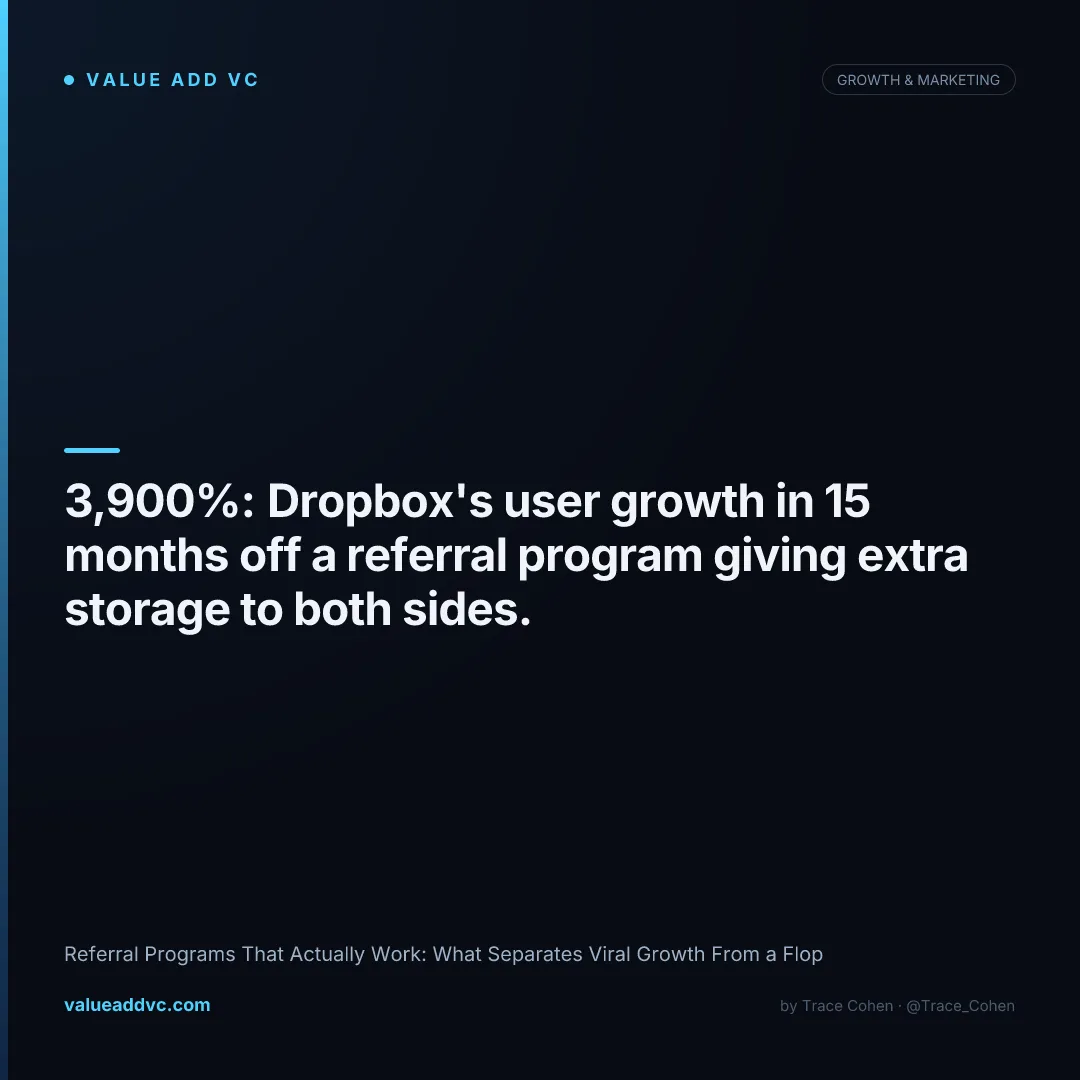
Dropbox's version is the most cited case for a reason: giving both the inviter and invitee 250MB of extra storage (later doubled to 500MB) cost the company almost nothing to provision, and it took the company from 100,000 registered users to 4 million in 15 months, a 3,900% increase according to multiple accounts of Drew Houston's 2010 Startup Lessons Learned talk. Dropbox has said the program produced a permanent 60% lift in signups and, at its peak, referrals made up 35% of daily signups while cutting acquisition costs roughly 60% versus paid channels. But the detail that matters most for this argument is the one that's easiest to skip past: a third of Dropbox's users were already coming from word-of-mouth before the referral program formalized anything.
Airbnb ran the A/B test on its own theory
Airbnb's first referral program, in 2011, underperformed — the mechanics required manual sharing with no mobile support, and by some accounts even internal staff weren't clearly aware it existed. The company's engineering team rebuilt it in 2014 as Referrals 2.0: mobile-first, frictionless one-tap sharing through WhatsApp and Messenger, and a double-sided reward of $25 in travel credit for the guest and $75 for a host whose referral led to a new listing. Airbnb's own engineering blog reported the redesign drove daily bookings and signups up 300% and produced 900% year-over-year growth in first-time bookings, with referrals generating up to 30% of first-time bookings in some markets where Airbnb had little brand recognition yet.
The reward structure barely changed between the two versions. What changed was that Airbnb built the second version around a growth pattern — international, word-of-mouth-driven trust in a stranger's home — that was already happening on its platform, and used the incentive to remove the friction stopping people from acting on it. This likely means the reward amount is doing less work than founders assume, and the underlying behavior it's amplifying is doing more.
Harry's proved you don't need an existing user base at all
The counter to "you need an existing product with fans" is Harry's, which had no product shipped yet. Its 2013 pre-launch waitlist collected 100,000 email signups in one week, with 77% arriving through referrals, using tiered non-cash rewards — free shaving cream at 5 referrals, up to a year of free blades at 50. What Harry's had instead of an existing product was a specific, sharable story (two ad executives annoyed at razor prices building their own factory) and a reward that mirrored the actual product, so redeeming it felt like a preview rather than a bribe. The lesson isn't "no product needed" — it's that the thing being amplified doesn't have to be usage; it can be a story people already wanted to repeat.
Where I could be wrong
PayPal is the case that cuts hardest against "you need pre-existing word-of-mouth." In 1999, an online payments account for individuals had no obvious reason to spread by itself — there was no story to tell and no organic buzz to amplify. PayPal paid for it directly instead: $20 to open an account and $20 for every successful referral, later cut to $10 and then $5 as the company scaled. The company reportedly grew from around 1 million users in March 2000 to 5 million by that September, a roughly 10%-daily growth rate during the steepest part of the curve, on its way past 100 million users. That's a program that manufactured virality with cash rather than amplifying anything that already existed, and it's arguably the most successful referral program in internet history.
I think the honest resolution is that PayPal had a different prerequisite instead of the one I'm arguing for: not organic word-of-mouth, but a two-sided network where every new user made the product more useful to the users already there. A payments network is worth more to me the more people I can pay with it — that compounding utility is what justified burning cash on referrals until the network reached critical mass. Dropbox, Airbnb, and Harry's didn't have that same network effect; they substituted pre-existing enthusiasm instead. So the real prerequisite for a referral program that works might be broader than "people are already talking about you" — it's "there is something real underneath the incentive for the reward to amplify," whether that's word-of-mouth, a network effect, or a story worth repeating. A program with none of those three is the one that flops, regardless of reward size.
It's also worth flagging survivorship bias directly: these are the referral programs written about precisely because they worked spectacularly. Most startup referral programs that quietly underperform never become case studies, so the sample here overstates how often the tactic succeeds and understates the base rate of programs that spend real reward budget for a shrug.
The trust data backs the amplification theory
There's a structural reason amplifying real word-of-mouth outperforms manufacturing it: people trust it more than any ad a referral program could ever compete with. Nielsen's Global Trust in Advertising report, based on more than 28,000 internet respondents across 56 countries, found 92% of consumers trust recommendations from people they know above every other form of advertising. And referred customers aren't just cheaper to acquire — a study of roughly 10,000 customers at a German bank by Wharton's Christophe Van den Bulte, with Bernd Skiera and Philipp Schmitt, found referred customers had a lifetime value 16% to 25% higher than otherwise-similar non-referred customers, churning at a rate about 18% lower. A referral program riding real trust isn't just acquiring users more cheaply — it's acquiring better ones.
Bottom line: A startup referral program that actually works is amplifying something real — existing word-of-mouth, a compounding network effect, or a story worth repeating — with a reward that mirrors the product and removes friction from sharing. One that flops is almost always trying to use the incentive to manufacture that "something real" out of nothing. Before building the reward tiers, the harder and more useful question is whether people are already telling friends about the product for free.
Latest from the Pulse
Get VC data most people never see
— 100% free
Weekly benchmarks, valuations, and fund data. Join 5,000+ investors. No spam.