

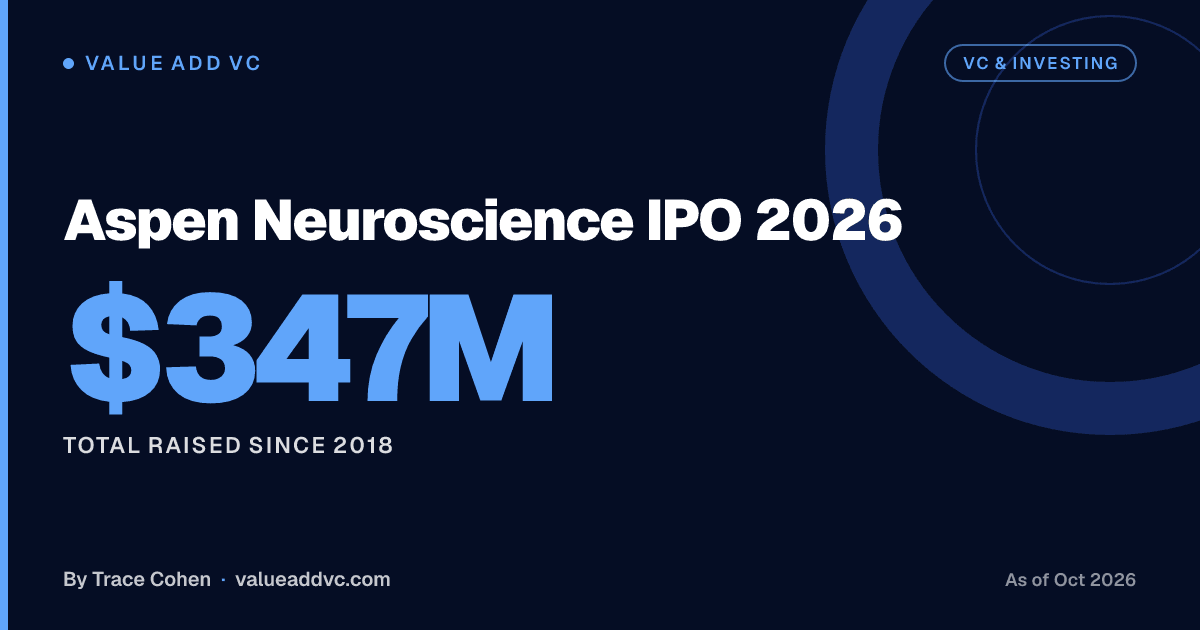
Aspen Neuroscience amended its IPO filing on October 22, 2026 to list on the Nasdaq Global Select Market under ticker ASPE, after raising about $347 million since 2018 from ARCH Venture Partners, OrbiMed, and other blue-chip biotech investors. The clinical-stage cell-therapy company's offering still has no price range or share count, leaving its targeted valuation unknown even as the deal nears pricing.
The San Diego-based biotech, incorporated in Delaware in 2018 and built on research from Scripps Research Institute's Jeanne F. Loring, is developing autologous cell therapies made from a patient's own reprogrammed stem cells. Its lead candidate, sasineprocel, targets Parkinson's disease and is dosing patients in the Phase 1/2a ASPIRO trial ahead of a planned Phase 3 study, according to the amended S-1 filed with the SEC.
Figures from Aspen Neuroscience's amended S-1, filed with the SEC on October 22, 2026.
Aspen Neuroscience IPO: Timeline From Series C to the Blank Price Range
Aspen's IPO filing has moved in stages since late 2025, growing its underwriting syndicate and firming up financial disclosures along the way, without yet setting the one number that matters most to public investors: a price.
| Date | Event | Key figure | Source |
|---|---|---|---|
| May 18, 2018 | Incorporated in Delaware as Aspen Biosciences, Inc.; renamed Aspen Neuroscience months later | — | SEC |
| Nov 21, 2025 | Series C co-led by OrbiMed, ARCH, Frazier, and Revelation Partners; Kite joins as a new investor | $115M | Pulse 2.0 |
| Mar 30, 2026 | Confidential S-1 submission to the SEC | — | Renaissance Capital |
| Oct 9, 2026 | Public S-1 filed; 3 bookrunners named (Leerink, Piper Sandler, Stifel) | Up to $100M | Renaissance Capital |
| Oct 12, 2026 | Coverage confirms FY2025 and H1 2026 net loss figures | $62M / $37M | BioPharma Dive |
| Oct 22, 2026 | Amendment No. 1: UBS and Oppenheimer added, now 5 underwriters; price range and share count still blank | $347M raised | SEC |
How we counted: every milestone Aspen Neuroscience disclosed in its own SEC filings or that outlets reported directly from them; May 2018 through Oct 22, 2026; 6 milestones; as of October 22, 2026.
Aspen Neuroscience's Funding Since 2018
The $115M Series C in November 2025 pulled total funding past $340M; the October 2026 S-1 puts the cumulative figure at $347M
Pulse 2.0 (Nov 21, 2025 Series C coverage) and Aspen Neuroscience's amended S-1 (SEC, Oct 22, 2026).
Data
| Item | Value |
|---|---|
| Through 2024 (prior rounds) | ~$225M |
| Series C (Nov 2025) | $115M |
| Total since 2018 (Oct 2026 S-1) | $347M |
Why Aspen Neuroscience's Price Range Is Still Blank
Aspen's public S-1, filed October 9, 2026, placed a standard $100 million placeholder on the offering — a figure registrants use to calculate SEC filing fees, not a real estimate of deal size — with Leerink Partners, Piper Sandler, and Stifel as joint bookrunners, according to Renaissance Capital. By the October 22 amendment, the underwriting group had grown to five banks with the addition of UBS Investment Bank and Oppenheimer & Co., a sign the deal was progressing toward a roadshow — but the amendment still left the share price and count blank, meaning neither Aspen nor its bankers had settled on what the market should pay.
That gap matters for a company with Aspen's balance sheet: $72.4 million in cash against a $264.9 million accumulated deficit and a net loss that grew from $31.8 million in the first half of 2025 to $36.5 million in the first half of 2026, per the SEC filing. The company's own prospectus states there is "substantial doubt" about its ability to continue as a going concern on existing cash alone — language that makes this IPO less a growth-capital event than a runway extension the company needs to actually close.
Aspen Neuroscience's Net Loss, H1 2025 to H1 2026
Aspen's net loss widened from $31.8M to $36.5M over the same six-month window a year apart, while full-year 2025 losses totaled $62.1M
Aspen Neuroscience's amended S-1, filed with the SEC, October 22, 2026.
Data
| Item | Net loss ($M) |
|---|---|
| H1 2025 | 31.8 |
| Full year 2025 | 62.1 |
| H1 2026 | 36.5 |
How Does Aspen Neuroscience's Cell Therapy Work?
Sasineprocel (formerly ANPD001) is an autologous iPSC-derived cell therapy: it reprograms a patient's own skin cells into induced pluripotent stem cells, then differentiates those into dopamine-producing neurons that are transplanted back into the same patient's brain to treat Parkinson's disease. Using a patient's own cells sidesteps the immune-rejection risk that comes with donor-derived treatments, but it means every dose has to be custom-manufactured per patient rather than produced at scale from a single cell bank — the central bear case for the autologous category broadly, not specific to Aspen.
The therapy has dosed 15 patients as of an August 18, 2026 data cutoff in the open-label ASPIRO Phase 1/2a trial and holds RMAT and Fast Track designations from the FDA, according to the SEC filing. Aspen expects to begin dosing in a Phase 3 trial in the second half of 2027, per BioPharma Dive — meaning IPO proceeds are funding clinical risk on an unapproved therapy, not a near-term product launch.
What the headline misses
A growing underwriter syndicate is not a priced deal. Five banks on the cover page signals Aspen and its advisors are preparing for a roadshow, but it says nothing about what investors will actually pay — and biotech IPOs with blank price ranges this late in the process sometimes price below the issuer's hopes, or get pulled entirely, especially for a single-asset company still in Phase 1/2a trials with no approved product and a documented going-concern risk. Research and development already consumes more than 70% of Aspen's operating expenses, according to BioPharma Dive, so even a successful IPO funds one more leg of a long, expensive trial program rather than resolving the company's capital needs outright.
Bottom line: Aspen Neuroscience's amended S-1 confirms it's heading toward a Nasdaq listing under ticker ASPE with $347 million in prior venture backing from ARCH Venture Partners, OrbiMed, and Kite — but with no price range, no share count, and a going-concern warning in its own prospectus, the deal is still a filing, not a confirmed IPO. Track how it compares to other small-cap biotechs testing the same fall window in our coverage of Lycia Therapeutics' IPO terms, and follow the broader pipeline on the Tech IPO Tracker.
Latest from the Pulse
Get VC data most people never see
— free to subscribe
Trace's notes on venture, AI and startups, a few times a week. Join 5,000+ subscribers. No spam.
No spam, unsubscribe anytime. Sent via Substack · Privacy · or subscribe on Substack ↗