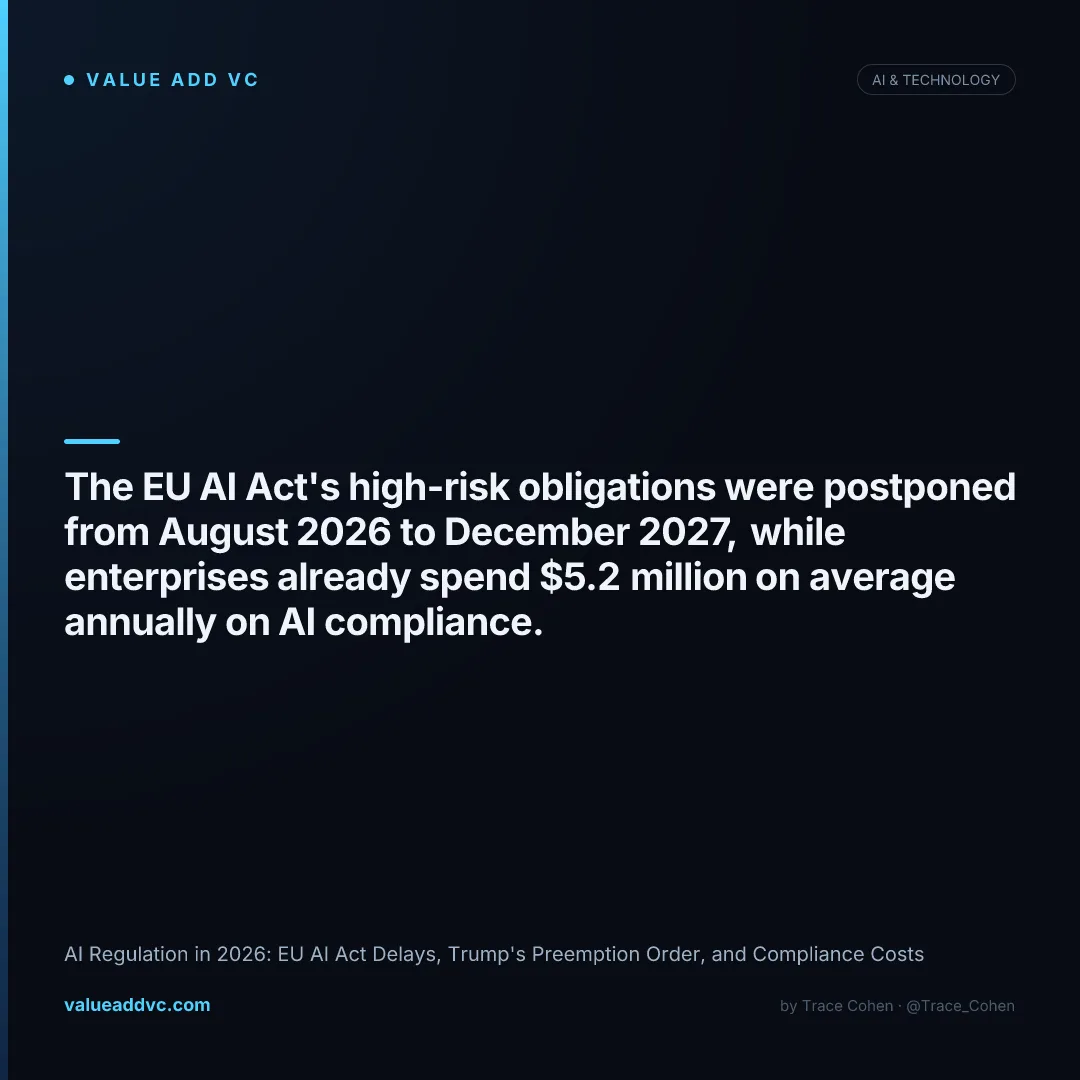
The EU just pushed its toughest AI Act rules from August 2026 to December 2027, and enterprises are still spending $5.2 million a year on average to comply with AI regulation anyway. Underneath the delay, 2026 produced two competing regulatory playbooks — Brussels writing binding statute, Washington trying to litigate state laws out of existence — and neither one is settled yet.
If you're building or investing in AI right now, the honest read is that the rulebook is still being written in real time on both continents. We track the AI companies operating inside this uncertainty on our AI valuations dashboard, and the regulatory picture is one of the biggest variables nobody is pricing correctly.
Figures are 2026 estimates blended from the European Commission's AI Act Service Desk, SQ Magazine, Prefactor, and the ACT App Association's AI regulation cost survey. Compliance overhead applies to regulated-sector AI models specifically.
AI Regulation in 2026: What's Actually in Force Between the EU and US
As of July 2026, the EU AI Act's transparency and prohibited-practice rules are already binding, but its toughest high-risk obligations were just delayed to December 2, 2027. In the US, most substantive AI regulation still comes from states — Texas and Illinois laws took effect January 1, 2026 — while a federal executive order attempts to preempt those state laws through litigation rather than new statute, leaving companies compliant with a genuinely split regime.
That split matters for anyone building AI products with EU or multi-state US exposure. The EU is moving toward one binding federal-style rulebook with real fines attached — up to €35 million or 7% of global turnover for the most serious violations. The US, by contrast, has no equivalent federal statute; what exists is a patchwork of state laws that the Trump administration is trying to override through a Justice Department task force, not through Congress. Two very different mechanisms, both live at the same time, and most compliance teams are budgeting for both because neither is fully resolved.
The EU AI Act Timeline: Why the High-Risk Deadline Just Slipped to December 2027
The EU AI Act was always designed to phase in obligations over several years, with prohibited practices banned first and the toughest Annex III high-risk system rules coming last. That last phase was originally set for August 2, 2026. On May 7, 2026, EU Council, Parliament, and Commission negotiators reached a provisional agreement on a "Digital Omnibus" package that pushes the Annex III deadline to December 2, 2027 — a 16-month reprieve that the Council gave final approval to on June 29, 2026, following a November 2025 Commission proposal that argued the original timeline left enterprises with an unrealistic readiness gap.
The delay only applies to the highest-risk category. General-purpose AI model obligations, transparency requirements, and the outright bans on practices like social scoring and manipulative AI remain on their original schedule and are already enforceable. Companies that assumed the whole AI Act had been pushed back are wrong — and given that third-party conformity assessments for high-risk systems cost €10,000 to €40,000 per system, the extra runway matters mostly for the subset of companies deploying AI in classified high-risk categories like hiring, credit, and law enforcement.
US AI Regulation 2026: Trump's Executive Order vs the State AI Law Patchwork
On December 11, 2025, President Trump signed "Ensuring a National Policy Framework for Artificial Intelligence," an executive order aimed at reducing the growing web of state AI laws in favor of a single federal standard. The order stood up a DOJ AI Litigation Task Force, active since January 10, 2026, to challenge state AI laws in federal court on preemption and interstate-commerce grounds. It also directed the FTC to issue a policy statement by March 11, 2026 classifying state-mandated bias-mitigation requirements as a per se deceptive trade practice, and told the FCC to consider a federal AI disclosure standard that would override conflicting state rules.
The catch, according to law firms including Ropes & Gray and Gibson Dunn: an executive order is not a statute passed by Congress, so it has no automatic preemptive force on its own. States are still legislating and enforcing AI laws as though the order doesn't exist, and the order itself carves out exceptions for child safety, AI infrastructure permitting, and state government procurement. For founders and compliance teams, that means state AI law exposure isn't going away in 2026 just because the White House wants a single national rule — it's an open legal fight that will likely take years of litigation to resolve.
State AI Laws in 2026: Texas, Illinois, Colorado, and California Compared
Below is where the major US and EU AI regulatory regimes actually stand as of July 2026 — not where they were originally scheduled to be a year ago.
| Regime | Status in July 2026 | Key Effective Date | Max Penalty / Scope |
|---|---|---|---|
| EU AI Act (general rules) | In force | Aug 2, 2025 – ongoing | Up to €35M or 7% global turnover |
| EU AI Act (Annex III high-risk) | Delayed | Dec 2, 2027 | Same tier, deferred 16 months |
| Texas TRAIGA | In force | Jan 1, 2026 | State AG enforcement, hiring/lending AI |
| Illinois HB 3773 | In force | Jan 1, 2026 | Human Rights Act AI amendments |
| Colorado AI Act (SB 189 revision) | Delayed + narrowed | Jan 1, 2027 | AG-only enforcement, no private suits |
| California ADMT rules (CPPA) | Pending | Jan 1, 2027 | Opt-out rights, employment decisions |
| Trump federal preemption EO | Contested | Jan 10, 2026 (task force live) | No statutory force yet |
Figures are July 2026 status blended from the European Commission AI Act Service Desk, the White House executive order text, the Colorado General Assembly (SB 189), and law-firm trackers from Littler, Seyfarth Shaw, and Troutman Pepper. Status reflects publicly available information as of this writing and is subject to further legislative change.
EU vs US: Two Different Approaches to AI Regulation in 2026
Author analysis based on European Commission and White House source documents; illustrative scoring, not an official index
What This Means for Founders and Investors Right Now
If you're raising or deploying capital into an AI company with any EU user base, the December 2027 Annex III delay buys real time — but it doesn't touch the general-purpose model rules or the prohibited-practice bans, which are live today. Startups building anything touching hiring, lending, insurance underwriting, or law enforcement should still design for the original high-risk framework, because €10,000-€40,000 per-system conformity assessments and a 16-month reprieve are not the same thing as regulatory relief; they're a scheduling change on a bill that's still coming due.
In the US, the smarter bet for 2026 diligence is to assume the state patchwork survives Trump's executive order, at least through this year. The DOJ task force only stood up in January 2026, the FTC's bias-mitigation policy statement only landed in March 2026, and legal experts broadly agree the order alone can't override state statutes without Congress or a court ruling. Texas and Illinois rules are already enforceable; Colorado and California follow in January 2027. Compliance teams that build to the strictest state requirement rather than betting on federal preemption will spend more in 2026 but avoid the whiplash if the litigation goes the states' way — which, per the legal consensus so far, is the more likely outcome in the near term.
There's also a diligence angle most seed and Series A checks still skip: compliance cost isn't evenly distributed across categories. A vertical SaaS company doing generic text generation faces almost none of this — the EU AI Act's prohibited-practice and transparency rules barely touch it, and no state law meaningfully restricts it either. But anything touching employment screening, credit decisioning, insurance underwriting, or biometric identification sits squarely inside both the EU's Annex III category and the strictest state laws, which means its real cost of capital is higher than the cap table implies. Investors pricing rounds in 2026 without asking which regulatory bucket a company falls into are underpricing risk in exactly the categories where the rules are tightening fastest, not loosening.
Bottom line: AI regulation in 2026 didn't converge — it split further. The EU pushed its hardest rules from August 2026 to December 2027 but left everything else, including €35M-scale fines for prohibited practices, fully in force. The US added state-level rules in Texas and Illinois on January 1, 2026, while a federal executive order tries to litigate those rules away without the statutory force to guarantee it works. Enterprises are already spending $5.2 million on average to keep up. Anyone underwriting AI companies in 2026 should treat "the regulatory picture is unclear" as a real, dollar-denominated risk factor — not a footnote — because it's currently costing real enterprises real money on both sides of the Atlantic.
Latest from the Pulse
Get VC data most people never see
— free to subscribe
Trace's notes on venture, AI and startups, a few times a week. Join 5,000+ subscribers. No spam.