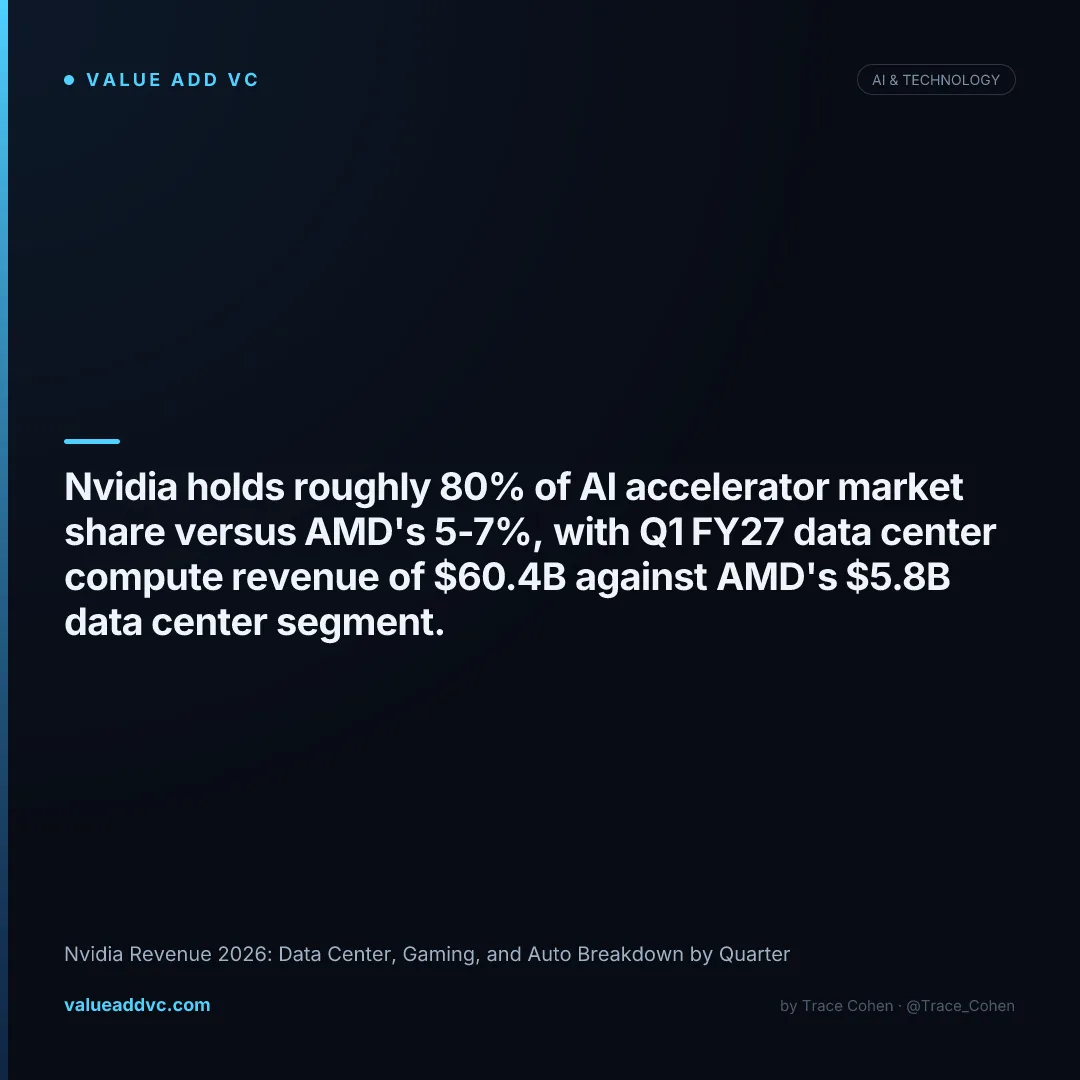
Nvidia posted $89.0 billion in data center revenue in a single quarter, up 117% year-over-year, and still holds roughly 73-80% of AI accelerator revenue depending on methodology. The caveat is that AMD and Google are both taking real share for the first time in years, and Meta just became Google's second confirmed anchor tenant.
For most of the last three years, "AI hardware" has been shorthand for "Nvidia GPUs." That's still directionally true, but it's no longer the whole story. AMD's Instinct MI300X and newly-shipping MI350X lines are winning real inference workloads on price, Google's TPU v7 (Ironwood) launched publicly at Cloud Next 2026 on top of the TPU v6 (Trillium) fleet already running Anthropic's up-to-1-million-chip commitment, and Meta signed its own multi-year TPU lease in February 2026. This is a look at where the three real contenders — Nvidia H200/B200, AMD MI300X/MI350X, and Google TPU — actually stand on revenue, share, performance, and price as of late August 2026.
Who's winning the AI hardware wars: Nvidia H200 vs AMD MI300 vs Google TPU v5/v6?
Nvidia is winning on revenue and share by a wide margin — roughly 73-80% of the AI accelerator market and $89.0B in quarterly data center revenue — while AMD is winning select inference deals on price and Google is winning Anthropic and now Meta workloads through TPU v6 Trillium and v7 Ironwood, neither of which is sold externally as hardware.
The three companies aren't really competing head-to-head for the same customer in the same way. Nvidia sells to everyone. AMD sells to hyperscalers and neoclouds looking for a cheaper second source. Google only serves its own cloud and a small number of anchor tenants like Anthropic. That structural difference is why "market share" numbers need context, not just a single percentage.
Nvidia H200 vs AMD MI300X: Specs, Performance, and Price
| Metric | Nvidia H200 | AMD MI300X |
|---|---|---|
| Architecture | Hopper | CDNA 3 |
| Memory | 141GB HBM3e | 192GB HBM3 |
| Memory Bandwidth | 4.8 TB/s | 5.3 TB/s |
| Theoretical FP16 Compute | ~989 TFLOPS | ~1,300 TFLOPS |
| Real-World Inference Throughput | ~25,300 tokens/sec (single GPU) | ~18,752 tokens/sec (74% of H200) |
| Cloud Rental (per hour, median/range, Aug 2026) | $4.50 median ($4.45-$10.60) | MI350X: $3.65-$4.40 on-demand* |
| Est. Unit Price | $25,000-$35,000 | $10,000-$15,000 |
*MI350X on-demand supply is still tight; spot rates on some clouds have spiked to $14-18/hour during launch shortages. Sources: Silicon Analysts 2026 GPU market share and TCO comparisons, SemiAnalysis MI300X vs H100/H200 benchmark series, aimultiple GPU benchmark reports, and August 2026 provider pricing aggregated by Spheron, Thunder Compute, and CloudRift. Real-world throughput derived from single-GPU inference benchmarks; production throughput varies materially by model and batch size.
Nvidia's revenue advantage: $89.0B in one quarter
Nvidia's Q2 fiscal 2027 results, reported August 26, 2026 for the quarter ended July 27, 2026, show total revenue of $96.2B (up 106% year-over-year, up 18% sequentially) and data center revenue of $89.0B, up 117% year-over-year and driven largely by the ramp of Blackwell Ultra infrastructure, according to Nvidia's earnings release. GAAP and non-GAAP gross margin both came in at 75.0%, and Nvidia guided Q3 FY27 revenue to roughly $108B. That single quarter's data center revenue alone is more than 13x AMD's entire data center segment for the same period.
AMD's Q2 2026 data center segment revenue was $6.7B, up 107% year-over-year from $3.2B, and now makes up 58% of AMD's roughly $11.5B in total quarterly revenue, according to AMD's Q2 2026 earnings release. Data center operating income swung from a $155M loss a year earlier to $2.1B, driven by EPYC CPU demand alongside ramping Instinct MI350 Series GPU sales. Our Nvidia revenue breakdown by segment has the full quarterly trend if you want to track how the data center line is shifting quarter to quarter.
Where Google's TPU v7 Ironwood actually fits
Google launched TPU v7 (Ironwood) publicly at Cloud Next 2026, purpose-built for inference at scale with up to 9,216 chips linkable into a single pod over 9.6 terabits per second of interconnect bandwidth, alongside the TPU v6 (Trillium) fleet already in broad production use. The catch remains unchanged: TPUs are not sold as hardware. Access is GCP rental or a direct lease agreement, which makes unit-for-unit market share comparisons to Nvidia and AMD structurally different.
The number that mattered most through 2025 was Anthropic's October 2025 expansion, which secured access to up to 1 million TPU chips and more than a gigawatt of capacity coming online through 2026, a deal reportedly worth tens of billions of dollars. That's no longer the only anchor commitment: The Information reported on February 26, 2026 that Meta signed a multi-year, multibillion-dollar lease for TPU v6e (Trillium) capacity, with the option to buy TPU v7 (Ironwood) hardware outright starting in 2027 as part of a broader silicon strategy that also includes Nvidia, AMD, and Meta's own MTIA chips. With two of the largest AI spenders now confirmed as TPU customers, Google has moved from "internal workload chip" to a real third leg of frontier-model compute supply, not just a rounding error next to Nvidia and AMD.
Nvidia H200 vs AMD MI300 vs Google TPU v5: the software gap is the real story
The Nvidia H200 vs AMD MI300 comparison keeps coming back to software, not silicon. AMD's MI300X wins on paper spec sheets — more memory, higher theoretical FLOPS, lower price — but Nvidia's CUDA ecosystem extracts a much higher percentage of that theoretical performance in production. That's why MI300X's real-world single-GPU inference throughput lands around 74% of H200's, even though its spec sheet compute number is higher. Google's ROCm-equivalent problem doesn't really exist, because Google controls its own stack top to bottom for internal and Anthropic workloads, but that same vertical control is what prevents TPUs from being purchased and deployed the way GPUs are.
For investors and operators tracking AI infrastructure spend, the practical read is: price Nvidia at a premium that's mostly justified by software maturity and ecosystem lock-in, price AMD as a credible but still-smaller-scale alternative worth watching for inference-heavy workloads where cost per token matters more than peak throughput, and treat Google TPU access (via GCP rental or an anchor-tenant deal like Anthropic's) as a compute-diversification play rather than a like-for-like GPU substitute. Our AI valuations dashboard tracks how compute-supply diversification is showing up in AI-lab funding terms.
Total cost of ownership: why AMD's cheaper price tag doesn't always win
A pure per-hour price comparison makes the AMD MI300X look like an easy win: roughly $1.85-$7.86/hour versus $4.45-$10.60/hour for the H200 (the August 2026 rental range in the table above), and a unit price of $10,000-$15,000 versus $25,000-$35,000. But total cost of ownership for a large training or inference cluster depends on more than sticker price. It depends on how much of the chip's theoretical performance you can actually extract in production, how quickly your engineering team can debug distributed training failures, and how mature the surrounding tooling is for things like quantization, kernel fusion, and multi-node orchestration.
That's where Nvidia's roughly two-decade head start with CUDA still shows up in real deployment numbers. Engineering teams that have spent years optimizing on CUDA can often get a cluster of H200s to 95%+ of theoretical throughput on well-understood workloads, while ROCm-based MI300X deployments frequently land closer to 60-75% of theoretical throughput unless a team has invested heavily in AMD-specific tuning. For a hyperscaler renting out thousands of chips, that efficiency gap can matter more than a 30-50% discount on the hourly rate, because it changes how many effective GPU-hours you're actually buying per dollar. AMD has been closing this gap release over release, and MI350X's improvements over MI300X are real, but the software maturity advantage Nvidia holds is still the single biggest reason its 73-80% revenue share hasn't moved faster despite years of AMD's hardware roadmap catching up on paper specs.
What the Nvidia vs AMD vs Google split means for AI infrastructure investors
For anyone underwriting AI infrastructure exposure in 2026 — whether that's a direct position in the public names, a venture bet on a neocloud, or LP exposure through a fund concentrated in AI compute — the practical read on Nvidia vs AMD vs Google TPU is that this is not a winner-take-all market anymore, but it's also not evenly split. Nvidia's $89.0B in single-quarter data center revenue and 73-80% share still make it the default allocation, and its 117% year-over-year data center growth rate shows demand isn't slowing even as competition intensifies.
AMD is the more interesting asymmetric bet at this point in the cycle: a $6.7B data center segment that more than doubled year-over-year off a small base, with data center operating income swinging from a loss to $2.1B in a single year, means AMD doesn't need to take Nvidia's crown to be a good investment — it just needs to keep converting a low single-digit percentage of Nvidia's addressable market every year. Google's TPU business is harder to underwrite directly since it isn't broken out as a standalone revenue line and isn't sold externally, but confirmed anchor deals with both Anthropic and Meta are the clearest evidence yet that TPUs are becoming a credible third leg of frontier compute supply rather than a Google-only curiosity. With two of the largest AI spenders now locked in as TPU customers, expect more AI labs to treat multi-vendor compute sourcing as standard practice rather than a hedge, which should structurally cap how high any single vendor's market share can climb from here. Track how these shifts flow into fund-level performance on our VC performance dashboard.
Bottom line
Nvidia is still winning the AI hardware wars by revenue and share — $89.0B in quarterly data center revenue against a 73-80% accelerator revenue share — but the margin is narrowing for the first time in years. AMD's Instinct line is real competition on price for inference workloads, and Google's TPU fleet now has two confirmed anchor tenants, Anthropic and Meta, that make it a genuine third option, not a footnote. If you're modeling AI infrastructure spend for 2026-2027, plan for a market with a dominant leader and two credible, fast-growing alternatives, not a monopoly.
Latest from the Pulse
Get VC data most people never see
— free to subscribe
Trace's notes on venture, AI and startups, a few times a week. Join 5,000+ subscribers. No spam.