I think generalist VC funds are struggling to raise in 2026 because LPs stopped treating "broad mandate, experienced partners" as a strategy and started treating it as the absence of one. When capital is scarce, allocators are using every commitment to buy something specific — sector access, a brand they can't get into otherwise, or the safety of a top-12 platform. A generalist fund with no sharp edge doesn't give an LP any of those things, and the fundraising data increasingly shows it.
Why generalist VC funds are struggling to raise in 2026
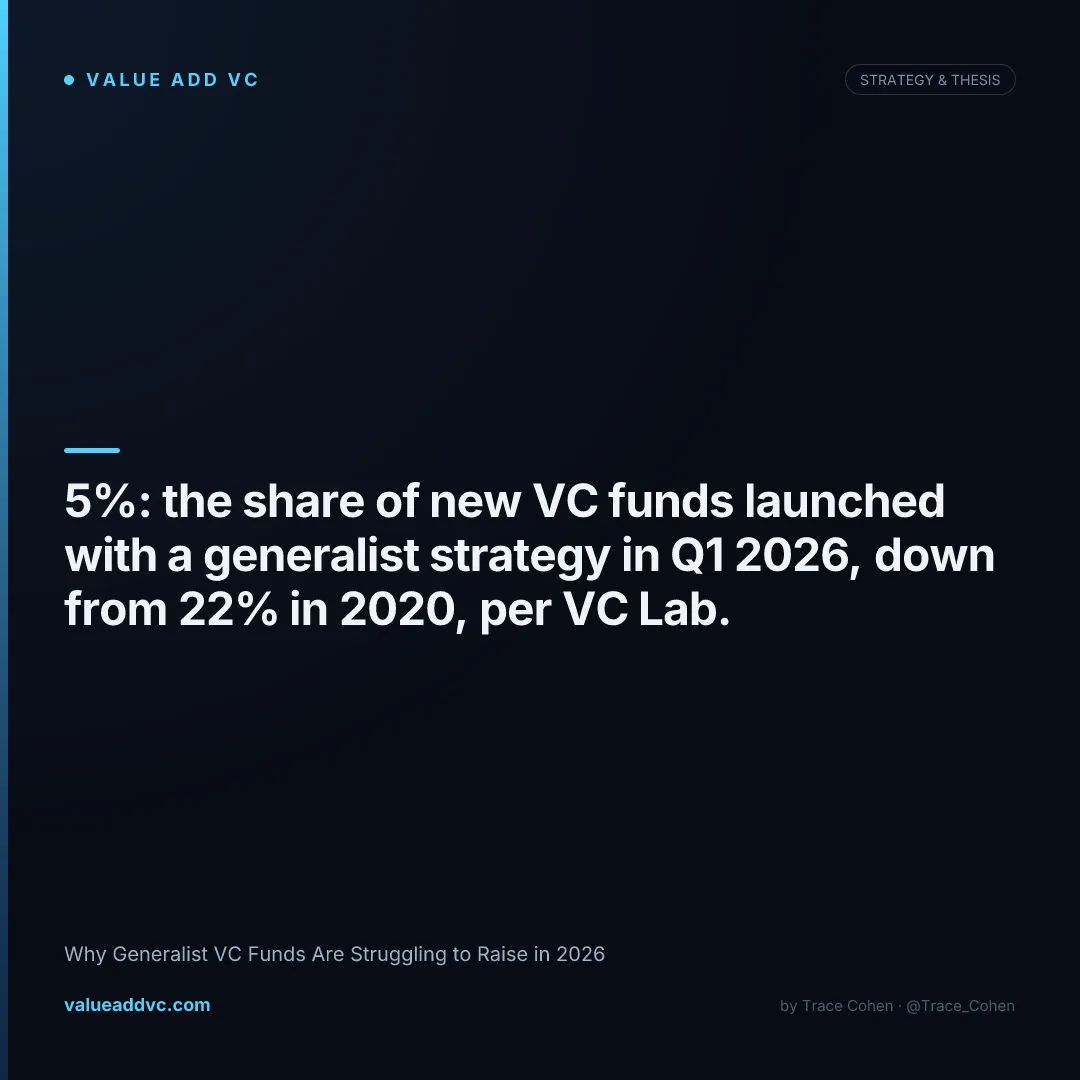
Generalist funds made up just 5% of new VC fund launches tracked in Q1 2026, down from 22% in 2020, according to VC Lab's analysis of nearly 800 fund launches. Median time in market to close a US VC fund has also stretched to roughly 15 months, the longest in over a decade. Together, those two numbers describe a market where undifferentiated funds take longer to raise and get started less often in the first place.
I don't think this is really an LP judgment on generalism as an investing philosophy. It's an allocation response to scarcity. PitchBook's Venture Monitor data shows that fund-close timelines stretched from roughly 9.7 months in 2022 to around 15-16 months by 2025, a roughly 60% increase, at the same time as 12 US venture firms collected more than 50% of all VC capital raised in the first half of 2025, with the top 30 firms taking 74%. When fewer dollars are chasing more fund managers, LPs get to be pickier, and "picky" in this cycle means picking a thesis, not a generalist.
Source: VC Lab, Generalist vs Specialist VC Data Unpacked (2026); PitchBook Venture Monitor; PitchBook, US venture capital firm concentration.
The specialists closing fast are the clearest evidence
Reach Capital, an 11-year-old firm focused on AI applications across learning, health, and work, closed an oversubscribed $265M Fund V in under six months in August 2026, pulling in university endowments, pension funds, and family offices. Belgium's Pitchdrive closed an oversubscribed €60M Fund IV for AI-native pre-seed startups and deliberately capped it rather than take more LP demand than its thesis could deploy well. Neither fund is a household name the way a multi-stage platform is — they raised on the strength of a specific, provable edge, not brand recognition.
That edge shows up in the return data LPs actually use to make decisions, too. VC Lab's dataset puts sector-specialist funds at a median 1.81x TVPI versus 1.69x for generalists. This likely means specialization isn't just an easier fundraising story — it's correlating with the outcomes LPs are underwriting to, which reinforces the allocation shift rather than just describing a fashion trend. Decile Group CEO Adeo Ressi put the LP mindset bluntly: "LPs don't want generalists who have decades of experience investing from the safety of a board room anymore. LPs want to back managers with highly specific, highly in-demand domain expertise and those who are connected to the people building the hottest companies now."
The other side of the barbell: $1B+ platforms
The generalist squeeze isn't only benefiting narrow specialists — it's also benefiting a small number of massive multi-stage platforms that get treated as a category of their own. Founders Fund alone raised $4.6B in new funds through mid-2025, more than twice what 44 first-time fund managers raised from LPs combined over the same stretch. General Catalyst was in talks to raise roughly $10B as of March 2026, up from the $8B it closed in 2024. TechCrunch's reporting put a16z, Founders Fund, and General Catalyst collectively raising close to $31B in 2026 alone. These firms are still, technically, generalists — they invest across sectors — but LPs treat a check to Founders Fund or General Catalyst as a bet on a platform and a brand, not a bet on "generalist" as a neutral strategy. The undifferentiated $150M generalist fund in between those two poles is what's actually disappearing.
Where I could be wrong
The strongest counterargument is that this isn't a structural rejection of generalism at all — it's a liquidity-driven flight to brand and scale that happens to correlate with sector focus, but isn't caused by it. Kleiner Perkins raised $3.5B in March 2026 across an early-stage and a growth-stage fund, more than 1.5x what it raised less than two years earlier, and it is an unapologetically broad, decades-old generalist brand by history. If the thesis were really "LPs have abandoned generalism," a firm like that should be struggling too. It isn't. What it has that a mid-market generalist fund doesn't is decades of realized DPI and a brand that functions like its own specialization — which suggests the real dividing line might be track record and scale, not sector focus per se, and that a new, unbranded specialist fund with a thin team could struggle just as much as a new generalist one. Worth noting too: even Kleiner Perkins framed this specific raise explicitly around AI rather than broad generalism, which cuts against a clean "old brands don't need a thesis" reading.
It's also worth noting that specialization isn't a guaranteed shield. a16z's crypto arm is reportedly raising its fifth fund at a target near $2B, less than half its $4.5B 2022 vehicle — a sector-specialist fund downsizing hard because its own sector went through a down-cycle. Sector focus can concentrate risk as easily as it concentrates edge; it just happens to be working for AI-adjacent specialists right now because AI is where LP demand currently sits.
And the VC Lab dataset behind the 22%-to-5% figure is drawn heavily from smaller, emerging-manager fund formations — the segment most exposed to LP pickiness in a tight market — so it may overstate how thoroughly generalism has fallen out of favor across the full venture market, including funds that never go through an accelerator-style launch program.
Bottom line: Generalist VC funds are struggling to raise in 2026 mainly in the crowded middle of the market — new and mid-sized funds without a defensible edge, where LPs now have the leverage to demand one. At the very top, brand and decades of DPI still function as their own kind of specialization, which is why a handful of massive generalist platforms keep closing huge funds while a 15-month median close time and a collapse from 22% to 5% generalist launches tell the story for everyone else.
Latest from the Pulse
Get VC data most people never see
— 100% free
Weekly benchmarks, valuations, and fund data. Join 5,000+ investors. No spam.