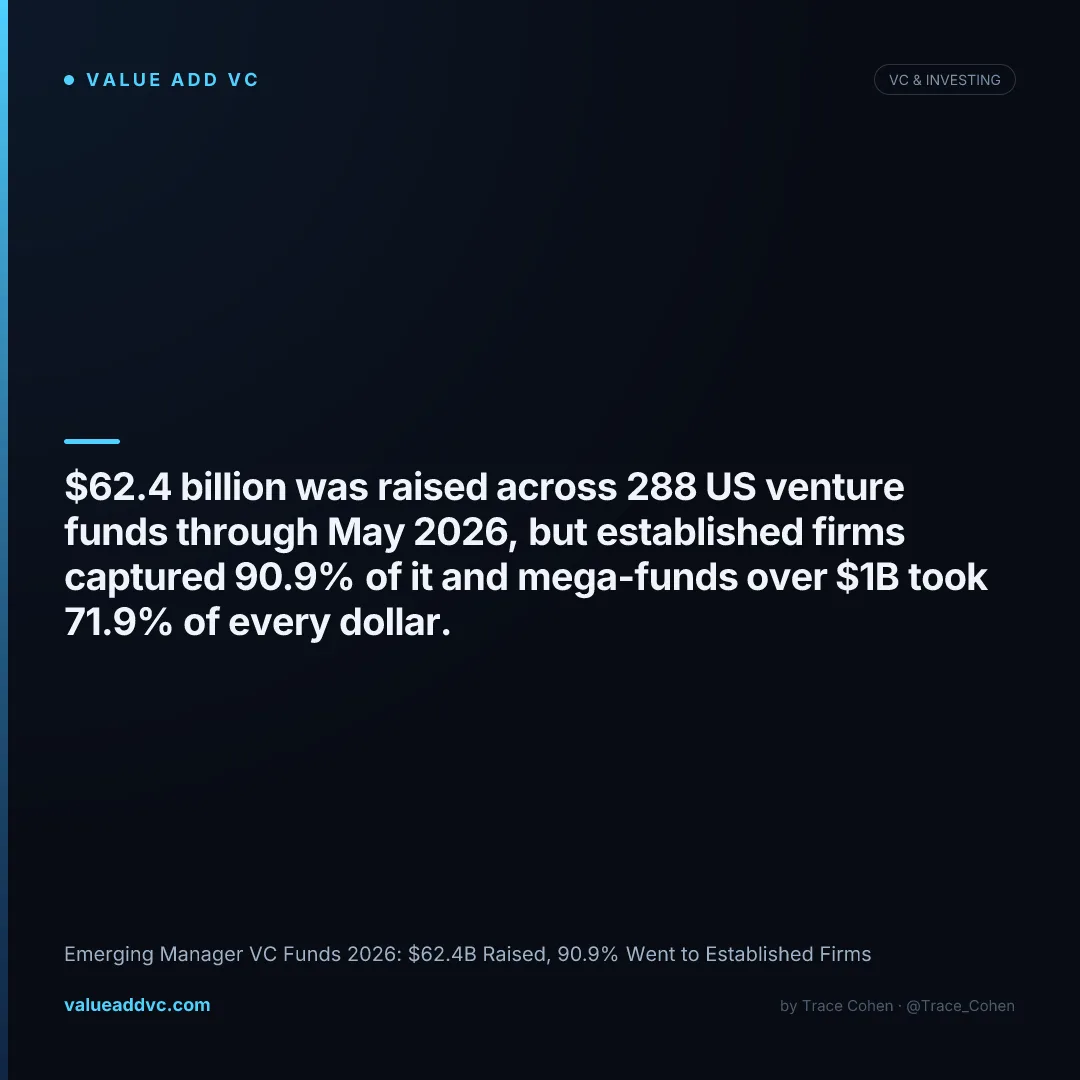
Emerging managers are fighting for a shrinking slice of a $62.4 billion pie: established VC firms captured 90.9% of all Q1 2026 fundraising, and funds larger than $1 billion accounted for 71.9% of every dollar committed through May — up from just 34.2% a year earlier.
That's the short answer. The longer answer is more interesting: on platforms built specifically to serve first-time GPs, nearly 90% of LP commitments in the first half of 2026 went into funds under $15 million — meaning the emerging-manager capital that does move is concentrating at the smallest, most selective end of the market, not disappearing entirely. I've watched this bifurcation play out across our own portfolio and the funds we track, and it's reshaping what a viable Fund I looks like in 2026.
What Is an Emerging Manager VC Fund in 2026?
An emerging manager VC fund in 2026 is typically a firm's first, second, or third institutional vehicle, usually under $250 million, run by a general partner without a decade-plus track record at a brand-name firm. The category raised roughly $62.4 billion across 288 U.S. vehicles through May 2026, but captured well under a tenth of that in dollar-weighted terms.
The label covers a wide range in practice. A solo GP raising a $5 million pre-seed vehicle and a team spinning out of a brand-name firm to raise a $400 million Fund II both qualify as "emerging" by most LP definitions, but they compete for entirely different pools of capital. The average Fund I raised through VC Lab, one of the larger emerging-manager fundraising platforms, comes in around $12 million — a size that carries real structural advantages for early-stage investing, since it forces concentration and discipline that mega-funds structurally can't replicate.
Emerging Manager VC Fund 2026 Fundraising: The Full Numbers
The headline fundraising number looks healthy. The distribution underneath it is not, if you're a first-time GP. Here's the full scorecard, compiled from PitchBook-NVCA Venture Monitor data and VC Lab's platform-level fundraising data.
| Metric | Figure | Context |
|---|---|---|
| Total US VC capital raised YTD (through May 2026) | $62.4B | Across 288 vehicles, PitchBook |
| Full-year 2025 total VC capital raised | $66.1B | Lowest total since 2018, 537 funds closed |
| Mega-fund (>$1B) share of capital, 2026 YTD | 71.9% | Up from 34.2% in 2025 and 49% in 2024 |
| Established firms' share of Q1 2026 fundraising | 90.9% | Leaves under 10% for emerging managers |
| Emerging vs. established fund count, full-year 2025 | 177 vs 199 | Lowest emerging-manager count since 2015 |
| Median time to close a VC fund | ~15 months | Longest close time in over a decade |
| LP commitments to funds under $15M, H1 2026 | ~90% | Per VC Lab platform fundraising data |
| Average LP check size on manager platforms | $159K | $150K-$250K checks convert 1.2x-2.4x higher |
Figures are blended from Q4 2025 and Q1 2026 PitchBook-NVCA Venture Monitor reports, NVCA.org, and VC Lab platform fundraising data (govclab.com). Fund-count and dollar figures come from different datasets and are not directly additive.
Why Capital Keeps Concentrating in Fewer, Bigger Funds
The mechanics behind the concentration aren't mysterious. LPs are still working through a multi-year distributions drought — paper markups without cash back — which pushes institutional allocators toward managers with long track records who can absorb a $50 million-plus check in one signature rather than forcing an LP to underwrite twenty separate $2 million relationships. The top 10 U.S. VC funds alone raised 42.9% of all capital committed through Q3 2025, a record in at least a decade. That's before counting the rest of the established-manager cohort.
Emerging vs Established Manager Fund Closings, Full-Year 2025
Source: PitchBook-NVCA Venture Monitor, Q4 2025 edition.
The gap matters because 2025's emerging-manager count of 177 closed vehicles was the lowest since 2015 — a full decade of prior growth in first-time fund formation effectively reversed in a single fundraising cycle. Our VC and PE performance dashboard tracks how that concentration is showing up in vintage-year returns as fewer, larger funds absorb a growing share of the best late-stage deal flow.
How Emerging Manager VC Funds Are Actually Winning LP Capital
The managers who are still closing funds share a specific playbook, and it isn't "raise a bigger fund to look more credible." It's the opposite. Three patterns show up consistently in the data on who's winning LP capital in 2026:
Staying small on purpose. Almost 90% of LP commitments on emerging-manager platforms in the first half of 2026 went to funds under $15 million — a size threshold that lets a solo GP or two-person team close on family offices, HNW individuals, and angels without needing an institutional-scale diligence process. Sequenced correctly, a $12 million Fund I with real DPI sets up a credible Fund II.
Hitting the LP check-size sweet spot. The average LP commitment on manager-focused platforms is $159K, but checks specifically in the $150K–$250K range convert into signed LPAs at 1.2x to 2.4x higher rates than checks outside that band. Funds that structure their minimum check size around that window close faster than funds that don't.
Picking a sector, not staying generalist. AI-focused emerging funds are drawing almost twice the LP commitment volume of deeptech or healthcare funds, and only about 11% of funds receiving new commitments in 2026 are generalist. LPs allocating to a first-time manager increasingly want a specific, defensible thesis, not "we'll invest broadly across tech." For managers building a track record, our emerging VC funds directory tracks 900+ active managers under $200 million by sector focus and check size.
Do Emerging Managers Actually Outperform? The Return Data
This is the argument every emerging manager makes to LPs, and the historical data mostly backs it up. Cambridge Associates' analysis of 2004–2016 vintages found that 53% of annual top-ten performing funds were first or second funds; expand that to include third and fourth funds, and 73% of top-ten funds were run by managers still classified as emerging. Separately, the Kauffman Foundation found first-time funds outperformed established firms by 3.1 percentage points annually from 1997 through 2011.
Preqin's broader dataset adds a size dimension: funds under $250 million tend to outperform larger funds on a net IRR basis, with the effect most pronounced below $100 million — almost exactly the range where most emerging venture managers actually operate. The caveat that matters for LPs: emerging managers populate both tails of the return distribution. A handful generate outlier outcomes; most produce forgettable ones. That dispersion, not a lack of average outperformance, is the real underwriting risk LPs are pricing in when they default to established brands during a distributions drought.
What LPs Want to See in an Emerging Manager VC Fund Pitch in 2026
Sitting on both sides of this — as an operator who's raised capital and an investor who allocates it — the diligence bar for a first-time fund has gotten noticeably more specific over the past two years. LPs writing $150K-$250K checks into a $12 million Fund I aren't underwriting a track record; they're underwriting a repeatable process. That shows up in four things reviewers ask for first.
A documented sourcing edge. Generic "we have a great network" claims don't clear diligence anymore. LPs want to see a specific, defensible reason deal flow reaches this GP before it reaches a Tier 1 firm — a founder community, an operator background in the sector, or a platform relationship that competitors can't replicate.
Realistic fund math. A $12-15 million fund needs a portfolio construction model that actually works at that size — typically 20-30 companies with meaningful reserves, not 60 spray-and-pray checks that make follow-on economics impossible. LPs increasingly ask GPs to walk through ownership targets and reserve ratios line by line rather than taking a deck's summary slide at face value.
GP commit and personal capital at risk. How much of their own money a GP is putting into the fund remains one of the fastest LP filters, since it signals conviction beyond management fees. Funds where the GP commit is a token 0.25% get noticeably more pushback in 2026 than they did in 2021.
A believable path to Fund II. Because DPI takes years to materialize, LPs backing a Fund I are implicitly underwriting the GP's ability to raise a Fund II on markups and early signal, not realized returns. A GP who can point to fast follow-on validation from Tier 1 co-investors on their first few checks closes meaningfully faster than one who can't.
The Bottom Line
Emerging manager VC funds in 2026 are operating in a genuinely bifurcated market: established firms and mega-funds are absorbing over 90% of headline fundraising dollars, while a smaller, more disciplined cohort of first-time managers is still closing funds by staying under $15 million, hitting the $150K-$250K LP check-size sweet spot, and picking a sharp sector thesis instead of going generalist.
The historical performance data — Cambridge Associates' 73% figure, Kauffman's 3.1-point outperformance — still favors backing emerging managers over the long run. The managers winning capital right now understand that the era of raising a $50 million Fund I on a resume alone is over, and the era of raising a disciplined $10-15 million fund with a real thesis is just getting started.
$62.4B raised. 90.9% went to established firms. 177 emerging-manager funds closed — the lowest since 2015.
The managers still winning are the ones who stopped trying to raise like it's 2021.
Track emerging manager fund activity and VC performance benchmarks at Value Add VC, and get more breakdowns like this in the Trace Cohen newsletter.
Latest from the Pulse
Get VC data most people never see
— 100% free
Weekly benchmarks, valuations, and fund data. Join 5,000+ investors. No spam.