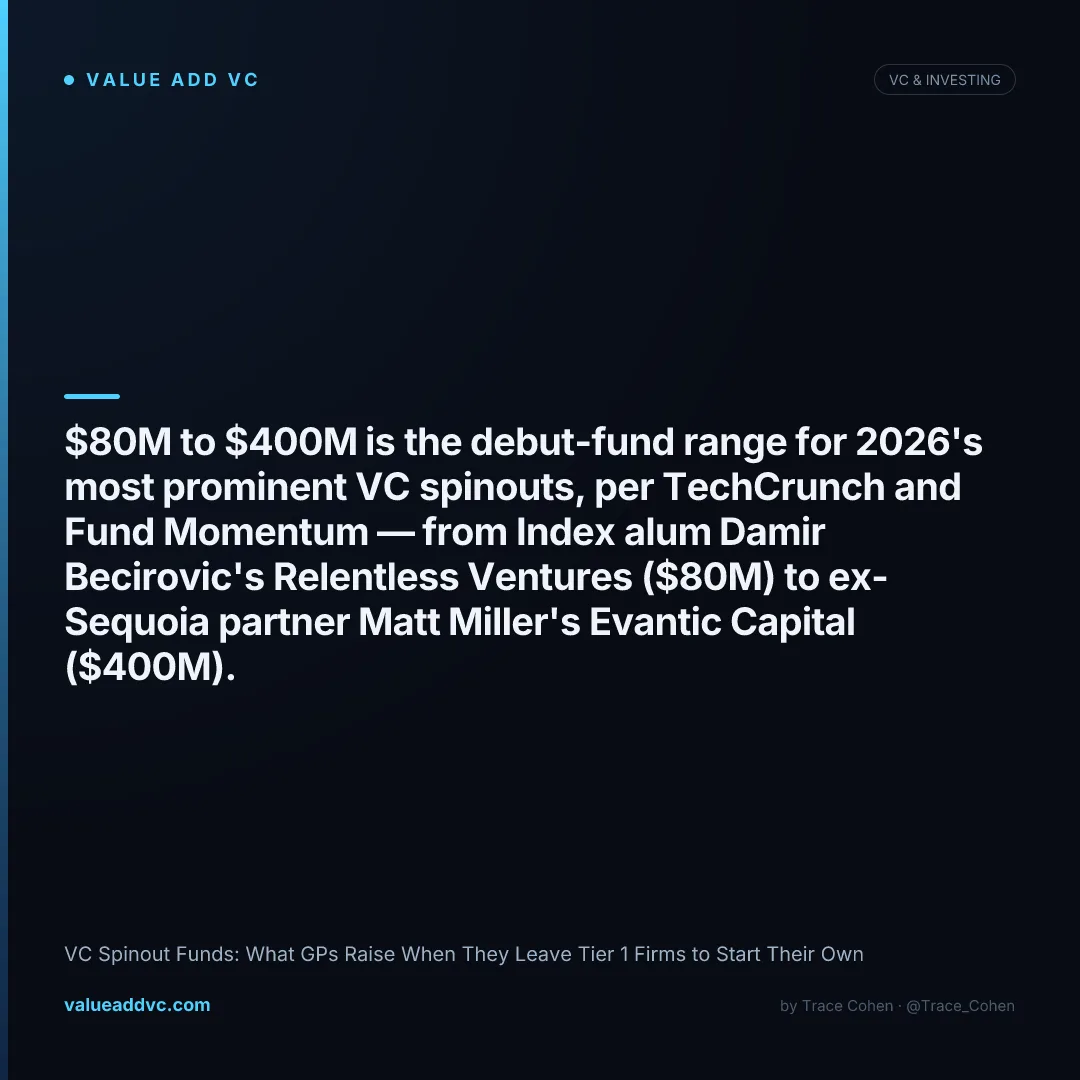
$80M to $400M is the debut-fund range for 2026's most prominent VC spinouts, per TechCrunch and Fund Momentum reporting on GPs who left tier 1 firms this year. That's the short answer. The longer answer is that spinout funds raise faster and bigger than typical first-time managers, but they still have to prove they can win deals without their old firm's name on the door.
Every VC cycle produces a wave of senior partners who leave brand-name firms to raise their own vehicles, and 2026 has been no exception — Index, Sequoia, a16z, and NFX alumni have all launched new funds this year. We track fund formation and performance benchmarks on our VC fund performance dashboard.
Figures are 2025-2026 estimates blended from TechCrunch, Fund Momentum, PitchBook, VC Lab, and Carta/Preqin GP commitment benchmarks.
How Do VC Spinout Funds Work When a GP Leaves a Tier 1 Firm?
A VC spinout fund is a new venture firm launched by a general partner who departs an established firm, often a household name like Sequoia, Index Ventures, or Andreessen Horowitz, to raise and manage an independent vehicle. The departing partner typically leverages their prior deal exposure and LP relationships to close a debut fund faster than a true first-time manager, even though the track record technically belongs to the old firm rather than to them personally.
2026 has produced several high-profile examples. Damir Becirovic, previously Index Ventures' lead on marketplaces and real-world services with a portfolio that included Discord and Patreon, left to launch Relentless Ventures, closing an $80M debut seed fund sized to lead $3M-$5M rounds with reserves. Matt Miller, an ex-Sequoia partner, launched Evantic Capital, a $400M fund targeting B2B AI enterprises across Europe, the U.S., and Israel — one of the largest spinout debuts of the year. Nandan Nilekani stepped back from his GP role at Fundamentum as the firm closed a $200M third fund, an internal succession rather than a full departure but structurally similar in how the new vehicle was priced and staffed.
VC Spinout Fund Examples: Who Left Where and What They Raised
| GP / Founders | Prior Firm | New Fund | Debut Size | Focus |
|---|---|---|---|---|
| Damir Becirovic | Index Ventures | Relentless Ventures | $80M | Seed, marketplaces |
| Matt Miller | Sequoia Capital | Evantic Capital | $400M | B2B AI, US/EU/Israel |
| Nandan Nilekani | Fundamentum (internal) | Fundamentum Fund III | $200M | Growth, India |
| Ashton Kutcher & Morgan Beller | Sound Ventures / a16z / NFX | New firm (unnamed) | TBD 2026 | Seed, consumer/tech |
| Devon Gethers & Karlton Haney | — | Meridian Ventures | $35M | Fund I, oversubscribed |
| Cleo Ventures founders | — | Cleo Ventures | €30M (~$33M) | Pre-seed/seed, European AI |
| Awani Capital team | — | Awani Capital Fund I | $500M target ($250M raised) | Debut, first close H1 2025 |
Figures are 2025-2026 data compiled from TechCrunch, Fund Momentum, and PitchBook reporting on fund launches and first closes. "TBD" indicates a fund size not yet publicly disclosed as of this writing.
GP Commit Economics for VC Spinout Funds
A departing partner doesn't just need LP capital — they need to fund their own GP commitment, and that number is meaningfully lower in venture than in adjacent asset classes. GP commitments in VC average 1.5%-1.7% of total fund size, according to Carta and Preqin benchmark data, versus roughly 2.5% for private equity buyout funds in the $100M-$500M range. On Matt Miller's $400M Evantic Capital fund, a 1.7% commitment works out to roughly $6.8M in personal capital; on Damir Becirovic's $80M Relentless Ventures, the equivalent commitment is closer to $1.3M-$1.4M.
That lower bar exists partly because VC GPs typically have less personal liquidity than buyout GPs coming off carry-heavy PE deals, and partly because LPs treat the GP commit as a signal of conviction rather than a meaningful loss-absorption cushion the way they do in leveraged buyouts. For a full breakdown of how commitment sizing scales with fund size, see our piece on GP commit requirements in 2026.
Why LPs Back VC Spinout Funds Over True First-Time Managers
Spinout GPs bring something a genuine first-time manager can't: a demonstrable, if informally attributed, deal history plus existing relationships with co-investors and founders built over years at a platform firm. Damir Becirovic's Discord and Patreon exposure at Index, for instance, is not something LPs can verify on his personal track record in a data room, but it shapes how quickly they're willing to commit anyway. That reputational transfer is why spinout debuts like Evantic Capital's $400M and Awani Capital's $500M target dwarf typical first-time fund sizes.
Even so, most LP capital in 2026 isn't chasing scale. Almost 90% of LP commitments in Q1-Q2 2026 went to funds targeting below $15M, and roughly 70% went to seed-stage vehicles specifically, per VC Lab data — with sub-$2M funds 2-2.5x more likely to reach a first close than funds in the $2M-$15M range. That means the market is bifurcated: a handful of brand-name spinouts absorb outsized checks while most capital still flows to small, disciplined, often non-spinout vehicles.
The mix is also shifting toward specialization. Generalist funds fell to just 11.2% of 2025 launches, down from 14.9% the year before, as specialist strategies — AI, deeptech, and healthcare in particular — became the clear majority. A spinout GP pitching a broad, undifferentiated thesis is fighting that trend; the ones raising the largest funds in 2026, like Evantic's B2B AI focus, are leaning into a specific sector rather than replicating their old firm's generalist mandate.
The Risks Specific to VC Spinout Funds
The core structural risk in any VC spinout fund is attribution. LPs are underwriting a person's individual judgment rather than an audited, firm-level return stream, because the deals that made the GP's reputation legally belong to the prior firm's fund, not to the GP personally. A partner who sourced a great investment inside a platform with dedicated research, reserves, and a recruiting network may perform differently once those resources disappear.
Fundraising drag is the second risk, and it hits larger spinout targets hardest. VC Lab's data showing sub-$2M funds closing 2-2.5x faster than $2M-$15M funds implies the same dynamic likely extends further up the size curve — a spinout targeting $400M-$500M, however strong the pedigree, is competing for a much smaller pool of LPs willing to write nine-figure checks into a brand-new entity, which is exactly why Awani Capital's $500M target fund needed its first four months just to reach the halfway mark at $250M.
VC Spinout Fund vs. Non-Spinout First-Time Fund: What Actually Differs
The practical difference between a spinout fund and a true first-time fund shows up in three places: speed to first close, average check size, and the LP base doing the underwriting. A spinout GP typically closes faster because a meaningful share of their eventual LP base already knows them — co-investors, syndicate partners, and sometimes former LPs from the prior firm who want continued exposure to that person's judgment specifically. Meridian Ventures, a non-spinout debut from Devon Gethers and Karlton Haney, still closed an oversubscribed $35M Fund I backed by publicly traded banks, family offices, and Fortune 500 executives — proof that pedigree from a tier 1 firm isn't strictly required to raise a credible fund, just that it tends to raise a bigger one faster.
Check size is the clearest divide. Spinouts from platforms with growth or B2B mandates, like Matt Miller's $400M Evantic Capital, are sized to write $5M-$15M checks with real reserves for follow-on rounds, while seed-focused spinouts like Relentless Ventures stay disciplined around $3M-$5M leads specifically so the fund can return meaningfully on a single $1B-plus outcome rather than needing several. That sizing discipline matters more than pedigree once a fund is actually deploying, because a fund raised too large for its stage ends up chasing larger, more competitive rounds just to put capital to work.
LP composition also differs. Spinout funds with strong brand-name pedigree can draw institutional LPs — endowments, funds-of-funds, and pension allocators — into a debut vehicle faster than a typical first-time manager could, because those LPs are underwriting continuity of a known investment style rather than taking a blind bet on an unproven decision-maker. That's part of why HighVista's $270M fund-of-funds vehicle and similar allocators have specifically targeted emerging and spinout managers in 2026 as a way to access differentiated deal flow without committing directly to dozens of small funds. For founders and LPs evaluating any new fund, the questions worth asking are the same regardless of spinout status: what's the fund's actual check size discipline, how much of the GP's cited track record is independently verifiable, and does the new firm's reserve strategy match its stated stage focus. We cover the LP side of that diligence in our guide to what LPs want to see in a first fund's deck and data room.
Bottom line: VC spinout funds in 2026 are raising $80M to $400M-plus on debut close by trading on reputational, not legal, track record — Damir Becirovic's Relentless Ventures and Matt Miller's Evantic Capital are the clearest examples. GP commitments stay modest at 1.5%-1.7% of fund size, well below private equity's 2.5%, but the fundraising environment still favors small and specialized over large and generalist: 90% of Q1-Q2 2026 LP commitments went to funds under $15M, and generalist launches fell to just 11.2% of the market. A tier 1 pedigree buys a faster start, not an easier one.
Latest from the Pulse
Get VC data most people never see
— free to subscribe
Trace's notes on venture, AI and startups, a few times a week. Join 5,000+ subscribers. No spam.