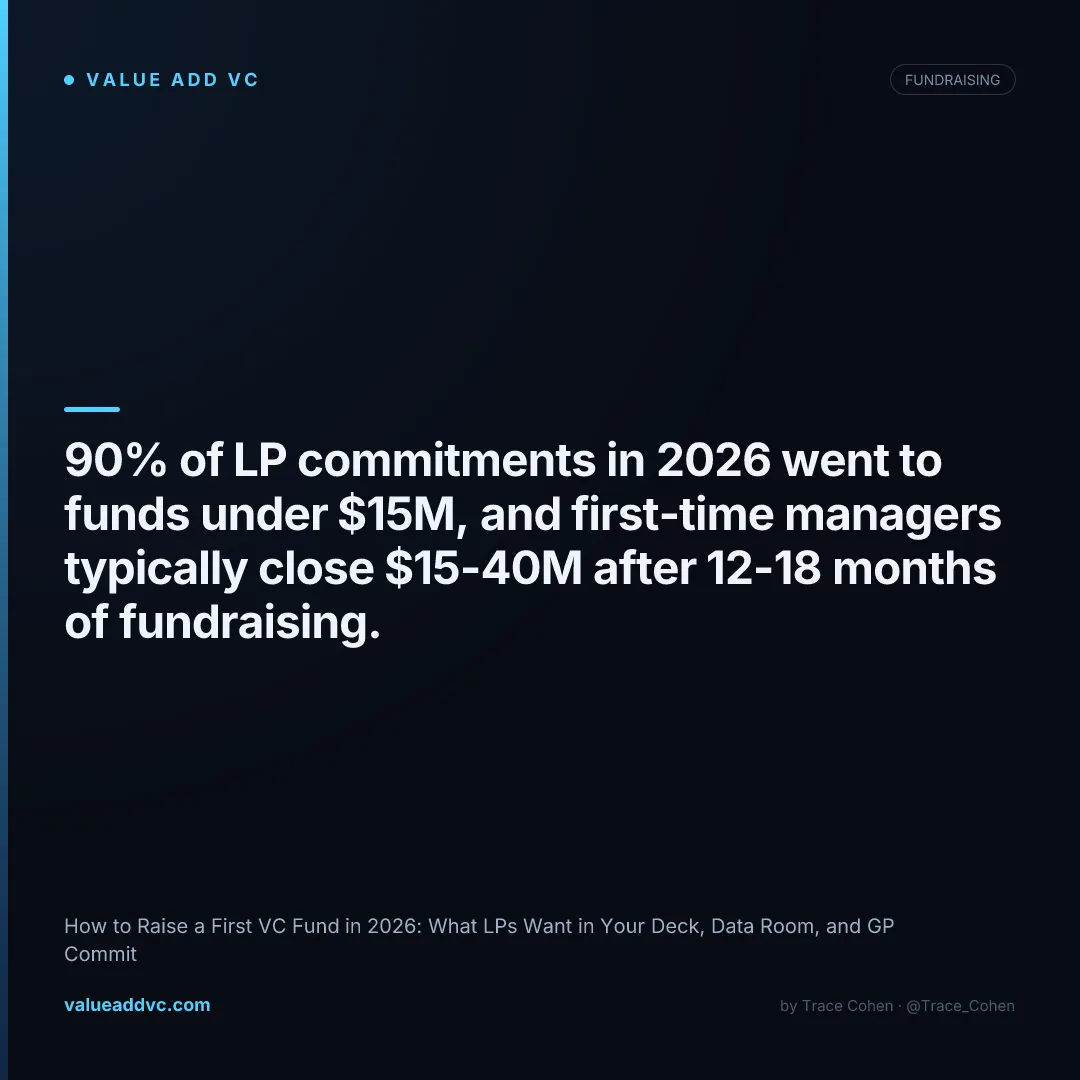
90% of LP commitments in 2026 went to funds under $15M, and 70% of institutional PE and VC capital still goes to GPs an LP has already backed — leaving roughly $30 of every $100 available to genuinely new managers. The good news buried in that: first-time funds are still getting funded, just at a smaller size, on tighter fee terms, and with a much more complete data room than five years ago.
I've sat on both sides of this table — raising capital as a founder and writing checks as an investor across 65+ companies — and the pattern with first-time GPs is consistent: the ones who close aren't the ones with the flashiest deck, they're the ones who treated the data room like it was already being diligenced by an institutional LP on day one. We track fund performance benchmarks more broadly on our VC performance dashboard, and the emerging-manager cohort is where the widest dispersion in outcomes actually lives.
Figures are 2026 estimates blended from VC Lab's emerging manager fundraising data, Sydecar's fund terms survey, Pipeline Road's institutional LP allocation statistics, and Altss's LP due diligence benchmarks.
How to Raise a First VC Fund in 2026
Raising a first VC fund in 2026 means targeting a $15-40M close over 12-18 months, since nearly 90% of LP commitments are going to funds under $15M and institutional capital remains concentrated in existing GP relationships. Success requires a complete 60-90 document data room, a competitive GP commit near 3% of fund size, and fee terms — typically 1.5-1.75% management and 15-20% carry — sharp enough to offset the risk LPs take on an unproven manager.
That's a narrower and more disciplined path than the 2021 vintage of first-time funds faced, when capital was abundant and terms were looser. The managers closing funds today are treating the LP relationship less like a pitch and more like a due diligence process they control from the first email.
First-Time Fund Terms: 2020 vs 2026
| Term | 2020 Market Standard | 2026 Market Standard |
|---|---|---|
| GP commitment | ~1.5% of fund size | ~3.0% of fund size |
| Management fee | 2.0% | 1.75% (median) |
| Standard carry | 20% | 20% standard, 15% common |
| Founder's economics discount | Rare | 1.0-1.5% fee / 10-15% carry on first $25-100M |
| Typical first close size | $10-25M | $15-40M |
| Fundraising timeline | 9-12 months | 12-18 months |
| Data room size | ~30-40 documents | 60-90 documents |
| Preferred return hurdle | 8%, American waterfall common | 8%, European waterfall increasingly expected |
| Average LP check size | Not consistently tracked | ~$159K |
Figures blended from Sydecar's 2026 emerging manager terms survey, Pipeline Road's state of capital raising report, and VC Lab's emerging VC fundraising data. LP check size and data room figures reflect 2026 institutional norms.
What Goes Into the Data Room LPs Actually Diligence First
A fully institutional-grade LP data room in 2026 typically runs 60-90 documents — the fund deck, LPA, PPM, GP track record and attribution schedules, compliance and cybersecurity policies, key-person provisions, and reference contacts. Nearly three-quarters of institutional LPs review the data room before they'll even take a first GP meeting, which means an incomplete or disorganized room can eliminate a fund from consideration before a partner ever gets a chance to pitch.
Two things dominate what LPs are actually looking for once they're inside the room. First, team stability: 74% of LPs cite it as the single most important qualitative factor, and a fund that has lost two partners in the past three years is treated as a hard red flag. Second, GP dependency: 62% of allocations are contingent on the continued involvement of the founding GP, which is why succession planning — not just track record — has become a standard data room section.
On track record specifically, most institutional LPs now want to see a TVPI of 2x or higher on a prior fund or angel portfolio with at least 3-5 years of data behind it, since Cambridge Associates data shows top-quartile VC funds produce 3x+ TVPI and 20%+ net IRR. If you're an operator without a prior fund, angel-portfolio attribution becomes the substitute track record LPs will diligence instead — which is worth building out well before you start raising.
How to Raise a First VC Fund: The Deck LPs Actually Want to See
The deck itself has gotten shorter, not longer, because the data room now carries the depth. LPs want the deck to answer four things fast: why this GP, why this strategy, why now, and what the fund economics actually look like at the terms being offered. A deck that spends ten slides justifying market size before getting to team and terms is a deck that loses the room.
Fee and carry terms belong on the page, not buried in an appendix — with median management fees compressed to 1.75% and 15% carry increasingly common for first-time funds, LPs comparing multiple emerging managers in the same quarter will notice immediately if a fund is pricing itself above market without a track record to justify it. Founder's economics — a discounted fee and carry on the first $25-100M raised — has become the standard lever GPs use to close an anchor LP quickly, then revert to full institutional terms for later closes.
Why It's Still This Hard to Raise a First VC Fund Right Now
Roughly 70% of institutional PE and VC commitments in 2024-2025 went to GPs an LP had already backed, meaning for every $100 of institutional capital committed, only about $30 was available to a genuinely new relationship. Established firms captured 90.9% of total fundraising dollars in Q1 2026 alone, and LPs allocate just 8-12% of their overall portfolios to emerging managers as a category — a structurally small pool that hasn't grown much even as fundraising momentum has improved.
The more realistic entry points in 2026 are family offices, which now represent roughly 22% of emerging-manager LP allocations and are the fastest-growing source, and pension emerging-manager programs, which 40-45% of large pensions maintain specifically to underwrite new relationships. Both groups move faster than large institutional LPs and are more willing to be a fund's first check — the anchor commitment that everything else in a raise gets built around. Our funds tracker follows which LP types are actually writing checks into new vehicles this year.
How to Raise a First VC Fund Without an Existing GP Relationship
Since roughly 70% of institutional capital in 2024-2025 went to GPs an LP had already backed, the practical question for most first-time managers isn't "how do I write a better deck" — it's "how do I get in front of the $30 of every $100 that's actually available to a new relationship." That capital tends to move through a narrower set of channels than the headline institutional LPs most emerging managers chase first.
Fund-of-funds and accelerator platforms like VC Lab have become a meaningful on-ramp precisely because they aggregate smaller checks from HNWIs and family offices into a single anchor commitment, which is one reason the average VC Lab-assisted fund lands around $12-14.5M rather than a full institutional-scale raise. Placement agents can help for funds targeting $30M or more, but their fees — typically 2-4% of capital raised — only pencil out once a fund is large enough to absorb the cost, so most sub-$20M first-time funds raise without one.
The other lever worth using early: LP matching tools and warm-intro networks specifically built for emerging managers cut down the blind-outreach cycle that used to define a first raise. A GP who spends the first three months of a raise cold-emailing family offices is competing on volume against managers who spent that same window getting three or four warm introductions into the pension and family-office programs that already have emerging-manager mandates. Sequencing the raise around those existing mandates — rather than a generic LP list — is consistently the difference between a 12-month close and an 18-month one.
Bottom line: Raising a first VC fund in 2026 means competing for a share of the 90% of LP capital going to funds under $15M, with a 60-90 document data room, a 3% GP commit, and fee terms near 1.75% management and 15-20% carry as the baseline cost of entry. The 70% of capital still flowing to existing GP relationships means family offices and pension emerging-manager programs are the more realistic first checks — not the large institutional LPs that dominate headlines. Build the data room like it's already being diligenced, because for nearly three-quarters of LPs, it is.
Latest from the Pulse
Get VC data most people never see
— 100% free
Weekly benchmarks, valuations, and fund data. Join 5,000+ investors. No spam.