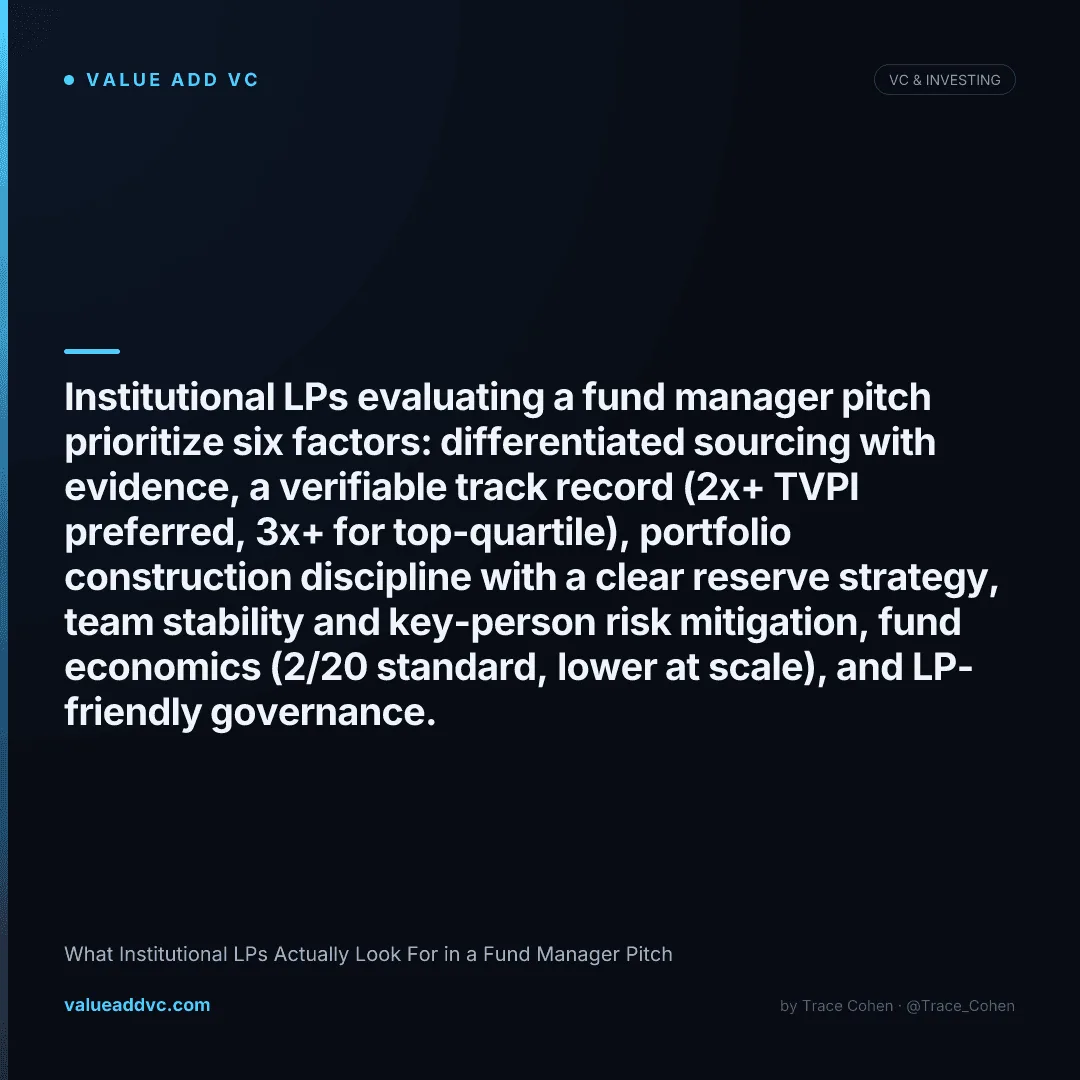
Institutional LPs — endowments, pension funds, foundations — reject more than 95% of fund manager pitches they receive. The ones that get funded share six specific characteristics. Most emerging managers pitch on the wrong ones.
I've sat on both sides of this table. As a founder who's raised from institutional investors and as an investor watching how LP capital actually moves, the gap between what managers think LPs care about and what LPs actually care about is enormous. Here's the framework that matters.
How Institutional LPs Allocate to Venture Capital
Understanding who you're pitching is prerequisite. Different LP types have radically different mandates, timelines, and constraints — and pitching a pension fund the same way you'd pitch a family office is a fast way to get a polite pass.
| LP Type | VC Allocation | Typical Min. Check | Due Diligence Timeline |
|---|---|---|---|
| Ivy/Top Endowments | 10–20% | $10M–$50M+ | 6–12 months |
| Mid-Size Endowments | 5–12% | $5M–$25M | 9–15 months |
| Public Pension Funds | 2–5% | $20M–$100M+ | 12–24 months |
| Foundations | 5–15% | $2M–$15M | 6–12 months |
| Sovereign Wealth Funds | 5–10% | $25M–$200M+ | 12–18 months |
| Insurance Companies | 1–3% | $10M–$50M | 12–18 months |
Sources: Cambridge Associates, Preqin 2024, NACUBO Endowment Study 2024
The 6 Factors That Actually Drive an Institutional LP Fund Manager Pitch Decision
1. Verifiable Track Record
This is the filter most managers fail. Institutional LPs want TVPI of 2x or better — ideally with DPI showing actual cash returned to LPs. Cambridge Associates data puts top-quartile VC at 3x+ TVPI and 20%+ net IRR. Quoting unrealized paper marks doesn't move the needle; realized returns on exited companies do. For a first fund with no prior fund history, a demonstrable angel portfolio with traceable markups or exits is the minimum viable track record. A portfolio of 20+ investments with 3–5 exits (even partial) demonstrates pattern recognition.
2. Differentiated Sourcing — With Evidence
Every manager claims proprietary deal flow. Institutional LPs hear this pitch 300 times a year. The managers who stand out can prove it: a network that produces deals at pre-market prices, a sector reputation that makes founders call you first, or a geographic edge in an underserved market. The question every LP is asking internally: why do the best deals call you? If you can't answer that with specifics — names, relationships, industries, conversion metrics — you don't have differentiated sourcing. You have hope.
3. Portfolio Construction Discipline
LPs want to understand your ownership targets, check size strategy, reserve policy, and follow-on approach. Emerging managers who don't have a clear reserve strategy — typically 40–50% of fund capital held back for follow-on investments — are signaling they haven't modeled their portfolio outcomes. Show that you understand concentration vs. diversification tradeoffs, and that you've built a model showing how you reach fund-level returns given your stage, check size, and target ownership.
4. Team Stability and Key-Person Risk
A fund is a 10–12 year relationship. Institutional LPs are betting on the team as much as the strategy. Key-person clauses — which trigger LP suspension rights if a named GP leaves — are standard in every LPA. What matters to LPs is whether the team has worked together under pressure, whether there's succession clarity, and whether the fund could survive departure of its lead GP. Solo GPs face more skepticism on this dimension; multi-GP funds with demonstrated working relationships carry lower key-person risk.
5. Fund Economics That Are LP-Aligned
The standard VC economics — 2% management fee, 20% carry, 8% hurdle — are a starting point, not a ceiling for negotiation. Funds above $300M face LP pressure to reduce management fees (1.5–1.75% is common). First-time managers sometimes offer MFN provisions or co-investment rights to attract anchor LPs. Institutional LPs scrutinize what management fees cover and whether they create incentives to grow AUM at the expense of portfolio returns.
6. LP-Friendly Governance and Transparency
Institutional LPs will scrutinize your LPA. LPAC (LP Advisory Committee) structure, fee offset provisions, conflict-of-interest policies, and reporting cadence all matter. Quarterly NAV reporting with audited annuals is the minimum. Funds that offer co-investment rights on large deals — at no additional fee or carry — score higher with LPs that have their own direct investment programs. Governance quality signals how you'll behave when the market turns.
What Institutional LPs Almost Never Say — But Always Think
Is the thesis repeatable?
One great exit doesn't prove a system. LPs want to see pattern recognition across 10+ investments, not a one-hit portfolio.
What happens when this doesn't work?
LPs want to understand how you handle a down round, a portfolio company failure, or a strategy that stops performing in a new market cycle.
Who referred you here?
Warm intros from existing managers or trusted co-investors reduce due diligence friction by an order of magnitude. Cold inbound almost never closes.
Is the fund size consistent with the strategy?
A $15M fund with a $100M+ ownership target is incoherent. Fund size, check size, stage, and ownership targets must all align.
The Institutional LP Due Diligence Process: What to Expect
Initial Screening
Deck review, website scan, initial reference checks. 80%+ of pitches end here without a meeting.
First Meeting
60–90 minute call with one or two LP team members. Focus: thesis clarity, track record evidence, team background.
Deep Dive
Full portfolio review, GP references, portfolio company references. LPA markup begins. Takes 4–8 weeks.
Investment Committee
LP team presents to IC. 1–3 IC meetings depending on institution size and check amount. Can take months.
Legal & Close
LPA negotiation, side letter execution, subscription documents. Soft close to hard close: 4–12 weeks.
Track top-performing VC funds and benchmark your fund metrics on the VC Performance Dashboard or explore LP benchmarking tools at Benchmarking on Value Add VC.
Institutional LPs don't invest in strategies.
They invest in managers who can prove they see deals others miss — and who have already done it.
Latest from the Pulse
Get VC data most people never see
— 100% free
Weekly benchmarks, valuations, and fund data. Join 5,000+ investors. No spam.