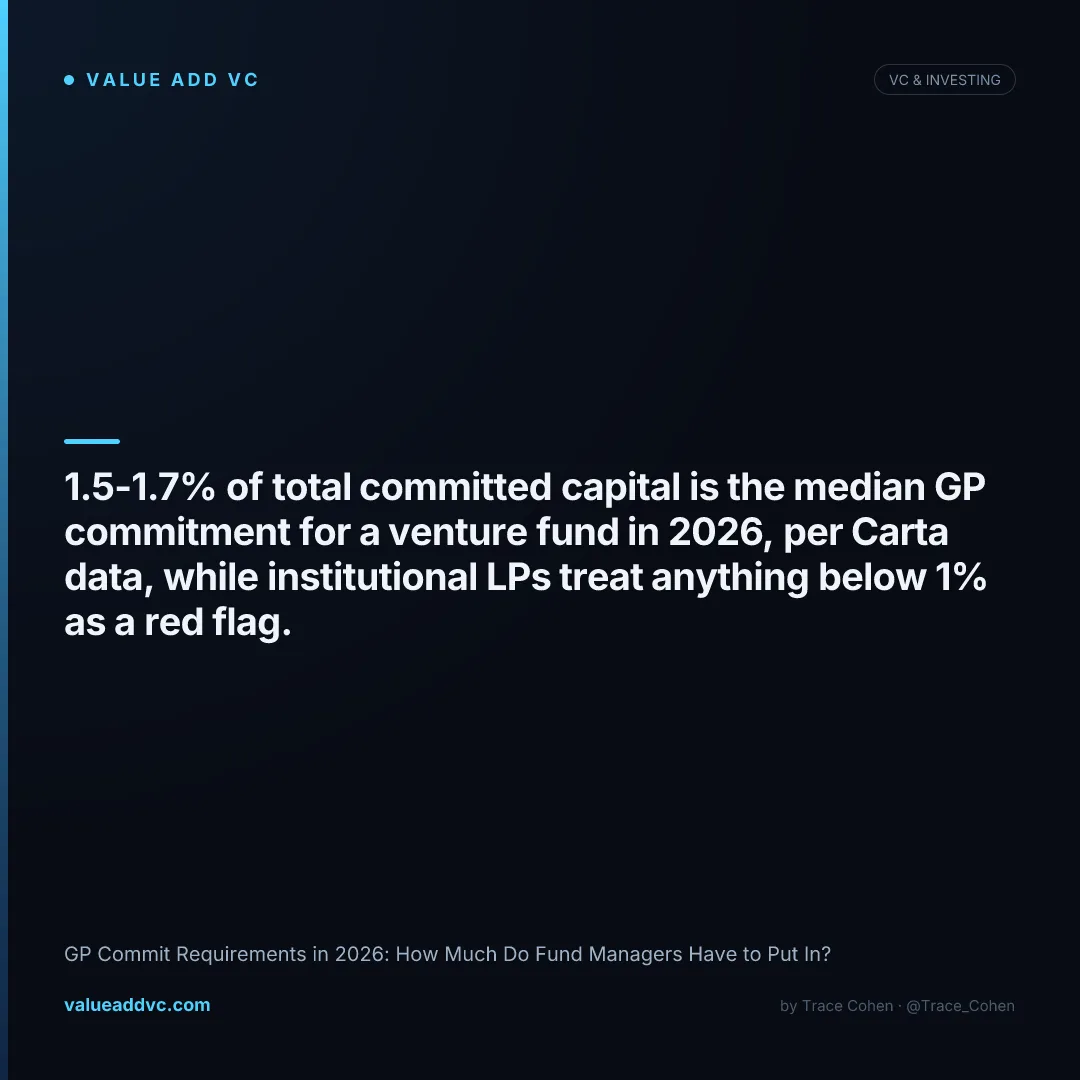
1.5-1.7% of total committed capital is the median GP commitment for a venture capital fund in 2026, per Carta's fund-formation data — meaning the general partners running a $50 million fund typically have to personally wire somewhere around $750,000 to $850,000 into their own vehicle. That's the short answer. The longer answer is that the percentage, the timing, and even whether it has to be cash at all have all shifted meaningfully over the past two years.
I've sat on both sides of this — raising GP commits for our own vehicles and evaluating other managers' commitments as an LP. It's one of the first numbers institutional allocators check, and it's also one of the most misunderstood parts of fund formation by first-time managers. We track fund-level return data on our VC & PE performance dashboard, and GP commit size is one of the quieter variables that correlates with how seriously LPs take a first close.
Figures are 2026 estimates blended from Carta's GP Commitment benchmark data, Umbrex's private equity glossary, Bunch Capital, and PitchBook's Q1 2026 emerging manager fundraising report. GP commit dollar figures are illustrative math applied to the cited median percentages.
What Is the GP Commit Requirement for a VC Fund in 2026?
The GP commit requirement is the percentage of a fund's total committed capital that the general partners must personally invest alongside their limited partners, and in 2026 that figure sits at a median of 1.5-1.7% for venture funds versus 2.55% for private equity, according to Carta's most recent fund-formation dataset. Most institutional LPs won't take a first meeting seriously if the GP commit falls below 1%, and many treat 2% as the real starting point for negotiation on a fund of any meaningful size.
The gap between VC and PE isn't random. PE funds tend to have older, wealthier general partners with more personal capital to deploy, and PE deal sizes create more room to justify a larger co-invest. VC funds, especially first-time and Fund II vehicles, are frequently run by managers still building personal net worth, which is exactly why the median has historically clustered closer to 1% and has only crept up toward 1.7% as LPs have pushed harder for alignment since 2023.
How Much Do Fund Managers Have to Put In? The Dollar Math by Fund Size
Percentages sound abstract until you run them against real fund sizes, and the dollar figures shift the conversation fast. A $10 million emerging-manager fund at a typical 3% commit still requires $300,000 in personal capital — often more than a first-time GP's entire liquid net worth. A $250 million growth-stage fund at 1.5% requires $3.75 million, a number that only wealthy or multi-fund GPs can realistically self-fund without financing help.
| Fund Size | Typical GP Commit % | GP Commit ($) | Typical Manager Profile |
|---|---|---|---|
| $10M | 3.0% | $300,000 | Solo GP, first-time emerging manager |
| $25M | 2.0% | $500,000 | Fund I with institutional anchor LP |
| $50M | 1.7% | $850,000 | VC median — Fund I or Fund II |
| $75M | 1.75% | $1.31M | Multi-GP team, growing platform |
| $100M | 1.5% | $1.5M | Institutional-scale venture fund |
| $250M | 1.5% | $3.75M | Growth-stage or multi-strategy fund |
| $500M+ | 1.0% | $5M+ | Mega-fund, often financed or fee-offset |
Figures are 2026 estimates blended from Carta's GP Commitment benchmark data, VC Lab's LPA Template guidance, and typical institutional LP ranges reported by Bunch Capital and Pipeline Road. Individual fund terms vary by manager track record and LP negotiation.
Why the GP Commit Requirement Exists — and Why LPs Enforce It So Strictly
The entire point of the GP commit is alignment: if a fund manager loses LP money, the manager should lose real personal money too, not just years of unrealized carried interest on paper. Institutional LPs — pensions, endowments, and fund-of-funds — have pushed the informal floor from roughly 1% a decade ago toward 1.5-2% today, arguing that a manager with genuine skin in the game underwrites deals more conservatively and is less likely to force marginal follow-on investments just to protect a markup.
A commit below 1% on a fund of any real size is treated by most institutional allocators as a signal the GP either lacks conviction or lacks liquidity — and either read is a problem in diligence. That's part of why established firms, which can more easily self-fund a 2% commit out of prior fund proceeds and management fee accumulation, captured 90.9% of total VC fundraising dollars in Q1 2026, while emerging managers without that cash cushion faced longer closes and smaller checks even when their strategy and track record were comparable.
How Emerging Managers Are Financing Their GP Commit in 2026
A GP commit requirement that sounds reasonable at 1.5-2% in percentage terms can still be a liquidity crisis for a first-time manager who doesn't have $500,000-$1 million sitting in a brokerage account. That gap has spawned an entire specialty-lending niche: Henry Capital raised a $3.5 million seed round in 2026 specifically to offer credit lines against GP commitments, underwriting the fund's quality rather than demanding personal guarantees the way a traditional bank loan would.
The other common workaround is a management-fee offset or deferral, now written directly into a growing share of 2026-vintage LPAs — the GP agrees to waive or defer part of their annual 1.25-2.0% management fee, with the deferred amount effectively counting toward the required commit over the fund's investment period rather than as a lump sum at first close. Anchor LPs backing emerging managers increasingly prefer this structure over an outright cash requirement, since it keeps the GP financially disciplined without forcing a founder-manager to drain personal savings before the fund has deployed a single dollar.
Negotiating the GP Commit: What Anchor LPs Actually Ask For
In practice, the GP commit percentage isn't handed down as a fixed rule — it gets negotiated during the anchor LP process, usually before a first close is even scheduled. A pension fund or fund-of-funds writing the first $10-20 million check into a new vehicle will typically push for the higher end of the 1.5-2% range and want to see the commit funded in cash rather than through a fee waiver, precisely because an anchor LP is taking the most career risk on an unproven manager. By contrast, an LP coming in during a second or third close, once the fund already has traction, is often comfortable with whatever commit structure the anchor already negotiated.
Timing matters just as much as the percentage. Most 2026-vintage LPAs call the GP commit down pro-rata alongside every LP capital call over the 3-5 year investment period rather than requiring it all at once, which is a meaningful concession for a cash-constrained emerging manager — a $850,000 total commitment on a $50 million fund might only require $150,000-$200,000 in year one if the fund is deploying at a typical pace. GPs who go into fundraising assuming they need the full commit in the bank before a first close are often negotiating from a weaker position than they need to.
There's also a growing split between multi-GP platforms and solo-GP funds. On a fund with three or four general partners, the aggregate 1.5-2% commit gets split across the team, which meaningfully lowers the individual dollar burden — a $100 million fund's $1.5 million commit becomes $375,000-$500,000 per partner on a four-person team versus the full amount for a solo GP running the same size vehicle. That math is part of why solo-GP emerging managers increasingly bring on a second general partner specifically to share the commit burden, not just to add investing bandwidth.
Bottom line: the GP commit requirement in 2026 sits at a median of 1.5-1.7% for venture funds, meaningfully below the 2.55% PE average but above the roughly 1% floor most institutional LPs still enforce as a minimum alignment signal. On real dollars, that's $300,000 on a $10 million emerging-manager fund and $850,000 on a $50 million Fund I or Fund II — money most first-time GPs don't have sitting in cash, which is exactly why fee-deferral structures and specialty lenders like Henry Capital have become standard parts of fund formation rather than exceptions. Any GP raising in 2026 should model the commit dollar figure early, not late — it's one of the first numbers a serious LP will ask about, and showing up without an answer is a worse signal than the percentage itself.
Latest from the Pulse
Get VC data most people never see
— 100% free
Weekly benchmarks, valuations, and fund data. Join 5,000+ investors. No spam.