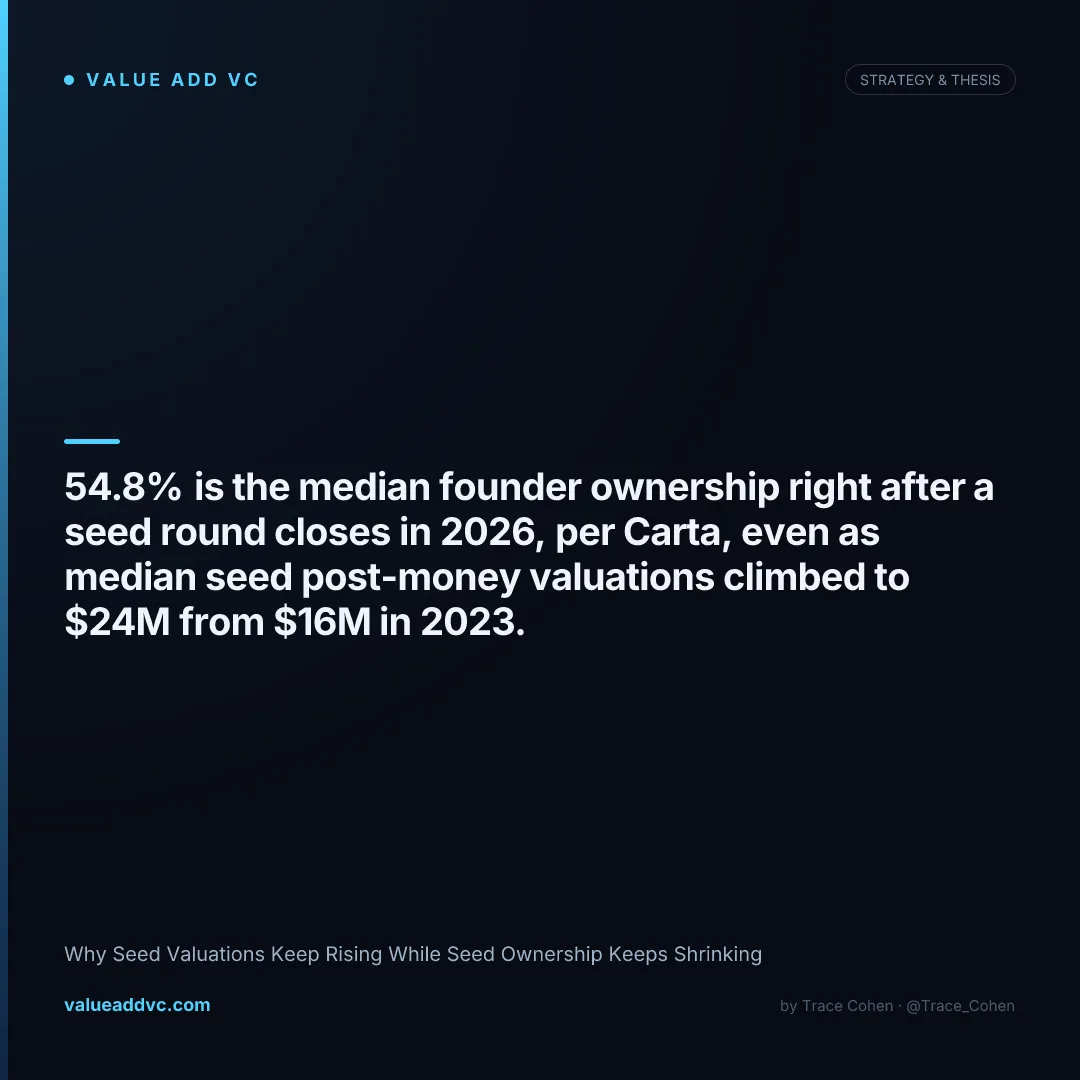
Seed valuations and founder dilution are rising together, not despite each other. Median seed post-money valuation hit $24M in 2026, up from $16M in 2023 — but by the time a startup reaches Series C, the option pool built to retain employees (16.8%) now owns more of the company than the founders who built it (16.1%). I don't think that's a coincidence, and I don't think most founders are pricing it in.
The standard founder story about a bigger seed round is that it's unambiguously good news: more capital, more runway, a higher number to put in the next pitch deck. I've watched that story get repeated enough times that it's worth pushing back on. A bigger valuation and a bigger round size are, mechanically, also a bigger cap table event — more option pool carved out up front, more SAFEs stacked before the round even primes, and more investors who each want a real allocation. The valuation headline goes up. What founders actually keep goes down faster than it used to.
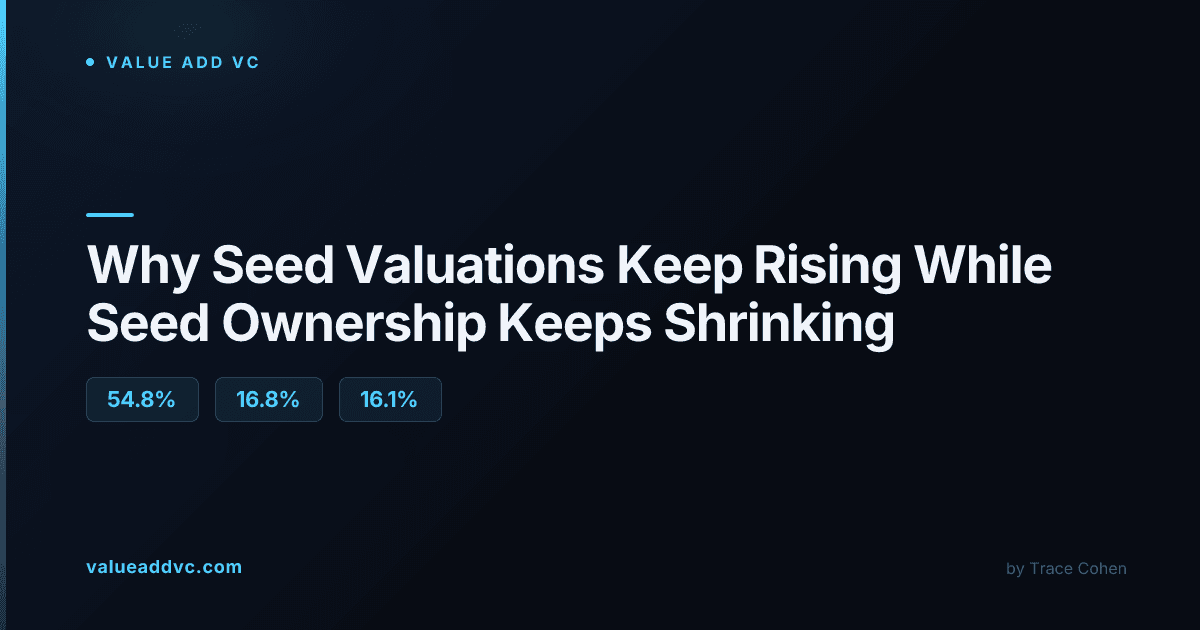
Source: Carta, Founder Ownership Report 2026 (9,304 startups, 2023-2026 raises); PitchBook data via Founded newsletter.
The valuation side of the story is real and well documented
Seed pre-money valuations have roughly tripled since 2020. PitchBook put the median seed pre-money at $7M in 2020 and $9M in 2021; by 2023 the full-year median had climbed to roughly $14.8M-$16M pre-money, and Carta's most recent data puts 2026's median seed post-money at $24M, up from $18M in 2024 and $16M in 2023. Round sizes moved in the same direction — from roughly $1.7M-$2M median checks in 2020-2021 to a $3.2M-$4.1M median by early 2026.
None of that is manufactured hype. AI-traction companies, repeat founders, and top-tier-backed rounds are genuinely pricing at a premium — PitchBook's "consensus" seed deals reportedly price near $40M pre-money, close to 3x the broader market median. Sector data backs up the same split at the round-size level: AI startups are raising seed rounds around $4.6M on average in 2026, roughly triple the $1.5M typical consumer-app seed check.
That bifurcation matters for who's setting the "market" valuation founders anchor to, but it's a separate story from what happens to ownership even in the ordinary, non-consensus seed round. A founder pattern-matching off a $40M AI-consensus deal while raising a $16M pre-money round in a slower-moving category is comparing themselves to a different market entirely — and the dilution mechanics below apply regardless of which market they're actually in.
Why ownership shrinks faster than the valuation story implies
Three mechanics do most of the work. First, option pools: most seed-stage pools now land close to 15% of the cap table, carved out of the pre-money valuation before a single investor dollar shows up — Carta's data shows the median pool grows from 12.1% at seed to 16.8% by Series C, a bigger claim on the company than the founders retain by that point. Second, SAFE stacking: in Q4 2025, 93% of pre-priced early-stage deals were SAFEs rather than priced equity or convertible notes, and multiple SAFEs stacked at different valuation caps compound dilution in a way that isn't simply additive — the math often surprises founders only when an investor forces a fully diluted cap table model ahead of the next priced round. Third, round mechanics at higher valuations tend to attract more investors wanting meaningful allocations, which pushes overall dilution per round higher even when the headline valuation looks generous.
This likely means the real founder skill in 2026 isn't negotiating the valuation number — it's negotiating the option pool size and refusing to let pre-seed and seed SAFEs stack without modeling the combined fully diluted impact before signing the next one. A $24M post-money headline is meaningless if 20% of it was already spoken for by pool top-ups and uncapped SAFE conversions before the term sheet was even drafted.
Where I could be wrong
The cleanest counter to this thesis is that a bigger slice of a much bigger pie can still be a better outcome in absolute dollar terms. A founder who owns 54.8% of a company that just raised at $24M post-money has more paper wealth tied to that stake than a founder who owned a larger percentage of an $8M post-money seed round in 2020 — and if the company's actual enterprise value keeps compounding, the percentage-ownership framing can understate how good the deal really is. Dilution is also the price of capital that funds the growth that makes the bigger valuation possible to begin with; a founder who refuses to raise, or who fights every basis point of option pool, may end up with a larger percentage of a company that never had the resources to become valuable.
It's also worth noting that Carta's sample (9,304 startups that raised from 2023-2026) is drawn from companies already using Carta's cap table software — disproportionately venture-backed, English-speaking-market startups — and may not generalize cleanly to every seed-stage company globally.
Bottom line: Seed valuations and founder ownership aren't moving in opposite directions by accident — they're two outputs of the same mechanism. Bigger rounds at higher valuations come bundled with bigger option pools and more stacked SAFE dilution, so the headline number climbing from $16M to $24M in three years tells you less about what founders actually keep than the stage-by-stage ownership curve does. By Series C, that curve already shows the option pool outweighing the founders it exists to help them hire around.
Latest from the Pulse
Get VC data most people never see
— 100% free
Weekly benchmarks, valuations, and fund data. Join 5,000+ investors. No spam.