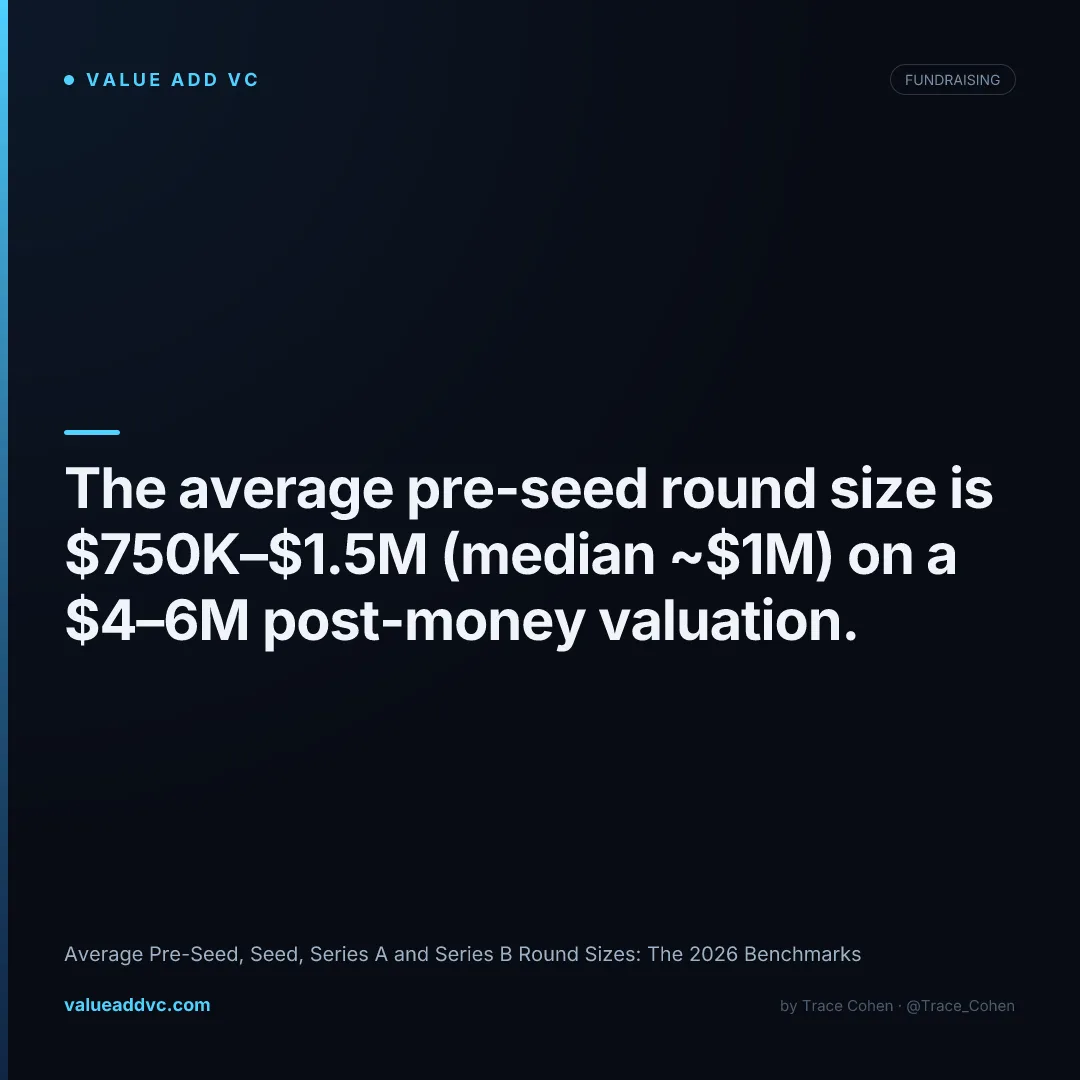
Average Round Size by Stage: Pre-Seed to Series B
Based on Carta State of Private Markets, PitchBook, and Crunchbase funding data, here's what each stage actually looks like in 2026:
| Stage | Median Round Size | Post-Money Valuation | Typical Dilution | Check Size (Lead) |
|---|---|---|---|---|
| Pre-Seed | $750K–$1.5M | $4–6M | 15–20% | $250K–$750K |
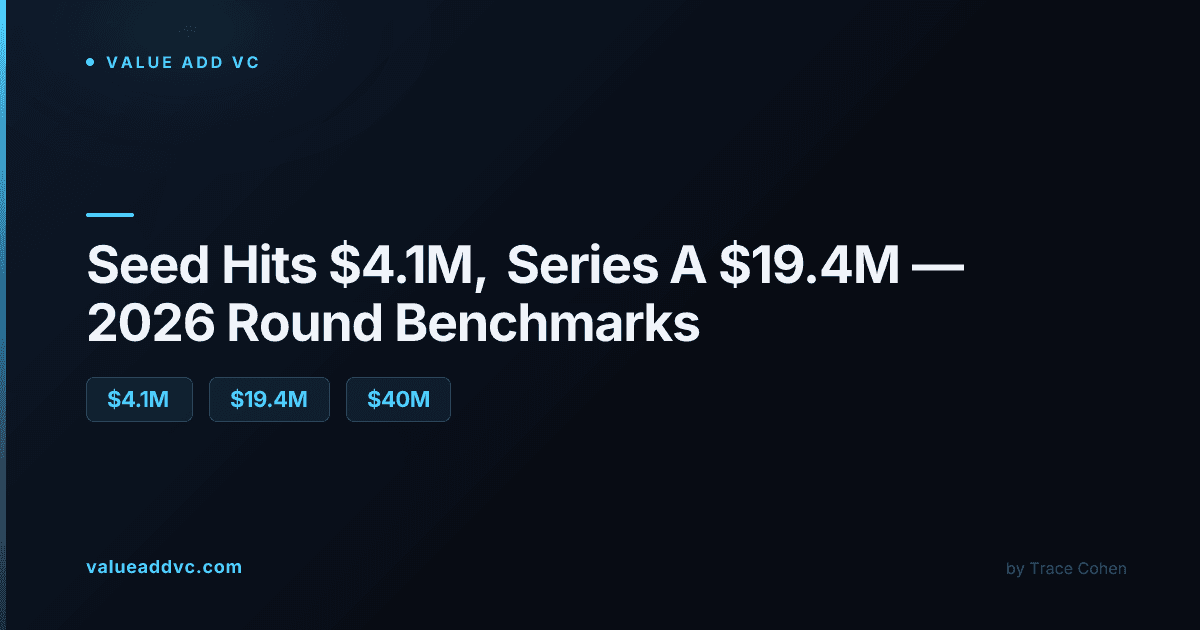
| Seed | $4.1M | $24M post (record) | 18% | $500K–$2M |
| Series A | $19.4M | $78.7M+ post (non-AI ~$40–42M pre) | 15–20% | $5–15M |
| Series B | $40M | $120–160M+ post | 15–20% | $15–25M |
Sources: Carta State of Private Markets: Q1 2026, the Q2 2026 PitchBook-NVCA Venture Monitor, and Crunchbase News venture coverage — latest data available as of this writing
As of September 2026: valuations have moved up sharply since this piece first published. Carta's Q1 2026 data put the median seed round at $4.1M (up from $3.2M the prior quarter) on a $24M post-money (up from $18M a year earlier), and the Q2 2026 PitchBook-NVCA Venture Monitor put the median Series A deal at $19.4M with a $78.7M+ post-money for the broader market. Much of that increase is concentrated in AI deals: megadeals of $100M or more made up 87.5% of the $412.7B deployed industry-wide in Q2 2026, and non-AI Series A rounds are still pricing closer to a $40–42M pre-money, so check the AI-vs-non-AI split before benchmarking your own round against the headline medians. For a deeper look at how that seed median splits by industry, see our seed round size ranked by sector breakdown.
The 2021 fundraising environment is gone. Median startup funding rounds in 2026 remain 30–50% below peak, the conversion rate from seed to Series A has dropped from ~50% to ~38%, and investors are underwriting to profitability paths they were ignoring a few years ago.
The simplest way to keep the stages straight: pre-seed funds the founder, seed funds the hypothesis, Series A funds the machine. These aren't just bigger checks as you go — they're completely different investments, with different evidence requirements, dilution expectations, and evaluation frameworks at each step.
I've made 65+ investments across every stage. I've watched founders raise at the wrong time, at the wrong size, and on the wrong terms — and I've watched others use market clarity to raise more efficiently than peers who were diluted out of their companies in 2021. This is the data you need before you go out.
Pre-Seed: Idea Stage in a Post-ZIRP World
Pre-seed is where most of the market noise is loudest and the data is least reliable. What I see in practice: the median pre-seed in 2026 is a $1M SAFE at a $5–6M post-money cap. Occasionally a strong repeat founder closes $2–3M on a $8–10M cap before writing a single line of code. That's the exception, not the rule.
What investors want to see
Team, thesis, why now — plus an initial signal of demand (waitlist, LOIs, pilot interest)
Instrument
SAFE (post-money cap) is the default in 2026. Convertible notes are less common. Priced pre-seeds are rare.
Who leads
Angel investors, pre-seed micro-funds ($25–75M fund size), and accelerators (YC, Techstars, On Deck alumni)
Timeline
2–6 weeks for warm intros; 8–12 weeks for a cold process if the team is strong
Seed Round in 2026: Higher Bar, More Competition for Dollars
The seed market has bifurcated. If you have early product-market fit signals — $50K–$200K ARR, strong week-1 retention, or a credible enterprise pilot — you can raise a $3–4M seed at a $15M post-money without much trouble. If you have a prototype and a vision, you are competing in a much harder pool.
Seed deals now run a $4.1M median per Carta's Q1 2026 data, up from $3.2M the prior quarter after several years of relatively flat round sizes. Post-money valuations, meanwhile, sit at a record $24M — up from $18M a year earlier and $16M two years earlier — as AI premiums pull the median up.
Median Seed Round
$4.1M
Up from $3.2M the prior quarter (Carta)
Median Post-Money
$24M
Record high, up from $18M a year earlier
Seed → Series A Rate
~38%
Down from 50%+ in 2020–2021
What Series A Investors Actually Require in 2026
Series A is where the market compression has been most dramatic in terms of what you need to show, not just valuation. In 2021, $500K ARR growing 300% got you a Series A lead. In 2026, the floor is closer to $1–2M ARR with 150%+ growth, and the best deals are often $2–3M ARR with 120%+ growth and strong retention.
Track the full startup funding benchmarks by stage, sector, and vintage on our Benchmarking dashboard to see how your metrics compare to what's actually raising.
ARR floor
$1–2M, with median at $1.5M for recently funded deals
Growth rate
150%+ YoY preferred; under 100% YoY is a very hard conversation unless there's a compelling market size story
Net Revenue Retention
110%+ is the new floor for SaaS; 125%+ is what separates competitive processes from single-offer situations
CAC Payback
Under 18 months for SMB, under 24 months for enterprise — longer than that, growth efficiency will be the primary objection
Team
At least one person with a clear reason to win in this specific market — domain expertise, unfair distribution advantage, or prior repeat founder signal
Series B in 2026: Efficiency Is the New Growth
Series B is where the post-2021 repricing has been most painful for companies that raised inflated Series A valuations. If you raised a $100M post-money Series A in 2022 and have grown to $8M ARR at 70% YoY growth, you are looking at a flat or down round. That's not a failure — it's arithmetic.
The median Series B in 2026 is a $40M deal (up from $35M as of the Q1 2026 PitchBook-NVCA Venture Monitor) on a $120–160M+ post-money. To get there cleanly, most companies need $5–10M ARR, growth of 80–120% YoY, and a clear path to rule-of-40 economics within two years. Private SaaS multiples are tracking at 4–8x ARR versus 15–20x in 2021 — which is exactly what you should expect at this stage today for non-AI companies.
What Gets a Clean Series B
- ✓ $5M+ ARR growing 100%+ YoY
- ✓ NRR above 115%
- ✓ CAC payback under 18 months
- ✓ Clear path to Rule of 40
- ✓ Named enterprise logos and referenceable customers
What Forces a Bridge or Down Round
- ✕ ARR below $3M with a 2022 Series A valuation
- ✕ Growth below 80% YoY
- ✕ Churn above 15% annually
- ✕ Burn multiple above 2.0x
- ✕ No obvious lead with a clear conviction thesis
The Conversion Math: What Actually Gets Through
The venture funnel is more brutal than most founders expect. Based on Carta data covering 2020–2024 cohorts:
~45%
Pre-Seed → Seed
Of companies that close a meaningful pre-seed, roughly half reach a subsequent seed round within 24 months
~38%
Seed → Series A
The most brutal filter — most companies exhaust runway or fail to reach repeatable metrics before A-round timing
~55%
Series A → B
The funnel widens once you've raised an A with real metrics — execution risk dominates over market risk
The implication: most companies that raise pre-seed will not raise a Series A. This isn't purely a failure of execution — it reflects how the funnel narrows as evidence requirements rise at each stage.
The Lines Are Blurring — Especially in AI
One important caveat: the traditional pre-seed → seed → Series A progression is less linear than it used to be. AI-native companies are raising rounds that structurally look like Series As — $10–20M on $60–100M pre-money — but are functionally pre-product bets on exceptional founding teams. Meanwhile, companies that would have raised Series As in 2019 are doing extended seed rounds at lower dilution to preserve optionality.
The category matters enormously. Enterprise SaaS companies face traditional ARR milestones. Developer tools companies raise on MAUs and usage depth. AI foundation model companies raise on compute access, research talent, and benchmark performance. Don't benchmark your round against a company building in a different category — the frameworks differ substantially and you'll price yourself wrong.
The Time Between Rounds Has Stretched
In 2021, the median time from seed to Series A was 12–14 months. Today it's 18–24 months. From Series A to Series B, it was 15–18 months in the frothy era — now it's 22–28 months. This isn't a problem if you plan for it. It's a fatal problem if you assume the 2021 timeline.
The practical implication: raise enough runway to reach the next stage's bar, not just to survive the next 12 months. The right amount of capital for a seed round in 2026 is typically 18–24 months of runway — not 12. See how top-performing VC funds and their portfolio companies are navigating this on the VC Performance dashboard.
The 2021 fundraising market rewarded speed. The 2026 market rewards discipline.
Know what stage you're actually at, raise the right amount for 20+ months of runway, and don't optimize for valuation at the expense of the investors you're taking on the cap table.
Compare your startup's metrics to stage benchmarks on the Benchmarking Dashboard at Value Add VC. Originally published in the Trace Cohen newsletter.
Latest from the Pulse
Get VC data most people never see
— 100% free
Weekly benchmarks, valuations, and fund data. Join 5,000+ investors. No spam.