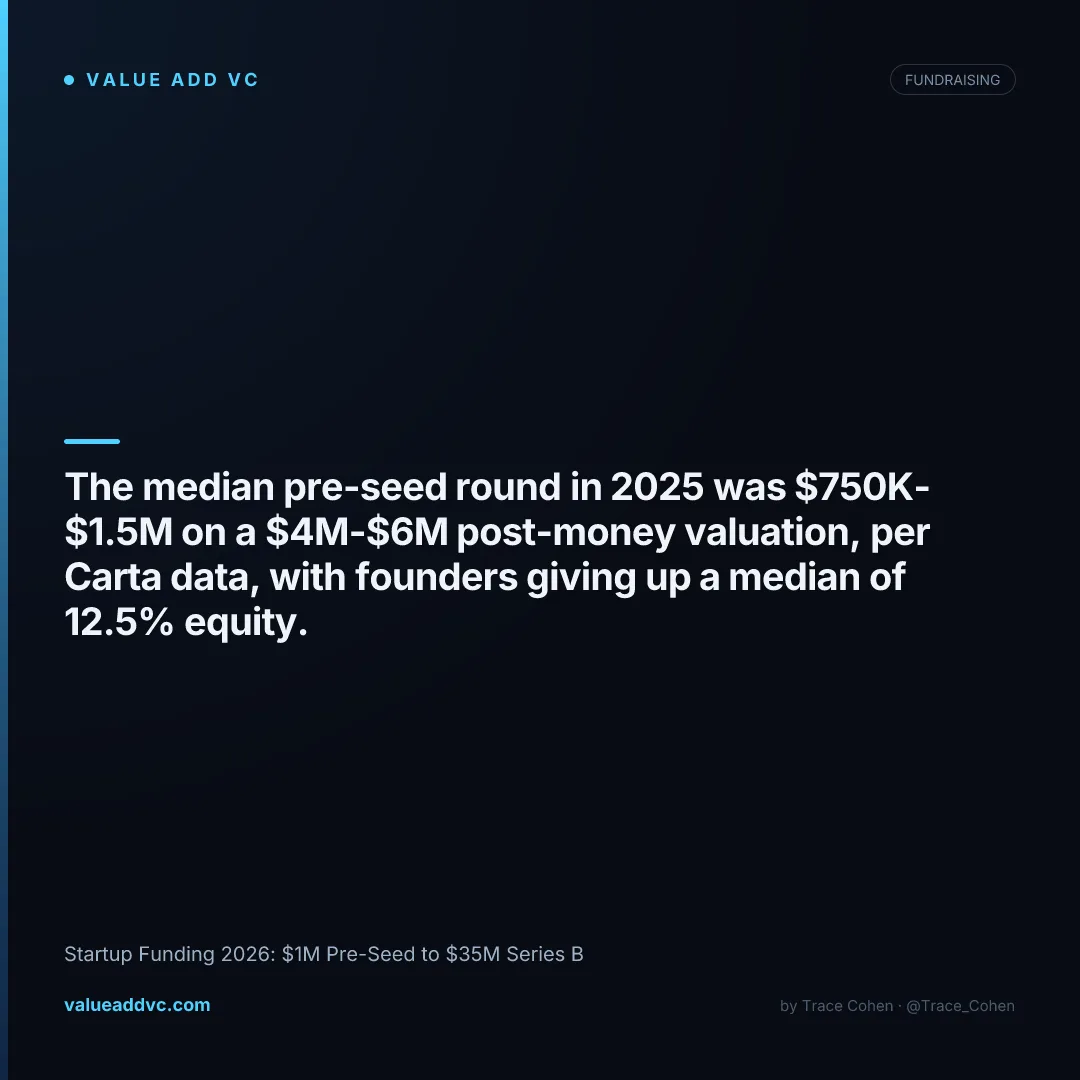
U.S. startups raised $10.4B across 50,316 pre-seed SAFEs and convertible notes in 2025, at a median round of $750K-$1.5M on a $4M-$6M cap.
Pre-seed in 2025 didn't collapse — it concentrated. Instrument count fell 13% year-over-year while total dollars invested slipped only about 1%, which means fewer founders got funded but the ones who did, on average, raised bigger checks. If you're mapping your own round against the market, the averages hide a real bifurcation: a thin layer of AI-native teams raising $3M-$5M pre-seeds at $20M+ caps, and everyone else fighting over checks under $500K.
What do pre-seed funding statistics show for round sizes in 2025?
Pre-seed funding statistics for 2025 show a median round of $750K to $1.5M, down from the frothier $1.5M-$2M medians of 2021, but up slightly from the 2023 trough. Nearly 45% of Q3 2025 rounds came in under $250K — up from 39% in Q2 2025 — meaning the "typical" pre-seed round most founders experience is smaller than the headline average suggests, because a small number of large AI rounds pull the mean upward.
That barbell shape matters for how you benchmark your own raise. Comparing your $400K friends-and-family round to a $3M AI pre-seed covered in TechCrunch is comparing two different markets that happen to share a label. Our VC performance dashboard breaks out fund-level deployment pace if you want to see how quickly capital is actually moving at this stage.
Pre-Seed Round Size and Valuation by Deal Size (2025)
| Round Size | Median SAFE Cap | Median Dilution | % of 2025 Rounds |
|---|---|---|---|
| Under $250K | $6M-$8M | ~8% | 45% |
| $250K-$999K | $10M | ~12% | 31% |
| $1M-$1.9M | $15M | 15.6% | 16% |
| $2M-$2.9M | $18M | 18.2% | 5% |
| $3M-$4.9M | $20M-$25M | 20.1% | 2.5% |
| $5M-$5.9M | $25M+ | 23.7% | 0.5% |
Figures are 2025 estimates blended from Carta's SAFE and convertible note platform data, RebelFund's dilution benchmarks, and Kruze Consulting's 2025-2026 pre-seed guide. Dilution figures reflect expected dilution at the round's valuation cap, not final post-conversion dilution.
How pre-seed dilution has shifted since 2022
Pre-seed dilution statistics have been remarkably stable relative to valuation swings. Median dilution sat at 12.5% at pre-seed, 19.5% at seed, 18% at Series A, and 14% at Series B in 2025 — meaning a founder who raises all four rounds without a down round or major recap typically retains roughly 50% of the company heading into growth stage. That math hasn't moved much since 2021, even though valuations swung by more than 50% peak to trough over the same period.
The 2022 peak of $10M-$12M caps collapsed to a $4M-$5M trough by late 2023 as rate hikes repriced every stage of venture. The 2025 rebound to $6M-$8M reflects both AI-driven demand for early checks and a broader normalization in the seed and Series A markets above it — see our full funding stage breakdown for how that flows through to seed and Series A pricing.
Why the pre-seed barbell exists: AI vs. everything else
The single biggest driver of 2025's pre-seed statistics is the split between AI-native teams and everyone else. A pre-seed startup with a working model demo, a technical founder from a recognizable lab, and a plausible path to enterprise revenue can command a $15M-$25M cap on a $2M-$3M raise — territory that used to require a priced Series A. Meanwhile, a pre-seed B2B SaaS or consumer startup without an AI angle is competing for $6M-$8M caps on $500K-$1M checks, roughly where the market sat in 2023.
This isn't a market inefficiency so much as investors repricing uncertainty. Specialist pre-seed funds told us the same story repeatedly through 2025: LPs are asking GPs to justify every non-AI check with a clearer path to a 10x-plus outcome, while giving AI deals more benefit of the doubt on valuation because the downside case (a strategic acquihire) looks less catastrophic than it did in prior cycles. That asymmetry is why the median cap moved from $5M in 2024 to $6M-$8M in 2025 even as deal count fell.
Geography still matters too. Bay Area and NYC pre-seed rounds carry a 20-30% valuation premium over the same-quality deal raised in Austin, Miami, or Denver, according to multiple 2025 syndicate data points — though that gap has narrowed from the 40%+ premium common in 2021, as more institutional pre-seed capital has followed founders outside the two coastal hubs.
SAFEs dominate pre-seed instrument choice in 2025
SAFEs made up 92% of all pre-priced pre-seed rounds in Q3 2025, per Carta, nearly eliminating convertible notes as the default instrument. The reason is structural: a SAFE can close in days without a formal valuation negotiation or interest-rate calculation, which matters enormously when 45% of 2025 rounds were under $250K and can't absorb the legal overhead a priced round or note requires.
For LPs and emerging managers tracking deployment pace at this stage, the shift to SAFEs also means faster time-to-close — most pre-seed SAFEs execute in under two weeks from term sheet to wire, versus 4-6 weeks historically common for priced seed rounds.
Time to close and investor composition at pre-seed
Beyond round size and dilution, two operational stats are worth tracking. First, time to close: most 2025 pre-seed SAFEs closed within 10-14 days of a verbal yes, versus 4-6 weeks for priced seed rounds, largely because there's no valuation negotiation to resolve — just a cap, a discount (if any), and a check size. Second, investor composition: angels and micro-VCs (funds under $50M) wrote roughly 70% of pre-seed checks by volume in 2025, with the remaining 30% split between accelerators, university funds, and larger multi-stage firms opportunistically writing small checks to get an early look at hot teams.
That composition shift toward micro-VCs and angels matters for founders choosing who to bring in first: a $25K check from a well-connected angel who can make three warm intros to seed funds is often worth more than a $100K check from a passive family office that never opens your investor updates. At this stage, deal quality of the check matters as much as the dollar amount, since the round is small enough that any single investor's non-capital value can meaningfully move your next raise.
Pre-seed funding statistics 2025 vs. 2024: what changed
Pre-seed funding statistics for 2025 show capital concentration, not contraction. Instrument count fell 13% year-over-year to 50,316 SAFEs and notes, while total dollars invested fell only about 1% to $10.4B. That gap — a 13-point decline in deal count against a 1-point decline in dollars — is the single clearest signal in the 2025 data: fewer founders are getting funded, but the checks going out are larger on average than in 2024.
For founders raising in 2026, the practical takeaway is that pre-seed has gotten more competitive, not more generous. A weak pitch that might have found a $250K check in 2021's spray-and-pray market now competes against sharper diligence and a smaller number of larger, more concentrated bets — often led by the same handful of specialist pre-seed funds and syndicates repeatedly.
What pre-seed funding statistics mean for your next raise
If you're pricing a 2026 pre-seed round, start from the median, not the headlines. A $750K-$1.5M raise on a $4M-$6M cap is the realistic center of the market — not the $3M seed-sized pre-seed rounds that dominate TechCrunch coverage, and not the sub-$100K friends-and-family rounds that never get reported at all. Anchoring your ask to the reported median gives you a credible starting point in negotiations with angels and pre-seed funds who see dozens of decks a month and know the real numbers.
Dilution discipline matters more than valuation optimization at this stage. A founder who takes a lower cap to keep dilution near the 12.5% median, rather than chasing a higher cap that requires giving up 18-20% to hit a specific dollar target, preserves more optionality for the seed and Series A rounds that follow — where dilution compounds fast. Run the cap table forward two rounds before you accept a term sheet, not just one.
Instrument choice is close to a solved problem: unless you have a specific reason to price the round now, a SAFE is the default for good reason — it's what 92% of the market is using, your lawyers have seen the paperwork hundreds of times, and it lets you close in days rather than the four-to-six weeks a priced round typically takes at this stage. Save the priced round negotiation for seed, when you have enough traction data to actually anchor a valuation conversation. For a broader view of how these dynamics play out at seed and Series A, see our startup funding rounds breakdown, and track live fund deployment trends on our VC performance dashboard.
Bottom line
The 2025 pre-seed market is smaller in deal count but not in dollars: $10.4B moved across 50,316 SAFEs at a median $750K-$1.5M round on a $4M-$6M cap, with founders giving up a median of 12.5%. If your round doesn't fit those numbers — either much smaller with heavier dilution, or claiming AI-tier caps without AI-tier traction — you're not wrong, but you should know exactly which side of the barbell you're pitching into before you set your terms.
Latest from the Pulse
Get VC data most people never see
— 100% free
Weekly benchmarks, valuations, and fund data. Join 5,000+ investors. No spam.