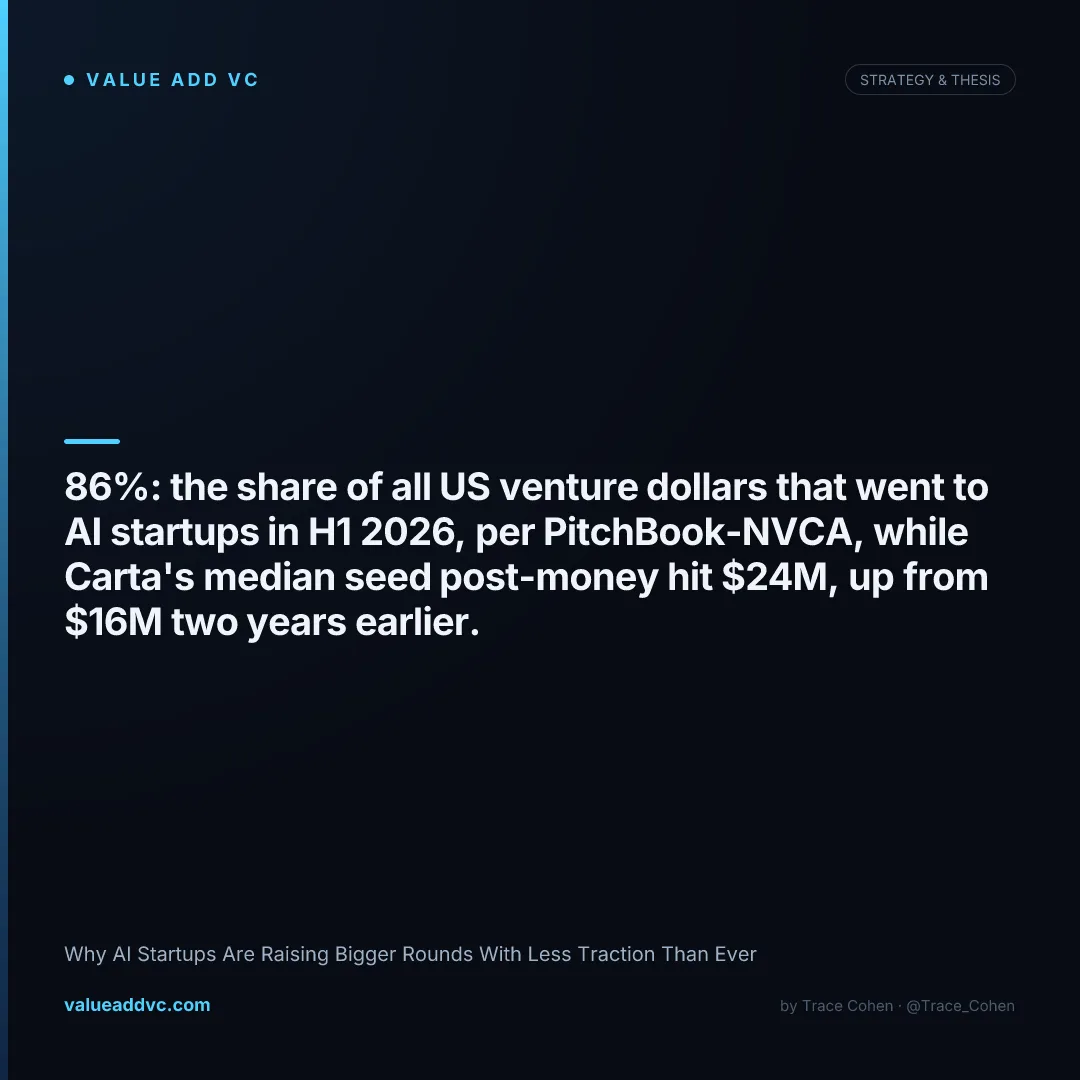
I think AI startups are raising bigger rounds with less traction than ever because the market stopped pricing rounds off revenue and started pricing them off scarcity — scarcity of provable AI-native teams, scarcity of deal access as three or four checks dominate every quarter, and scarcity of time to diligence anything before someone else signs the term sheet. AI companies took 86% of every US venture dollar in H1 2026, and the median seed round has ballooned right alongside deals that closed with no product and no revenue at all.
Why AI startups are raising bigger rounds with less traction
AI startups captured 86% of all US venture dollars in the first half of 2026 — $355.9B of the $412.7B total, according to the PitchBook-NVCA Venture Monitor. Rounds of $100M or more accounted for 87.5% of everything deployed in that stretch. Meanwhile the median seed post-money valuation across all sectors hit a record $24M in Q1 2026, according to Carta's State of Private Markets, up from $18M a year earlier and $16M two years before that — a 50% jump in two years, well before most of that seed cohort has any revenue to show.
The gap shows up cleanly by sector, too. Carta's seed data puts the median AI round at roughly $4.6M versus about $3.2M for the broader market — companies raising more capital earlier, on less operating history, purely because "AI" is in the deck.
Source: PitchBook-NVCA Venture Monitor via SiliconANGLE (July 2026); Carta, State of Private Markets Q1 2026; Fortune, citing PitchBook (August 2026).
The extreme end: rounds that outran revenue entirely
The clearest evidence isn't the median, it's the outliers investors were willing to fund. Mira Murati's Thinking Machines Lab closed a $2B seed round at a $12B valuation in July 2025, led by a16z with Nvidia, Accel, and Jane Street joining, before the company had disclosed a product or a dollar of revenue. Ilya Sutskever's Safe Superintelligence was reportedly valued at $32B on a $2B round in April 2025 — a company that has stated it has no near-term plan to ship a product or generate revenue at all.
Cognition, the maker of the Devin coding agent, is the more instructive case because it did have revenue — just not enough to explain the price at the moment it was set. Its ARR reportedly grew from about $1M in September 2024 to $73M by June 2025, and weeks later Cognition closed $400M at a $10.2B valuation, roughly 140 times that trailing ARR. The growth was real. The multiple investors paid for it, at that moment, was not something a 2019 SaaS diligence memo would have cleared.
What I think is actually driving this
I don't think this is mostly about AI companies being better businesses than the last cycle's darlings. It's about three separate scarcities colliding. First, FOMO on a race investors believe is winner-take-most: if you think there will be two or three durable frontier labs and a handful of application-layer winners, the "correct" move is to overpay for a shot at being in the round, not to wait for proof. Second, diligence timelines have compressed because competition for the same term sheet is fierce — when three funds are trying to close in a week, nobody is running the multi-month reference-check process a Series B used to get. Third, there's a genuine scarcity of "AI-native" founding teams with real research or product credibility, which pushes price up on team and pedigree rather than on the metrics that used to anchor a term sheet.
This likely means the benchmark itself has changed: investors are increasingly underwriting to model evals, technical team pedigree, and platform narrative instead of ARR, because ARR at the earliest stage of a frontier bet has always been a weak signal of eventual outcome. The problem is that logic, built for two or three genuine frontier labs, is now being applied to application-layer AI startups that are not frontier labs and do have a real revenue bar to clear.
Where I could be wrong
The strongest counterargument is that pre-revenue mega-rounds for exceptional teams aren't new, and treating them as evidence of a broken market conflates two different asset classes. Biotech has funded pre-revenue, pre-product companies against a team and a scientific thesis for decades, and nobody calls that irrational — it's a recognized model for funding binary, capital-intensive research bets. Thinking Machines Lab and Safe Superintelligence look a lot more like that model — a small number of extremely well-credentialed researchers pursuing a research bet — than like a typical seed-stage SaaS company. If you accept that framing, the "less traction" framing is simply the wrong yardstick for a tiny number of frontier-research bets that were never going to be judged on near-term revenue to begin with.
Cognition itself is the cleanest evidence the market does eventually correct toward traction. By September 2026, its ARR had grown to $900M and its valuation to $48B in a new round led by Andreessen Horowitz, Accel, and Founders Fund, TechCrunch reported — about a 53x revenue multiple, a fraction of what it was paying for at signing a year earlier. Revenue caught up to the price instead of the price staying detached from revenue forever. Framing every large round as "less traction" risks lumping a company that ultimately grew into its valuation in with the handful of true no-revenue mega-rounds that haven't had the chance to yet.
And most of the market isn't Thinking Machines Lab or Safe Superintelligence. Carta's own data shows the typical AI seed round is $4.6M, not $2B, and most seed investors are still asking for real early usage or revenue before writing a check. The headline-grabbing, no-revenue mega-rounds are real, well-documented, and directionally significant — but they're a small number of deals concentrated among a handful of firms with unusually deep pockets, not the median outcome for an AI startup raising in 2026.
Bottom line: AI startups are raising bigger rounds with less traction than ever at the extremes — a $2B seed with no product, a $32B valuation with no revenue plan — and the median has moved too, with seed post-money valuations up 50% in two years. I think that's driven by FOMO on a perceived winner-take-most race, compressed diligence under competitive pressure, and real scarcity of credible AI-native teams, not by AI startups suddenly building better traction than everyone else. The honest caveat is that a handful of genuine frontier-research bets are getting lumped in with a broader trend they don't really represent, and most AI startups raising seed and Series A rounds this year still have to show real usage to get funded at all.
Latest from the Pulse
Get VC data most people never see
— 100% free
Weekly benchmarks, valuations, and fund data. Join 5,000+ investors. No spam.