

Cognition raised more than $2 billion at a $48 billion valuation in September 2026 — nearly double its $26 billion mark from just four months earlier, backed by annualized revenue that grew from $492 million to $900 million over the same span.
TechCrunch reported on September 8, 2026 that Cognition, the AI coding startup behind the Devin agent, closed a Series E led by new investors Andreessen Horowitz and Accel, with existing investors Founders Fund, General Catalyst and Avenir participating. The round comes just four months after Cognition's previous raise, American Bazaar reported separately, nearly doubling its valuation in that window. At $2 billion, it ranked among the 10 biggest US startup funding rounds Value Add VC tracked for the month.
Cognition Valuation 2026: How the AI Coding Startup Hit $48 Billion
Cognition's $48 billion valuation is the result of a Series E that closed in September 2026, four months after a prior round valued the company at $26 billion. What's driving the re-rating is disclosed revenue growth rather than narrative alone: Cognition's annualized revenue run rate rose from $492 million in May 2026 to $900 million by September, and The Information projects the company could reach $4 billion to $5 billion in ARR by the end of 2026.
Source: TechCrunch, American Bazaar, September 8-9, 2026.
Cognition's Funding History: From $10.2B to $48B in One Year
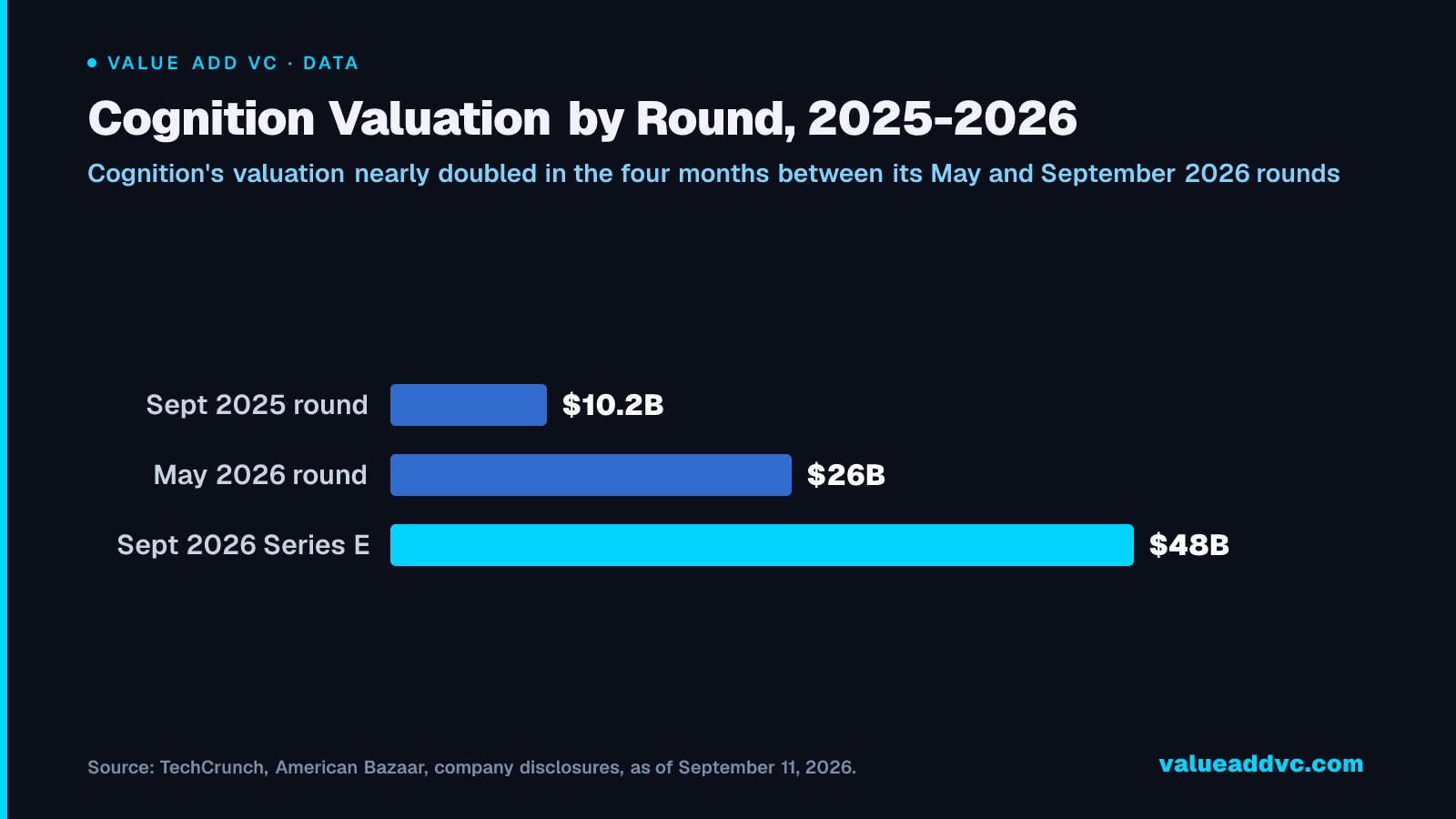
Cognition's valuation has climbed in three steps over roughly twelve months: a $400 million round in September 2025 at a $10.2 billion valuation, a round of more than $1 billion in May 2026 at roughly $26 billion, and the reported $2 billion-plus Series E in September 2026 at $48 billion. That's a 4.7x increase in a year, with the steepest single jump — 85% — coming in the most recent four-month stretch alone.
Cognition Valuation by Round, 2025-2026
Cognition's valuation nearly doubled in the four months between its May and September 2026 rounds
TechCrunch, American Bazaar, company disclosures, as of September 11, 2026.
Data
| Item | Value |
|---|---|
| Sept 2025 round | $10.2B |
| May 2026 round | $26B |
| Sept 2026 Series E | $48B |
What Cognition Actually Sells: Devin and Windsurf
Cognition, founded in San Francisco in 2023 by CEO Scott Wu, makes Devin, an AI coding agent marketed as capable of autonomously handling software engineering tasks — writing, testing and debugging code across a project — rather than just suggesting completions the way a copilot-style tool does. The company also owns Windsurf, an AI-native code editor. Its enterprise customer list includes Mercedes-Benz Group and GE Aerospace, giving Cognition a foothold in industrial engineering workflows that more developer-focused rivals haven't built out to the same degree. Acceptance of autonomous, AI-written code is uneven even in the open-source world Cognition's own tools write into — Linux creator Linus Torvalds told critics of AI-assisted kernel contributions to "fork it, or just walk away" in July 2026, while other major open-source projects moved to ban AI-generated code outright. For comparisons with other AI company valuations, see our AI valuations dashboard.
| Metric | Figure |
|---|---|
| Founded | 2023, San Francisco |
| CEO | Scott Wu |
| Flagship product | Devin (AI coding agent) |
| IDE product | Windsurf |
| Enterprise customers | Mercedes-Benz Group, GE Aerospace |
| ARR, Sept 2026 | $900M |
| Implied revenue multiple | ~53x run-rate ARR |
| Total disclosed funding since Sept 2025 | $3.4B+ |
Sources: TechCrunch, Cognition company disclosures, as of September 2026.
The SpaceX Acquisition Approach Cognition Turned Down
A month before the Series E closed, Bloomberg reported on August 19, 2026 that SpaceX had approached Cognition about a potential acquisition — its second attempted takeover of an AI coding startup in under a week, coming just five days after SpaceX completed its $60 billion all-stock acquisition of Cursor-maker Anysphere. Cognition CEO Scott Wu publicly disputed the report, stating the company was "not for sale" and that the two companies had not been in talks, according to TechCrunch's write-up of his response.
A specific, on-the-record "not for sale" denial from a founder — mid-fundraise at a valuation target well above where the approach reportedly happened — is a stronger public rebuttal than most acquisition-rumor stories draw. Whatever the precise nature of the outreach, Cognition chose to raise a fresh, richly priced round instead of engaging with an acquirer that had just spent $60 billion absorbing its most direct competitor.
How Cognition's Round Compares to Clay and Harvey
Cognition's raise landed in the same week as two other AI-application megarounds — Clay's $115 million Series D at a $7.1 billion valuation, and Harvey's $550 million round at a $15.5 billion mark — continuing a pattern of AI-native software companies re-rating on customer and usage momentum multiple times within a single year. Infrastructure plays like Temporal also raised mega-rounds in the same period, suggesting the repricing touched every layer of the AI stack.
September 2026 AI Megarounds: Cognition vs Clay vs Harvey
TechCrunch, Axios, American Bazaar, September 2026
Data
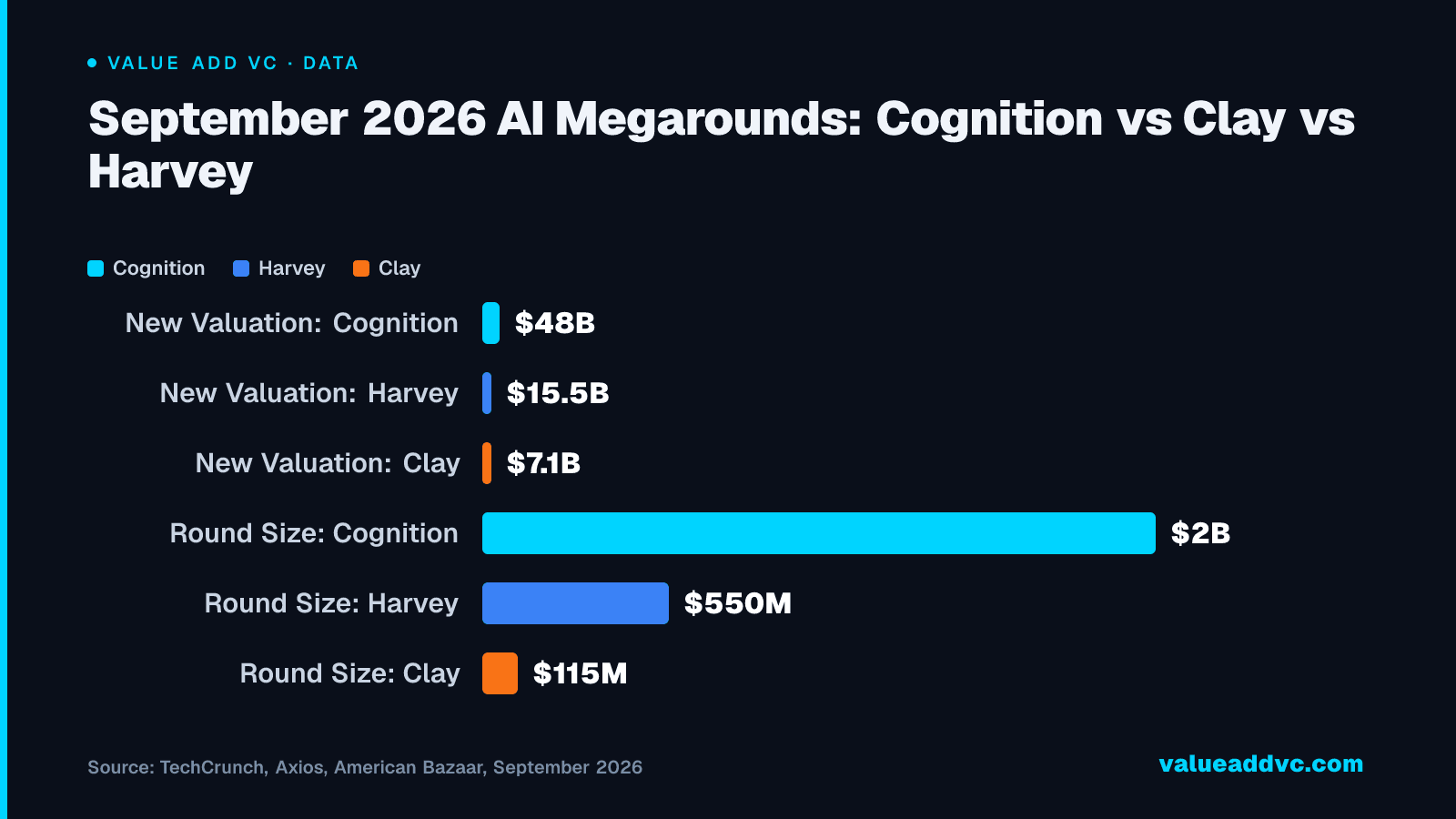
Cognition's round is more than 3x the size of Harvey's and 17x Clay's — the biggest of the three AI-application megarounds that closed within days of each other.
What the Headline Misses
A $900 million ARR figure at a $48 billion valuation implies roughly a 53x multiple on run-rate revenue — rich even by 2026's AI-software standards. This repricing pattern — where AI startups are raising bigger rounds with less historical proof than previous cycles — reflects how investor capital has concentrated in the sector. None of Cognition's disclosed numbers come with gross-margin or net-retention data, so a headline ARR figure this large doesn't by itself confirm the business converts usage into durable, profitable revenue at the pace its valuation now assumes. Coding-agent compute costs are real, and Cognition hasn't disclosed what's left of that $900 million after paying for the GPU time that generates it. The AI infrastructure layer those compute dollars flow toward is itself re-rating fast — see Modal Labs' $15.75 billion valuation, priced at a comparatively modest 15.75x ARR next to Cognition's 53x. This likely means investors are pricing continued revenue-multiple compression as guidance is hit, not current profitability — a bet that only pays off if the $4-5 billion ARR target for year-end actually lands.
The bet also assumes AI coding doesn't consolidate into a winner-take-all market. Replit, a smaller competitor, was separately reported in July 2026 to be raising at a far more conservative valuation on a comparable revenue base — a sign the category can support more than one large outcome, but not necessarily two priced as richly as Cognition's. Factory, a direct rival pitching the same autonomous-agent category at a far smaller $5 billion mark, is also backed by Khosla Ventures — the same firm that invests in Cognition, a cross-bet that spilled into a public dispute in October 2026. Cognition's $2 billion check was also the largest of the 14 developer tools funding rounds Value Add VC tracked in Q3 2026, more than four times the size of the next-largest round in the group.
The Bottom Line
Cognition's $48 billion valuation is backed by real, disclosed revenue growth — ARR nearly doubled to $900 million in four months — which is a meaningfully different story than most AI-application companies re-rating this year on flat or undisclosed revenue. That doesn't make the roughly 53x multiple safe: it leaves little room for a second-place finish if AI coding consolidates the way search or social networking once did, and none of the disclosed figures answer what the business actually keeps after compute costs.
See where Cognition ranks among the highest-revenue private companies tracked in 2026.
For more on how AI-application companies are re-rating in 2026, see How Does Cognition Make Money. Track private AI valuations on the AI Valuations dashboard at Value Add VC.
Latest from the Pulse
Get VC data most people never see
— free to subscribe
Trace's notes on venture, AI and startups, a few times a week. Join 5,000+ subscribers. No spam.
No spam, unsubscribe anytime. Sent via Substack · Privacy · or subscribe on Substack ↗