

Clay's Series D has closed: $115 million raised at a $7.1 billion post-money valuation on September 9, 2026 — up 129% from the $3.1 billion Series C it closed thirteen months earlier.
Wellington Management led the round, according to Clay's own September 9, 2026 funding announcement, confirming the $7 billion pre-money figure Axios first reported on August 31, 2026. Clay is the New York-based AI platform sales and marketing teams use to pull prospect data from dozens of sources and trigger automated outreach — the same budget line as tools like Apollo for B2B lead generation. Unlike the two private step-ups that preceded it (an August 2025 priced round and a January 2026 employee tender offer), BetaKit reported this one is a traditional primary Series D with new capital raised, not just a repricing of existing shares.
Clay Valuation 2026: The $7.1 Billion Series D
Clay's Series D closed September 9, 2026 at a $7.1 billion post-money valuation, up from the $5 billion mark set in a January 2026 employee tender offer led by DST Global, and more than double the $3.1 billion valuation from Clay's $100 million Series C in August 2025, led by CapitalG. Three data points in just over thirteen months describe an unusually steep re-rating even by 2026 AI-software standards — roughly 129% valuation growth in a year, now with a disclosed capital-raised figure ($115 million) attached to the newest mark, even if a matching current revenue figure still is not.
Source: Business Wire (Clay), Axios, September 2026.
The Valuation Trajectory: $3.1B to $7.1B in Thirteen Months
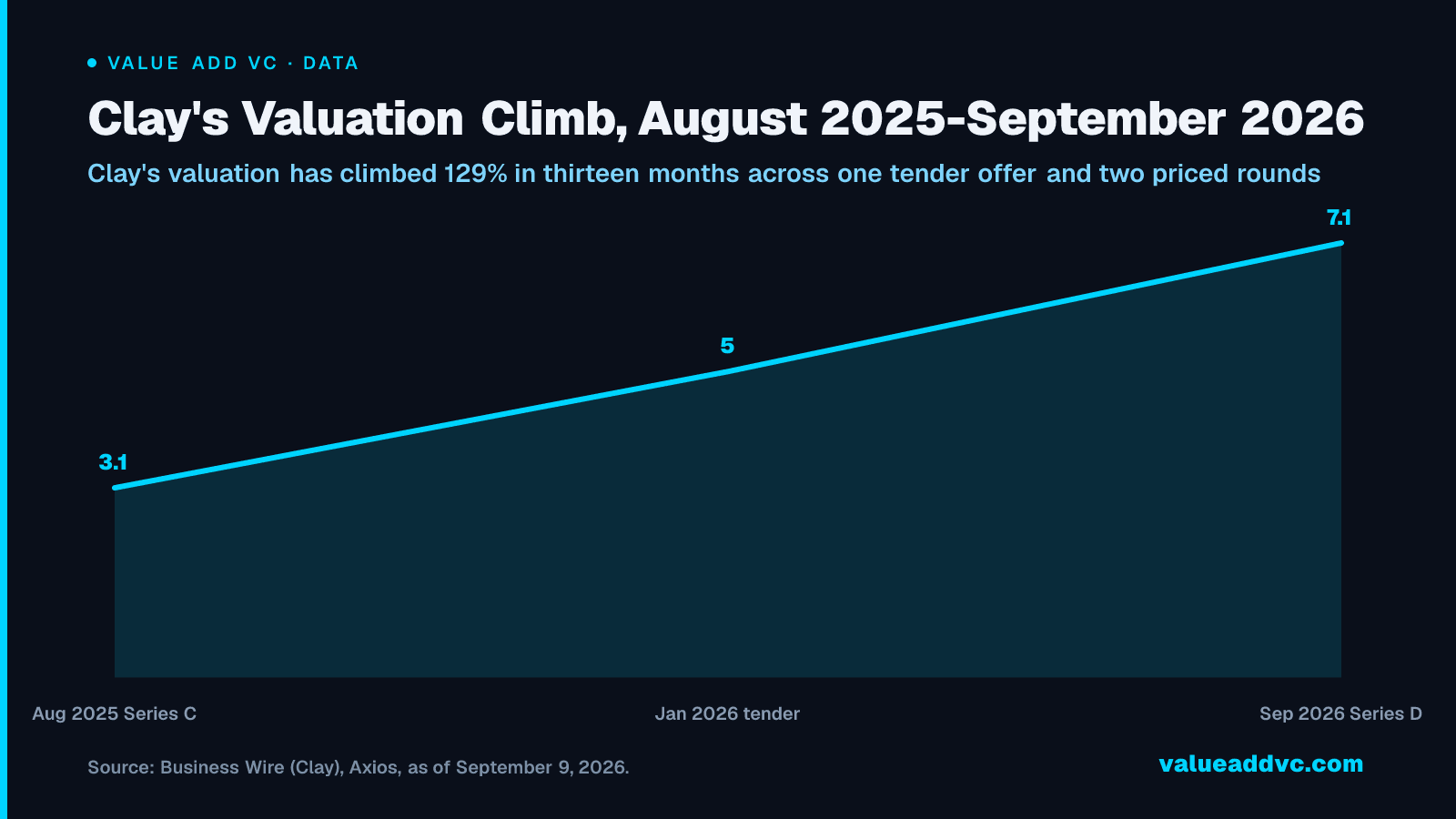
Clay closed a $100 million Series C in August 2025 at a $3.1 billion valuation led by CapitalG. Its private mark roughly doubled to $5 billion in a January 2026 employee tender offer led by DST Global, per a BusinessWire release from the company. The Wellington-led Series D pushed that number to $7.1 billion post-money eight months later, the first step-up in this sequence to come with a specific new-capital figure ($115 million) rather than a repriced tender.
Clay's Valuation Climb, August 2025-September 2026
Clay's valuation has climbed 129% in thirteen months across one tender offer and two priced rounds
Business Wire (Clay), Axios, as of September 9, 2026.
Data
| Item | Valuation ($B) |
|---|---|
| Aug 2025 Series C | 3.1 |
| Jan 2026 tender | 5 |
| Sep 2026 Series D | 7.1 |
What Clay Actually Sells
Clay's core product is a data-enrichment and workflow layer for go-to-market teams: it aggregates contact and company data from dozens of external sources, then lets sales and marketing teams build AI-driven sequences that personalize outreach at a scale manual research can't match. That puts it in direct competition with established data providers like ZoomInfo and Apollo.io, as well as a newer wave of AI-native sales-automation startups including Icon and 11x. Clay's differentiation, according to customers cited in prior coverage, is breadth of data-source integration rather than any single proprietary dataset — a model that scales well with revenue but leaves it more exposed to any single data vendor changing its own API terms or pricing. Notably, Clay still isn't a CRM — see our full Attio vs Clay breakdown for what that means for teams deciding what to adopt first.
| Round | Date | Valuation | Lead |
|---|---|---|---|
| Series C ($100M) | Aug 2025 | $3.1B | CapitalG |
| Employee tender offer | Jan 2026 | $5B | DST Global |
| Series D ($115M) | Sep 9, 2026 | $7.1B post-money | Wellington Management |
Sources: Business Wire (Clay), Axios, as of September 9, 2026.
Who Backed the Series D, and Who Clay Now Counts as Customers
Alongside lead investor Wellington Management, Clay named ten other participants in the round: Sequoia, Andreessen Horowitz (through its Perennial growth strategy), StepStone Group, Meritech Capital, DST Global, CapitalG, BoxGroup, Boldstart Ventures, Bloomberg Beta, and Evolution. Several — CapitalG and DST Global among them — were already Clay shareholders from the Series C and the January tender, meaning existing backers doubled down alongside Wellington rather than being fully replaced by new late-stage money.
On the customer side, Clay said it now serves more than 17,000 customers, up from roughly 10,000 a year earlier, and that its base includes 80% of the Forbes AI 50 along with named accounts such as Anthropic, Google, OpenAI, Stripe, ElevenLabs, Workday, and Siemens. Alongside the raise, Clay also launched a $1 million scholarship fund aimed at training "GTME" — go-to-market engineer — professionals, a role the company has spent much of 2025-2026 positioning as a new job category built around its platform.
"We believe the next wave of companies will be built by teams that think about growth in a systematic way. We want to make this career accessible to more people."
— Kareem Amin, Clay co-founder and CEO, in the company's September 9, 2026 Series D announcement.
Why Wellington Is Writing Late-Stage AI Checks
Wellington Management, a public-markets-oriented asset manager increasingly active in late-stage private rounds in 2026, led a similarly structured deal for enterprise search company Glean earlier in the year, suggesting the firm is running a consistent playbook of writing large checks into AI-native software companies with fast-growing usage rather than waiting for an IPO to get exposure. That's a broader 2026 pattern: Cognition's $48 billion valuation and Harvey's $15.5 billion mark both closed within weeks of Clay's own round, part of a wave of AI-application companies re-rating on customer-logo and usage momentum multiple times within a single year.
What the Headline Misses
The Series D closing with a disclosed $115 million raised is a real step up in transparency from the two private step-ups that preceded it — but it did not come with a fresh, dated revenue number. Clay's own materials repeat a $50 million ARR milestone against an "April 2026" target that had already passed by the time the round closed in September, which reads as recycled boilerplate rather than a current figure. Sacra, a private-company research firm, has separately estimated Clay's ARR near $150 million as of May 2026 — but that is Sacra's model, not a number Clay has confirmed. This likely means outside investors are still pricing Clay off usage and customer-logo momentum rather than an audited revenue multiple, a pattern that shows up across the broader SaaS market on our SaaS valuations dashboard. Sales-automation tools also face a structural risk that cuts the other way from the valuation trend: as foundation-model providers make it cheaper to build basic outreach personalization directly, the moat for a mid-layer aggregation tool like Clay depends on maintaining data-integration breadth that a well-funded competitor, or a customer's own in-house team, could plausibly replicate over time.
The Bottom Line
Clay's valuation has gone from $3.1 billion to $7.1 billion in thirteen months across two priced rounds and one tender-style step-up, and the September Series D finally disclosed how much new capital changed hands — $115 million — even though a current, dated revenue figure still has not followed it. That gap between disclosed capital and undisclosed revenue is the one to watch heading into whatever Clay's next fundraise or public update turns out to be.
For more on 2026's AI-application funding wave, see Cognition's Valuation. Track private company valuations on the VC Fundraises 2026 tracker at Value Add VC.
Latest from the Pulse
Get VC data most people never see
— free to subscribe
Trace's notes on venture, AI and startups, a few times a week. Join 5,000+ subscribers. No spam.
No spam, unsubscribe anytime. Sent via Substack · Privacy · or subscribe on Substack ↗