
$32 billion is what Safe Superintelligence is worth on paper as of September 25, 2026 — the same number investors set in April 2025, now backed by $8 billion of cash raised, zero revenue, zero shipped products, and roughly 50 employees, with the model an investor teased for August still nowhere in sight.
Two things changed for Ilya Sutskever's lab since the spring, and one thing that was supposed to change didn't. Nvidia wired $5 billion on July 27, 2026 alongside a long-term compute agreement, taking SSI's lifetime funding from $3 billion to roughly $8 billion in a single transaction. In early August, a public-markets investor with no obvious reason to leak said on a podcast that SSI intended to release its first model that month. It didn't happen: as of this update, seven weeks past that window, SSI has issued no model, no paper, and no statement about either the rumor or a revised date. The enormous new check landed on schedule; the rumored first shipment didn't, which is itself the most concrete new data point on the $32 billion mark since April 2025.
SSI Valuation in 2026: What the $32 Billion Mark Actually Rests On
SSI's $32 billion valuation was set by a $2 billion round in April 2025 led by Greenoaks Capital, and it is still the reference price 17 months later, with no new priced round reported as of September 25, 2026. Nvidia's $5 billion July 2026 check was reported at or near that same mark rather than as an up-round. Nothing underneath it has been priced by revenue, users, or a shipped model.
What holds the number up is a syndicate, not a P&L. Sequoia Capital, Andreessen Horowitz, DST Global, and SV Angel funded the September 2024 seed; Greenoaks led in April 2025 with Alphabet and Nvidia joining as strategic investors, per CTech. Sutskever incorporated the company on June 19, 2024 with Daniel Gross and Daniel Levy after leaving OpenAI, where he had been co-founder and chief scientist. Gross left for Meta's superintelligence group in July 2025, leaving Sutskever as CEO and Levy as president across offices in Palo Alto, California and Tel Aviv, Israel.
The Funding Timeline: $1B Seed to $8B Raised in 26 Months
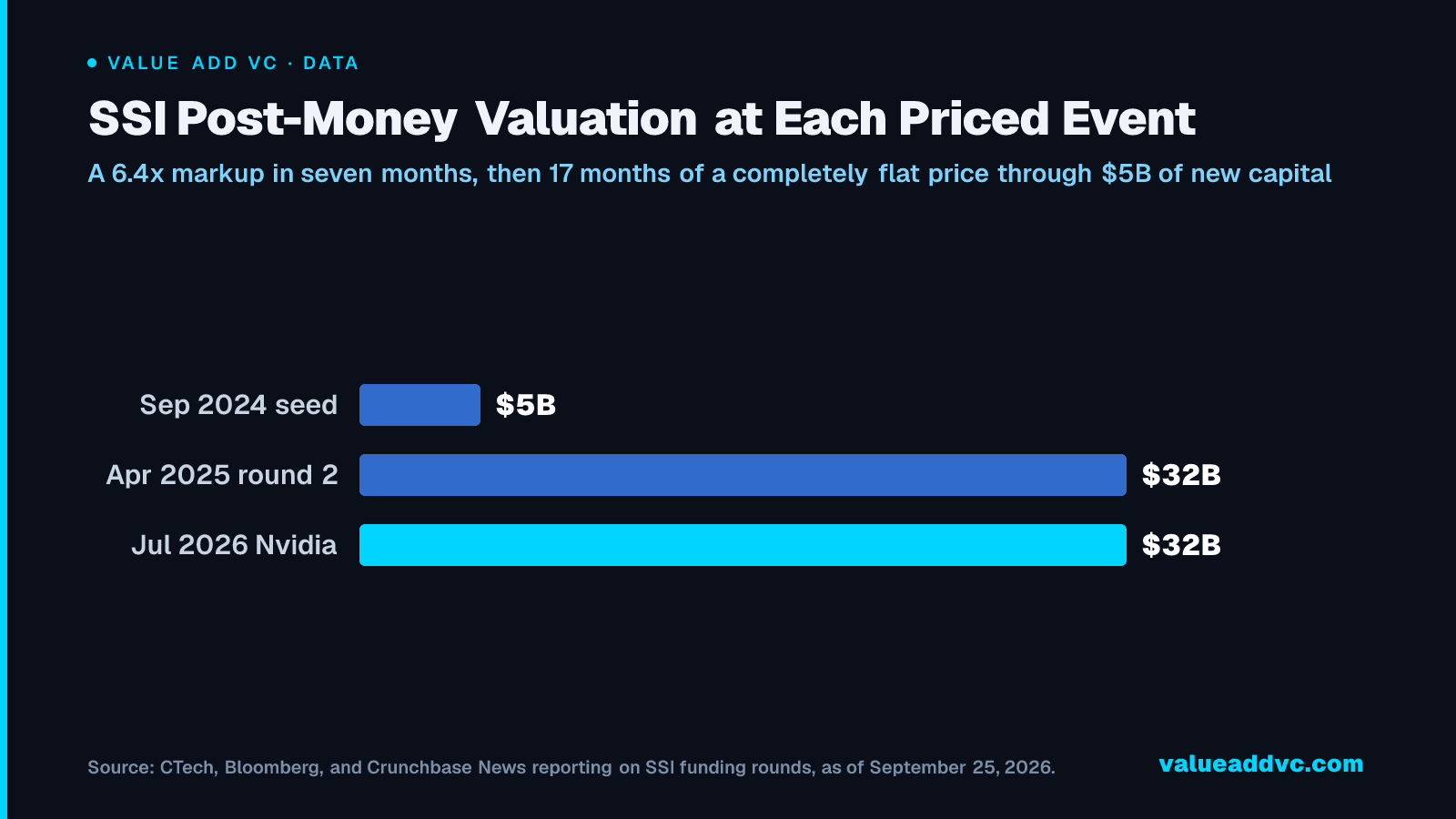
Three rounds, 26 months, and a 6.4x markup that happened entirely in the first seven months. The September 2024 seed was already unusual — $1 billion into a company with no disclosed roadmap — and the April 2025 round multiplied that price by more than six before anyone outside the building had seen an output. Then the price stopped moving, and the money kept arriving anyway.
| Event | Date | Amount | Valuation | Lead / key investors |
|---|---|---|---|---|
| Incorporated | Jun 19, 2024 | — | — | Sutskever, Gross, Levy |
| Seed | Sep 2024 | $1B | $5B | Sequoia, a16z, DST Global, SV Angel |
| Round 2 | Apr 2025 | $2B | $32B | Greenoaks; Alphabet, Nvidia join |
| Google Cloud TPU deal | Apr 2025 | Not disclosed | — | Google Cloud (compute supply) |
| Nvidia strategic round | Jul 27, 2026 | $5B | ~$32B | Nvidia (+ Vera Rubin supply deal) |
| Secondary indication | Sep 8, 2026 | Broker-estimated | $93.64 / share | Hiive (broker-estimated) |
| Cumulative to date | Sep 25, 2026 | ~$8B | $32B | 7+ institutional backers |
Sources: CTech on the April 2025 round; Bloomberg and Crunchbase News on the $5 billion Nvidia round; TechCrunch on the Google Cloud agreement; Hiive for the secondary indication as of September 8, 2026. Secondary quotes are broker indications on an unaudited private company, not transacted prices.
SSI Post-Money Valuation at Each Priced Event
A 6.4x markup in seven months, then 17 months of a completely flat price through $5B of new capital
CTech, Bloomberg, and Crunchbase News reporting on SSI funding rounds, as of September 25, 2026.
Data
| Item | Value |
|---|---|
| Sep 2024 seed | $5B |
| Apr 2025 round 2 | $32B |
| Jul 2026 Nvidia | $32B |
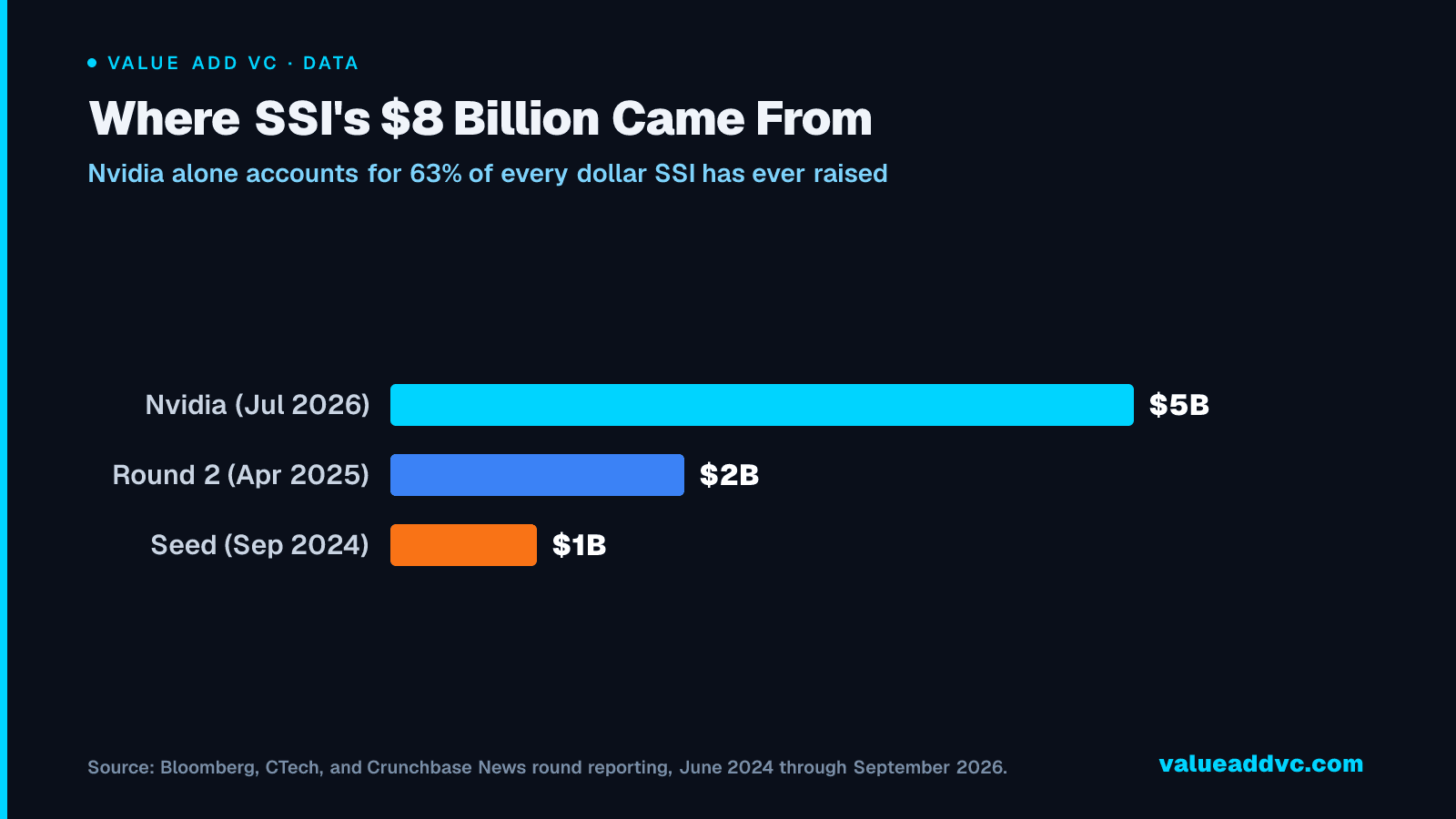
Where SSI's $8 Billion Came From
Nvidia alone accounts for 63% of every dollar SSI has ever raised
Bloomberg, CTech, and Crunchbase News round reporting, June 2024 through September 2026.
Data
| Item | Value |
|---|---|
| Nvidia (Jul 2026) | $5B |
| Round 2 (Apr 2025) | $2B |
| Seed (Sep 2024) | $1B |
What Nvidia Actually Bought for $5 Billion
The July 27, 2026 deal was announced as a long-term strategic partnership, not a straight financing. Nvidia's money came paired with a multi-year supply commitment giving SSI access to the Vera Rubin platform — an arrangement SSI said would expand its compute by an order of magnitude, according to SiliconANGLE. The practical effect was a supplier switch: SSI had been training on Google Cloud TPUs under the April 2025 arrangement, and the Nvidia agreement pulls that workload onto Nvidia silicon.
Sutskever framed it as a readiness signal rather than a rescue, and it is the closest thing to a progress report SSI has issued:
“We have research that is worthy of scaling up, and having access to a big NVIDIA computer will let us do so.”
— Ilya Sutskever, in the Nvidia–SSI partnership announcement, July 27, 2026
The check is large in absolute terms but small against Nvidia's 2026 pace. The Santa Clara chipmaker committed more than $40 billion of equity across AI and infrastructure companies in the first five months of the year alone, CNBC reported on May 9, 2026, including a roughly $30 billion stake in OpenAI. Read against that, the SSI investment is a small option premium on a research approach Nvidia otherwise has no window into — and one that keeps a rival's TPUs out of a marquee lab. That reading is analysis, not something Nvidia has stated.
The Cap Table Math Nobody Has Disclosed
“At or near the $32 billion mark” is doing a lot of work in the coverage of Nvidia's round, because two very different deals fit that description. If $32 billion was the pre-money, the post-money is $37 billion and Nvidia bought about 13.5% of the company. If $32 billion was the post-money — the way the April 2025 figure was quoted — Nvidia bought roughly 15.6%, and every prior holder was diluted by more than twice what the April 2025 round cost them. No filing has settled which it was, and SSI is a Delaware private company with no obligation to say.
Either version puts a chip vendor on the register of a lab that competes with three other Nvidia portfolio companies for the same researchers. The earlier rounds are cleaner arithmetic: $1 billion at a $5 billion post-money in September 2024 sold about 20% of the company, and $2 billion at $32 billion in April 2025 sold about 6.25%. Compound the three rounds in sequence and outside investors end up somewhere near 37% of the company, which would leave Sutskever, Levy, and early employees with the controlling economic block after three financings. That matters more than the headline price, because it means no investor group can force a sale, a pivot, or a commercial roadmap. It is also an inference drawn from round sizes rather than a disclosed ownership table — SSI has never published one, and option pools and secondary sales would move the figure.
The August Model Release That Didn't Happen
Gavin Baker, chief investment officer at Atreides Management, said on Patrick O'Shaughnessy's Invest Like the Best podcast in early August 2026 that SSI intended to put out its first model during the month. That was always a secondhand claim from an investor, not a company announcement, and it has not held up: SSI issued no statement, named no date, and published no model card, and August ended with no release. As of September 25, 2026 — roughly seven weeks past the window Baker described — nothing from SSI has appeared in any public model catalog, and the company has never confirmed or denied the rumor itself.
Whenever it does land, it would be SSI's first externally checkable artifact of any kind. The lab has published no research papers, released no weights, run no demos, and maintains a website that is essentially a name and a hiring link — a record MoneyWise summarized as never having published a word of research. The bet investors made was on a thesis Sutskever laid out on Dwarkesh Patel's podcast on November 25, 2025: that the 2020–2025 “age of scaling” is finished and progress now depends on new research ideas rather than larger clusters. A first release, whenever it comes, is still the first chance anyone outside the cap table gets to grade that thesis.
A missed rumor is not the same as a broken promise — SSI never confirmed Baker's timeline in the first place, so there is no company statement to hold it to. But it does close off one reading that was available in August: that taking Nvidia's compute in late July and shipping within weeks would mean the model was already trained before the Vera Rubin capacity arrived. Seven weeks of silence since makes that sequencing look less likely, not more.
How SSI's Mark Compares to Other Pre-Revenue AI Labs
Two labs of similar vintage are the fairest comparison, and SSI is the outlier in both directions — highest price, least evidence. Mira Murati's Thinking Machines Lab raised $2 billion in July 2025 at a $12 billion post-money and has not printed a new primary round since; Forge quoted its secondary shares at $318.92 on August 17, 2026, marking the company near $13.5 billion. Fei-Fei Li's World Labs closed $1 billion on February 18, 2026 — $200 million of it from Autodesk, with AMD, Fidelity, Emerson Collective, and Nvidia alongside — after Bloomberg reported talks near $5 billion in January. Both have shipped: Thinking Machines put out its Tinker fine-tuning API in October 2025, and World Labs ships its Marble spatial product.
Pre-Revenue AI Research Labs: Valuation and Capital Raised
Forge, TechCrunch, Bloomberg, and CTech reporting on SSI, Thinking Machines Lab, and World Labs, as of August 20, 2026.
Data
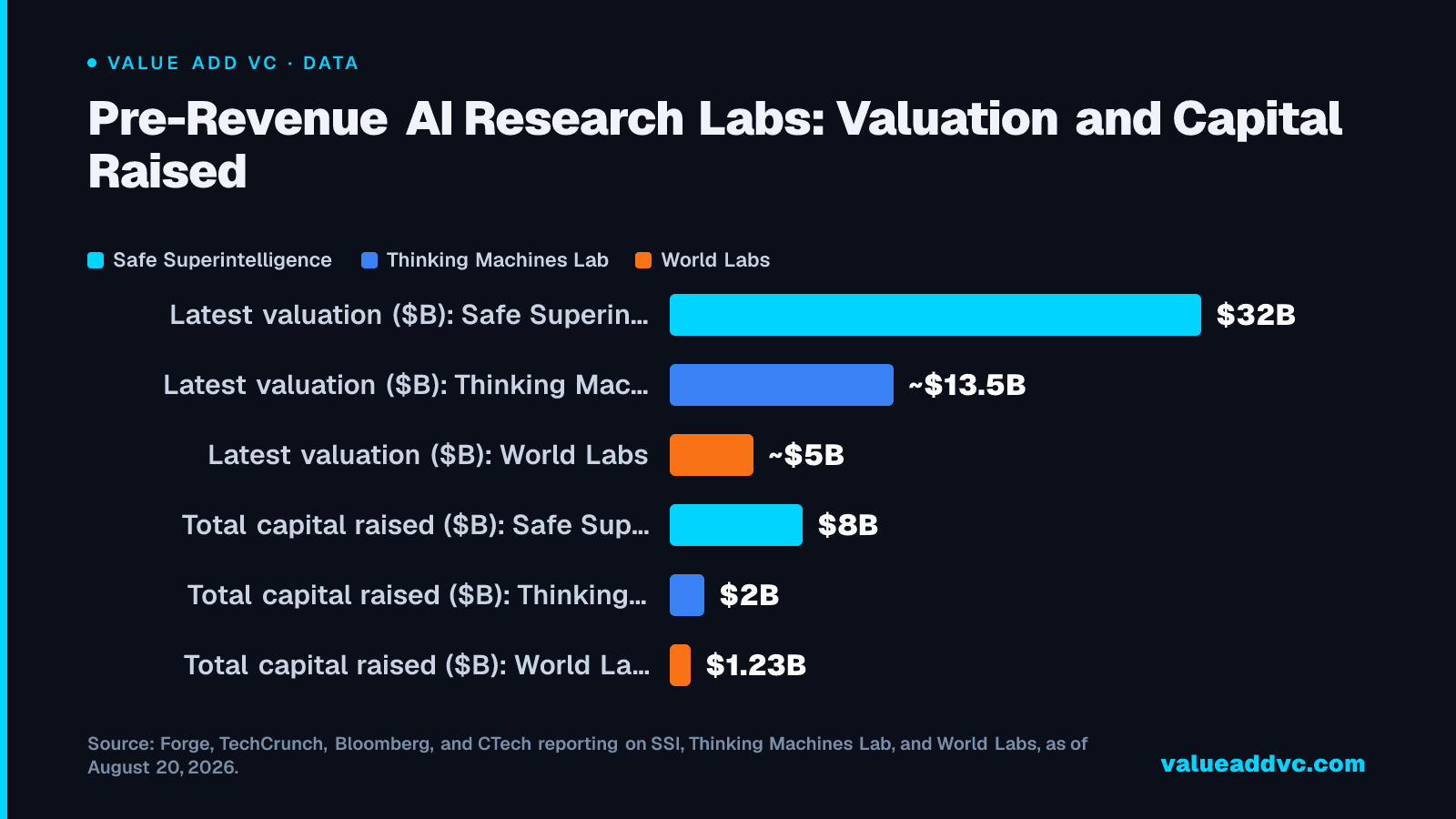
SSI carries 2.4x the valuation of Thinking Machines Lab and roughly six times that of World Labs, and is the only one of the three with no shipped product. Thinking Machines' figure is a secondary-market mark, not a priced round.
What the headline misses
“$32 billion, no revenue” is the easy shot, and it understates how deliberate the structure is. SSI never promised interim products, so measuring it on shipped features is measuring it against a plan it explicitly rejected. Nor is there a near-term burn problem: a two-digit headcount against $8 billion of cash implies years of runway on any plausible assumption about frontier compute costs, and the Nvidia agreement converts a large slice of that spend into contracted capacity rather than spot GPU rental.
The genuine risk is subtler than “they haven't shipped.” It is that a flat price for 17 months, now including a missed rumored release window, is itself information. Its two closest peers have both been remarked since their last priced rounds, upward on secondary demand in one case and through a fresh financing in the other; SSI has been remarked by nothing, because there is nothing to mark against. Anthropic's annualized run rate passed $65 billion in late July 2026, with second-quarter revenue above $11.5 billion against $787 million a year earlier — numbers an LP can argue about. SSI offers no such surface. If the first model lands and is merely competitive rather than discontinuous, the $32 billion mark loses the one thing that has been protecting it, which is the absence of evidence either way.
What Would Reprice SSI From Here
Three events would move the number. The first is the release itself and, more importantly, whether SSI publishes methodology alongside it — a model with no accompanying account of how its safety properties were achieved leaves the original thesis exactly as unfalsifiable as it was before. The second is a priced round: any new equity above $32 billion would confirm that the flat mark was patience rather than doubt, and anything below it would be the first public admission that the April 2025 price overshot. The third is a change in the operating model — a hiring surge, a commercial team, or a published product roadmap would each signal that the “one goal, one product” approach needed adjusting under competitive pressure.
Watch the secondary market for the earliest signal. Broker indications on private AI names tend to move before primary rounds do, and SSI now has enough shareholders across three financings that transfer requests should start producing a deeper order book than the roughly flat one Hiive was still showing as of September 8, 2026.
The Bottom Line
As of September 25, 2026, SSI sits on $8 billion in the bank, a valuation that has not moved since April 2025, and a rumored first model that missed its own August window without comment from the company. The Nvidia deal solved compute and the funding solved runway; neither solved the underwriting problem, which is that no one outside Palo Alto and Tel Aviv has seen the work. Whether $32 billion turns out to be cheap or absurd is a question a release — not another round, and not another rumor — will finally start to answer.
Track private AI valuations across the market on the AI Valuations dashboard and broader private-market comps on the Unicorn Tracker at Value Add VC.
Latest from the Pulse
Get VC data most people never see
— free to subscribe
Trace's notes on venture, AI and startups, a few times a week. Join 5,000+ subscribers. No spam.
No spam, unsubscribe anytime. Sent via Substack · Privacy · or subscribe on Substack ↗