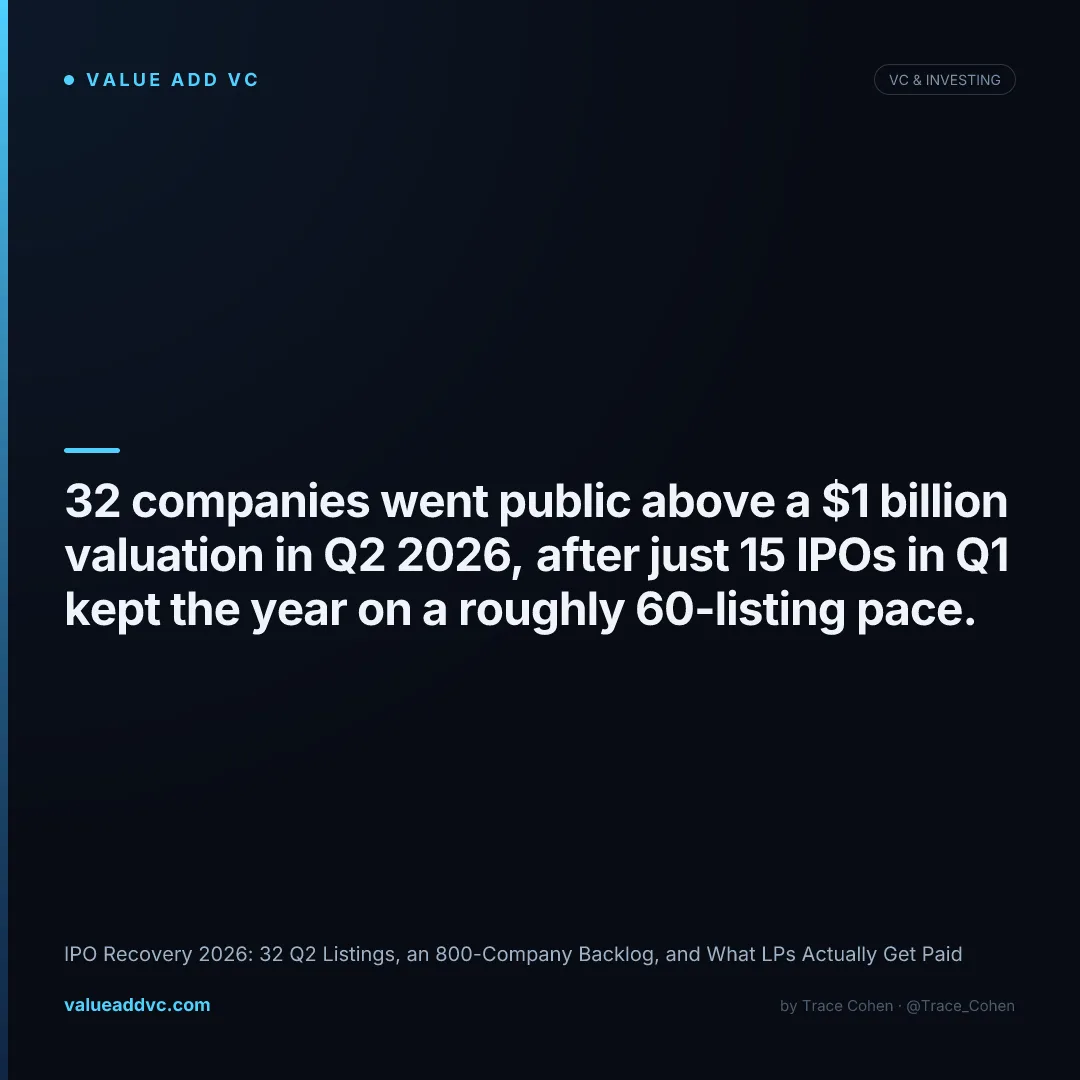
32 companies went public above a $1 billion valuation in Q2 2026, after just 15 IPOs in Q1 kept the year on a roughly 60-listing pace. Zoom out, though, and this recovery still trails 2025's 995 venture-backed M&A exits, and fewer than 20% of 2024-2025 vintage VC funds have reached 1x DPI — so most LPs reading headlines about a hot IPO market still haven't seen a wire hit their account.
Every LP call I've sat in this year has the same subtext: the market looks better, so where's the cash? IPO counts and LP distributions are related but not the same thing, and 2026 is the clearest illustration yet of that gap. The public market window is genuinely reopening — but the roughly 800-company unicorn backlog didn't build up overnight, and it isn't clearing overnight either.
Figures blended from PitchBook/NVCA venture monitor data, Forge Global, Crunchbase News, and Carta's Q1 2026 VC Fund Performance report, as of July 2026.
What Is Driving the 2026 IPO Recovery for LPs?
The 2026 IPO recovery is being driven by a jump from 15 venture-backed IPOs in Q1 to 32 companies listing above a $1 billion valuation in Q2, alongside a record $510 billion in global startup investment in H1 2026 that's pulling more of the roughly 800-company unicorn backlog toward public markets, though most LPs still won't see cash distributions until portfolio companies actually list and lockups expire.
Q1 2026's 15 listings continued a slow-reopening pattern that's persisted since 2022, but the jump to 32 billion-dollar-plus IPOs in Q2 is the clearest single-quarter acceleration of the cycle. Forge Global's tracking of the 2026 pipeline and CB Insights' scouting reports both point to the same driver: a backlog of roughly 800 unicorns that are financially mature enough to go public finally has enough of a receptive window to start clearing, concentrated heavily in AI infrastructure, fintech, and defense-tech names. We track the specific companies and timing on our Tech IPO Calendar, which currently lists more than 30 companies actively expected to go public this year.
M&A Still Dominates the Exit Landscape, Even During an IPO Recovery
The headline IPO numbers obscure a bigger fact: acquisitions, not public listings, remain the dominant exit path for venture-backed companies by a wide margin. PitchBook and NVCA recorded 995 US venture-backed company acquisitions in 2025, compared to just 62 public listings for the entire year — a roughly 16-to-1 ratio. In Q1 2026 specifically, an estimated 68% of all startup exits occurred through acquisition rather than an IPO, meaning the "IPO recovery" narrative describes a genuine but still-small slice of total liquidity events.
That matters for how LPs should read 2026 exit data: a rising IPO count is a real, positive signal for the largest, most visible unicorns in a fund's portfolio, but it says very little about the median portfolio company, which is far more likely to exit — if it exits at all — through an acquisition that rarely gets the same press coverage or the same multiple.
Why the 2026 IPO Recovery Hasn't Reached Most LPs' DPI Yet
DPI — Distributions to Paid-In capital, the actual cash LPs have received back — is the metric that separates a real recovery from a paper one, and it's lagging badly relative to the improving IPO headlines. Carta's Q1 2026 data, drawn from 2,775 VC funds closed between 2017 and Q1 2026 representing roughly $119.3 billion in commitments, shows fewer than 20% of 2024-2025 vintage funds have reached even 1x DPI, the point at which LPs have simply gotten their original capital back, let alone a profit.
The lag by vintage year is stark: 85% of 2017-vintage funds have generated some DPI by 2026, but only 53% of 2019-vintage funds have begun returning any capital at all, and just over half of the 2020 vintage has started, with about 15% of 2020-vintage funds generating their very first distribution as recently as 2025. That six-to-eight-year lag between a fund closing and meaningful DPI is exactly why LPs in 2022-2024 vintage funds are watching the 2026 IPO market so closely — it's the earliest realistic signal of when their own capital might start coming back. We break down these benchmarks in more depth on our VC & PE Performance dashboard.
2026 IPO Recovery vs. Prior Cycles: The Full Numbers
| Metric | 2025 | Q1 2026 | Q2 2026 |
|---|---|---|---|
| VC-backed IPOs (US) | 62 (full year) | 15 | 32 ($1B+ valuation) |
| VC-backed M&A exits (US) | 995 | n/a (68% of exits) | n/a |
| Global startup investment | ~$368B (est. full year) | n/a | $510B (H1 total) |
| Unicorn IPO backlog | ~800+ | ~800 | ~800 (slowly clearing) |
| 2024-25 vintage funds at 1x DPI | n/a (funds too young) | <20% | <20% |
| New VC funds raised (Carta-tracked) | n/a | 86 funds, $3.9B | n/a |
| IPO exit share of total exits | ~6% (62 of ~1,057) | ~32% | higher (32 of quarter's total) |
Figures are 2025-2026 estimates blended from PitchBook/NVCA Venture Monitor data, Stout's Q1 2026 Venture Capital Industry Update, Forge Global, Crunchbase News, and Carta's Q1 2026 VC Fund Performance report. IPO exit share is an approximation based on reported quarterly and annual exit counts.
How the 2026 IPO Recovery Compares to 2021's Boom and the 2022-2023 Freeze
It's worth grounding 2026's numbers against the last full cycle. 2021 saw well over 1,000 venture-backed exits globally with IPOs making up a meaningfully larger share than the roughly 6% they represented in 2025, before the market essentially shut the IPO window for most of 2022 and 2023 — a two-year stretch where many funds saw close to zero new listings from their portfolios. 2024 and 2025 were slow-reopening years, with 2025's 62 total US listings still running well below pre-2022 norms even as private valuations recovered on paper. Q2 2026's jump to 32 billion-dollar-plus listings is the first quarter since the freeze that looks structurally different rather than just marginally better, which is why bankers and LPs alike are treating it as a genuine inflection rather than another false start.
The distinction matters because DPI lags exits by design — a company that IPOs still has lockup periods, and even LPs whose portfolio companies list in 2026 typically won't see distributed shares or cash for two to six months after the offering, sometimes longer if a GP chooses to hold and distribute stock gradually rather than all at once. That mechanical delay is layered on top of the vintage-year lag already described above, which is why even a strong back half of 2026 for IPOs won't meaningfully move 2024-2025 vintage DPI until well into 2027.
What LPs Should Actually Watch Through the Rest of 2026
The single most useful thing an LP can do right now is stop treating "IPO market is recovering" as a proxy for "my distributions are coming." The two are correlated with a multi-quarter lag, not synchronized. If Q2 2026's pace of 32 billion-dollar listings holds or accelerates through Q3 and Q4, expect DPI in the 2020-2022 vintage cohort to start climbing meaningfully in 2027 — but 2024-2025 vintage funds, sitting at under 20% having reached even 1x DPI, are years away from a comparable inflection regardless of how strong the IPO window gets this year.
The practical read for GPs raising right now: LPs have gotten sharper about distinguishing TVPI marks from actual DPI, and a fund's ability to point to real distributions — not just rising valuations on paper — is becoming the deciding factor in re-up decisions. That's a harder bar to clear than it was in 2021, but it's also a healthier one for the asset class long-term.
There's also a portfolio-construction lesson buried in the vintage data. Funds that concentrated heavily in a handful of large, IPO-track companies are the ones best positioned to benefit from a quarter like Q2 2026, since a single billion-dollar-plus listing can move an entire fund's DPI on its own. Funds built around a wider spread of smaller bets are more dependent on the acquisition market, where exit multiples are typically lower and less publicized, which is one reason the same "IPO recovery" headline can mean very different things for two funds of the same vintage. LPs doing diligence on a re-up should ask GPs directly how many portfolio companies are realistically IPO-track versus acquisition-track, rather than taking a fund's overall TVPI at face value.
Bottom line: The 2026 IPO recovery is real by volume — 32 companies listed above $1 billion in Q2 alone, up from 15 in Q1 — but it hasn't yet closed the gap between paper returns and actual cash to LPs. M&A still accounts for the large majority of venture exits, the unicorn backlog sitting at roughly 800 companies is clearing slowly rather than all at once, and fewer than 20% of 2024-2025 vintage funds have reached 1x DPI. Watch DPI by vintage, not IPO headlines, if you want to know when this recovery actually reaches your capital account.
Latest from the Pulse
Get VC data most people never see
— 100% free
Weekly benchmarks, valuations, and fund data. Join 5,000+ investors. No spam.