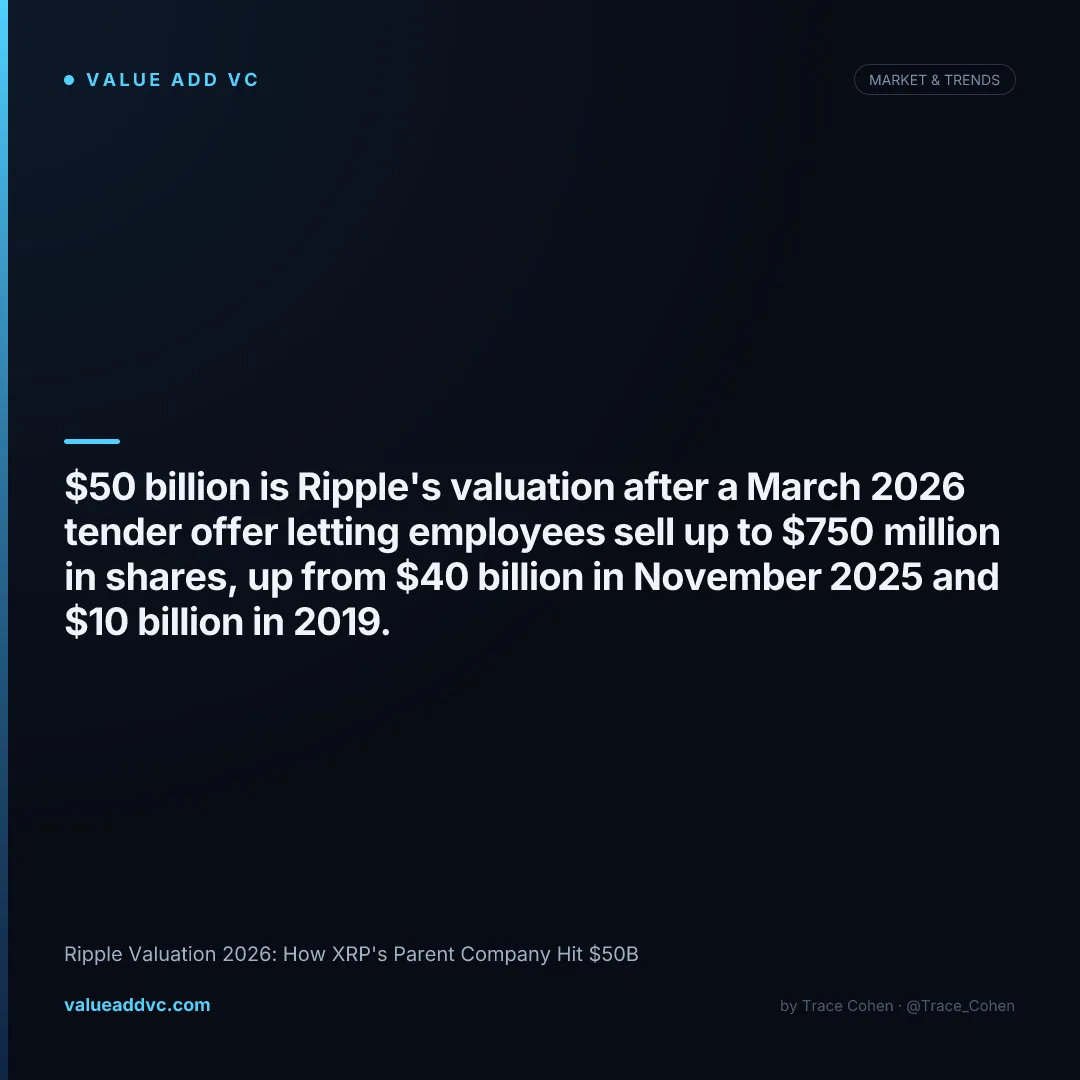
Ripple was valued at $50 billion in a March 2026 employee share buyback, up from $40 billion just four months earlier and $10 billion at its December 2019 Series C. The jump followed the August 2025 close of the SEC's five-year lawsuit against the company, and it arrived without a single primary funding round attached to the latest number at all.
Ripple Labs is the San Francisco company behind the XRP Ledger, the RippleNet cross-border payments network, and — since December 2024 — the RLUSD stablecoin. It is not the same thing as XRP, the cryptocurrency, even though the two get conflated constantly. That distinction matters more than usual right now: Ripple's $50 billion price tag comes from a private tender offer among employees and early shareholders, while XRP trades publicly and carried a roughly $90.5 billion market cap of its own on August 28, 2026.
Chris Larsen and Jed McCaleb co-founded the company in San Francisco in September 2012 under the name OpenCoin, renaming it Ripple Labs in 2015. For most of the following decade the story was a payments company signing individual bank partnerships one at a time while fighting a federal lawsuit. The last eighteen months changed that: the SEC case ended, the acquisitions started stacking up, and the valuation followed.
Sources: Bloomberg, CoinDesk, Fortress Investment Group, and SEC court filings, 2025-2026.
Ripple Valuation 2026: How the Company Got From $40B to $50B
Ripple's valuation reached $50 billion in March 2026 through a $750 million tender offer that let employees and early investors sell existing shares, not through a new primary funding round. That's a 25% jump from the $40 billion mark set just four months earlier, in a November 5, 2025 raise led by Fortress Investment Group and Citadel Securities.
The mechanics matter here. A tender offer or buyback prices the company at whatever level buyers and sellers agree to trade existing stock, without Ripple raising a dollar of new capital or diluting its cap table. That's different from the November round, where Fortress, Citadel Securities, Pantera Capital, Galaxy Digital, Brevan Howard, and Marshall Wace put fresh money in at the $40 billion price. The buyback also wasn't Ripple's first attempt — a September 2025 tender offer at the same $40 billion valuation drew the weakest employee participation of any prior round, according to CNBC's reporting on the November raise, before demand picked back up by March.
That participation gap is worth sitting with: at a private company, a tender price also sets what departing employees actually get paid for their stock and anchors how new hires' grants get priced going forward. Sellers who held out in September, betting the number would keep climbing rather than locking in $40 billion, were proven right within six months — the March price came in 25% higher. That's the kind of dynamic that keeps building on itself in a fast-appreciating private stock, right up until the trend reverses.
The SEC Case Is Actually Closed — Here's What That Means
The SEC sued Ripple in December 2020, alleging its XRP sales were unregistered securities offerings. Judge Analisa Torres split the difference in July 2023, ruling that Ripple's institutional sales of XRP violated securities law but its programmatic sales on exchanges did not. Both sides kept appealing pieces of that ruling until August 7, 2025, when Ripple and the SEC jointly dropped their remaining cross-appeals in the Second Circuit, according to CoinDesk's coverage of the case's final stretch.
Ripple paid the original $125 million civil penalty and remains under a permanent injunction against unregistered institutional XRP sales — the SEC and Judge Torres never agreed to lift that part of the judgment, despite two joint settlement requests. The practical effect for Ripple's valuation: a nearly five-year legal overhang that had scared off institutional capital is gone, and Torres's 2023 framework — institutional sales are securities transactions, programmatic exchange sales are not — is now the settled law of the case rather than an open question on appeal.
What the headline $50B number misses
Ripple's $50 billion valuation and XRP's roughly $90.5 billion token market cap are not the same measurement, and treating them as interchangeable produces the wrong read. Ripple holds a large treasury of XRP — commonly estimated in the 38 to 40 billion token range — but a company valuation and a freely-traded token's market cap are priced in different markets by different buyers for different reasons. One read on this: the investors who set Ripple's $50 billion price appear to have marked the company's XRP holdings below the open market price XRP was trading at in March 2026, rather than crediting the treasury at full market value, according to DL News's analysis of the buyback. That's the opposite of what you'd expect if the $50 billion figure were simply riding XRP's price up.
There's a second wrinkle worth flagging as inference rather than fact: XRP holders have no equity claim on Ripple the company. If Ripple's enterprise valuation keeps climbing on custody, prime brokerage, and stablecoin revenue, that doesn't mechanically flow through to XRP's price — and if XRP's price falls, that doesn't mechanically shrink Ripple's private valuation either, since a tender offer prices the stock buyers and sellers agree on, not a formula tied to the token.
The Acquisitions Behind the Valuation
Ripple's climb to $50 billion tracks a buying spree, not just a payments-volume story. In 2025 alone the company closed four acquisitions totaling nearly $4 billion, aimed at turning RippleNet from a cross-border payments rail into a fuller institutional finance stack: custody, prime brokerage, treasury management, and stablecoin infrastructure all under one roof.
| Acquisition | Price | Closed | Detail |
|---|---|---|---|
| Hidden Road | $1.25B | Closed Oct 2025 | Global multi-asset prime broker, becoming Ripple Prime; average daily transactions now over 60M |
| GTreasury | $1.0B | 2025 | Corporate treasury management software, Ripple's entry into enterprise treasury tooling |
| Metaco | $250M | May 2023 | Institutional digital asset custody, clients include BNP Paribas and Standard Chartered's Zodia Custody |
| Rail | $200M | 2025 | Stablecoin payments infrastructure, folded into Ripple Payments |
| Palisade | Undisclosed | 2025 | Digital asset wallet infrastructure, fourth of four 2025 deals totaling nearly $4B |
Sources: Ripple press releases, TechCrunch, Cointelegraph, and Architect Partners deal data, 2023-2025.
Ripple has described the goal as building a "one-stop shop for digital asset infrastructure" — pairing bank-grade custody (Metaco) with a global prime broker (Hidden Road) and enterprise treasury software companies already use to move cash (GTreasury), then routing settlement through RLUSD and the XRP Ledger underneath all of it. That's a different growth playbook than Coinbase's, which has leaned on building products like its Base network in-house. Ripple has largely bought its way into adjacent institutional-finance categories instead, and that spending is a big part of why the balance sheet Monica Long points to when she talks about staying private looks the way it does.
RLUSD and the Payments Business Behind the Number
RLUSD, Ripple's dollar-backed stablecoin launched in December 2024, crossed $2 billion in market capitalization by late August 2026, split roughly between $963 million issued on the XRP Ledger and $1.1 billion on Ethereum. It's a small stablecoin next to Circle's $77 billion USDC or Tether's much larger float, but it dominates about 98% of stablecoin liquidity native to the XRP Ledger and is the collateral asset Ripple is now plugging into the Hidden Road prime brokerage business it bought.
On the payments side, cumulative volume moved through Ripple Payments (the rebranded RippleNet) had crossed $95 billion by January 2026, spanning more than 70 currency corridors. Japan, the Philippines, and Mexico account for a disproportionate share of that volume — high-cost, high-friction remittance corridors where a same-day settlement rail beats correspondent banking on price. None of that revenue is disclosed in dollar terms; Ripple is private and doesn't publish a P&L, which is exactly why the market has to lean on funding-round and tender-offer prices to estimate what the business is worth.
The technical case underneath those corridors is speed: XRP Ledger transactions typically settle in three to five seconds, at network fees running $0.0002 to $0.001 per transaction, and Ripple says its Asia-Pacific corridors alone — anchored in Japan and the Philippines — generate roughly 56% of its global on-demand liquidity volume. This likely means Ripple's near-term payments growth is less about winning new geographies and more about deepening a small number of remittance routes it already dominates, with on-demand liquidity volume reportedly growing 30% to 40% annually inside that concentrated footprint.
How Ripple's $50B Stacks Up Against Other Crypto Companies
At $50 billion, Ripple is now priced above every publicly traded crypto company, including Coinbase's roughly $45.1 billion market cap as of August 2026. That's a notable flip: Coinbase has been public since 2021 and reports quarterly earnings, while Ripple's number comes from a single private tender offer with no audited financials attached. Kraken, still working toward its own listing, shows the same private-market volatility problem from the other direction — its valuation has swung between $13.3 billion and $20 billion in the past year alone. The table below lines up six crypto-native companies by how the market currently prices them, whether that price comes from a public listing or a private transaction.
| Company | Status | Valuation | Basis | Note |
|---|---|---|---|---|
| Ripple | Private | $50.0B | March 2026 tender offer ($750M buyback) | Employees and early investors selling shares, not a primary raise |
| Coinbase (COIN) | Public, Nasdaq | $45.1B | Market cap, August 2026 | Listed via direct listing in April 2021 |
| Circle (CRCL) | Public, NYSE | $16.0B | Market cap, late July 2026 | Down from a post-IPO high after listing in June 2025 |
| Kraken | Private, targeting IPO | $13.3B | April 2026 Deutsche Börse stake purchase | Down from a $20B November 2025 mark |
| BitGo (BTGO) | Public, NYSE | $2.0B | IPO priced above range, January 2026 | First crypto custody pure-play to go public |
| Securitize (SECZ) | Public, NYSE | $1.25B | SPAC merger with Cantor Equity Partners II, July 2026 | BlackRock-backed tokenization platform |
Sources: Bloomberg, companiesmarketcap.com, Multiples.vc, TradingView, and SiliconANGLE reporting, as of August 2026.
Ripple vs. Public Crypto Peers by Valuation
Bloomberg, companiesmarketcap.com, and Multiples.vc, August 2026
Ripple's private $50B tender price now sits above Coinbase's public market cap and roughly 3x Circle's.
So Is Ripple Actually Going Public?
The honest answer is that Ripple's own leadership isn't giving one consistent line. President Monica Long told Bloomberg in early January 2026 that Ripple planned to stay private, arguing the company's balance sheet after its $500 million November raise gave it "room" it wouldn't get from public markets and the disclosure obligations that come with them. That was the company's position as 2026 opened.
By August 18, 2026, at the Wyoming Blockchain Symposium, CEO Brad Garlinghouse struck a noticeably different note: Ripple has "been very happily private for a long time," he said, "but we are more neutral now on the topic." Garlinghouse pointed to Circle's strong post-IPO run as a positive signal, while noting the lukewarm reception BitGo and Securitize got when they went public earlier in 2026 as a reason for caution. Asked separately in June whether XRP holders could ever see equity from a Ripple listing, Garlinghouse didn't rule it out, saying only that "perhaps there will be a special arrangement." Nothing here is a filed S-1 or a set date — it's a company whose president said no in January and whose CEO sounded open by August, which is its own kind of signal about where the conversation inside Ripple is heading. Track which crypto and fintech names actually have paperwork on file on our IPO tracker.
Garlinghouse's caution has a specific reference point. BitGo priced its IPO above range at a $2 billion valuation in January 2026, then saw its stock fall 13% on the second day of trading. Securitize, the BlackRock-backed tokenization platform, went public in July 2026 through a $400 million SPAC merger with Cantor Equity Partners II rather than a traditional IPO, landing at a $1.25 billion pre-money valuation. Both are far smaller than a public Ripple would be, but they're the two most recent crypto listings Garlinghouse has in front of him as reference points, alongside Circle.
Bottom line: Ripple's valuation hit $50 billion in a March 2026 tender offer, up from $40 billion in November 2025 and $10 billion at its 2019 Series C, powered by the August 2025 close of the SEC case and nearly $4 billion in 2025 acquisitions across custody, prime brokerage, and treasury software. It's now priced above Coinbase's public market cap, but the number rests on a private buyback rather than audited earnings, and the company's own executives disagree on whether an IPO is next.
Latest from the Pulse
Get VC data most people never see
— free to subscribe
Trace's notes on venture, AI and startups, a few times a week. Join 5,000+ subscribers. No spam.