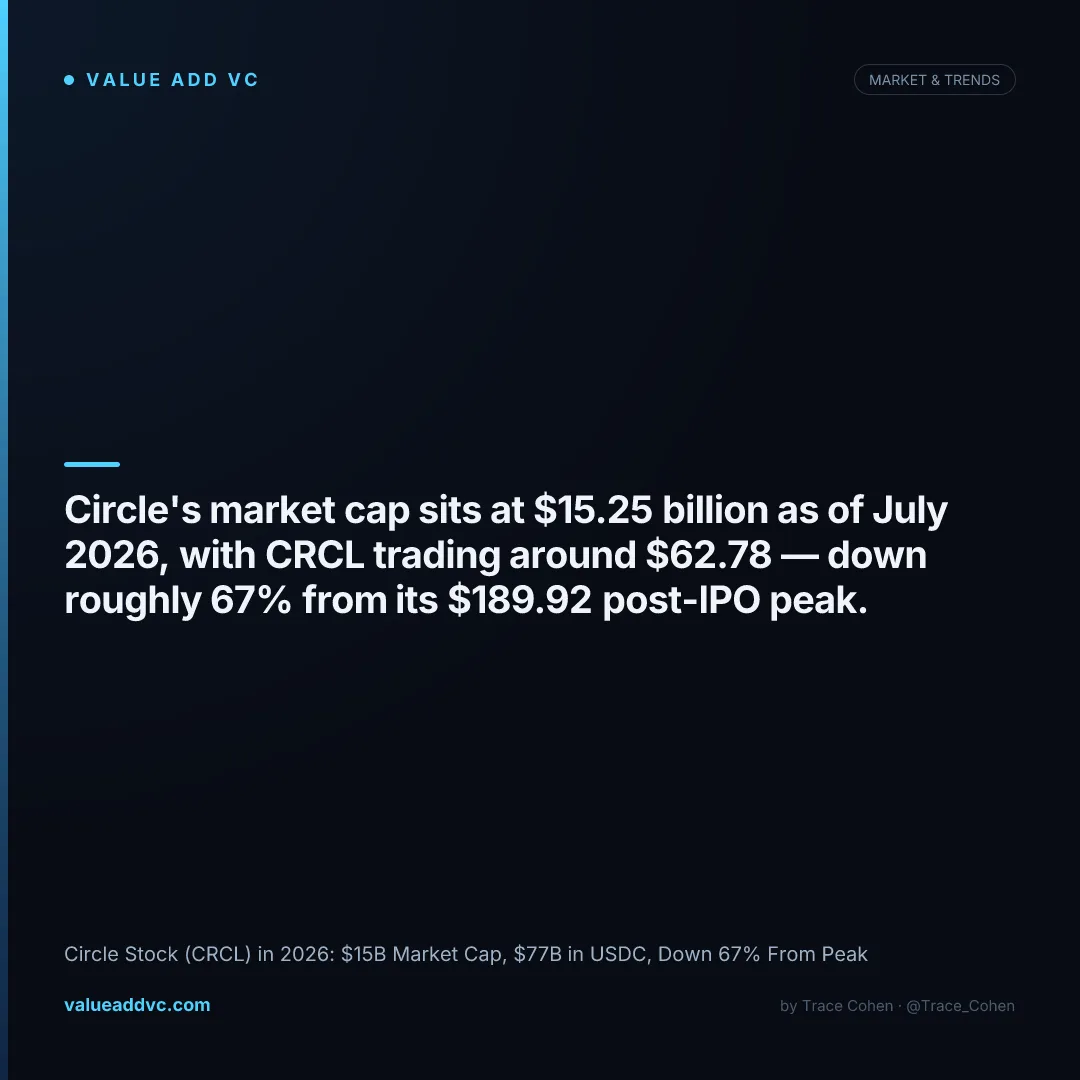
Circle Internet Group's market cap is $15.25 billion in July 2026, but CRCL trades at $62.78 — down 67% from its $189.92 post-IPO peak even as USDC circulation grew to $77 billion. A stablecoin that keeps growing while its issuer's stock craters — that gap is the thing to explain.
Circle went public on June 5, 2025, and put on one of the loudest IPO debuts in years, popping 168% on day one before running to nearly $190 a share within weeks. A year later, the stock is worth about a third of that peak, even though the underlying business — USDC in circulation, quarterly revenue, adjusted EBITDA — has grown every single quarter since listing. The gap between Circle's fundamentals and its stock price is the story here, and it says a lot about how public markets are pricing stablecoin issuers now that the initial hype has worn off.
Sources: Circle Internet Group Q1 2026 earnings release, stockanalysis.com, WallStreetZen, The Block (May 2026).
What Is Circle's Stock (CRCL) Worth in 2026?
Circle's stock (NYSE: CRCL) is valued at roughly $15.25 billion in market capitalization as of late July 2026, with shares trading around $62.78. That's up from Circle's $31 IPO price in June 2025 but down sharply from the stock's 52-week high of $189.92, a decline of about 67% from peak even as the company's core USDC business kept expanding. Circle reports Q2 2026 results on August 5, and Clear Street recently trimmed its price target to $128 from $157 while keeping a Buy rating heading into that print.
The comparison table below puts Circle's USDC against Tether's USDT — the two stablecoins that between them account for the overwhelming majority of the roughly $321 billion stablecoin market. It's the clearest way to see why Circle, despite being the smaller issuer by market cap, commands the vast majority of investor and media attention: it's the only one of the two that's a public, audited company.
| Metric | Circle (USDC) | Tether (USDT) |
|---|---|---|
| Stablecoin in circulation | $77.0B (Q1 2026) | ~$184B (mid-2026) |
| Share of stablecoin market cap | ~24% | ~58% |
| Share of stablecoin transaction volume | 63% | ~35-37% |
| YoY circulation growth | +28% | Declining, -$5.4B in 60 days (mid-2026) |
| Q1 2026 profit | $0.21 EPS on $694M revenue | $1.04B net profit |
| Full-year 2025 profit | -$0.44 EPS (loss) | >$10B net profit |
| Corporate structure | Publicly traded (NYSE: CRCL) | Privately held (El Salvador-based) |
| Reserve transparency | Monthly attestations, US GAAP-audited annual financials | Quarterly attestations, no full GAAP audit |
| Primary revenue driver | Reserve interest income on USDC backing | Reserve interest income on USDT backing |
Figures are 2026 estimates blended from Circle's Q1 2026 earnings release, CoinDesk, Bitcoin.com News, and CoinGecko market data, checked July 2026. Tether does not publish full GAAP-audited financials, so its figures rely on quarterly reserve attestations.
USDC vs USDT: Stablecoin Market Cap, Mid-2026
Tether's USDT is still roughly 2.4x larger than USDC by market cap, but USDC is growing circulation faster and leads in transaction volume share.
Circle Q1 2026 earnings, CoinDesk Tether reserve report, May 2026.
Circle's USDC Growth in 2026: Circulation, Revenue, and Margins
USDC circulation has climbed every quarter since Circle's IPO: from roughly $60 billion in early 2025, to $73.7 billion in Q3 2025, to $75.3 billion in Q4 2025, and finally $77.0 billion at the end of Q1 2026 — a 28% year-over-year increase. Full-year 2025 circulation grew 72% versus the end of 2024, and management has guided to a 40% compound annual growth rate for USDC through the current cycle. Onchain USDC transaction volume hit $21.5 trillion over the trailing year, up 263%, and USDC now represents 63% of all stablecoin transaction volume even though it trails USDT in total circulation.
Revenue has followed a similar upward path but with more volatility quarter to quarter. Circle posted $770 million in Q4 2025 revenue and $2.7 billion for full-year 2025, up 64% year-over-year. Q1 2026 revenue came in at $694 million, up 20% year-over-year but below the $715 million analysts expected — the miss that helped drag the stock lower even as adjusted EBITDA grew 24% to $151 million and diluted EPS turned positive at $0.21, versus a $0.44 per-share loss the year before. Operating expenses rose 32% year-over-year to $136 million, which is the line item management is now under the most pressure to control.
Why Circle Stock Fell 67% From Its Post-IPO Peak
CRCL's decline from $189.92 to around $62.78 isn't a story of collapsing fundamentals — it's a story of an IPO that got priced for perfection and a business that's growing well but not quite fast enough to keep up with the multiple investors initially assigned it. At its peak, Circle traded at a market cap well north of $40 billion against a USDC base under $70 billion, implying investors were pricing in a growth trajectory closer to management's 40% long-run CAGR guidance sustained indefinitely, plus meaningful margin expansion. The Q1 2026 revenue miss, the 32% jump in operating expenses, and flat-to-decelerating circulation growth relative to the post-IPO run rate all chipped away at that story.
There's also a structural headwind specific to stablecoin issuers: nearly all of Circle's revenue comes from interest income earned on the US Treasury reserves backing USDC, which means Circle's earnings power is partly a function of prevailing interest rates rather than pure product-market fit. If rates decline further in 2026 and 2027, Circle's reserve income shrinks even if USDC circulation keeps growing, which is a dynamic public-market investors are still learning to price for a business type that barely existed as a standalone public company before June 2025. You can compare how other 2025-2026 fintech listings have performed post-IPO on our Tech IPO Calendar.
Where USDC Fits in the $321 Billion Stablecoin Market
The total stablecoin market sits at roughly $321 billion as of mid-2026, and it remains heavily concentrated: Tether's USDT and Circle's USDC together account for well over 80% of all stablecoin value in circulation. Tether holds the larger share by market cap at roughly $184 billion, or about 58%, backed by a reserve buffer of $8.23 billion and total assets of roughly $191.8 billion against $183.5 billion in liabilities. Tether posted $1.04 billion in Q1 2026 profit alone and more than $10 billion for all of 2025 — a profit margin structure Circle, as a public, more heavily regulated and audited company, has not come close to matching.
That asymmetry is the core tension in the Circle investment case. USDC is winning on transaction-volume share (63%) and on trust-sensitive use cases — enterprises and regulated institutions increasingly prefer USDC precisely because Circle publishes audited financials and monthly reserve attestations that Tether does not match. But Tether's larger reserve base and lack of public-company overhead let it convert a larger share of interest income straight to profit, which is part of why Tether can post $10 billion in annual profit on a private balance sheet while Circle, at less than half Tether's circulation, is only now turning consistently profitable as a public company.
How US Stablecoin Regulation Changes the Circle vs Tether Calculus
The passage of the GENIUS Act reshaped the competitive landscape between USDC and USDT in a way that shows up in Circle's investor pitch more than in its current financials. The law establishes a federal framework requiring payment-stablecoin issuers to hold 1:1 reserves in cash or short-duration Treasuries, publish monthly attestations, and in most cases be a US-domiciled, regulated entity to serve US customers directly. Circle, already publishing audited annual financials and monthly reserve reports since well before the law passed, is structurally closer to compliant than Tether, which remains headquartered outside the US and has historically published less frequent, narrower attestations rather than full GAAP audits.
That regulatory gap is the bull case for USDC gaining share over the next several years even if Tether keeps its lead in raw circulation today. Large US banks, payment processors, and fintechs weighing which stablecoin to integrate increasingly cite regulatory clarity as a top selection criterion, and Circle's 63% share of stablecoin transaction volume — well above its 24% share of stablecoin market cap — suggests that shift toward USDC in actual usage may already be underway even before circulation fully catches up.
Is Circle Stock Worth Buying After the Pullback?
At $62.78, Circle trades at roughly 22x its Q1 2026 annualized revenue run rate (~$2.78 billion) and about 25x its annualized adjusted EBITDA — multiples that are no longer priced for the euphoric growth investors expected on day one, but that still assume USDC keeps compounding toward management's 40% long-run guidance. Bulls point to USDC's 63% share of stablecoin transaction volume, 20 million-plus paid enterprise relationships flowing through onchain rails, and a regulatory environment under the GENIUS Act that increasingly favors audited, US-domiciled issuers like Circle over offshore competitors like Tether. Bears point to the Q1 revenue miss, rising operating expenses, and the interest-rate sensitivity baked into a reserve-income business model.
The honest read: Circle's business is healthier today than at IPO by almost every operating metric — more USDC in circulation, more revenue, and now positive EPS — but the stock got priced for a growth rate the business hasn't sustained, and the market has spent the past year correcting that gap rather than the fundamentals deteriorating outright. Investors comparing Circle to other 2025-2026 fintech and payments listings can track broader valuation trends on our Big Tech Earnings dashboard and our AI Valuations dashboard for adjacent infrastructure comps.
Circle's August 5 Q2 2026 print is likely to be the next real catalyst either way. If USDC circulation growth reaccelerates back toward the 40% CAGR management has guided to, and operating expense growth cools from the 32% pace posted in Q1, the stock's current ~22x revenue multiple starts to look cheap relative to where public payments and fintech infrastructure names have historically traded at similar growth rates. If circulation growth stays closer to the high-20s percentage range and expenses keep climbing, the multiple compression that's already knocked two-thirds off the stock since its peak could have further room to run.
The bottom line:
Circle's business kept growing every quarter after its IPO — $77B in USDC, $694M in quarterly revenue, positive EPS — but CRCL still trades 67% below its post-IPO peak because the stock, not the business, got ahead of itself in 2025.
Track how public fintech and stablecoin issuers are being valued relative to private markets on our Tech IPO Calendar, compare against public mega-cap tech earnings on our Big Tech Earnings dashboard, and see fund-level exposure on our VC Performance dashboard at Value Add VC. Originally published in the Trace Cohen newsletter.
Latest from the Pulse
Get VC data most people never see
— 100% free
Weekly benchmarks, valuations, and fund data. Join 5,000+ investors. No spam.