
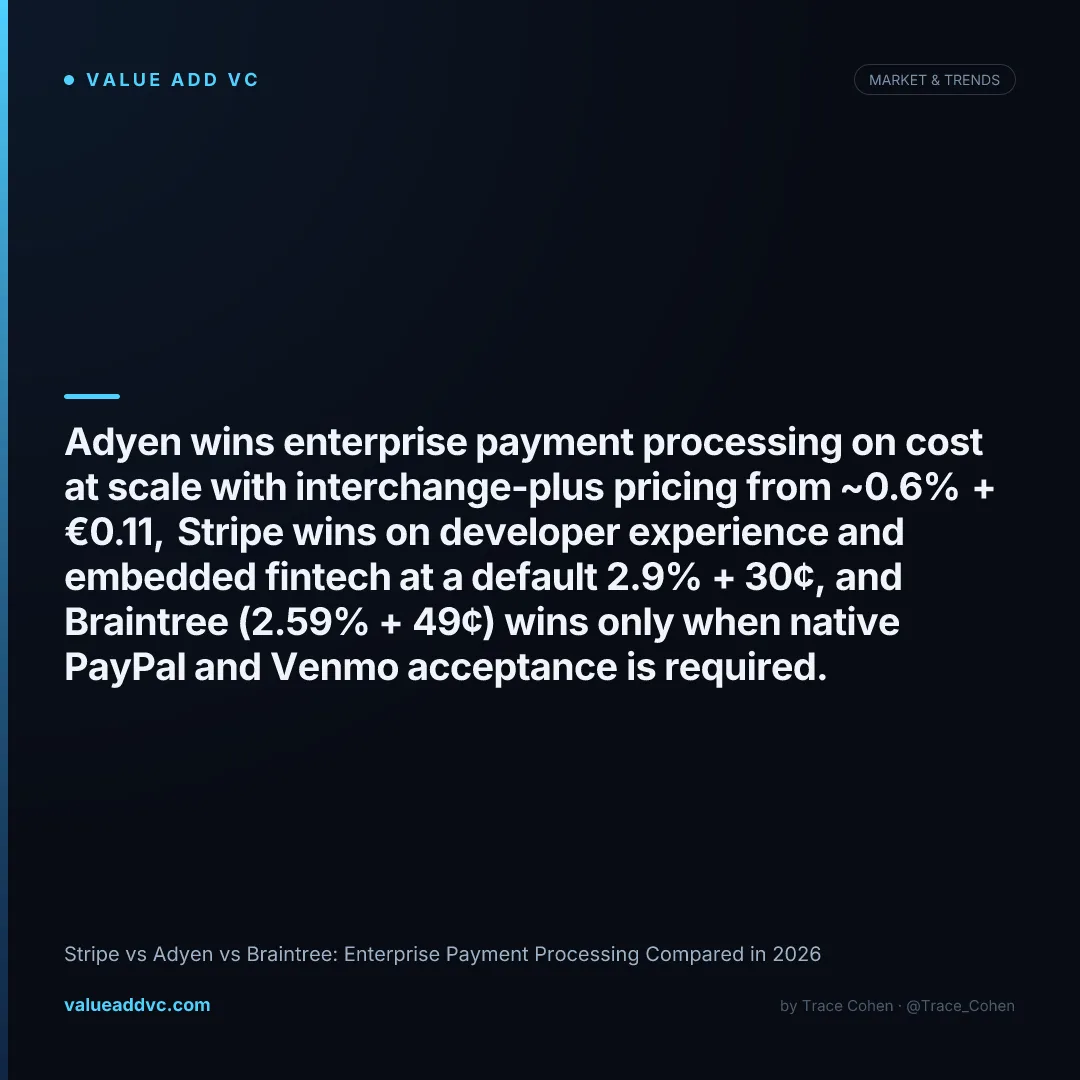
At enterprise volume, Adyen is the cheapest of the three — interchange-plus from roughly 0.6% + €0.11 versus Stripe's default 2.9% + 30¢ and Braintree's 2.59% + 49¢. That's the short answer. The longer answer is more interesting, because sticker price is almost never what an enterprise actually pays.
Stripe processed $1.9 trillion in total payment volume in 2025, up 34% year-over-year and enough to pass PayPal's $1.79 trillion for the first time. Adyen processed €803.8 billion in H1 2026 alone, up 24% year-over-year, on its way to another full-year record. Braintree, folded inside PayPal's total payment volume, is the smallest standalone story of the three but the default rail for native PayPal and Venmo — and it just posted a ninth straight quarter of profitable growth. Each took a different bet on how payments should be priced, built, and sold — and at the enterprise tier those bets produce very different bills. As of August 2026, Stripe carries a $159 billion valuation from its February 2026 employee tender offer, up from $91.5B a year earlier.
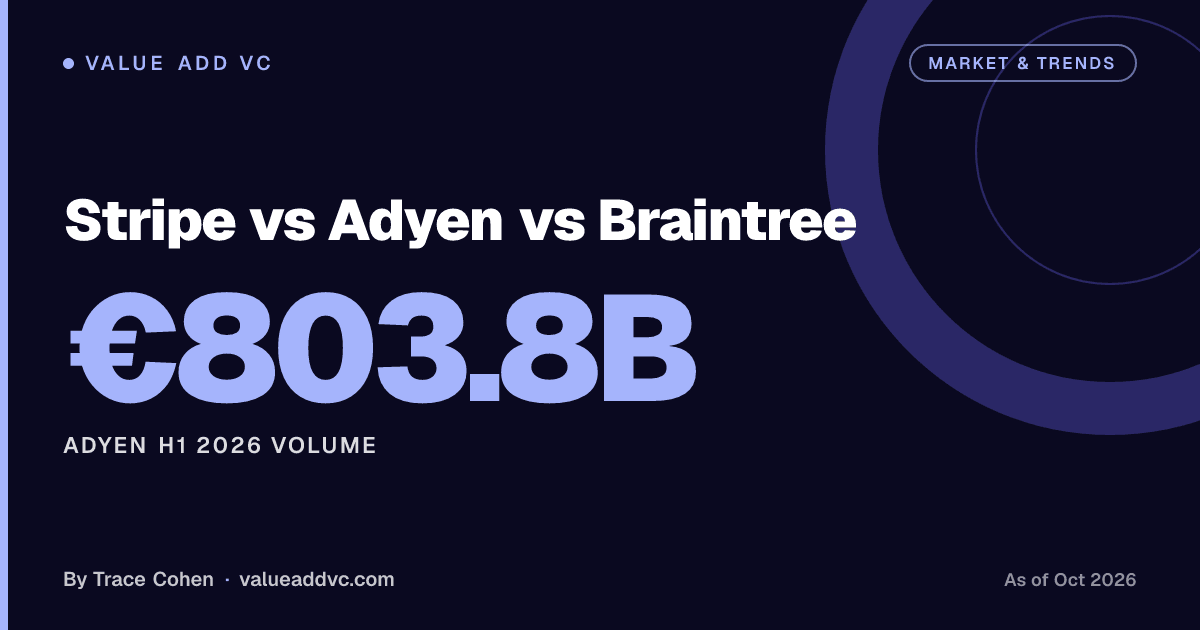
Figures from Stripe's 2025 annual update, Adyen's H1 2026 financial results, and PayPal's Q2 2026 earnings report, as of August 27, 2026.
Stripe vs Adyen vs Braintree: enterprise payments compared in 2026
For enterprise payment processing in 2026, Adyen offers the lowest blended cost through interchange-plus pricing, Stripe offers the best developer tooling and embedded-finance stack at a higher default rate, and Braintree differentiates on native PayPal and Venmo acceptance. The right choice depends on annual volume, whether you sell software or goods, and how much of your stack you want to own versus buy.
| Attribute | Stripe | Adyen | Braintree |
|---|---|---|---|
| Default US card rate | 2.9% + 30¢ | Interchange + ~0.6% + €0.11 | 2.59% + 49¢ |
| Pricing model | Flat-rate; custom IC+ at scale | Interchange-plus only | Flat-rate; custom IC+ over $80k/mo |
| Latest reported volume | $1.9T FY2025 (+34% YoY) | €803.8B H1 2026 (+24% YoY) | Part of PayPal; PSP volume +13% Q2 2026 |
| In-store (POS) support | Stripe Terminal | Native unified commerce | Limited / online-first |
| Owner / parent | Independent (~$159B val.) | Public (AMS: ADYEN) | PayPal (NASDAQ: PYPL) |
| Best-fit buyer | Platforms, SaaS, marketplaces | Global omnichannel retail | PayPal/Venmo-native merchants |
| Differentiator | Developer & fintech stack | Cost + single global platform | Native PayPal + Venmo |
Source: Stripe 2025 Annual Update, Adyen H1 2026 Financial Results, PayPal Q2 2026 earnings report, company pricing pages, as of August 2026.
Stripe vs Adyen vs Braintree: Default US Card Rate
Company pricing pages, 2026
Data
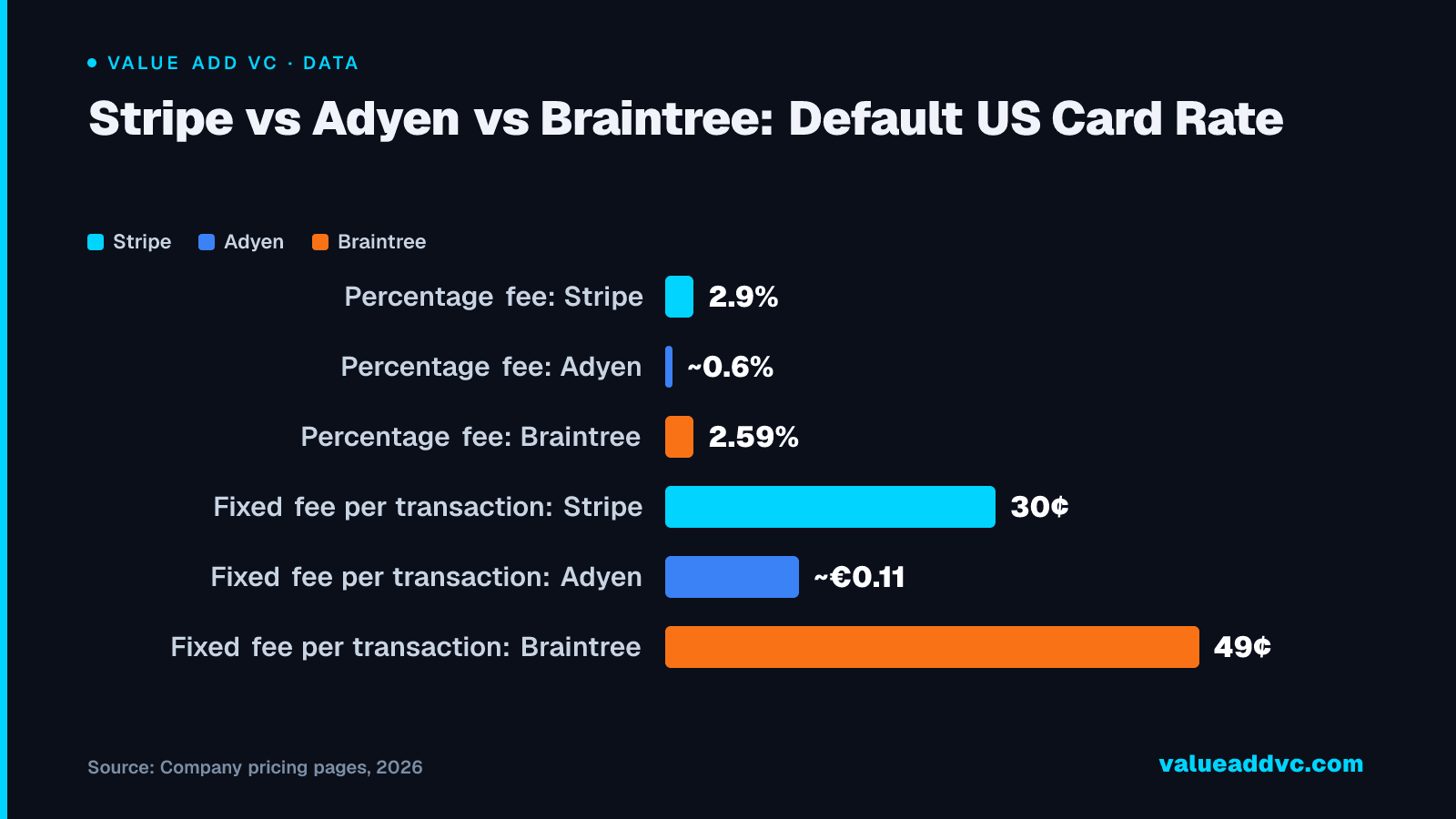
Adyen's markup is a fixed acquiring fee on top of true interchange, so its blended rate falls as ticket size and volume rise — the opposite of Stripe and Braintree's flat percentages.
Adyen vs Stripe: fees, revenue and take rate head to head
Adyen vs Stripe is the comparison most enterprise buyers end up making, because Braintree mostly enters the deal for PayPal and Venmo. On fees, Adyen's US list price is a fixed $0.13 plus interchange++ plus 0.60% for Visa and Mastercard, with no monthly or setup fees, according to Adyen's pricing page (the €0.11 figure above is its euro price). Stripe's standard US price is 2.9% + 30¢ for domestic cards, plus 1.5% for international cards and 1% for currency conversion, per Stripe's pricing page as of October 2026.
| Adyen vs Stripe | Adyen | Stripe |
|---|---|---|
| US card list price | $0.13 + interchange++ + 0.60% | 2.9% + 30¢ |
| International card / FX | Passed through in interchange++ | +1.5% intl card; +1% conversion |
| Monthly or setup fees | None; minimum invoice by industry | None on standard pricing |
| 2025 net revenue | €2,364.2M (+18%) | $6.8B (+~33%, reported) |
| 2025 payment volume | €1,394.3B | $1.9T (+34%) |
| Net revenue as % of volume (our arithmetic) | ~0.17% | ~0.36% |
| Profitability | 53% EBITDA margin (FY2025) | $3.2B free cash flow, 47% margin (reported) |
| Ownership / valuation | Public (Euronext Amsterdam: ADYEN) | Private; $159B tender (Feb 2026) |
| 2026 outlook | 21–23% net revenue growth (constant currency) | No public guidance (private company) |
Sources: Adyen and Stripe US pricing pages; Adyen H2 2025 results; Adyen H1 2026 results; The Information via SaaStr. Take rates are Value Add VC arithmetic and mix euro and dollar figures within each company only. As of October 16, 2026.
Stripe is the larger business: its 2025 net revenue was $6.8 billion, up about a third, with $3.2 billion of free cash flow, The Information reported in July 2026, as summarized by SaaStr. Adyen reported 2025 net revenue of €2,364.2 million, up 18% (21% in constant currency), on €1,394.3 billion of processed volume, with a 53% EBITDA margin. On Value Add VC's arithmetic, Adyen keeps about 0.17% of the volume it processes against roughly 0.36% at Stripe, which is the cost gap a large merchant sees, expressed from the processor's side.
Both are buying into adjacent software. Adyen closed its Talon.One loyalty and Orb usage-billing acquisitions after H1 2026 and now guides to 21% to 23% constant-currency net revenue growth for 2026. Stripe and Advent International bid about $53 billion for PayPal in July 2026 and then dropped the pursuit, RTÉ reported on August 28, 2026, citing Bloomberg. Stripe's last company-set price is the $159 billion February 2026 tender; Forge's secondary-market indicator implied about $184.4 billion as of October 1, 2026, Benzinga reported, which is a trading estimate, not a round.
Adyen vs Stripe: 2025 Revenue and Take Rate
Adyen H2 2025 results; The Information via SaaStr; Value Add VC arithmetic, Oct 2026
Data
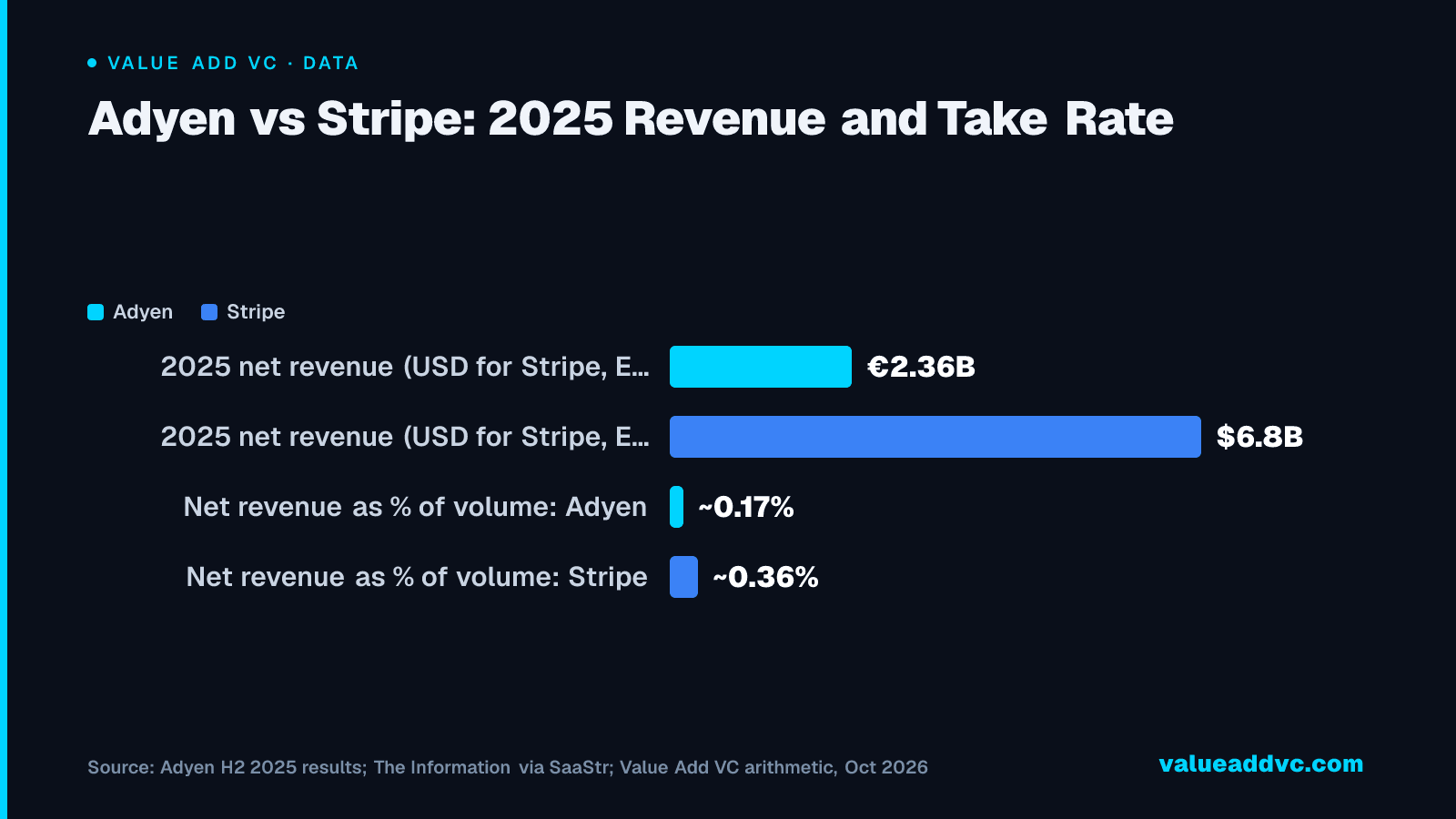
Stripe earns about twice as much per dollar processed; Adyen converts more of its revenue to profit.
How the three pricing models actually differ
The single biggest decision in enterprise payment processing in 2026 is flat-rate versus interchange-plus. It sounds like accounting trivia. It is worth millions at scale.
Flat-rate (Stripe default, Braintree default)
You pay one blended number — 2.9% + 30¢ on Stripe, 2.59% + 49¢ on Braintree — regardless of the underlying card. Simple to forecast, but you overpay on cheap debit cards because the processor pockets the spread. Great under ~$2M/year, expensive above it.
Interchange-plus (Adyen default, Stripe/Braintree custom)
You pay the true network interchange (set by Visa/Mastercard, typically 1.15%–2.5%) plus scheme fees plus a fixed, transparent processor markup — Adyen's is roughly 0.6% + €0.11. The markup never grows with ticket size, so your blended rate falls as volume and average order value rise.
Run the math on a merchant doing $500M a year at a $120 average order value. On Stripe's flat 2.9% + 30¢ that's roughly $14.5M in card fees plus ~$1.25M in per-transaction charges — call it $15.75M. On Adyen's interchange-plus, with US blended interchange near 1.9% and a 0.6% markup, the all-in lands closer to $12.5–13M. That ~$3M annual delta is exactly why large omnichannel retailers default to Adyen, and why Stripe quietly offers interchange-plus to anyone big enough to ask.
Where Stripe wins enterprise payments in 2026
Stripe wins enterprise payment processing in 2026 when the customer is a software company, a marketplace, or a platform that wants to monetize payments itself. Stripe Connect lets a platform onboard and pay out sub-merchants and take a slice — the core of the embedded-finance wave. No competitor matches Stripe's API surface, documentation, or speed-to-integration.
Embedded payments / Connect
Best-in-class for platforms that resell payments to their own users
Developer velocity
Cleanest APIs and docs; fastest to ship and iterate
Fintech building blocks
Issuing, Treasury, Capital, and Billing on one account
Authorization optimization
Adaptive Acceptance and network tokens lift approval rates
The trade-off is cost. Stripe's default rate is the highest of the three, and while it negotiates aggressively above ~$1M/month, you have to be a real account to unlock it. If payments are a feature of your product, Stripe is usually worth the premium. If payments are just a cost center, the premium is harder to justify. Stripe is also pushing that same bundling logic into AI spend — its reported $8 billion-plus acquisition of AI model router OpenRouter in August 2026 signals it wants to own token-cost management the same way it owns payment processing.
Where Adyen and Braintree win enterprise payments
Adyen wins the global omnichannel enterprise — the retailer or brand that sells in stores, online, and in-app across dozens of countries and wants one platform, one settlement, and one reconciliation. Adyen built a single financial stack rather than stitching acquirers together, which is why it banks Uber, Spotify, McDonald's, and Microsoft. Its take rate sits near 0.6%, a fraction of Stripe's sticker rate, because it sells to merchants whose own margins demand it.
Pick Adyen when
- ✓ You process $250M+ and cost is the priority
- ✓ You need unified in-store and online on one platform
- ✓ You sell across many countries and currencies
- ✓ You want interchange-plus transparency by default
Pick Braintree when
- ✓ Native PayPal and Venmo acceptance is essential
- ✓ You want one integration for cards + PayPal wallet
- ✓ Your buyers skew US consumer and mobile
- ✓ You value PayPal's buyer trust at checkout
Braintree's honest position in 2026 is narrower than it was five years ago. Its 2.59% + 49¢ is competitive, and as PayPal's gateway it's the cleanest way to accept PayPal and Venmo natively alongside cards. But on pure card processing it doesn't out-price Adyen or out-build Stripe. It wins on the wallet, not the rail.
What H1 2026 earnings changed
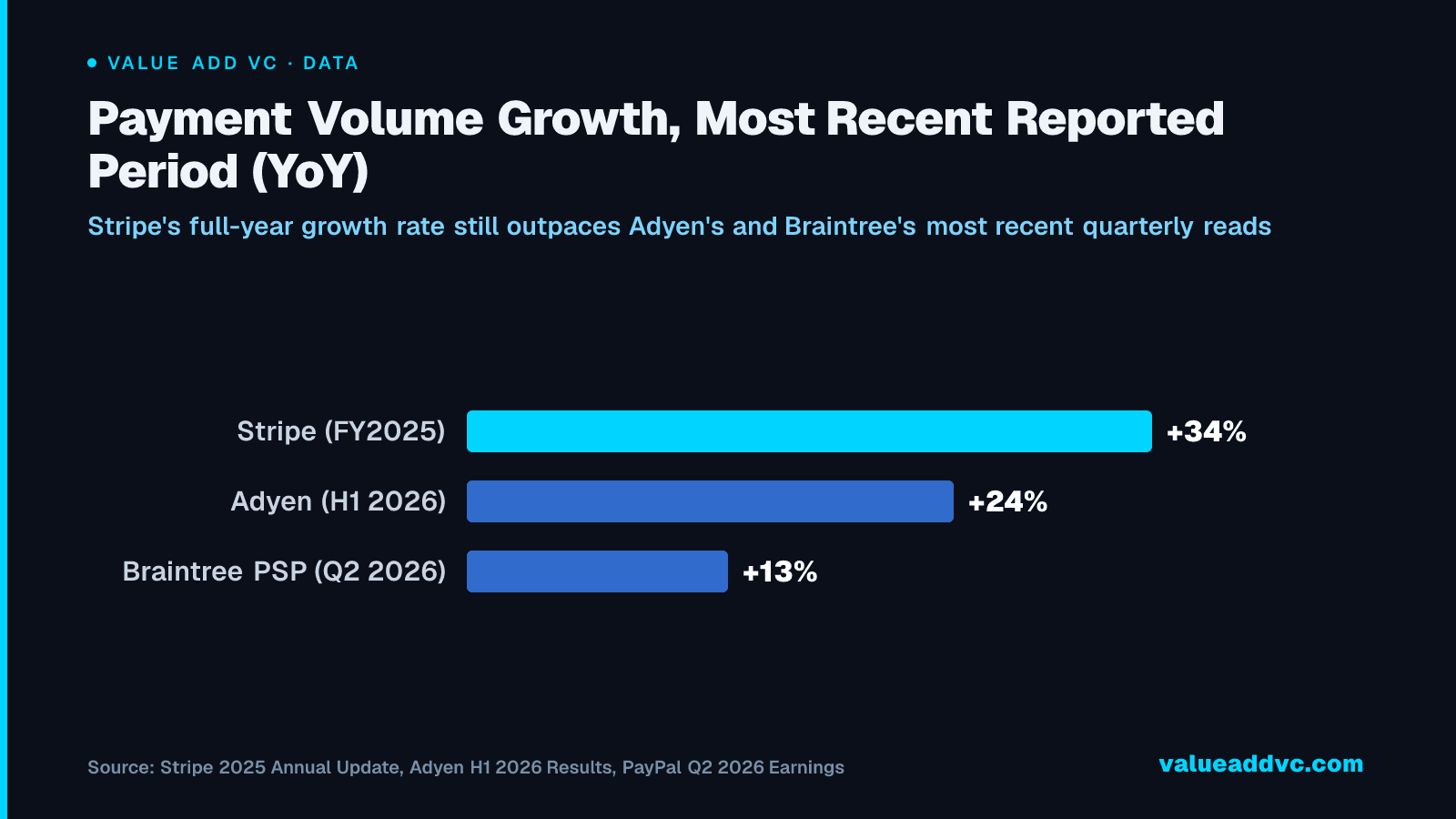
All three companies reported fresh numbers between June and August 2026, and the picture shifted at the margins. Adyen's H1 2026 results showed processed volume up 24% year-over-year to €803.8 billion, but net revenue grew only 19% (21% at constant currency) to €1,302.9 million — a gap analysts read as take-rate compression as large customers scale into Adyen's volume-tiered discounts. Meanwhile PayPal's Q2 2026 earnings report disclosed that Braintree's PSP volume growth accelerated to 13%, its ninth consecutive quarter of profitable growth — a reversal of the shrinking-Braintree narrative that dominated 2023 and 2024. Stripe has not published a mid-2026 volume update since its 2025 annual letter, so its most current disclosed figures are still the $1.9 trillion FY2025 volume and the $159 billion valuation confirmed in its February 2026 tender offer.
Payment Volume Growth, Most Recent Reported Period (YoY)
Stripe's full-year growth rate still outpaces Adyen's and Braintree's most recent quarterly reads
Stripe 2025 Annual Update, Adyen H1 2026 Results, PayPal Q2 2026 Earnings
Data
| Item | Value |
|---|---|
| Stripe (FY2025) | +34% |
| Adyen (H1 2026) | +24% |
| Braintree PSP (Q2 2026) | +13% |
What the headline numbers miss
Adyen's cost advantage is real but not static. Its fixed acquiring markup means the blended rate a merchant pays keeps falling as it grows — which is exactly the dynamic that produced the H1 2026 take-rate softness analysts flagged: Adyen's biggest customers are graduating into cheaper tiers faster than new volume replaces the margin. One read on this: the same mechanic that makes Adyen the low-cost option for a $500M merchant today will keep compressing Adyen's own economics as its customer base matures, which is a risk to Adyen's shareholders more than to a buyer choosing a processor — but it is a reason the €0.11 fixed markup should not be treated as permanently fixed in a vendor negotiation. None of the three companies' growth rates above are apples-to-apples: Stripe's is a full calendar year, Adyen's a half year, and Braintree's a single quarter, so treat them as directional, not as a ranked scoreboard.
The verdict: which processor wins enterprise payments in 2026
There is no single winner — but there is a clear answer per profile. For a global retailer or omnichannel brand processing serious volume where every basis point matters, Adyen wins on cost and platform unification. For a SaaS company, marketplace, or platform that treats payments as a product surface, Stripe wins on developer experience and embedded fintech. For a US consumer brand that lives and dies by PayPal and Venmo at checkout, Braintree wins on wallet-native acceptance.
If forced to name one overall winner for the median enterprise buyer in 2026, it's Adyen — its interchange-plus model is structurally cheaper at scale and its single global platform removes the integration tax that flat-rate processors hide. But "cheapest" only wins if cost is your bottleneck. For most software-led companies, the few extra basis points Stripe charges buy speed, optionality, and a fintech stack that turns payments from a line item into a revenue line. Track how these names trade and IPO on the Tech IPO tracker and SaaS Valuations dashboard.
Stop comparing sticker prices. At enterprise scale, all three negotiate.
Adyen wins on cost, Stripe wins on build, Braintree wins on the wallet — pick the bottleneck you're actually solving for.
Track payments and fintech valuations on the SaaS Valuations Dashboard at Value Add VC. Originally published in the Trace Cohen newsletter. See the full Adyen and Stripe company profiles for revenue, TPV, and business-model detail.
Latest from the Pulse
Get VC data most people never see
— free to subscribe
Trace's notes on venture, AI and startups, a few times a week. Join 5,000+ subscribers. No spam.
No spam, unsubscribe anytime. Sent via Substack · Privacy · or subscribe on Substack ↗