
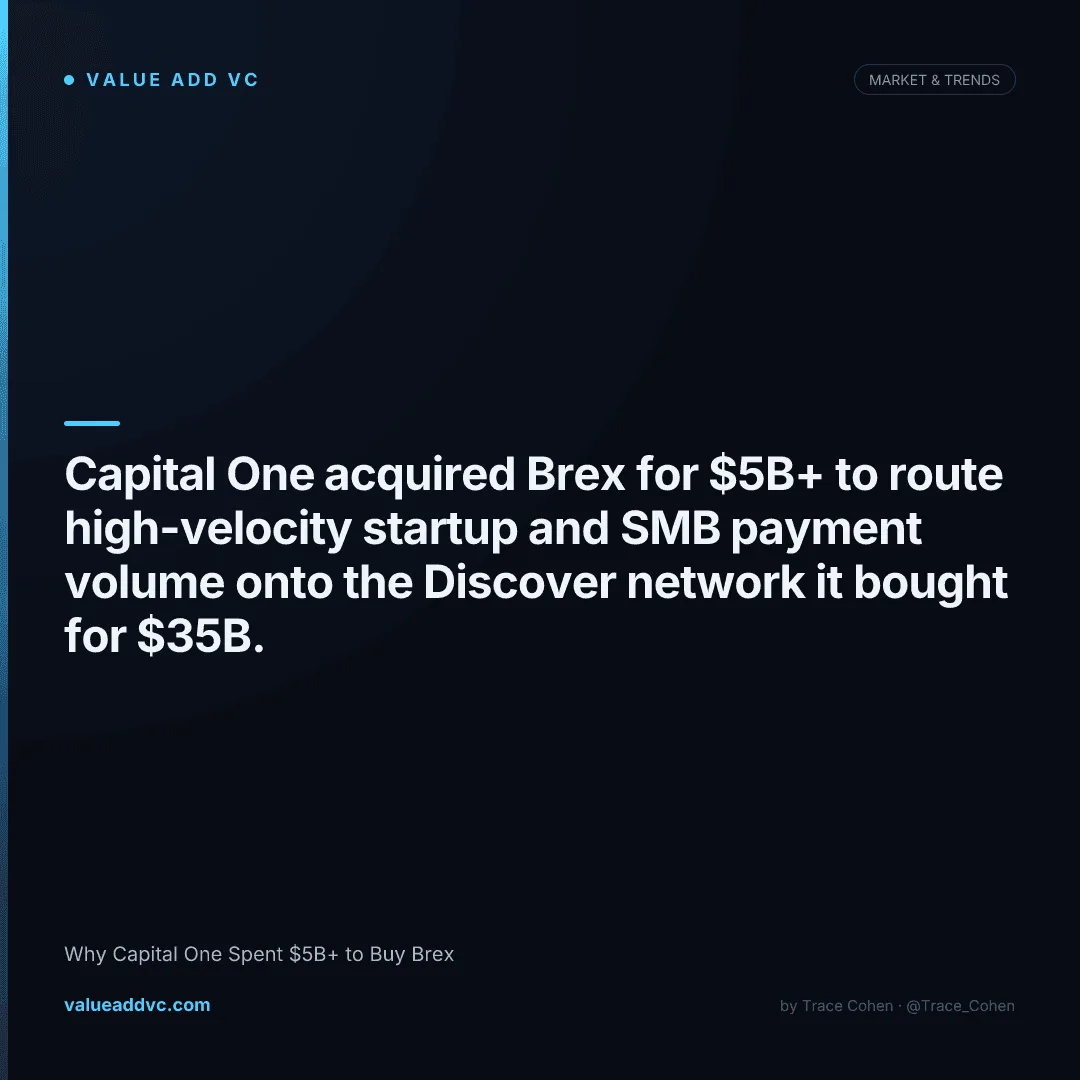
This is a rails business. Always has been.
Most coverage of the Brex acquisition focused on valuation. But $5B+ is just one part of the story. The even bigger picture is where Capital One is trying to reposition itself in the trillion-dollar payments stack. To understand why, you have to zoom out — past startups, past venture outcomes — and look at how power actually works in fintech payments.
How the Payments Stack Actually Works
Card Networks (Visa, Mastercard)
Operate global authorization, clearing, and settlement rails. Assign BINs, define network rules, certify issuers. Their moat is interoperability at scale.
Issuers (Capital One)
Licensed banks that extend credit, underwrite cardholders, manage fraud and chargebacks on the consumer side. Decide whether a transaction is approved — within network rules and fee structures.
Acquirers & Processors
Onboard merchants, provide terminals and gateways, manage merchant risk, handle settlement, interface with the network on behalf of the merchant.
American Express (different model)
Both issuer and network. Owns BINs, merchant relationships, and cardholder accounts. More control, fewer intermediaries — a payments platform with a balance sheet attached.
Most banks never had the option to own the network layer. They issued cards, but fees, rules, and product constraints were set by someone else. That structural reality defined the industry for decades. For a closer look at how the acquirer/processor layer prices out at enterprise scale, see Stripe vs Adyen vs Braintree, compared.
Why Discover Was Worth $35B
Visa
~52%
US market share
Mastercard
~24%
US market share
Amex
~19%
US market share
Discover
~5%
US market share
Owning Discover moved Capital One up the stack. Instead of being only an issuer on someone else's network, Capital One gained the ability to route transactions internally — fewer network tolls paid out, more basis points retained, more control over pricing and product structure over time.
Why Brex Is Strategic
Brex is not just a fintech customer base. It represents concentrated, high-velocity payment volume in a segment that matters: SMBs, startups, and tech-forward companies. These customers spend heavily, move quickly, and adopt new financial infrastructure earlier than the broader market.
Volume is oxygen for a network.
If Capital One wants Discover to matter more over time, it needs transaction flow. Brex provides a channel for that flow. Over the coming years, some portion of that volume can migrate off Visa and Mastercard rails onto Discover's — quietly, gradually, structurally.
This is not about the fintech customer base.
It's about feeding the network and acquiring the talent to scale it.
Originally published in the Trace Cohen newsletter. Explore fintech and VC analysis at Value Add VC. See the full Brex company profile for its funding history and business model.
Latest from the Pulse
Get VC data most people never see
— free to subscribe
Trace's notes on venture, AI and startups, a few times a week. Join 5,000+ subscribers. No spam.
No spam, unsubscribe anytime. Sent via Substack · Privacy · or subscribe on Substack ↗