
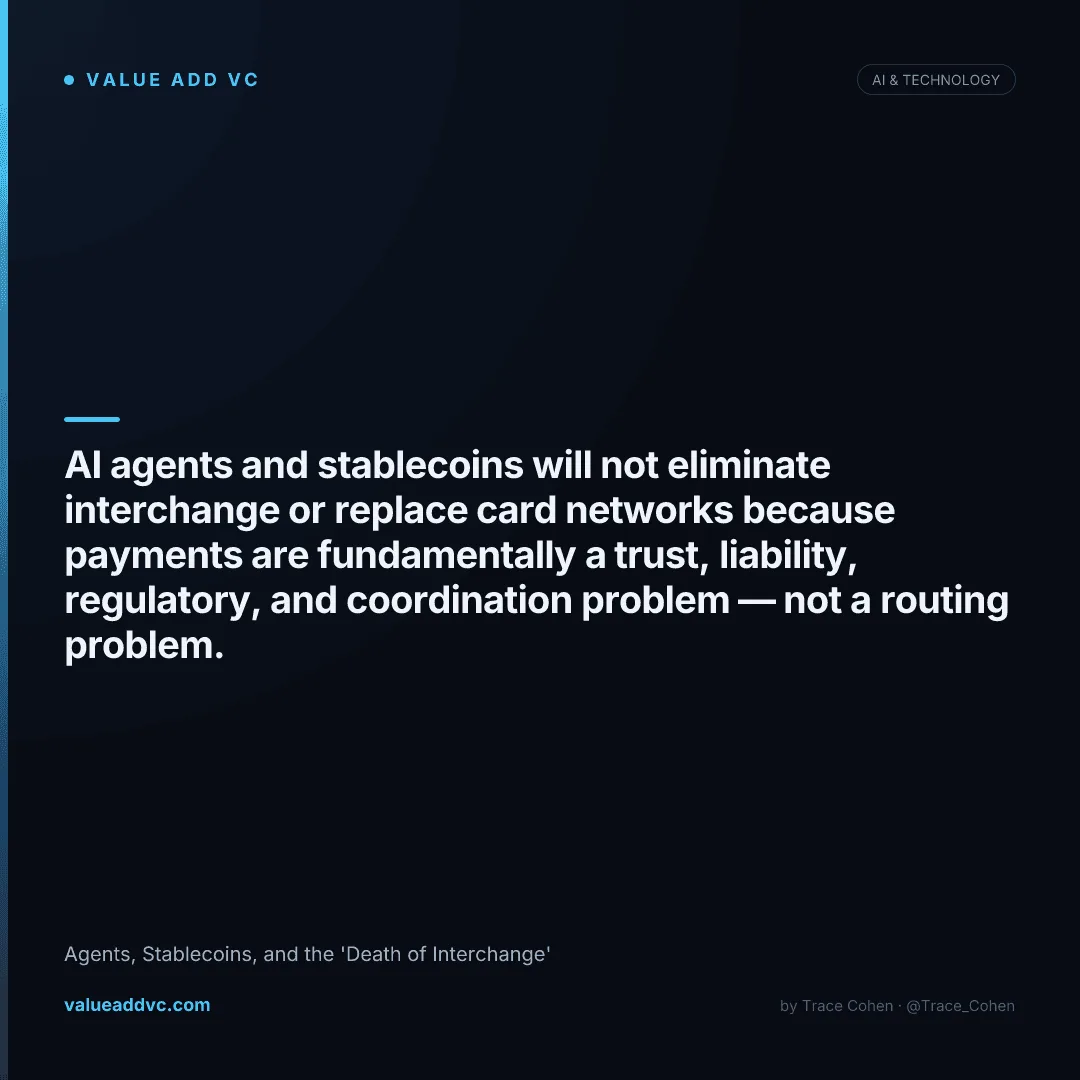
There's a growing narrative that AI agents plus stablecoins are about to eliminate interchange and route around the card networks. I don't think it plays out that way.
I say that not only as someone who invests in AI, but as someone who spent years at American Express working on B2B payments infrastructure. Payments look simple from the outside. They are not. They are not primarily a routing problem. They are a trust, liability, regulatory, and coordination problem.
8 Reasons the Narrative Doesn't Hold
Intelligence Does Not Replace Infrastructure
An agent can initiate a transaction. It cannot by itself solve the institutional coordination required to make that transaction compliant at global scale. Moving money requires capital requirements, supervision, and defined accountability — not just API calls.
Liability Is the Core Product
When consumers swipe a card, they are buying liability protection. If an AI agent makes an unauthorized purchase or misinterprets instructions, who is liable? The model provider? The wallet custodian? The stablecoin issuer? Until liability is clearly defined and regulated, agents cannot replace cards at scale.
Regulation Is Structural
Retail payments are among the most regulated systems in finance. Any alternative must address licensing across jurisdictions, identity verification, AML/KYC, consumer protection, data privacy, and cross-border legal alignment. From experience, regulatory alignment is often the gating factor.
Interchange Funds Real Infrastructure
Interchange funds fraud detection, dispute resolution, network security, compliance operations, and risk underwriting. If stablecoin rails expand into mainstream retail, they will need to rebuild many of these same functions. When that happens, cost structures return.
Stablecoin Economics Are Different
Most stablecoin issuers monetize through interest income on reserves. Card networks monetize payment volume, cross-border flows, data services, and fraud tooling. A treasury-backed token is not equivalent to a global switching network embedded in banking systems.
Reported Scale Can Be Misleading
Much stablecoin volume is crypto-native: exchange settlement, arbitrage, and treasury movements between trading entities. That is not the same as regulated retail commerce with consumer protection and dispute rights attached.
Consumers Follow Incentives
Consumers use cards because they receive points, cashback, travel benefits, purchase protection, and fraud coverage. Most consumers aren't going to manage wallets or custody keys to reduce a cost they don't directly perceive.
Integration Is More Likely Than Replacement
Stablecoins may serve as additional settlement rails. Agents may automate B2B and cross-border flows. Networks may incorporate tokenized infrastructure under existing consumer interfaces. Replacing global consumer card networks requires rebuilding the legal, regulatory, and risk architecture underneath them.
AI will influence payments. It may meaningfully reshape parts of the stack.
But replacing global consumer card networks is a structural challenge, not an API problem.
Originally published in the Trace Cohen newsletter. Explore more fintech and AI analysis at Value Add VC, including how enterprise processors actually price interchange today.
Latest from the Pulse
Get VC data most people never see
— free to subscribe
Trace's notes on venture, AI and startups, a few times a week. Join 5,000+ subscribers. No spam.
No spam, unsubscribe anytime. Sent via Substack · Privacy · or subscribe on Substack ↗