
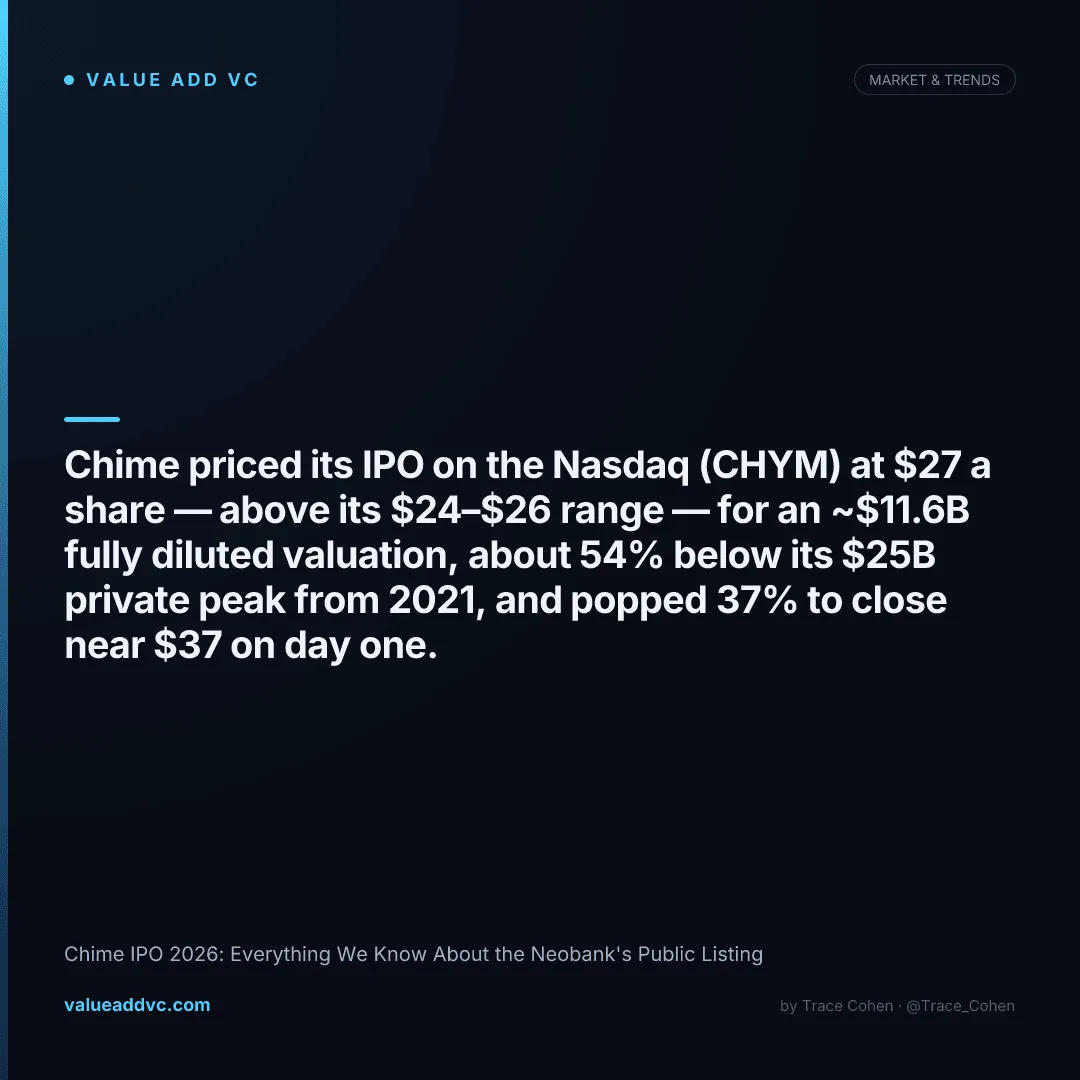
Chime went public in June 2025 at $27 a share. Sixteen months later, as of October 5, 2026, CHYM closed at $28.29 — after a year spent mostly below its IPO price — while revenue grew 27% and the company turned GAAP-profitable.
Correction (updated October 5, 2026): an earlier version of this article described Chime's IPO as a 2026 event and included several figures that did not match Chime's filings. Chime priced its IPO on June 11, 2025. The article has been rewritten from the final prospectus, Chime's quarterly earnings releases filed with the SEC, CNBC's reporting, and Yahoo Finance price history.
Chime is a useful case study for anyone holding late-stage private fintech paper. It listed at less than half of its peak private valuation, watched its stock fall well below the IPO price even as revenue grew, then rerated sharply after its second straight quarter of GAAP net income. In September 2026 it agreed to buy one of the banks it had been renting, which would make it a bank holding company. This post walks through each step with the underlying numbers.
The Chime IPO, by the numbers
Chime's amended S-1 marketed the shares at $24.00 to $26.00. The final prospectus, dated June 11, 2025, priced 32,000,000 Class A shares at $27.00 for $864 million in gross proceeds. Chime sold 25,900,765 of those shares and selling stockholders sold 6,099,235, so Chime's own take before expenses was about $662.6 million after the underwriting discount. Morgan Stanley, Goldman Sachs and J.P. Morgan led the deal. CNBC reported that the price valued Chime at $11.6 billion.
| Item | Detail | Source |
|---|---|---|
| Pricing date | June 11, 2025 | Final prospectus |
| First trading day | June 12, 2025 (Nasdaq: CHYM) | CNBC; Yahoo Finance |
| Marketed range | $24.00–$26.00 | Amended S-1 |
| IPO price | $27.00 | Final prospectus |
| Shares sold | 32.0M (25.9M by Chime, 6.1M by holders) | Final prospectus |
| Gross proceeds | $864M | Final prospectus |
| Valuation at pricing | $11.6B | CNBC |
| First-day open / close | $43.00 / $37.11 | Yahoo Finance |
| 2024 revenue | $1,673.3M | Final prospectus (audit report) |
| Active Members at IPO | 8.6M (as of Mar 31, 2025) | Final prospectus |
The prospectus also set up a dual-class structure. Co-founders Chris Britt and Ryan King held roughly 34.7% and 31.3% of the voting power after the offering, according to the filing, through Class B shares that carry 20 votes each.
Valuation: $25B private peak vs. $11.6B at the IPO
In August 2021, Chime raised $750 million in a Series G at a $25 billion valuation, CNBC reported at the time, with SoftBank, Sequoia Capital Global Equities, General Atlantic, Tiger Global and Dragoneer among the primary investors. CNBC put the prior valuation at $15 billion in October 2020, citing PitchBook data.
The IPO valuation of $11.6 billion was therefore about 54% below the 2021 round on a headline basis. CNBC reported that Chime's largest institutional holders before the offering were DST Global and Crosslink Capital, with 17% and 9.5% of shares. For 2020–2021 vintage fintech positions generally, a listing like this delivers real liquidity, but whether it is a gain or a loss depends on the round an investor bought into.
For a current reference point: Chime's Q2 2026 10-Q reports 347.0 million Class A and 31.6 million Class B shares outstanding as of August 3, 2026. At the October 5, 2026 close of $28.29, that is a basic market capitalization of roughly $10.7 billion. That figure counts only outstanding shares, so it is not directly comparable to the $11.6 billion valuation CNBC reported at pricing, which may rest on a different share count (for example, one that includes equity awards).
How CHYM stock has traded since the IPO
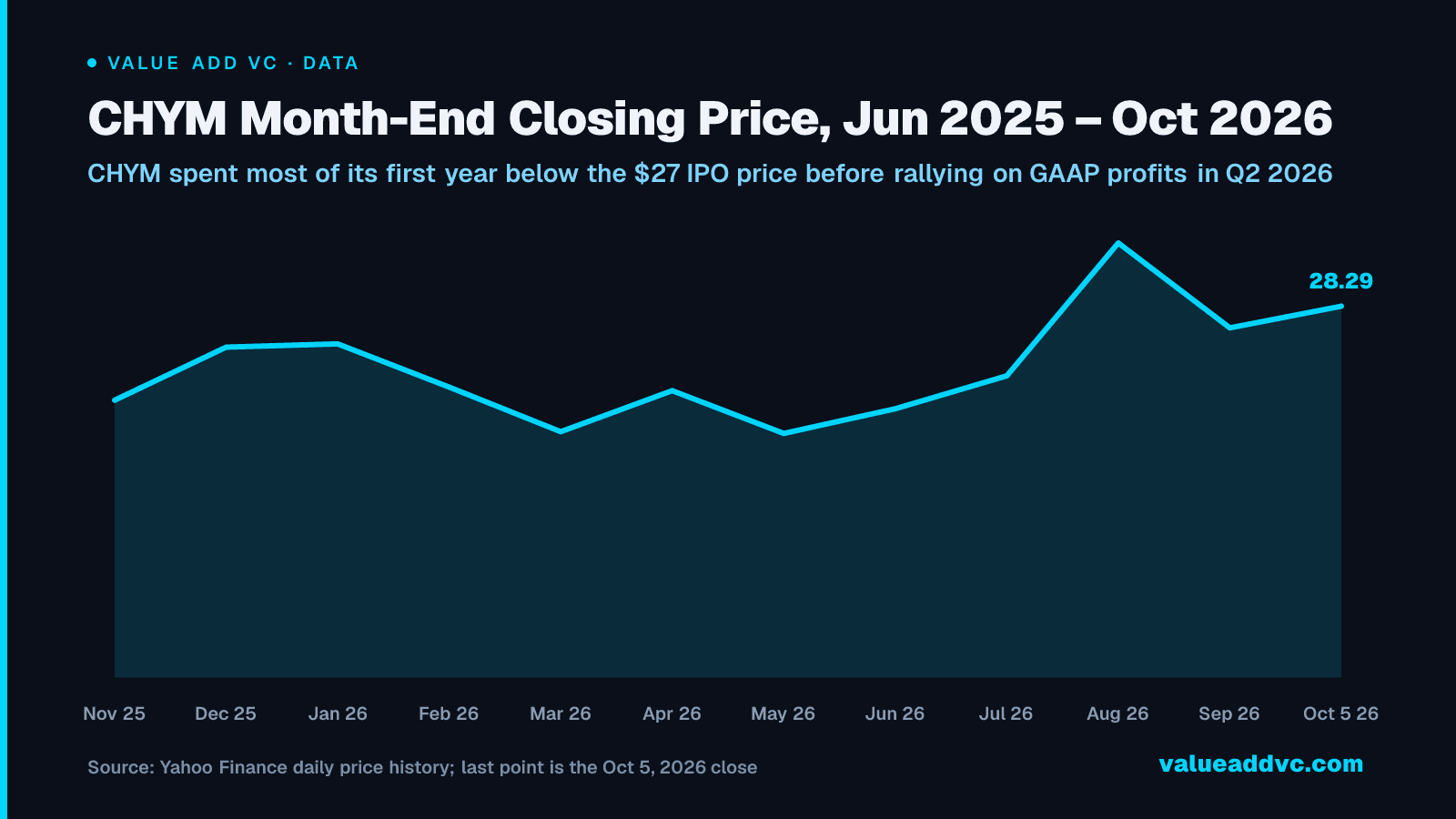
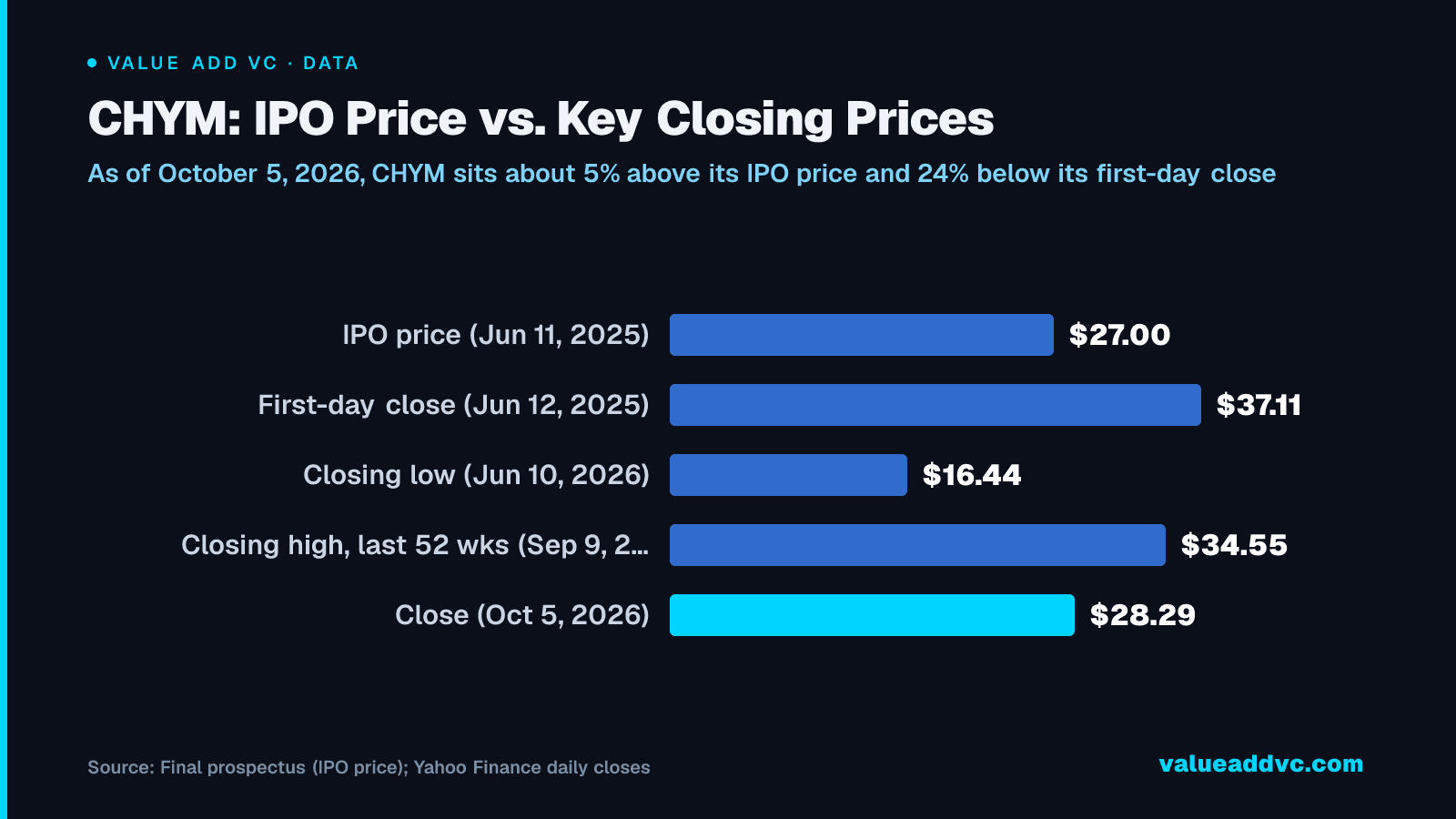
Based on Yahoo Finance daily price history, CHYM opened at $43 on June 12, 2025 and closed its first day at $37.11, 37% above the IPO price. The pop did not hold. Shares closed below $27 by late August 2025 and ended October 2025 at $17.17, even as quarterly revenue kept growing 25% or more year over year.
The stock's closing low came on June 10, 2026 at $16.44 (intraday low $15.88 the next day), almost exactly one year after the IPO and about 39% below the offering price. The turn came with the second-quarter print: CHYM closed at $25.92 on August 5, 2026, the day results came out, and at $31.25 on August 6, a 20.6% one-day gain. It closed at $34.55 on September 9, the day after the Stride Bank announcement, then gave back part of the gain to close at $28.29 on October 5, 2026.
CHYM Month-End Closing Price, Jun 2025 – Oct 2026
CHYM spent most of its first year below the $27 IPO price before rallying on GAAP profits in Q2 2026
Yahoo Finance daily price history; last point is the Oct 5, 2026 close
Data
| Item | Close ($) |
|---|---|
| Jun 25 | 34.51 |
| Jul 25 | 34.41 |
| Aug 25 | 26.41 |
| Sep 25 | 20.17 |
| Oct 25 | 17.17 |
| Nov 25 | 21.13 |
| Dec 25 | 25.17 |
| Jan 26 | 25.42 |
| Feb 26 | 22.13 |
| Mar 26 | 18.73 |
| Apr 26 | 21.86 |
| May 26 | 18.6 |
| Jun 26 | 20.48 |
| Jul 26 | 22.99 |
| Aug 26 | 33.11 |
| Sep 26 | 26.64 |
| Oct 5 26 | 28.29 |
CHYM: IPO Price vs. Key Closing Prices
As of October 5, 2026, CHYM sits about 5% above its IPO price and 24% below its first-day close
Final prospectus (IPO price); Yahoo Finance daily closes
Data
| Item | Value |
|---|---|
| IPO price (Jun 11, 2025) | $27.00 |
| First-day close (Jun 12, 2025) | $37.11 |
| Closing low (Jun 10, 2026) | $16.44 |
| Closing high, last 52 wks (Sep 9, 2026) | $34.55 |
| Close (Oct 5, 2026) | $28.29 |
The business since the IPO: five quarters of results
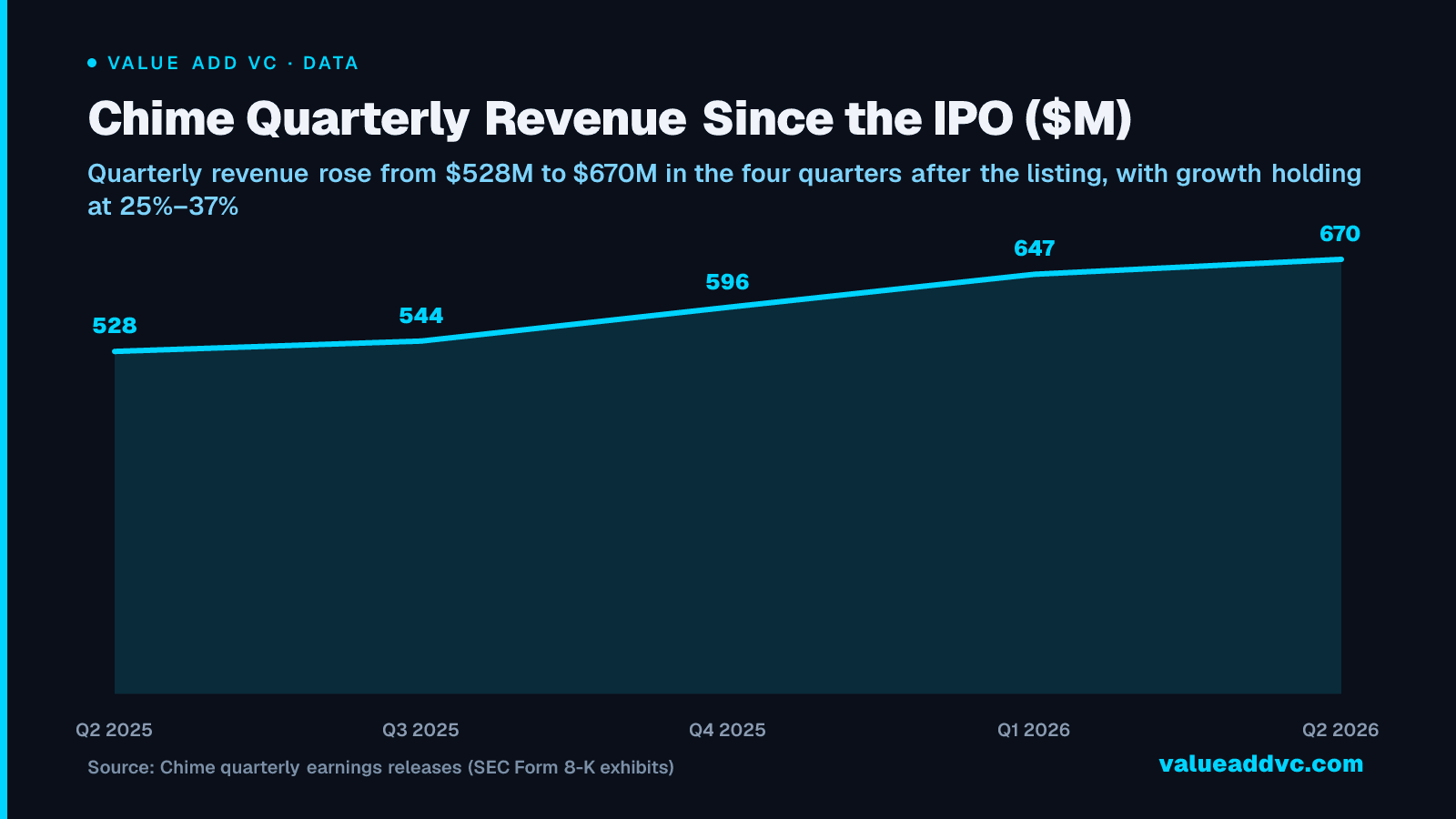
Revenue has grown every quarter since the listing. Chime's full-year 2025 results showed revenue of $2.2 billion, up 31%, and adjusted EBITDA of $127 million. The GAAP picture was distorted by the IPO itself: Chime reported a $923 million net loss in Q2 2025, which it attributed mainly to $928 million of stock-based compensation and related payroll tax triggered by the offering.
| Quarter | Revenue | YoY growth | GAAP net income (loss) | Adj. EBITDA | Active Members |
|---|---|---|---|---|---|
| Q2 2025 | $528M | +37% | ($923M) | $16M | 8.7M |
| Q3 2025 | $544M | +29% | ($55M) | $29M | 9.1M |
| Q4 2025 | $596M | +25% | ($45M) | $57M | 9.5M |
| Q1 2026 | $647M | +25% | $53M | $119M | 10.2M |
| Q2 2026 | $670M | +27% | $28M | $102M | 10.4M |
Sources: Chime earnings releases for Q2 2025, Q3 2025, Q4 2025, Q1 2026 and Q2 2026, filed as exhibits to Form 8-K. Adjusted EBITDA is a non-GAAP measure.
Chime Quarterly Revenue Since the IPO ($M)
Quarterly revenue rose from $528M to $670M in the four quarters after the listing, with growth holding at 25%–37%
Chime quarterly earnings releases (SEC Form 8-K exhibits)
Data
| Item | Revenue ($M) |
|---|---|
| Q2 2025 | 528 |
| Q3 2025 | 544 |
| Q4 2025 | 596 |
| Q1 2026 | 647 |
| Q2 2026 | 670 |
Q1 2026 was Chime's first GAAP-profitable quarter as a public company, according to its Q1 2026 release, and Q2 2026 was the second. Guidance moved up all year. In February 2026 Chime guided to 2026 revenue of $2.63–$2.67 billion; it raised that to $2.66–$2.69 billion in May, to $2.725–$2.745 billion with Q2 results in August, and to $2.76–$2.77 billion (about 26%–27% growth) alongside the Stride Bank announcement on September 8, 2026. The same release guided Q3 2026 revenue to $705 million, roughly 30% growth, and full-year adjusted EBITDA to $481–$489 million.
How Chime makes money
Chime's 10-Q describes payments revenue as interchange: fees generated when members make purchases with Chime-branded debit and credit cards, which Chime's partner banks collect as the issuers and pass on to Chime. In Q2 2026, payments revenue was $430 million, about 64% of the $670 million total, and grew 17% year over year. Purchase volume reached $38 billion in the quarter.
The faster-growing line is platform-related revenue, which rose 48% to $240 million in Q2 2026. Per the 10-Q, it comes from products including MyPay (earned-wage advances with a fee for instant delivery), ATMs, outbound instant transfers, SpotMe, Instant Loans, cash deposits, third-party partnerships and high-yield savings. Chime said MyPay originations reached $4.5 billion in Q2 2026 with a 0.9% loss rate, and Instant Loans originations grew nearly 70% quarter over quarter to $300 million.
Payments revenue — $430M (Q2 2026)
Interchange on Chime debit and credit card purchases. +17% YoY.
Platform-related revenue — $240M (Q2 2026)
MyPay, Instant Loans, ATMs, instant transfers, SpotMe and more. +48% YoY.
Chime Prime
Premium tier launched in April 2026 for members with $3,000+ in monthly qualifying direct deposits.
ARPAM — $260 (Q2 2026)
Average revenue per Active Member, +6% YoY.
The structural risk sits in the interchange line. The 10-Q's risk factors say Chime depends in part on its bank partners keeping the Durbin Amendment's small-issuer exemption from debit interchange limits, and that payments revenue could be harmed if a partner lost it. Under the Federal Reserve's Regulation II, exempt issuers are those that, together with their affiliates, report assets of less than $10 billion. That is the context for the line in the Stride announcement that Chime will manage its balance sheet to keep assets below $10 billion for the foreseeable future.
The Stride Bank deal: Chime becomes a bank holding company
On September 8, 2026, Chime announced a definitive agreement to acquire Stride Bank, N.A., its partner bank for more than seven years, for $590 million in cash. Under the merger agreement, Chime is buying Stride's Oklahoma parent, Central Service Corporation, and the filing notes that Chime will become a bank holding company as a result.
| Price | $590M cash, funded from Chime's balance sheet |
| Valuation of target | About 1.5x Stride's tangible book value, per Chime |
| Expected net synergies | More than $100M (partner-bank fee savings, lending expansion, lower cost of funds) |
| Approvals needed | OCC and Federal Reserve Board |
| Expected close | First half of 2027 |
| After closing | Stride becomes Chime Bank, N.A.; Chime plans to keep assets below $10B |
The deal addresses two weaknesses in the partner-bank model at once: Chime pays fees to the banks that hold its members' deposits, and it does not control the charter its interchange economics depend on. It also adds new exposure — bank regulation at the holding-company level and the integration of a century-old community bank. Until the deal closes, member deposits remain FDIC-insured through The Bancorp Bank, N.A. or Stride Bank, N.A., as the announcement states.
Other changes since the listing
- Buybacks: Chime announced a $200 million share repurchase program with Q3 2025 results and an additional $200 million authorization with Q1 2026 results.
- Leadership: Mark Troughton, previously COO, was appointed President effective December 8, 2025. CFO Matt Newcomb stepped down effective August 7, 2026, and Troughton became President and Interim CFO.
- Headcount: on July 31, 2026, Chime committed to a reorganization cutting about 10% of its workforce, with an estimated $16–$20 million in net cash restructuring charges in Q3 2026.
- Products: Chime launched Chime Prime and Chime Invest (commission-free investing through Atomic Invest) in 2026, and says its Chime Card credit mix reached 27% of purchase volume in Q2 2026.
What Chime's first 16 months say about fintech IPOs
Three lessons stand out. First, a successful pricing day is not a verdict. CHYM priced above its range and popped 37% on day one, then traded below the offering price for most of the following year while revenue grew 25%+ every quarter. Second, the rerating arrived with GAAP profit, not with growth alone: the 20.6% jump on August 6, 2026 came after the Q2 2026 report that showed a second straight quarter of positive net income alongside raised guidance. Third, the valuation gap from 2021 has not closed — at $28.29, Chime's basic market cap of roughly $10.7 billion is still well under the $25 billion of its Series G.
For late-stage private fintechs such as Stripe and Plaid, Chime is a reference point for how public investors price consumer fintech: on margins and durability of the revenue line rather than on member counts. For LPs in 2020–2021 vintage funds, it is a reminder that an IPO can return capital to early holders while leaving peak-round investors below cost.
You can follow upcoming listings and current filing status on the IPO pipeline and the tech IPO tracker.
Chime's IPO was a 2025 event, priced at $27 and $11.6 billion.
The story since is a company that kept growing, turned GAAP-profitable in 2026, and is now buying its own bank — with a stock that, as of October 5, 2026, is roughly back where it started.
Figures are from Chime's SEC filings, CNBC reporting and Yahoo Finance price history, last checked October 5, 2026. Stock prices are daily closes unless noted. Track the IPO market on the Tech IPO dashboard at Value Add VC.
Latest from the Pulse
Get VC data most people never see
— free to subscribe
Trace's notes on venture, AI and startups, a few times a week. Join 5,000+ subscribers. No spam.
No spam, unsubscribe anytime. Sent via Substack · Privacy · or subscribe on Substack ↗