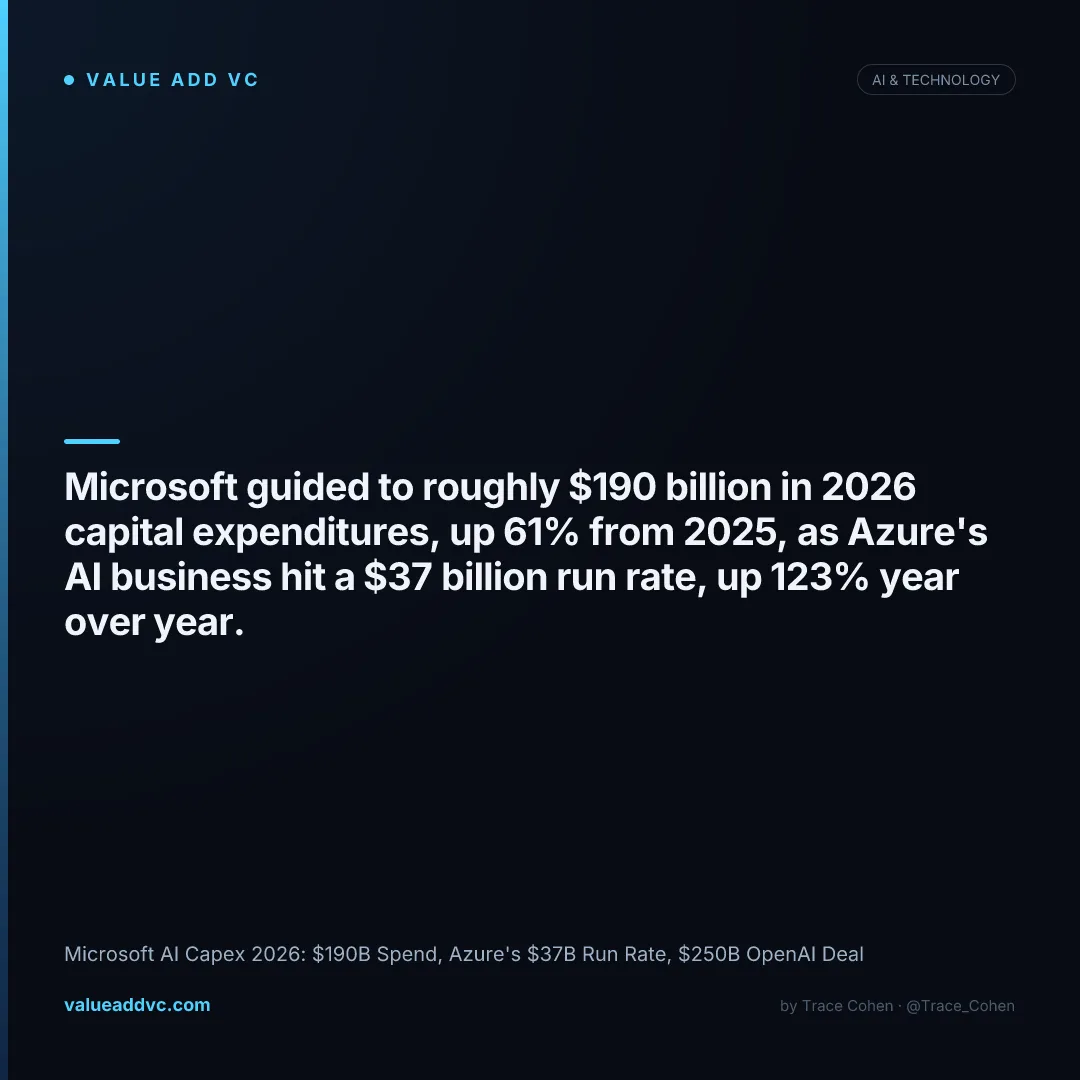
Microsoft guided to roughly $190 billion in calendar 2026 capital expenditures — up 61% from 2025 — as Azure's AI business hit a $37 billion annual run rate, up 123% year over year. That's the short answer. The longer answer is that OpenAI alone has now contracted to buy $250 billion of incremental Azure capacity, and Microsoft still can't build data centers fast enough to keep up.
A year ago, Microsoft was spending about $80 billion a year on AI-enabled data centers and calling it an aggressive bet. In 2026, that number has more than doubled to $190 billion, and CFO Amy Hood told investors on the April 2026 earnings call that demand still exceeds the capacity Microsoft can bring online. This is the clearest data point yet on whether hyperscaler AI spending is disciplined investment or an arms race with no ceiling — and the answer, based on Azure's growth numbers, is that Microsoft thinks the ceiling is still a long way off.
Update (Jul 29, 2026): after extending data-center useful lives, Microsoft now guides ~$175B for CY2026 including finance leases; Hood said underlying investment plans are unchanged ("Outside of this useful life impact, our calendar year 2026 CapEx investment expectations remain unchanged," per CFO Dive). After the late-July Q2 calls, the big four's combined 2026 capex guidance is roughly $730 billion.
Figures are 2025-2026 data blended from Microsoft's FY2026 Q1-Q3 earnings calls and 10-Q filings, CNBC, GeekWire, and Alphastreet reporting on Microsoft's April 2026 earnings. Azure AI run rate and growth figures are as disclosed in Microsoft's fiscal Q3 2026 (quarter ended March 2026) results.
How Much Is Microsoft Spending on AI Capex in 2025 and 2026?
Microsoft spent roughly $80 billion on AI-enabled data centers and infrastructure in fiscal 2025 (the year ended June 2025), a figure the company first disclosed in January 2025 and that held up as an accurate full-year number. For calendar 2026, Microsoft has now guided to approximately $190 billion in total capital expenditures — a 61% increase year over year, and more than double what it was spending just two years earlier. CFO Amy Hood attributed roughly $25 billion of that 2026 increase specifically to higher memory and component prices rather than net-new capacity, meaning the real physical build-out, while still enormous, is growing somewhat slower than the headline dollar figure suggests.
Microsoft AI Capex: Fiscal 2025 vs Calendar 2026 Guidance
Microsoft FY2026 Q1-Q3 earnings calls, CNBC, CFO Dive
Azure's AI Business Is Growing Faster Than the Capex That Funds It
The number that justifies Microsoft's spending, in the eyes of most analysts, is Azure's AI run rate: $37 billion annualized as of fiscal Q3 2026 (quarter ended March 2026), up 123% year over year. That's not total Azure revenue — it's the AI-specific slice, and it's growing faster than Azure overall, which itself grew 39-40% in constant currency in the same quarter, beating Microsoft's own guidance and a roughly 35-36% analyst consensus. Microsoft Cloud revenue overall came in at $54.5 billion for the quarter, up 29% year over year, on total company revenue of $82.9 billion, up 18%, with GAAP EPS of $4.27, up 23%.
For Q4 fiscal 2026, Microsoft guided to $86.7-87.8 billion in revenue and Azure growth of 39-40% in constant currency — again above the roughly 37% StreetAccount consensus — with quarterly capex expected to exceed $40 billion. Satya Nadella has said the company plans to double its overall AI infrastructure capacity within two years, and more than 80% of Fortune 500 companies are now reported to be using Azure AI services in some form, which is the demand signal Microsoft points to when justifying the spend to investors who have grown increasingly nervous about capex-to-revenue ratios across the entire hyperscaler cohort. CFO Amy Hood has also flagged that power availability, not chip supply, is the real bottleneck keeping Microsoft's unfulfilled Azure backlog stuck near $80 billion.
The $250B OpenAI Commitment and What It Means for Microsoft's Azure Backlog
On October 28, 2025, Microsoft and OpenAI signed a definitive agreement under which OpenAI contracted to purchase an incremental $250 billion of Azure services, on top of whatever OpenAI was already spending with Microsoft. That commitment came as part of a broader restructuring of Microsoft's stake in OpenAI, and it stacks on top of OpenAI's own separate disclosure that it expects to spend roughly $50 billion on computing power across all providers in 2026 — meaning Microsoft is only one, if likely the largest, of OpenAI's compute vendors, alongside deals like the SoftBank-backed Stargate infrastructure project. The original $13 billion investment that seeded this partnership came with its own unusual terms, including provisions tied to how the relationship changes if OpenAI reaches artificial general intelligence — details we unpack in our explainer on what the original agreement actually covers.
The $250 billion figure is a contracted commitment, not revenue booked in a single year — it will show up in Azure's numbers gradually as OpenAI actually consumes the capacity, which is itself gated by how fast Microsoft can physically build data centers and secure power. That's the central tension in Microsoft's 2026 story: the demand backlog (OpenAI's $250B commitment, Azure's 40% growth, more than 80% of the Fortune 500 on Azure AI) is larger than the supply Microsoft has been able to bring online, which is exactly why capex guidance keeps climbing rather than plateauing. We track deal structures like this on our AI valuations dashboard, where compute commitments increasingly function as a proxy for revenue visibility in AI company valuations.
Microsoft's 2026 AI Capex vs Amazon, Google, and Meta
Microsoft's $190 billion 2026 capex guidance puts it in the middle of the pack among the four largest hyperscalers, not at the top. Amazon has guided to roughly $200 billion, driven mostly by AWS data center expansion. Google/Alphabet has guided to $175-185 billion, nearly doubling its 2025 spend as it leans into TPU-based infrastructure for Gemini. Meta has disclosed $115-135 billion in 2026 capex, also nearly double its $72 billion spent in 2025. Combined, the four companies are on pace to spend around $725 billion in 2026, up roughly 77% from about $410 billion in 2025 — with more than 60% of that spend reportedly going into power, cooling, and physical data center construction rather than chips alone.
The Full Numbers: Microsoft AI Capex vs. Its Hyperscaler Peers in 2026
| Metric | Microsoft | Amazon | Meta | |
|---|---|---|---|---|
| 2026 Capex Guidance | $190B | $200B | $175-185B | $115-135B |
| 2025 Capex (approx.) | $80B (FY25 AI-specific) | $125B | ~$91B | $72B |
| YoY Capex Growth | +61% | ~+60% | ~+95% | ~+70% |
| Cloud Segment Growth (latest qtr.) | 40% (Azure) | ~20% (AWS) | ~30% (Google Cloud) | n/a — ads-led business |
| Primary AI Compute Bet | Nvidia GPUs + Maia silicon | Trainium + Nvidia | TPU v5/v6 + Nvidia | MTIA + Nvidia |
| Headline AI Customer Commitment | OpenAI: $250B incremental | Anthropic investment + AWS usage | Gemini/internal + cloud customers | Internal (Llama, ads, Meta AI) |
| Market Cap (July 2026) | ~$2.87T | ~$2.3T | ~$2.2T | ~$1.5T |
Figures are 2025-2026 estimates blended from company earnings calls and 10-Q/10-K filings, CNBC, Seeking Alpha, Tom's Hardware, and Yahoo Finance reporting as of July 2026. Market cap figures are approximate as of mid-July 2026 and fluctuate daily; cloud growth figures reflect each company's most recently reported quarter.
Is Microsoft's AI Capex Actually Paying Off?
The bear case on hyperscaler AI capex is that it's outrunning demand and will eventually crush free cash flow. Microsoft's own numbers argue against that, at least for now: fiscal Q3 2026 revenue of $82.9 billion (up 18%) and GAAP EPS of $4.27 (up 23%) both beat expectations in the same quarter capex kept climbing, and Azure's 39-40% guided growth for Q4 came in above consensus rather than below it. That combination — accelerating growth alongside accelerating spend — is the pattern investors want to see, and it's why Microsoft's stock, despite a rough 2026 with shares down from a 52-week high of $555.45 to around $397 in mid-July, still commands a market cap near $2.87 trillion.
The risk isn't that Microsoft is spending too much relative to demand — it's that demand (OpenAI's $250B commitment, 40% Azure growth, more than 80% Fortune 500 penetration) has consistently outpaced Microsoft's ability to physically build capacity, which is a supply-chain and power-grid problem more than a financial one. That's a better problem to have than the alternative, but it's also why capex guidance has jumped from $80 billion to $190 billion in roughly eighteen months with no sign of flattening.
The other variable investors are watching is depreciation. As Microsoft brings tens of billions of dollars of GPU clusters online each quarter, depreciation expense on that hardware flows straight through the income statement, and Nvidia-generation GPUs typically depreciate over just 4-6 years — much faster than the office buildings and general-purpose servers that made up most of Microsoft's capex a decade ago. Microsoft itself extended its useful-life assumption on servers and network equipment from 4 to 6 years, a change with real implications for how overstated AI-era profits might be. That's part of why Wall Street now scrutinizes the gap between capex and free cash flow growth almost as closely as it watches Azure's headline growth rate, since a slowdown in cloud demand would hit Microsoft's margins on a lag, through depreciation already locked in from data centers built in 2025 and 2026.
Bottom line: Microsoft is guiding to roughly $190 billion in 2026 AI capex — up 61% from 2025 and more than double the roughly $80 billion it budgeted for AI-enabled data centers in fiscal 2025, and the growth story backing that spend looks real so far — Azure's AI business is at a $37 billion run rate, up 123% year over year, and OpenAI alone has committed to $250 billion in incremental Azure purchases. Among the big four hyperscalers, Microsoft's spend sits second to Amazon's roughly $200 billion, as the group collectively pushes toward $725 billion in combined 2026 capex. The number to watch from here isn't the capex figure itself — it's whether Azure's 39-40% growth guidance holds through the back half of 2026, because that's the only thing that will tell investors whether $190 billion was disciplined investment or the peak of the cycle. Track live data on the AI Spending Tracker.
Latest from the Pulse
Get VC data most people never see
— free to subscribe
Trace's notes on venture, AI and startups, a few times a week. Join 5,000+ subscribers. No spam.
No spam, unsubscribe anytime. Sent via Substack · Privacy · or subscribe on Substack ↗