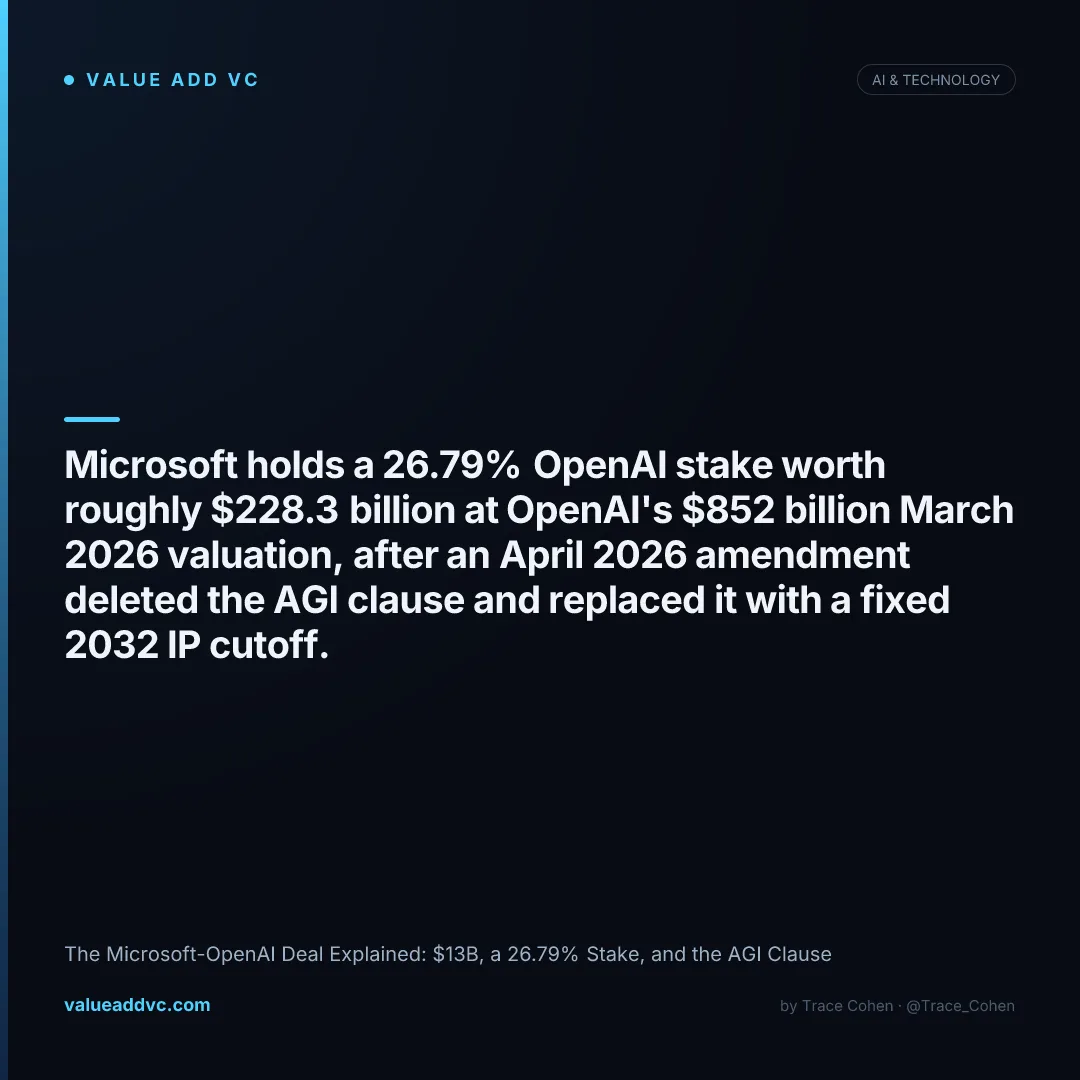
Microsoft's 26.79% OpenAI stake is worth roughly $228.3 billion at OpenAI's $852 billion valuation — on a cumulative $13 billion investment. That's the short answer. The longer answer is that the deal's most important clause just got deleted entirely.
I've tracked this relationship since the first Microsoft-OpenAI checks went out, and the April 2026 amendment is the biggest structural shift in the partnership since OpenAI's for-profit conversion. Microsoft gave up exclusivity, OpenAI gave Microsoft a fixed, dated IP guarantee instead of an open-ended AGI trigger, and the revenue-share math changed too. Here's exactly what's in the amended agreement and what it means for both companies.
Sources: CNBC, Directions on Microsoft, Spyglass, Microsoft 10-Q filings, checked July 2026.
What Does the Microsoft-OpenAI Deal Actually Give Microsoft?
The Microsoft-OpenAI deal gives Microsoft a 26.79% economic stake in OpenAI's Public Benefit Corporation, a 20% share of OpenAI's revenue through 2030 under a newly imposed cap, and IP access to OpenAI's models locked in through a fixed 2032 date. That stake, formalized in OpenAI's October 2025 restructuring from nonprofit to PBC, was worth approximately $228.3 billion as of OpenAI's $852 billion March 2026 funding round — up from roughly 32.5% estimated before the recapitalization diluted Microsoft's position.
| Deal Term | Before April 2026 | After April 2026 Amendment |
|---|---|---|
| AGI clause | Open-ended — triggered a Microsoft response if OpenAI declared AGI | Deleted entirely, replaced by a fixed 2032 IP cutoff date |
| Revenue share | 20%, uncapped, tied to OpenAI's compute usage | 20%, capped, runs through 2030 regardless of tech progress |
| Cloud exclusivity | Microsoft Azure exclusive infrastructure partner | Non-exclusive — OpenAI models now on AWS Bedrock |
| Equity stake | ~32.5% estimated pre-recapitalization | 26.79% fully diluted, formalized October 2025 |
| Stake value | Not formally quantified pre-PBC conversion | ~$228.3B at $852B March 2026 valuation |
| IP access horizon | Undefined, contingent on AGI determination | Fixed through 2032, independent of AGI status |
Figures are 2026 estimates blended from CNBC, Directions on Microsoft, Spyglass, and Microsoft SEC filings. Stake value fluctuates with OpenAI's most recent private funding round valuation.
Why Microsoft Let the AGI Clause Get Deleted
The original AGI clause was a landmine for Microsoft: if OpenAI's board ever declared it had reached artificial general intelligence, Microsoft's access to the most advanced future models could have been cut off or renegotiated on OpenAI's terms. Deleting that clause and replacing it with a hard 2032 date removes the ambiguity entirely — Microsoft now knows exactly how long its IP rights last, independent of any subjective AGI determination OpenAI's board might make. The tradeoff was exclusivity: OpenAI's compute and model-licensing relationship with Microsoft is now non-exclusive, and OpenAI models showed up on AWS Bedrock the day after the amendment was announced. For more on how AI-lab valuations compare across the frontier model race, see our AI valuations dashboard.
What Happens at AGI Now That the Clause Is Gone?
With the AGI clause removed, nothing contractually specific happens if OpenAI declares AGI — Microsoft's IP rights simply run to 2032 regardless of that determination, and the two companies' financial relationship (the capped 20% revenue share) continues through 2030 on its own separate timeline. This is a meaningful shift from the pre-2026 structure, where an AGI declaration could have triggered a genuine renegotiation or termination event.
For investors, the practical read is that Microsoft traded a scenario with sharp, binary risk (losing access at an ambiguous future AGI moment) for a scenario with a known, dated horizon and reduced exclusivity. That's a rational trade for a company holding $228.3 billion of exposure to a single private company — certainty about the IP timeline matters more than exclusivity once the stake gets that large. Compare this to how other frontier-model investments are structured on our big tech earnings dashboard.
Microsoft-OpenAI Deal: Old Terms vs New Terms
CNBC, Directions on Microsoft, Spyglass, 2026
Bottom line: Microsoft's $13 billion cumulative bet on OpenAI is now worth roughly $228.3 billion on a 26.79% stake, and the April 2026 amendment traded away Azure exclusivity for a fixed, dated IP guarantee through 2032 and a capped 20% revenue share through 2030. The AGI clause that once made this partnership's future uncertain is gone — replaced by contract terms both sides can actually plan around. Explore more AI infrastructure and valuation benchmarks on Value Add VC.
Latest from the Pulse
Get VC data most people never see
— 100% free
Weekly benchmarks, valuations, and fund data. Join 5,000+ investors. No spam.