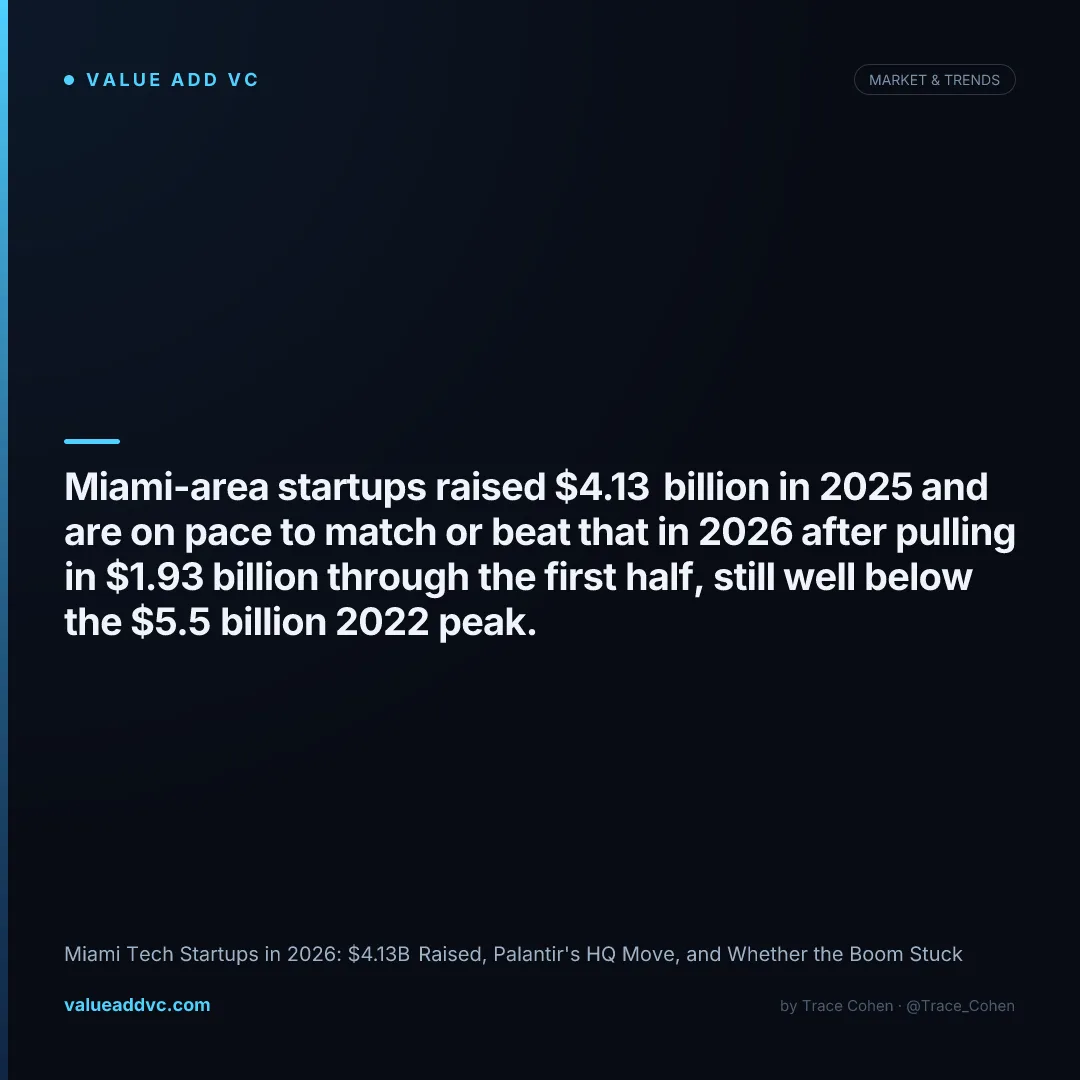
Miami-area startups raised $4.13 billion in 2025 — the best year since the 2022 pandemic peak of $5.5 billion — and 2026 is on pace to match or beat it after $1.93 billion came in across the first half. That's the short answer. The longer answer is that the boom didn't vanish, it just got more selective.
Every few months since 2021, someone declares Miami tech either the future of American innovation or a real estate-fueled mirage that's already popped. Neither framing survives contact with the actual deal data. What's really happened is a market that peaked hard, corrected harder, and then found a real floor — one that's now attracting a different kind of company than the crypto-and-content-creator wave that made headlines five years ago.
Figures are 2022-2026 estimates blended from PitchBook-NVCA Venture Monitor data reported via Refresh Miami. 2026 figures are Q1 and Q2 actuals; full-year 2026 is a run-rate projection, not a final total.
Miami Tech Startups in 2026: How Much Capital Is Actually Flowing
Miami-Fort Lauderdale startups raised $1.1 billion across 111 deals in Q1 2026 and $832 million across 100 deals in Q2 2026, putting the region on pace to meet or exceed the $4.13 billion it raised in all of 2025 — itself the strongest year for the market since the 2022 pandemic-era peak of $5.5 billion across 423 deals. See individually verified deals behind these totals on the South Florida funding tracker.
The Q1 number is inflated by three medtech megarounds worth a combined $565 million, which is a reminder that any single quarter in a mid-sized market like Miami can swing hard on one or two outlier checks. Smooth that out and the underlying run-rate looks more like $700-900 million a quarter — real, durable capital, but nowhere near the frothy 2021 vintage when Miami briefly out-fundraised entire European countries on a per-capita basis.
Quarterly Deal Volume Is Cooling From Its Late-2025 Run
Deal dollars dropped from roughly $1.1 billion in Q1 2026 to $832 million in Q2, a normal sequential dip once you strip out the medtech megarounds, but worth tracking against late-2025 quarters when the region was compounding toward that $4.13 billion full-year number. The trend line below uses rounded quarterly figures to show the shape of the deceleration.
The Companies That Actually Relocated Headquarters to Miami in 2026
The clearest evidence the Miami move stuck isn't a funding chart — it's the list of companies that put down permanent roots with full headquarters relocations rather than a satellite office or a founder's part-time condo. Two of the largest moves of 2026 happened within three weeks of each other.
| Company | From | To | When | Scale |
|---|---|---|---|---|
| Palantir Technologies | Denver, CO | Aventura, FL | Feb 2026 | Global HQ, 500+ staff planned |
| D-Wave Quantum | Palo Alto, CA | Boca Raton, FL | Jan 2026 | Corporate HQ + primary US R&D |
| Varonis | New York, NY | Miami, FL | Early 2025 | Global HQ |
| Amazon (corporate/tech ops) | — | Wynwood, Miami, FL | Jan 2025 | Expanded corporate + tech operations |
| Citadel | Chicago, IL | Miami, FL | 2022 | HQ; ~$2.5B supertall tower under construction |
| Icahn Enterprises | New York, NY | Sunny Isles Beach, FL | 2024 | HQ relocation |
Figures are 2022-2026 relocation data compiled from Refresh Miami, Bisnow South Florida, and company announcements. "Scale" reflects publicly disclosed staffing or facility plans at time of announcement.
Which Sectors Are Actually Raising Money in Miami
Medtech and healthtech drove the Q1 2026 spike, with three megarounds worth $565 million out of the quarter's $1.1 billion total, but fintech and proptech remain the two sectors with the deepest bench of repeat Miami-based founders. That's a legacy of the market's original 2020-2022 wave, when fintech founders specifically cited Florida's regulatory environment and proximity to Latin American capital markets as reasons to build in Miami rather than New York or the Bay Area.
Crypto, which was arguably the loudest sector during Miami's original hype cycle — think Bitcoin conferences on South Beach and a mayor who briefly took his salary in Bitcoin — has quietly become a smaller share of the deal count in 2026 than it was in 2021-2022. Web3 activity never fully disappeared, but it stopped being the story that defined the market, replaced by AI infrastructure, defense tech, and space-adjacent deals that better reflect where national VC dollars are actually flowing this cycle.
Deep tech and quantum computing got a meaningful boost simply from D-Wave's relocation — a single corporate HQ move can reshape a regional narrative faster than a year of seed rounds, because it signals to talent and later-stage investors that specialized technical hiring is now possible locally, not just executive and sales hiring. It's part of a broader shift reflected in the growing roster of local billion-dollar companies.
What's Driving the 2026 Relocation Wave Specifically
A proposed California wealth tax on billionaires accelerated a fresh round of West Coast executive relocations in early 2026, layered on top of the structural reasons that already pulled finance and tech south starting in 2020: no state income tax, a growing base of hedge funds and private equity shops following Citadel's lead, and an increasingly credible talent pool that no longer requires flying candidates in from New York or the Bay Area. More than 74 companies relocated headquarters to Florida between 2020 and 2025 — more than any other state.
What's different about the 2026 cohort versus the 2021 one is the type of company moving. Palantir and D-Wave are publicly traded, cash-generative, and bringing hundreds of jobs with them — not a two-person seed-stage team chasing lower rent and better weather. That's a meaningfully stickier signal than the influencer-and-crypto migration that dominated the narrative during Miami's original "How Can I Help?" era under former mayor Francis Suarez.
Where Miami Still Falls Short of Bay Area or NYC
Miami-Fort Lauderdale ranked tied for 5th nationally in VC deal count (with Austin) but only 10th in dollar volume in Q2 2026, per the PitchBook-NVCA Venture Monitor — a gap that tells you the market is good at generating deal flow but still thin on the mega-round, growth-stage capital that defines San Francisco, New York, and Boston. There is still no local equivalent of Sequoia or a16z headquartered in Miami; the funds writing the biggest local checks remain based in California even when they're actively investing in South Florida companies.
The biggest deal of 2026 so far illustrates the point: Merge Labs, a brain-computer interface startup, raised at a $25.085 billion valuation with funding largely supplied by OpenAI's investment team — a marquee number for the region, but one where the lead capital still originated from a Bay Area-based investor. Boats Group's $600 million growth round from CPP Investments and General Atlantic is a more locally-rooted example, backing an online marketplace operator actually headquartered in the metro.
Did the Miami Tech Move Really Stick? My Take
I've watched this market from both the investor and operator side since before the pandemic wave, and the honest answer is: partially, and in a healthier way than the hype cycle suggested it would. The speculative capital — the checks written because a founder had a good Miami Beach dinner rather than a good business — mostly did leave when the 2022 correction hit. What replaced it wasn't nothing; it was a smaller, more durable base of family offices, hedge funds, and now publicly traded tech companies that moved for structural tax and cost reasons that don't reverse when a fundraising cycle turns.
For founders deciding where to build, the data supports a nuanced read: Miami is now a legitimate top-5 hub for getting a deal done, especially at seed and Series A, but growth-stage and mega-round capital still concentrates where it always has. eMerge Americas, the flagship event of Miami Tech Week, drew over 20,000 participants in April 2026 — proof the community infrastructure is real, even if the largest checks are still being flown in from elsewhere. Track the live funding and valuation data behind moves like these on our VC performance dashboard and our unicorns tracker.
What This Means If You're a Founder Deciding Where to Build
If your business depends on being physically near growth-stage lead investors, corporate development teams, or a deep bench of Series C+ specialists, the Bay Area and New York still win on pure density — Miami's #10 national ranking in dollar volume versus #5 in deal count tells you exactly where the gap sits. But if you're raising a seed or Series A round, hiring generalist talent, and want a lower cost structure with genuine access to Latin American markets, the 2026 data supports treating Miami as a real primary option rather than a lifestyle compromise.
The practical test I give founders considering the move: look at who's actually renewed their lease or bought real estate versus who's still on a month-to-month sublet from 2021. Palantir, D-Wave, Varonis, and Citadel all made permanent, capital-intensive commitments — that's a different signal than a founder posting a skyline photo from a WeWork. For live valuation and funding comparisons across markets, see our SaaS valuations dashboard.
Bottom line: Miami tech didn't collapse and it didn't become the next Silicon Valley either — it settled into a real, $4 billion-a-year market that's now attracting publicly traded companies like Palantir and D-Wave Quantum for the same structural reasons that first pulled Citadel south in 2022. The pandemic-era hype is gone. What's left is smaller, slower, and considerably more durable.
Latest from the Pulse
Get VC data most people never see
— 100% free
Weekly benchmarks, valuations, and fund data. Join 5,000+ investors. No spam.