
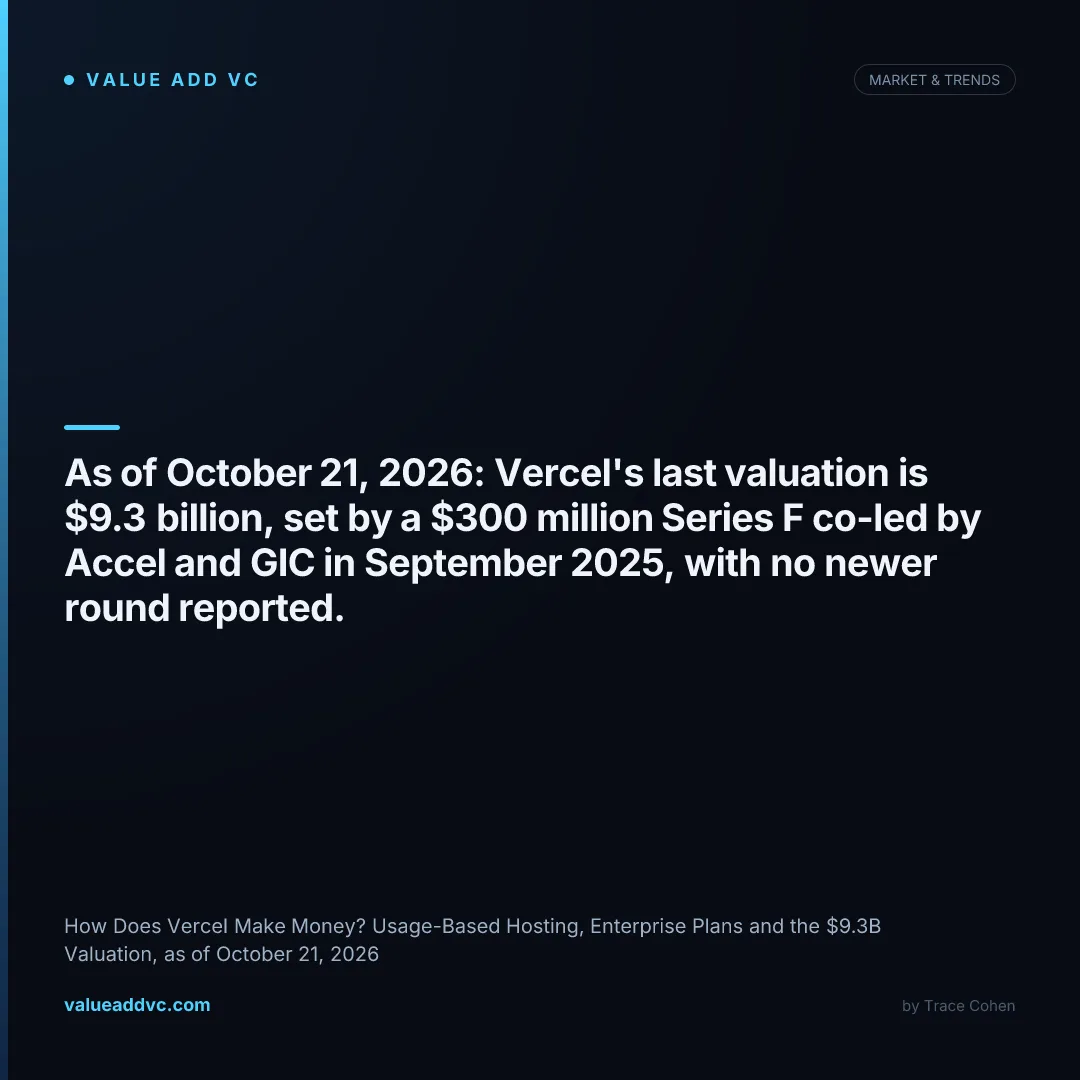
As of October 21, 2026, Vercel's last valuation is still $9.3 billion, from its September 2025 Series F, and its revenue was reportedly about $600 million annualized in October, up from a $340 million run rate in February — earned on a platform where the free tier is genuinely production-capable and the open-source framework that drives adoption (Next.js) works on any hosting provider. Vercel doesn't lock in developers with proprietary tools. It earns their business by making deployment, scaling, and team collaboration so seamless on Vercel's infrastructure that the convenience is worth paying for even when free alternatives exist.
Founded in 2015 as ZEIT by Guillermo Rauch (who also created Socket.IO), Vercel has grown into the default deployment platform for modern web development. The company's strategy is a textbook open-source commercial model: Next.js brings developers to the ecosystem; Vercel's cloud platform converts them into paying customers. Here's how every dollar is made, and what's changed in the thirteen months since Vercel last raised.
Vercel: Key Numbers (as of October 21, 2026)
| Date | Event | Amount / Valuation / Revenue | Source |
|---|---|---|---|
| Sep 30, 2025 | $300M Series F co-led by Accel and GIC, plus a ~$300M tender offer | $9.3B valuation | Vercel |
| Feb 2026 | Annual recurring revenue run rate at the end of February (from $100M at the start of 2024) | $340M ARR | TechCrunch |
| Apr 13, 2026 | CEO Guillermo Rauch on an IPO: "ready and getting more ready"; no filing | No IPO filed | TechCrunch |
| Oct 1, 2026 | Annualized revenue, per a person close to the company; up from $500M in July (unconfirmed by Vercel) | ~$600M (reported) | Dealroom, syndicating The Information |
| Oct 21, 2026 | No newer round, tender or valuation reported | $9.3B | Value Add VC news review |
The $600 million figure is single-source reporting attributed to an unnamed person and is a run rate, not GAAP revenue. Vercel's confirmed figures are the $9.3 billion valuation and the $340 million February run rate.
Revenue figures from Forbes (Feb 2026 run-rate) and Dealroom/The Information (Oct 2026, attributed to a person close to the company, unconfirmed by Vercel). Next.js download data from npm. Funding from Vercel's Series F announcement and Crunchbase, as of October 2026.
How does Vercel make money
Vercel makes money through tiered platform subscriptions with usage-based billing on top. The Hobby tier is free — it supports personal projects with limited serverless function execution, bandwidth, and build minutes. It's genuinely useful for solo developers, portfolio sites, and experiments, which is why it serves as the top of Vercel's adoption funnel.
Pro at $20 per user per month is where revenue starts. Pro raises usage limits (1TB bandwidth included, 1,000 GB-hours of serverless compute), adds team collaboration (shared projects, preview deployment comments, environment variable management), and includes Vercel Analytics and Speed Insights. Most small-to-medium teams land here. Usage beyond the included limits is billed at published overage rates — $0.18/GB for additional bandwidth, $0.18/GB-hour for additional compute.
Enterprise is custom-priced (typically $1,000-$10,000+/month) and adds SSO/SAML, SLA guarantees (99.99% uptime), advanced DDoS protection via Vercel Firewall, audit logs, HIPAA compliance options, and dedicated support. Enterprise customers include Washington Post, Under Armour, Notion, and HashiCorp. Revenue also comes from platform add-ons: Vercel Blob (object storage), Vercel AI Gateway (unified AI provider API), and various marketplace database integrations. The overall billing model means Vercel's revenue scales with customer traffic — as a customer's website gets more visitors, Vercel's bill grows automatically without a sales conversation.
The Next.js flywheel: open source as a growth engine
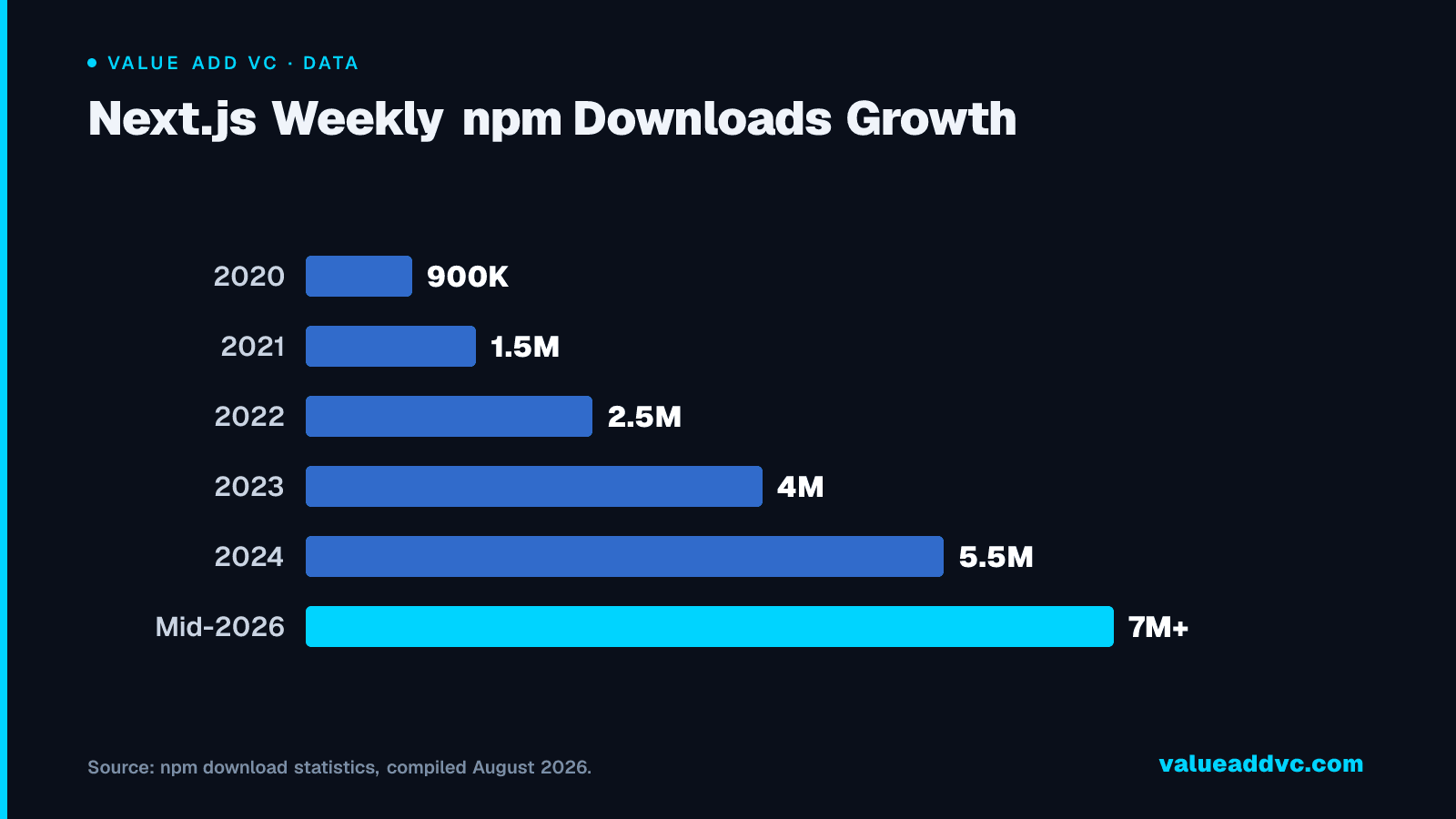
Next.js is the single most important asset in Vercel's business model — and it's completely free. With over 7 million weekly npm downloads, Next.js is the most popular React meta-framework by a wide margin (Remix/React Router is second at roughly 2 million, Gatsby has faded below 500K). Every developer who adopts Next.js is a potential Vercel customer because Vercel provides the zero-config deployment experience specifically optimized for Next.js features like Server Components, incremental static regeneration (ISR), middleware, and image optimization.
The key to this model is that Next.js works everywhere — AWS, Google Cloud, Cloudflare, Netlify, self-hosted — so there's no vendor lock-in complaint. Vercel earns the deployment by being better integrated, not by being the only option. That credibility is what makes the open-source investment pay off: developers trust Next.js precisely because it's not proprietary, and that trust translates into willingness to pay for Vercel's managed platform when they need production reliability without DevOps overhead.
Next.js Weekly npm Downloads Growth
Next.js grew from 900K weekly downloads in 2020 to 7M+ by mid-2026, making it the most widely adopted React framework and Vercel's primary adoption funnel.
npm download statistics, compiled August 2026.
Data
| Item | Value |
|---|---|
| 2020 | 900K |
| 2021 | 1.5M |
| 2022 | 2.5M |
| 2023 | 4M |
| 2024 | 5.5M |
| Mid-2026 | 7M+ |
Vercel's valuation: $9.3 billion and the path forward
Vercel announced and closed a $300 million Series F on September 30, 2025 at a $9.3 billion valuation, co-led by Accel and Singapore's GIC, with new investors including funds managed by BlackRock, StepStone, Khosla Ventures, Schroders, and Adams Street Partners. That's nearly 3x the $3.2 billion valuation from its May 2024 Series E. Vercel also ran a roughly $300 million tender offer alongside the round for certain early investors, employees, and former employees, per its announcement. Total funding across all rounds is approximately $863 million.
At the round's own disclosed growth figures — 82% year-over-year revenue growth as of the raise — the $9.3 billion valuation already implied a rich multiple. It's gotten richer since: Forbes and TechCrunch put Vercel's run rate at $340 million by the end of February 2026, and by October 2026 people close to the company told Dealroom and The Information that revenue had reached roughly $600 million annualized, up 148% year over year and about 20% more paying customers than July. This likely reflects the same AI-coding surge CEO Guillermo Rauch described in April 2026 — he said Vercel is "ready and getting more ready" for an eventual IPO, without giving a timeline, and that roughly 30% of apps on the platform were AI-agent-driven even then.
The valuation is lower per revenue dollar than AI infrastructure companies like Baseten (22x) or frontier AI labs, but higher than traditional hosting companies. The bull case for Vercel is that it's becoming a full-stack cloud platform, not just a frontend host — Fluid Compute (full Node.js/Python runtime), Vercel Queues (event processing), Vercel Sandbox (code execution), and the AI Gateway all expand Vercel's addressable market from "deploy a website" to "run your entire application backend." That evolution, if successful, would justify meaningfully higher revenue per customer and a broader TAM than frontend hosting alone. For context on developer tool valuations, see our SaaS valuations dashboard.
| Round | Date | Amount | Valuation | Lead Investors |
|---|---|---|---|---|
| Series A | Apr 2020 | $21M | ~$100M | Accel |
| Series B | Dec 2020 | $40M | $600M | GV |
| Series C | Jun 2021 | $102M | $2.5B | Bedrock Capital |
| Series D | Nov 2021 | $150M | $2.5B | GGV, Tiger Global, Greenoaks |
| Series E | May 2024 | $250M | $3.2B | Accel |
| Series F | Sep 2025 | $300M | $9.3B | Accel, GIC |
Funding data from Vercel's Series F announcement (via Pulse2 and Bloomberg), Crunchbase, and prior Vercel press releases, compiled October 2026.
What the $600M Figure Misses
The $600 million ARR figure getting cited across coverage this fall traces back to "a person close to the company," relayed by Dealroom and The Information — not a Vercel press release, an SEC filing, or an on-record executive statement. The last company-adjacent, independently corroborated number is the $340 million run rate Forbes reported for February 2026. A private company nearing a potential IPO has every incentive to let strong unconfirmed numbers circulate, so treat the jump from $340M to $600M in eight months as directionally credible — consistent with the AI-coding-agent demand story Rauch has described publicly — but not yet a figure Vercel has put its own name behind.
Vercel vs Netlify, Cloudflare, and AWS
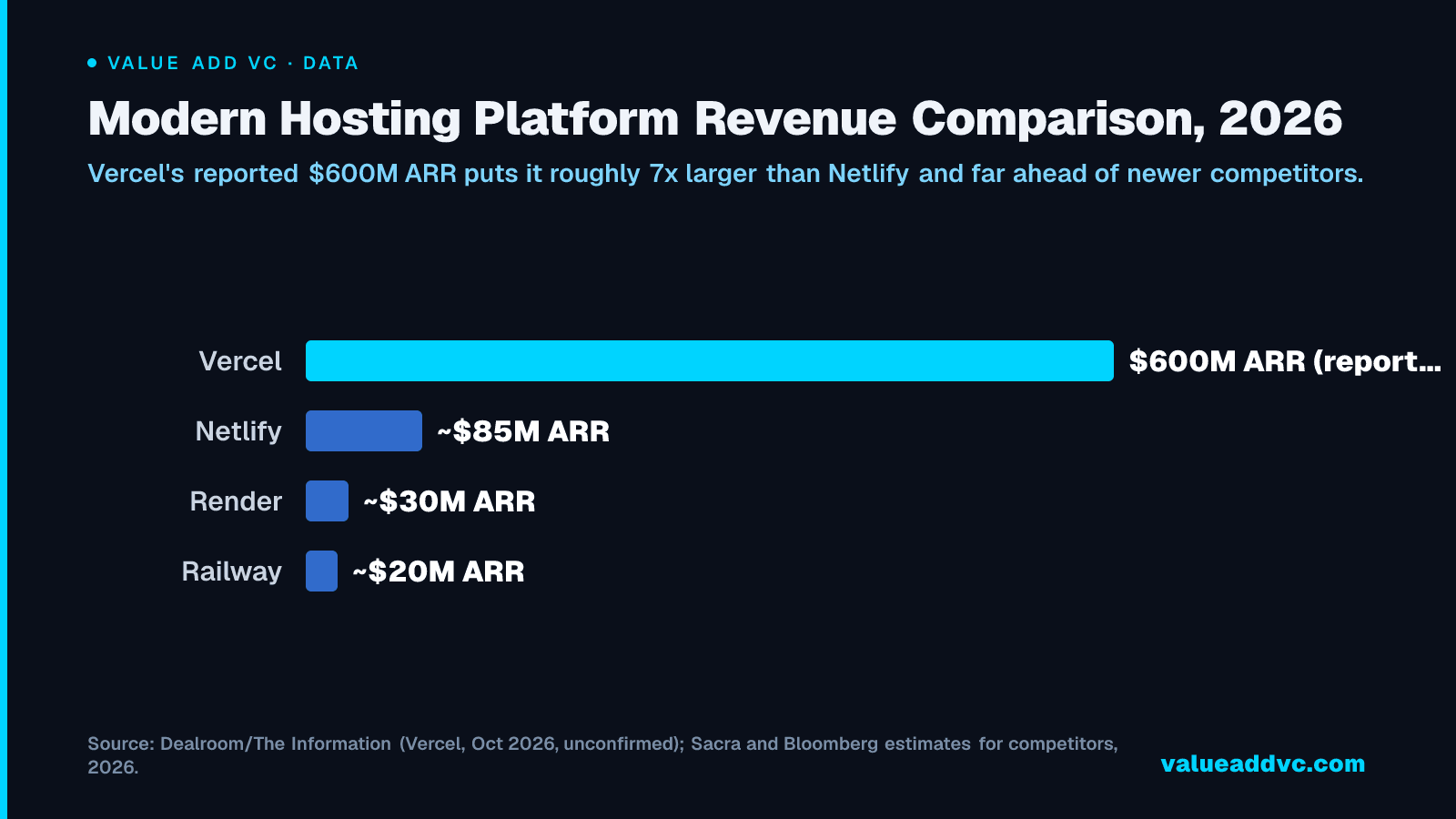
Vercel leads the modern frontend/full-stack hosting market with a reported $600 million or more in annualized revenue, well ahead of Netlify at roughly $85 million, and smaller platforms like Render (~$30M) and Railway (~$20M). Cloudflare Pages is part of Cloudflare's broader $1.6 billion revenue but competes directly on static and edge-rendered hosting with aggressive pricing (generous free tier, Workers for serverless compute).
Vercel's competitive advantage is the Next.js integration — no other platform supports every Next.js feature at parity without configuration. Netlify supports Next.js through adapters but occasionally lags on new features like Server Actions or partial prerendering. Cloudflare competes on raw edge performance and pricing (Workers are cheaper per invocation than Vercel Functions). The real long-term competitor is AWS/GCP/Azure directly, which enterprise teams evaluate when their hosting bill at Vercel crosses into high five or six figures — at that scale, the convenience premium of managed deployment is weighed against the cost savings of running on raw infrastructure.
Modern Hosting Platform Revenue Comparison, 2026
Vercel's reported $600M ARR puts it roughly 7x larger than Netlify and far ahead of newer competitors.
Dealroom/The Information (Vercel, Oct 2026, unconfirmed); Sacra and Bloomberg estimates for competitors, 2026.
Data
| Item | Value |
|---|---|
| Vercel | $600M ARR (reported) |
| Netlify | ~$85M ARR |
| Render | ~$30M ARR |
| Railway | ~$20M ARR |
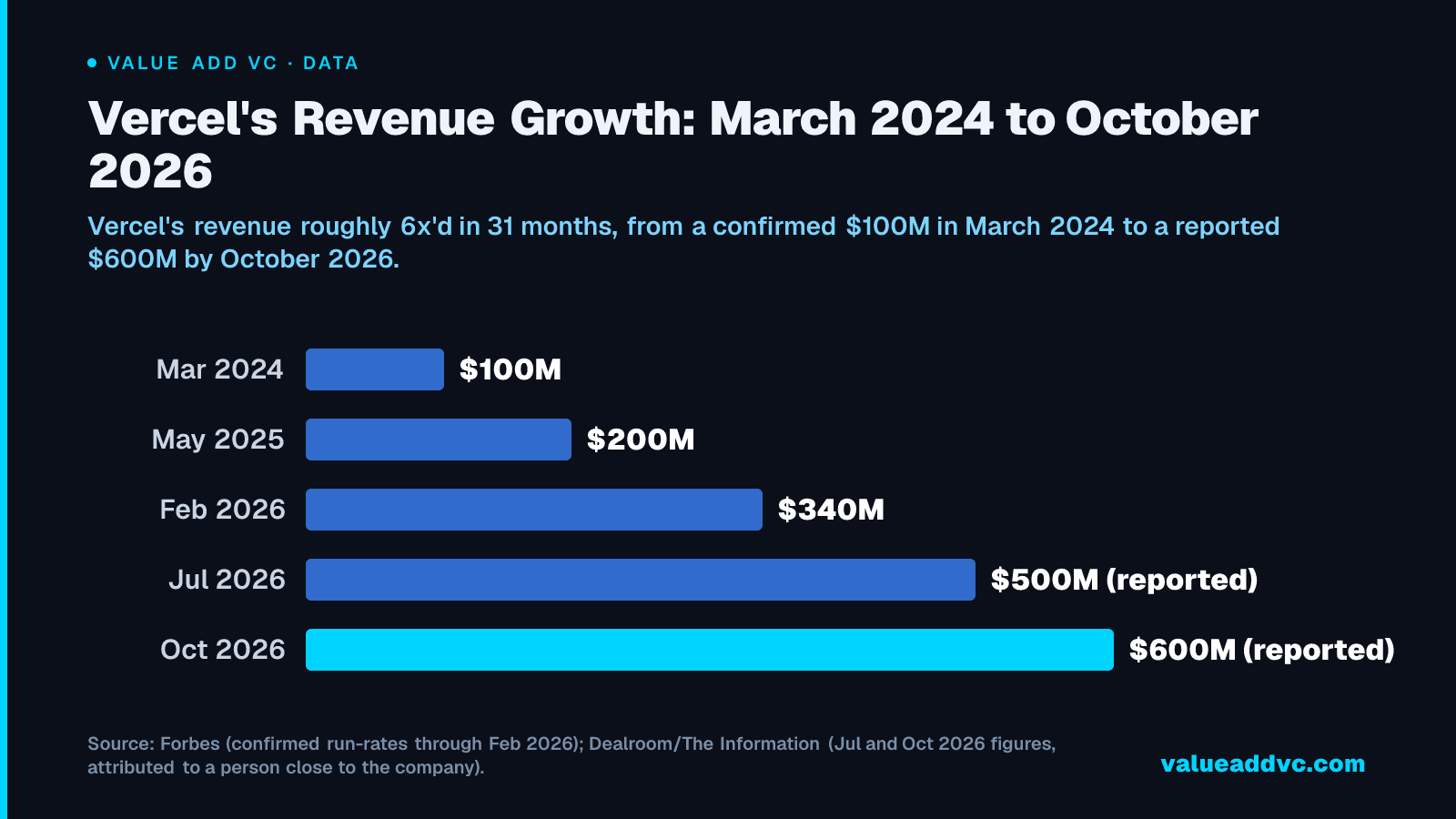
Vercel's Revenue Growth: March 2024 to October 2026
Vercel's revenue roughly 6x'd in 31 months, from a confirmed $100M in March 2024 to a reported $600M by October 2026.
Forbes (confirmed run-rates through Feb 2026); Dealroom/The Information (Jul and Oct 2026 figures, attributed to a person close to the company).
Data
| Item | Value |
|---|---|
| Mar 2024 | $100M |
| May 2025 | $200M |
| Feb 2026 | $340M |
| Jul 2026 | $500M (reported) |
| Oct 2026 | $600M (reported) |
Bottom line: Vercel makes money by charging developers and teams for cloud hosting — serverless compute, bandwidth, and enterprise features — on a platform specifically optimized for Next.js and modern web frameworks. At a reported $600M+ in annualized revenue on a $9.3 billion valuation, the company is transitioning from a frontend deployment platform into a full-stack cloud provider with Fluid Compute, Queues, Sandbox, and AI Gateway. Next.js (7M+ weekly downloads) is the open-source growth engine that makes the whole model work: it builds trust and adoption without vendor lock-in, and Vercel's cloud converts that adoption into revenue by being the best-integrated deployment target for the framework it maintains.
Track Vercel's latest funding and valuation moves on Value Add VC's Vercel hub, and compare it against other AI infrastructure valuations on the AI Valuations dashboard.
Latest from the Pulse
Get VC data most people never see
— free to subscribe
Trace's notes on venture, AI and startups, a few times a week. Join 5,000+ subscribers. No spam.
No spam, unsubscribe anytime. Sent via Substack · Privacy · or subscribe on Substack ↗