

$10 to $100 a month — that's the full spread of GitHub Copilot's five paid 2026 pricing tiers. That's the short answer. The longer answer is that the sticker prices barely moved this year, but what each price actually buys changed a lot on June 1, 2026, when GitHub quietly swapped its old Premium Request system for a token-metered AI Credits model.
Copilot pricing questions spike every time GitHub touches billing, and this year they touched it twice — a usage-based billing announcement in the spring, then the actual cutover on June 1. Developers searching for a straight answer keep landing on stale comparison pages built around the old Premium Request Unit system. Here's what Copilot actually costs right now, plan by plan, credit by credit.

GitHub Copilot Pricing in 2026: What Each Plan Costs
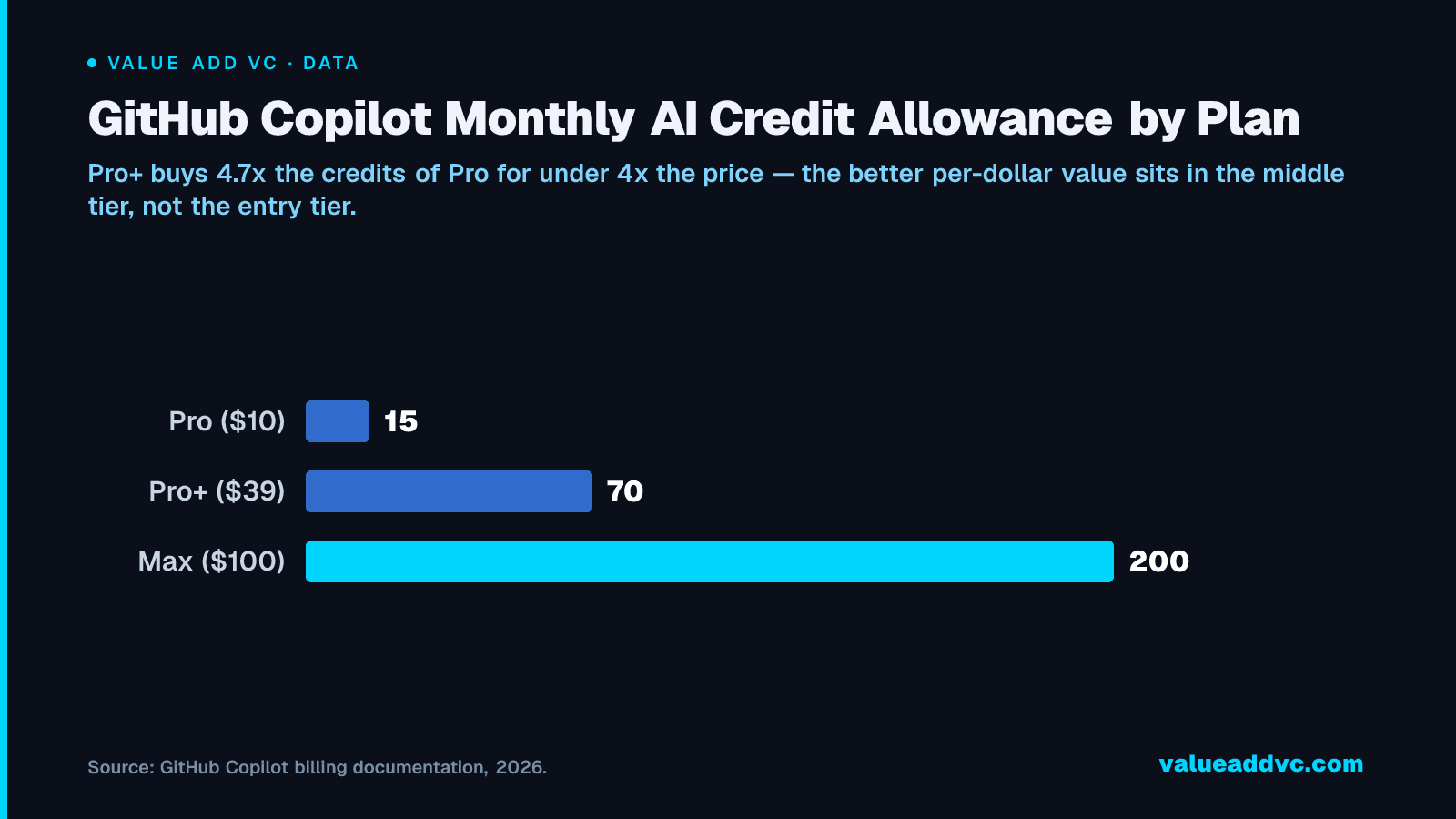
GitHub Copilot pricing in 2026 spans six tiers total: Free ($0), Pro ($10/month), Pro+ ($39/month), Max ($100/month) for individuals, plus Business ($19/user/month) and Enterprise ($39/user/month) for teams. Every paid individual tier now comes bundled with a fixed monthly allowance of AI Credits — Pro gets $15, Pro+ gets $70, and Max gets $200 — which is spent down as you use chat, agent mode, code review, or the Copilot CLI.
Every GitHub Copilot Plan Compared
The table below lays out all six plans side by side — price, monthly AI Credit allowance, model access, and who each tier is actually built for. Inline completions and next-edit suggestions are unlimited and free on every paid plan; only agentic and chat-based usage pulls from the credit pool.
| Plan | Price | Monthly AI Credits | Model access | Best for |
|---|---|---|---|---|
| Free | $0 | Limited monthly chat/agent requests | Base models only | Trying Copilot before committing |
| Pro | $10/mo | $15 | Standard + limited premium models | Individual devs, light chat/agent use |
| Pro+ | $39/mo | $70 | Full premium model lineup (Opus, GPT-5-class) | Daily agent-mode users |
| Max | $100/mo | $200 | Full premium lineup, highest allowance | Heavy multi-agent workflows |
| Business | $19/seat/mo | $19/seat (org-pooled) | Standard + premium models | Small-to-mid engineering teams |
| Enterprise | $39/seat/mo | Org-pooled, promo credits to Sep 1, 2026 | Full premium lineup + compliance tooling | Regulated orgs on GitHub Enterprise |
Figures are 2026 pricing blended from GitHub's own billing documentation, GitHub's official blog announcement of the usage-based billing shift, and third-party pricing trackers (No Code MBA, Automation Atlas, UsageBox) as of July 2026. One AI Credit equals $0.01 USD.
Why GitHub Copilot Pricing Changed on June 1, 2026
For years, Copilot billed usage in Premium Request Units (PRUs) — a flat count of requests regardless of how much a model actually had to think or how many tokens a response consumed. On June 1, 2026, GitHub replaced PRUs with GitHub AI Credits, a per-token billing unit where 1 credit equals $0.01. The base subscription prices didn't move — Pro is still $10, Pro+ is still $39 — but the underlying economics did: a long agentic session against a reasoning-heavy model now consumes credits proportional to actual token usage, instead of counting as a flat one or two requests the way it used to under PRUs.
The practical effect, as developers have flagged on GitHub's own community forums and in coverage from Visual Studio Magazine, is that heavy users of agent mode and multi-step coding tasks are burning through their monthly allowance faster than before, even though the sticker price is unchanged — the trade quoted by developers has been "you will get less, but pay the same price." Inline completions and next-edit suggestions remain unmetered on every paid tier, so the change mostly bites teams leaning hard on chat, code review, and autonomous agent workflows rather than everyday autocomplete.
GitHub Copilot Monthly AI Credit Allowance by Plan
Pro+ buys 4.7x the credits of Pro for under 4x the price — the better per-dollar value sits in the middle tier, not the entry tier.
GitHub Copilot billing documentation, 2026.
Data
| Item | Value |
|---|---|
| Pro ($10) | 15 |
| Pro+ ($39) | 70 |
| Max ($100) | 200 |
GitHub Copilot Pricing History: How We Got to 2026
Copilot launched in 2021 at a flat $10/month for individuals with no usage metering at all — you paid one price and used it as much as you wanted. That changed in 2023 when GitHub introduced Business ($19/seat) and Enterprise ($39/seat) tiers for organizations, and again in 2024 when GitHub began experimenting with "premium requests" to ration access to more expensive frontier models like GPT-4 and early Claude models, while keeping base completions unlimited. By early 2025, Premium Request Units (PRUs) had become the standard currency across every paid plan: a fixed monthly allotment of requests, with overage billed at roughly $0.04 per additional PRU.
The PRU system had an obvious flaw: it charged the same one unit whether a model answered a two-line question or ran a 40-step autonomous refactor consuming tens of thousands of tokens. As agent mode usage exploded through 2025 — GitHub's own usage data showed agentic sessions growing far faster than simple chat queries — that flat-rate structure became increasingly mispriced against GitHub's actual compute costs. The June 1, 2026 move to token-metered AI Credits was GitHub's fix: usage now scales with actual model cost, which is why heavy agent users are the ones feeling the pricing squeeze this year even though nobody's subscription bill went up.
Promotional credit boosts for Business and Enterprise customers, put in place to soften the transition, are scheduled to expire on September 1, 2026 — worth flagging for any team currently budgeting off this year's effective (promo-inflated) usage rather than the steady-state allowance that kicks in afterward.
GitHub Copilot Pricing FAQ: What Trips People Up
A few details in the 2026 pricing structure catch developers off guard. First, inline completions and next-edit suggestions are unmetered on every paid plan — a developer who never touches chat or agent mode could run Pro at $10/month indefinitely without ever approaching the $15 credit allowance. Second, credits don't roll over month to month on individual plans, so an unused balance resets rather than accumulates, which matters for anyone budgeting around occasional heavy-usage months. Third, Business and Enterprise credits pool at the organization level rather than per-seat, meaning a 20-person team's combined $380/month in Business credits can be unevenly consumed by a handful of power users unless an admin sets per-seat caps.
One more wrinkle worth knowing before signing an annual contract: GitHub bills annual plans upfront at a discount versus month-to-month, but the AI Credit allowance is still calculated and reset monthly regardless of billing cadence — annual billing saves on the subscription price, not on usage costs.
GitHub Copilot vs Cursor Pricing in 2026
Copilot's closest pricing comparison is Cursor, the standalone AI-first code editor, which also moved to usage-based billing over the past year. At the entry tier the gap looks wide — Copilot Pro at $10/month against Cursor Pro at $20/month — but that comparison flatters Copilot because it's comparing two different usage envelopes. Once you move up to the tiers built for daily agent use, the picture narrows: Copilot Pro+ costs $39/month against Cursor Pro+ at $60/month for developers who need frontier-model access every day.
GitHub Copilot vs Cursor: Comparable Tier Pricing
GitHub Copilot billing docs; Cursor pricing page; MorphLLM and AI Pricing Guru comparisons, 2026.
Data
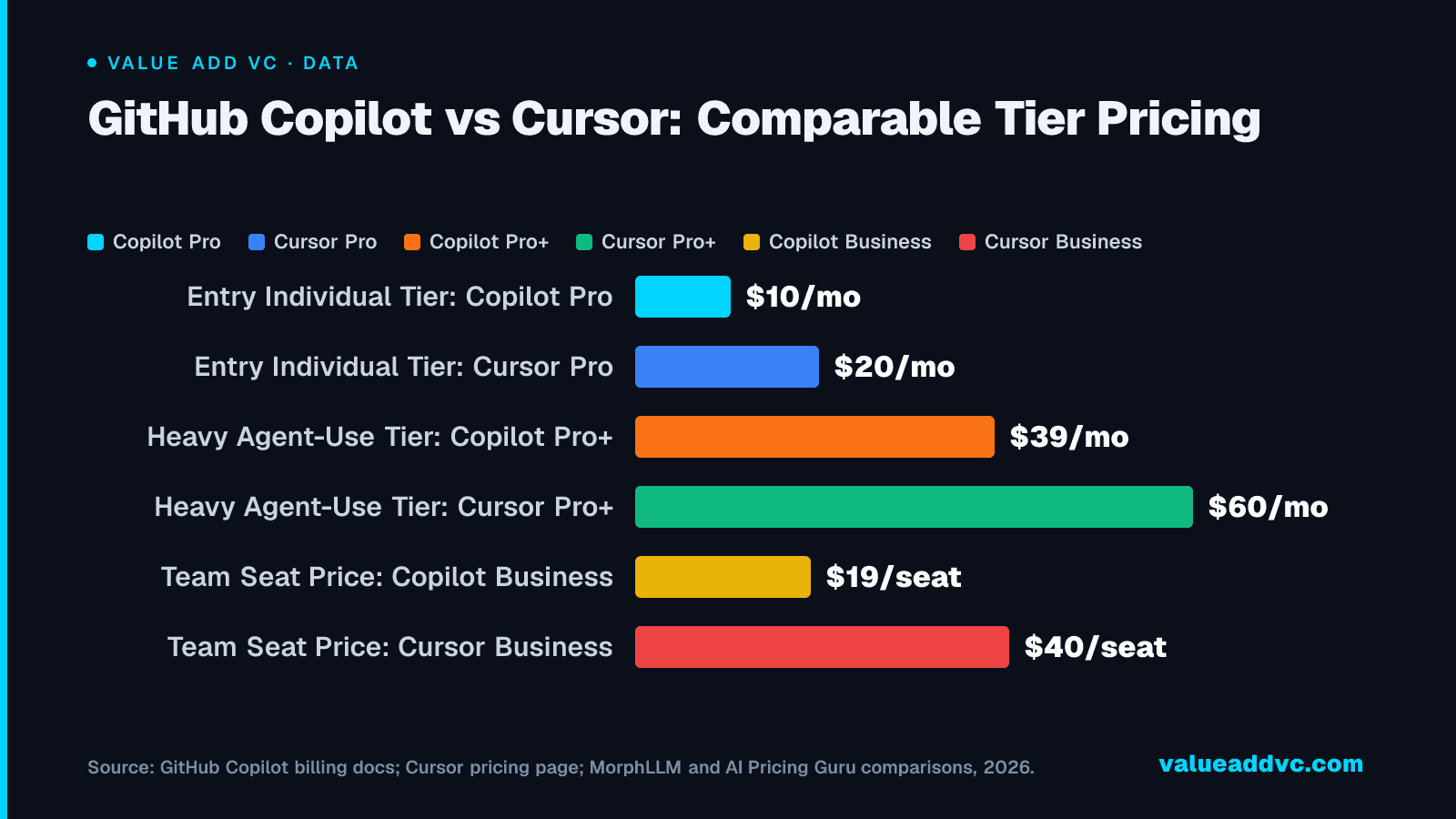
The team-level gap is the one worth doing math on before you sign a company-wide contract. Copilot Business at $19/seat versus Cursor Business at $40/seat works out to roughly $2,520 a year in savings for a 10-person engineering team — real money, though it should be weighed against Cursor's deeper IDE-native agent tooling, which is a large part of why some teams pay the premium anyway. For a broader look at how the two editors compare beyond price, see our Cursor vs GitHub Copilot vs Windsurf comparison.
How to Pick the Right GitHub Copilot Plan
The right tier depends almost entirely on how much agentic and chat usage you actually run, not on how many lines of inline completion you accept — those are unmetered everywhere. A few concrete signals:
- Free is genuinely usable for students, hobbyists, and anyone testing whether Copilot fits their workflow before paying.
- Pro ($10/mo) covers most individual developers who use chat occasionally but lean mainly on inline completions, which don't touch the credit pool.
- Pro+ ($39/mo) is the right call the moment agent mode becomes a daily habit — $70 in credits against frontier models absorbs meaningfully more usage than Pro's $15.
- Max ($100/mo) only makes sense for developers running multiple concurrent agent sessions or large multi-file refactors regularly enough to exhaust Pro+'s allowance.
- Business ($19/seat) is the default recommendation for any team already standardized on GitHub, given the roughly 2x price advantage over Cursor's equivalent seat.
- Enterprise ($39/seat) only earns its premium over Business if you specifically need IP indemnification, audit logging, or are already paying for GitHub Enterprise and want the integration — see our Enterprise vs Individual breakdown for the full seat-by-seat math, including the ~$21/seat GitHub Enterprise Cloud tax most buyers miss.
Anyone evaluating the broader AI coding tool landscape rather than Copilot specifically should also check our AI coding tools ranked for 2026 roundup, which weighs Copilot, Cursor, Windsurf, Devin, and Claude Code on more than just price.
The Bottom Line
GitHub Copilot pricing in 2026 still spans a familiar $10-to-$100 range across Pro, Pro+, and Max, plus $19 and $39 seat prices for Business and Enterprise — but the June 1, 2026 switch to per-token AI Credits means the same dollar buys less than it did under the old Premium Request system, especially for heavy agent-mode users. Copilot still undercuts Cursor at every comparable tier, most dramatically at the team level, which keeps it the default choice for cost-conscious engineering orgs already living inside GitHub. The plan that actually saves money is the one sized to how much chat and agent usage you run — not the cheapest sticker price on the page.
Latest from the Pulse
Get VC data most people never see
— free to subscribe
Trace's notes on venture, AI and startups, a few times a week. Join 5,000+ subscribers. No spam.
No spam, unsubscribe anytime. Sent via Substack · Privacy · or subscribe on Substack ↗