
$71 million, led by Index Ventures and Ribbit Capital, for a robotics company most of the market had never heard of until Monday. The more interesting number is who wrote the smaller checks.
Enigma came out of stealth on July 27, 2026 with a seed round backed not just by two brand-name lead funds, but by a roster of angel investors pulled directly from OpenAI, Anthropic, Google DeepMind, xAI, Cognition, and Wiz. That's an unusual signal for a seed-stage company with no disclosed valuation, no named customers, and no revenue figure. When operators at five of the most closely watched AI labs on earth personally write checks into the same seed round, it tells you something about how the smart money inside frontier labs is quietly betting on where the next layer of value gets captured — and right now, a chunk of it is betting on robotics interfaces, not another foundation model.
How much funding did Enigma raise and who led the round?
$71 million, in a seed round led by Index Ventures and Ribbit Capital, with Sarah Guo's Conviction Partners also participating. Ribbit's other 2026 bets on regulated-industry AI include leading Valon Technologies' $150 million Series D into mortgage servicing. What sets the round apart isn't the lead pairing — it's the angel bench underneath them: a group of technology executives and researchers pulled from OpenAI, Anthropic, Thinking Machines, xAI, and Cognition, plus operators connected to Wiz, the Israeli cybersecurity company that sold to Google for $32 billion in 2025. No post-money valuation, customer names, or revenue figures were disclosed alongside the round, which is typical for a seed-stage company still in the earliest phase of commercialization but unusual given the size of the check relative to standard seed rounds, which averaged closer to $3-4 million in the US in early 2026 per Carta data.
What does Enigma actually build?
Enigma's pitch is a foundation-model layer for robot control that works across hardware, not a single robot platform. The company builds AI models designed to make any robot, on any hardware, intelligent, plus the user interfaces sitting on top of that intelligence layer so that operating the machine feels closer to adjusting a phone's volume than programming an industrial arm. That's a meaningfully different bet than most of the well-funded humanoid players, which are building integrated hardware-plus-software stacks from the ground up. Enigma is effectively betting that robot hardware commoditizes faster than robot intelligence does, and that the company that owns the control layer — not the chassis — captures the durable margin. It's the same wedge thesis that made Travis Kalanick's Atoms pitch a "computer for the physical world" rather than a single robot product, applied one layer down the stack.
2026 Robotics/Physical AI Rounds: Enigma vs. Recent Peers ($M)
Source: TechCrunch, SiliconANGLE, company disclosures, July 2026.
Data
| Item | Value |
|---|---|
| Enigma (seed) | $71M |
| Ropedia (pre-A) | $30M |
| Atoms (growth) | $1.7B |
| Skild AI (Series B) | $1.4B |
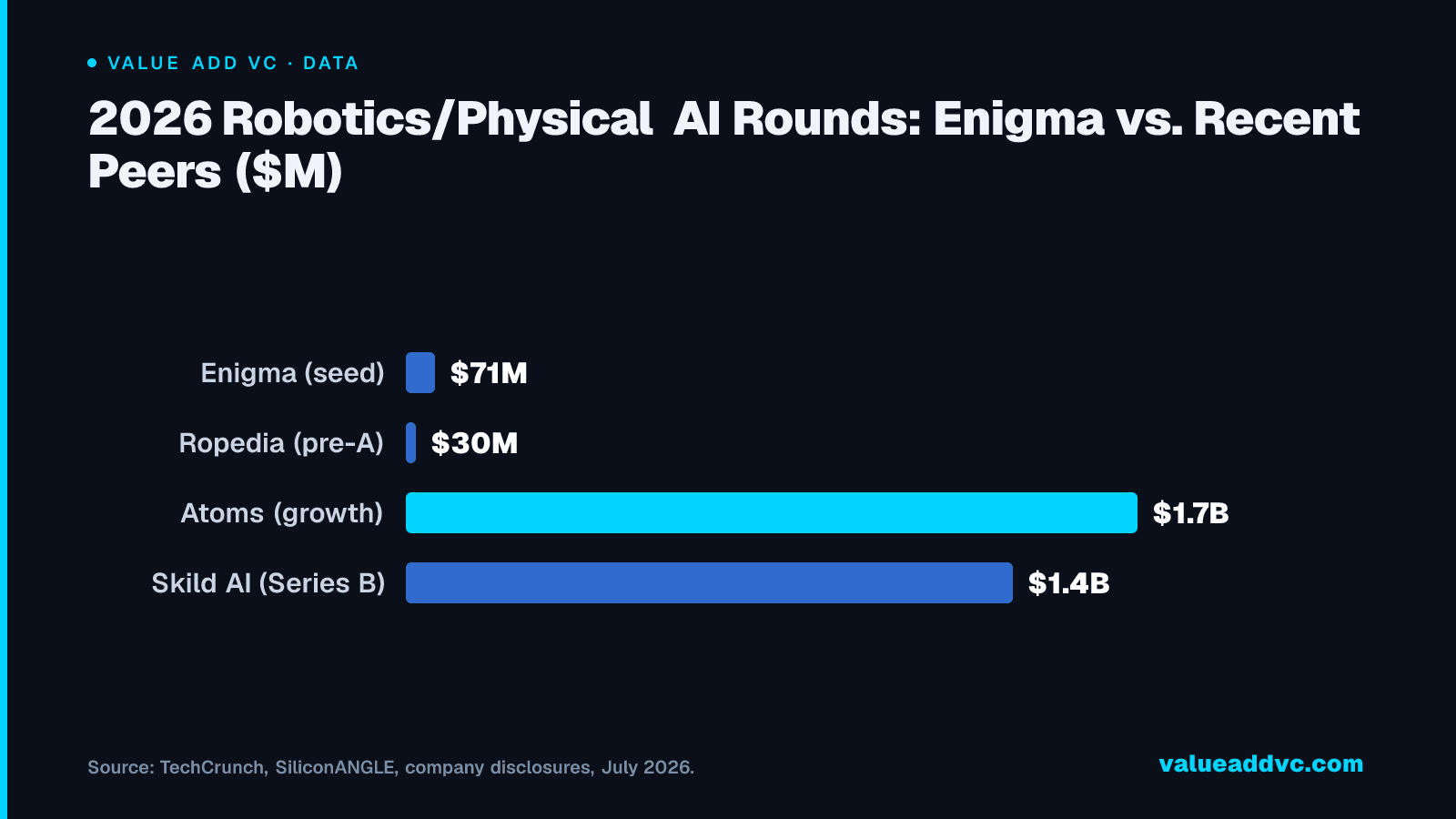
Figures are July 2026 round sizes as reported by TechCrunch and SiliconANGLE; stages differ and are not directly comparable on valuation.
Who founded Enigma, and why does Unit 8200 matter here?
Enigma was co-founded by CEO Jonathan Jacobi — reportedly Microsoft's youngest-ever employee before Wiz founder Assaf Rappaport recruited him — and Gal Niv. The two met as teenagers competing in hacking competitions and later served together in Unit 8200, the Israeli intelligence corps' elite technical unit that has become one of the most productive founder pipelines in tech, having already produced Wiz, Snyk, Armis, and a long list of other venture-backed companies. I've written before about how much of the current cybersecurity and infrastructure wave traces back to that same unit, and Enigma is a data point that the pipeline is now feeding physical AI and robotics too, not just software security. For investors, a Unit 8200 founding team is close to a known quantity — it doesn't guarantee product-market fit, but it's a strong prior on execution speed and technical depth, which is part of why two lead funds and a dozen operator-angels were comfortable writing checks into a company with zero disclosed revenue.
Why did OpenAI, Anthropic, and xAI employees personally back a robotics seed round?
This is the detail worth sitting with. Angel participation from individual researchers and executives at OpenAI, Anthropic, Google DeepMind, xAI, and Cognition in the same seed round is a meaningful signal about where insiders at the frontier labs think the next investable layer sits. Foundation-model economics for large language models are increasingly a scale game reserved for companies that can raise $10 billion-plus rounds — Anthropic alone closed a $65 billion Series H in 2026 at a $965 billion valuation. Individual operators at those labs generally can't get exposure to that scale of opportunity through angel checks. Robotics control layers are a different story: still early, still seed-priced, and still small enough for a $25,000-$100,000 angel check to matter. When the people building GPT-5.5, Claude Opus 4.8, and Grok are personally betting seed capital on who controls the next generation of robots, that's a distinct signal from VC fund allocation alone, and worth tracking on the AI Valuations Dashboard.
What is robots.online, and why open 100+ robots to public control?
Alongside the funding announcement, Enigma launched a public experiment at robots.online that lets anyone in the world control more than 100 of its proprietary robots in real time, housed in hangars in Israel and California. Visitors can direct the robots to draw pictures with a paintbrush, spar with swords, and mix liquids in simple chemistry demonstrations. It's an unusually public go-to-market move for a company that raised money as a "stealth" startup just days earlier, and it functions as both a marketing stunt and a live stress test — every interaction is a data point on how the underlying model generalizes across unscripted human commands at scale, which is exactly the kind of real-world interaction data that's scarce and expensive to collect in robotics compared to text or code.
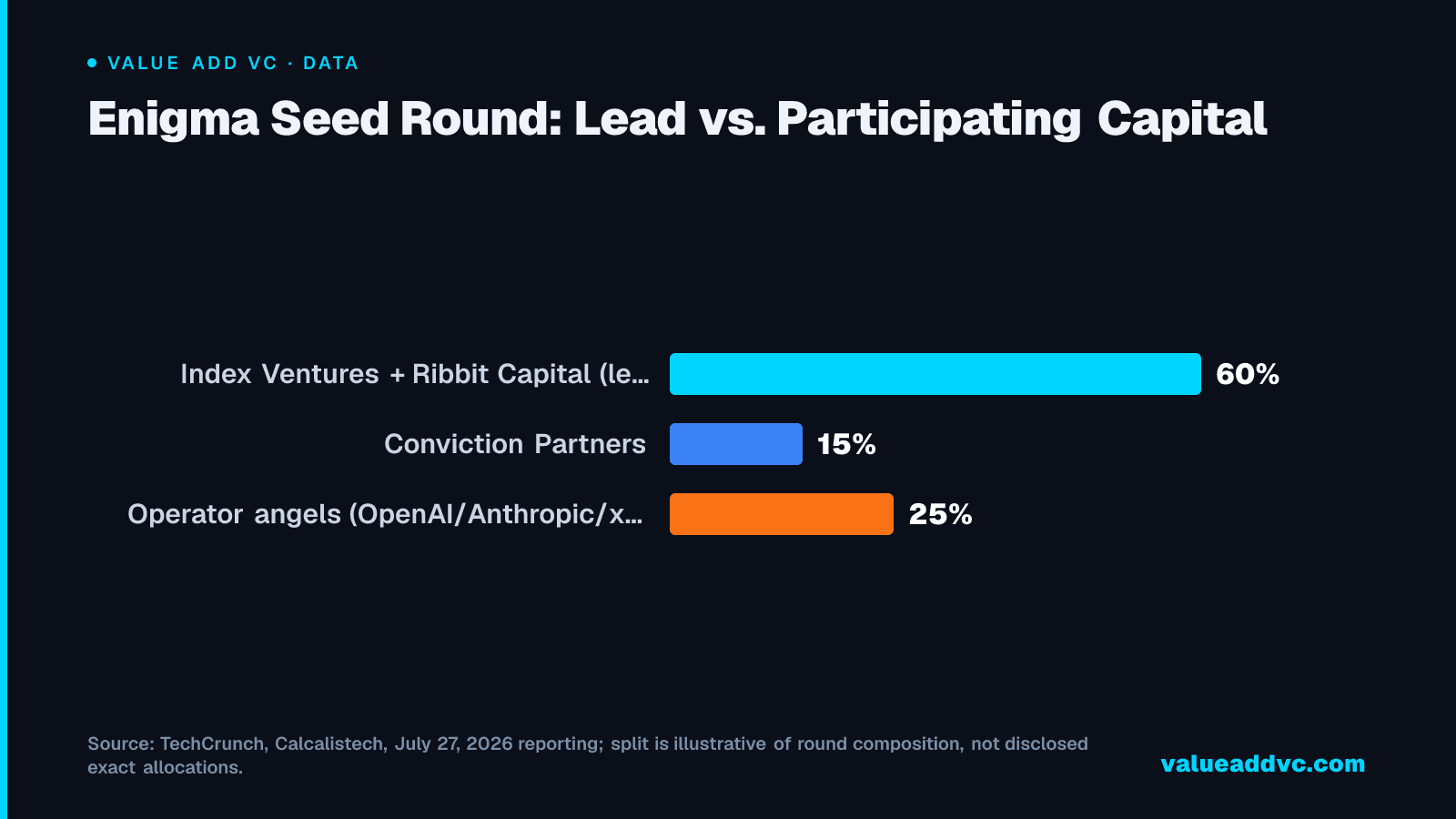
Enigma Seed Round: Lead vs. Participating Capital
Source: TechCrunch, Calcalistech, July 27, 2026 reporting; split is illustrative of round composition, not disclosed exact allocations.
Data
| Item | Value |
|---|---|
| Index Ventures + Ribbit Capital (leads) | 60% |
| Conviction Partners | 15% |
| Operator angels (OpenAI/Anthropic/xAI/etc.) | 25% |
How does Enigma fit into the broader 2026 physical AI funding wave?
Robotics and physical AI startups raised a record $27.6 billion across 1,009 deals in 2025, more than double the prior year, and 2026 has kept pace with mega-rounds like Atoms' $1.7 billion close and Skild AI's $1.4 billion Series B at a $14 billion valuation. Enigma's $71 million seed is small next to those growth-stage numbers, but it's large for its stage — most US seed rounds in early 2026 closed well under $10 million, per Carta's fundraising data. That gap between typical seed size and Enigma's check reflects both the founders' pedigree and a broader pattern this cycle: investors are increasingly front-loading conviction into physical AI teams at the earliest possible stage rather than waiting for traction, because the capital chasing proven robotics companies at Series B and beyond has gotten extremely competitive and expensive. You can track how these valuations move on the Unicorn Tracker.
The Bottom Line:
Enigma raised $71M on July 27, 2026 with no disclosed valuation or revenue — but the angel list, stacked with operators from OpenAI, Anthropic, DeepMind, xAI, and Cognition, is the real story. When frontier-lab insiders personally bet seed capital on who controls the next generation of robots, that's a signal worth more than the check size.
Track how physical AI and robotics valuations are moving on the AI Valuations Dashboard and see which companies just crossed $1B on the Unicorn Tracker at Value Add VC. Originally published in the Trace Cohen newsletter.
Latest from the Pulse
Get VC data most people never see
— free to subscribe
Trace's notes on venture, AI and startups, a few times a week. Join 5,000+ subscribers. No spam.
No spam, unsubscribe anytime. Sent via Substack · Privacy · or subscribe on Substack ↗