
As of October 21, 2026, Atoms is Travis Kalanick's industrial robotics company, and its headline number is still the $1.7 billion equity round it closed on July 22, 2026, led by a16z, with Uber putting in about $100 million. No valuation has been disclosed. The stranger detail is who's writing the check.
Uber's board forced Kalanick out as CEO in 2017, in one of the ugliest founder exits in tech history. Nine years later, Uber is a financial backer of his new company. I don't think that reunion is the actual story here — the actual story is that Kalanick has quietly assembled a $1.7 billion industrial robotics company out of a ghost-kitchen business, an acquired mining-robotics startup, and a brand-new logistics division, and investors just priced it as one of the largest physical AI rounds of the year without a disclosed valuation to argue over.
Atoms: Key Numbers (as of October 21, 2026)
| Date | Event | Amount / Valuation / Revenue | Source |
|---|---|---|---|
| Mar 13, 2026 | Kalanick launches Atoms, folding in CloudKitchens and acquiring Pronto (autonomous mining and industrial vehicles) | Not disclosed | TechCrunch |
| Jul 22, 2026 | Equity round led by Andreessen Horowitz; Ben Horowitz joins the board; Bain Capital, Fifth Wall and Uber participate | $1.7B (equity) | TechCrunch; Investing.com via Yahoo |
| Jul 22, 2026 | Post-money valuation | Not disclosed | The Next Web |
| Aug 5, 2026 | Uber's check in the round, reported by The Information and confirmed by TechCrunch; ex-Uber finance chief Gautam Gupta joins as CFO | ~$100M | TechCrunch |
| Oct 21, 2026 | No newer round or valuation reported | $1.7B raised | Value Add VC news review |
Atoms has not disclosed revenue or a valuation. CloudKitchens' last reported mark, about $15 billion in January 2022, predates the Atoms structure and is not a valuation of Atoms.
How much did Travis Kalanick's Atoms raise in funding?
$1.7 billion, in an equity round led by Andreessen Horowitz and announced July 22, 2026. Bain Capital, Fifth Wall, Chemistry, K5 Global, SV Angel, and Alpha Square Group joined the round, and so did Uber, with about $100 million per TechCrunch — a detail that's driven most of the coverage of this deal (TechCrunch). Ben Horowitz is taking a board seat as part of the investment. Notably, no party has disclosed a post-money valuation, which is unusual for a raise this size and suggests the company and a16z preferred to let the headline be the check size, not the multiple.
What is Atoms, and how did CloudKitchens become a robotics company?
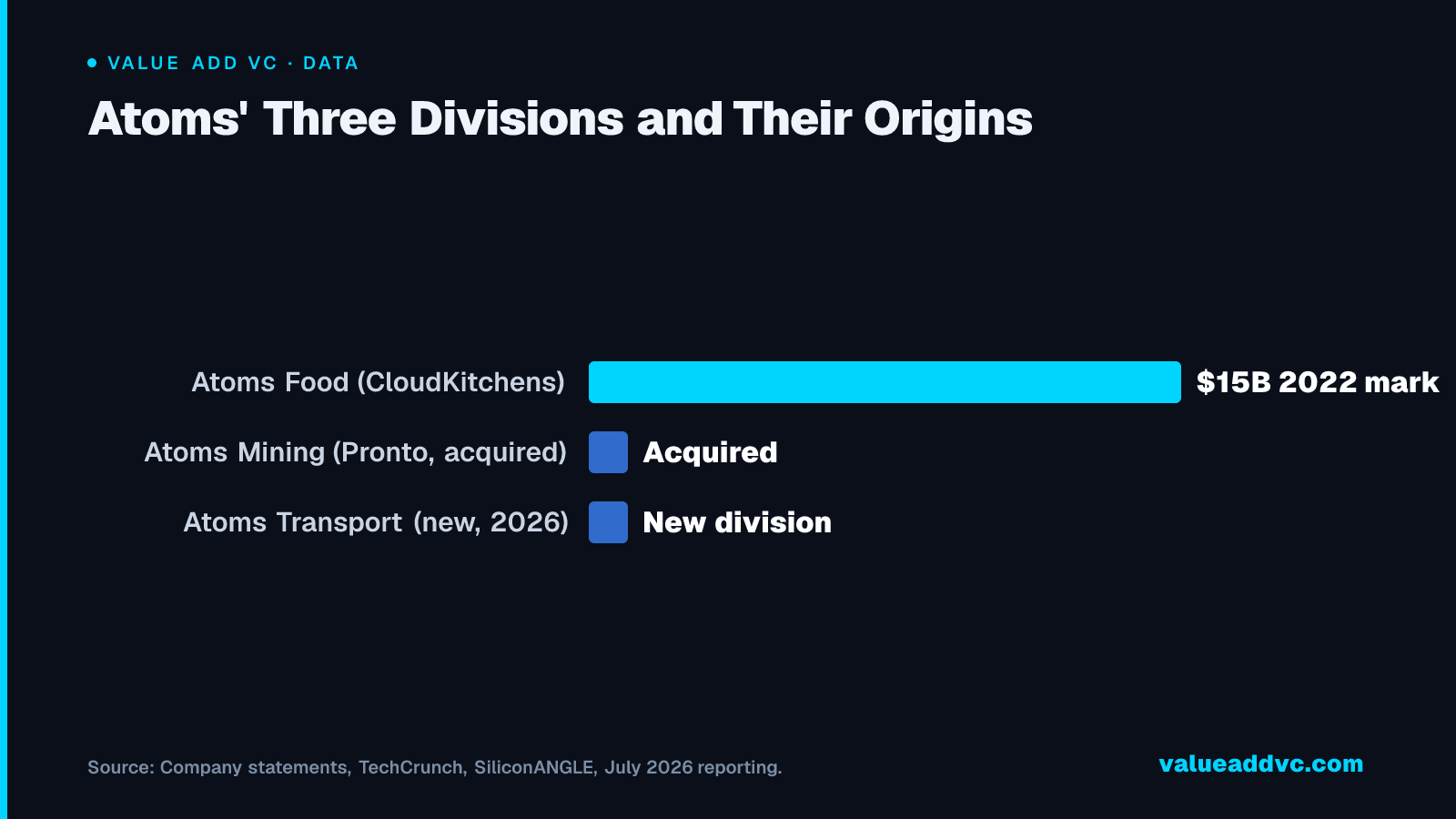
Atoms launched publicly on March 13, 2026, and it's structurally unusual for a "startup" this size: it's three operating divisions stitched together, not a single product built from scratch. Atoms Food is the original CloudKitchens ghost-kitchen business (formerly City Storage Systems), which was reported in January 2022 to be valued at about $15 billion, with Saudi Arabia's Public Investment Fund among its backers. Atoms Mining is built around Pronto, a heavy-industry automation company Kalanick acquired from Anthony Levandowski — his former Uber colleague from the self-driving-car unit. Atoms Transport is the newest piece, extending the same sensor-and-robotics stack into logistics and freight. Kalanick's framing is that Atoms is building a "computer for the physical world" — software, sensors, robotics, and AI applied to how physical goods get made, stored, and moved, using what the company calls a "wheelbase for robots" rather than a humanoid form factor.
Atoms' Three Divisions and Their Origins
Source: Company statements, TechCrunch, SiliconANGLE, July 2026 reporting.
Data
| Item | Value |
|---|---|
| Atoms Food (CloudKitchens) | $15B 2022 mark |
| Atoms Mining (Pronto, acquired) | Acquired |
| Atoms Transport (new, 2026) | New division |
Why is Uber investing in the man it fired as CEO?
I'd resist reading too much sentimentality into this. Uber's board removed Kalanick in June 2017 following a string of scandals and investor pressure, and he sold off nearly all of his remaining Uber stock by 2019. Uber joining a $1.7 billion round in his new venture nine years later is a capital allocation decision, not a reconciliation — Uber has no board seat at Atoms and Kalanick has no operating role at Uber. What it does signal is that Uber's leadership sees strategic value in the automation and logistics technology Atoms is building, enough to write a check into a founder they once forced out. That's a more interesting data point about how thoroughly Silicon Valley compartmentalizes founder drama from capital allocation than it is a story about redemption.
How does Atoms' $1.7B round compare to other physical AI valuations in 2026?
Atoms raised more capital in one round than most of its physical AI peers, but without a disclosed valuation it's hard to say where it ranks. For context, Figure AI's September 2025 Series C valued the humanoid robotics company at $39 billion. Skild AI raised $1.4 billion in January 2026 at a $14 billion valuation, co-led by SoftBank and Nvidia. Physical Intelligence's confirmed mark is $5.6 billion from a $600 million Series B in November 2025, though reporting from March 2026 put the company in talks for a new round near $11 billion. Atoms' $1.7 billion is one of the larger single physical AI checks of 2026, though without a price it can't be placed on a valuation table. You can track how these valuations are moving on the AI Valuations Dashboard.
Leading Physical AI Company Valuations, 2026 ($B)
Source: Company disclosures, SoftBank/Nvidia round reporting, CapitalG Series B terms, 2025-2026.
Data
| Item | Value |
|---|---|
| Figure AI | $39B |
| Skild AI | $14B |
| Physical Intelligence | $5.6B |
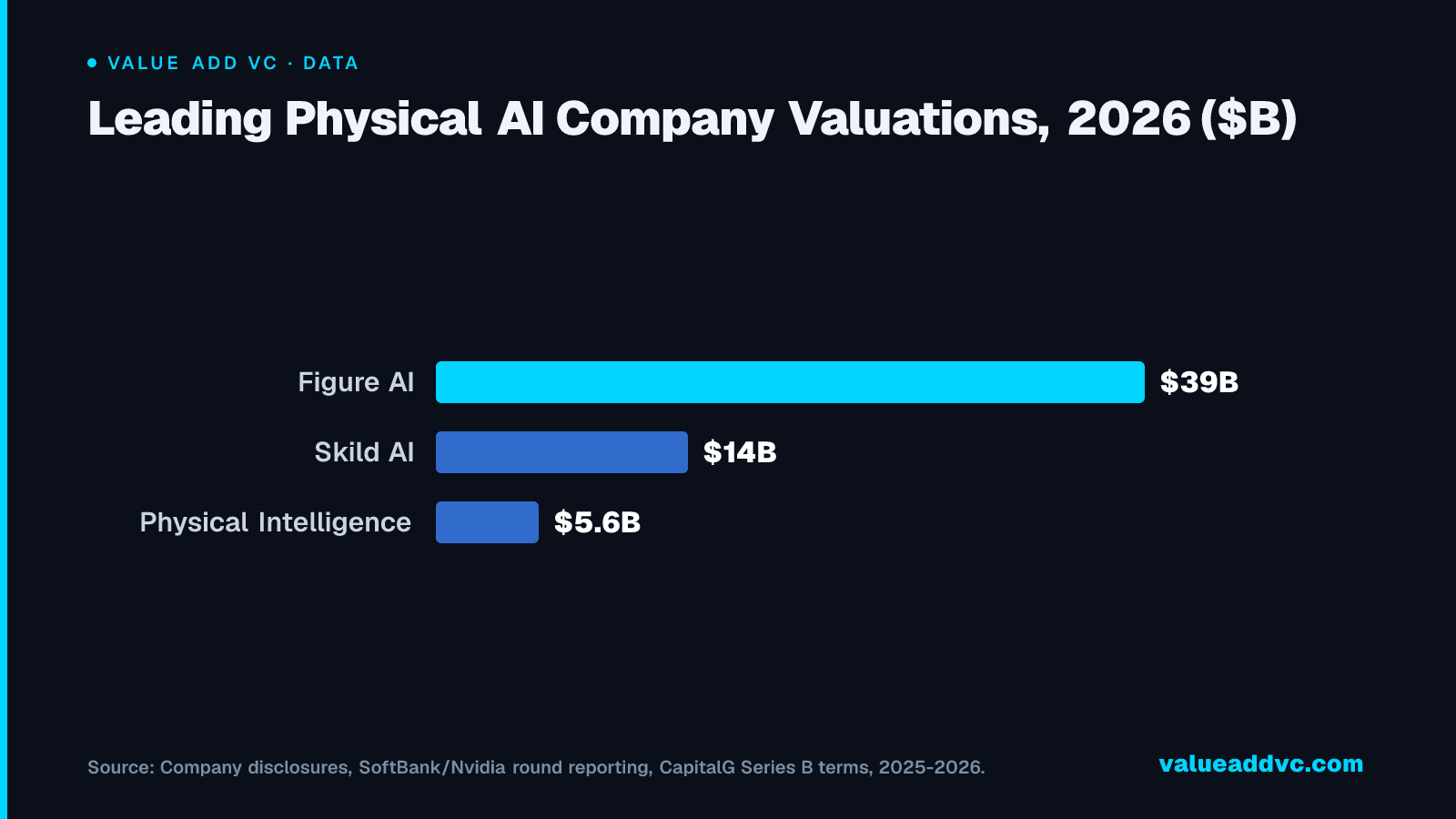
Atoms' valuation was not disclosed in its $1.7B round and is omitted from this chart rather than estimated.
Should investors care about Atoms versus the humanoid robotics field?
Atoms is a genuinely different bet than Figure AI, 1X, or Tesla's Optimus program, which are racing to build general-purpose humanoid hardware. Kalanick has explicitly said Atoms is building specialized robots on a shared "wheelbase," not humanoids, and the company already owns cash-generating businesses in CloudKitchens rather than starting from a pure research thesis. For LPs and allocators tracking the broader physical AI wave, Atoms is worth watching less as a robotics pure-play and more as a test of whether a founder with operating scars from Uber can run three heavy-industry businesses under one roof without the coordination costs eating the automation gains.
The Bottom Line:
Atoms raised $1.7B on July 22, 2026 with Uber — Kalanick's own former company — in the round, but the real story isn't the reunion. It's that a ghost-kitchen operator, an acquired mining-robotics firm, and a new logistics unit just got priced as one of 2026's largest physical AI bets, undisclosed valuation and all.
Track how physical AI and robotics valuations are moving on the AI Valuations Dashboard and see which companies just crossed $1B on the Unicorn Tracker at Value Add VC. Originally published in the Trace Cohen newsletter.
Latest from the Pulse
Get VC data most people never see
— free to subscribe
Trace's notes on venture, AI and startups, a few times a week. Join 5,000+ subscribers. No spam.
No spam, unsubscribe anytime. Sent via Substack · Privacy · or subscribe on Substack ↗