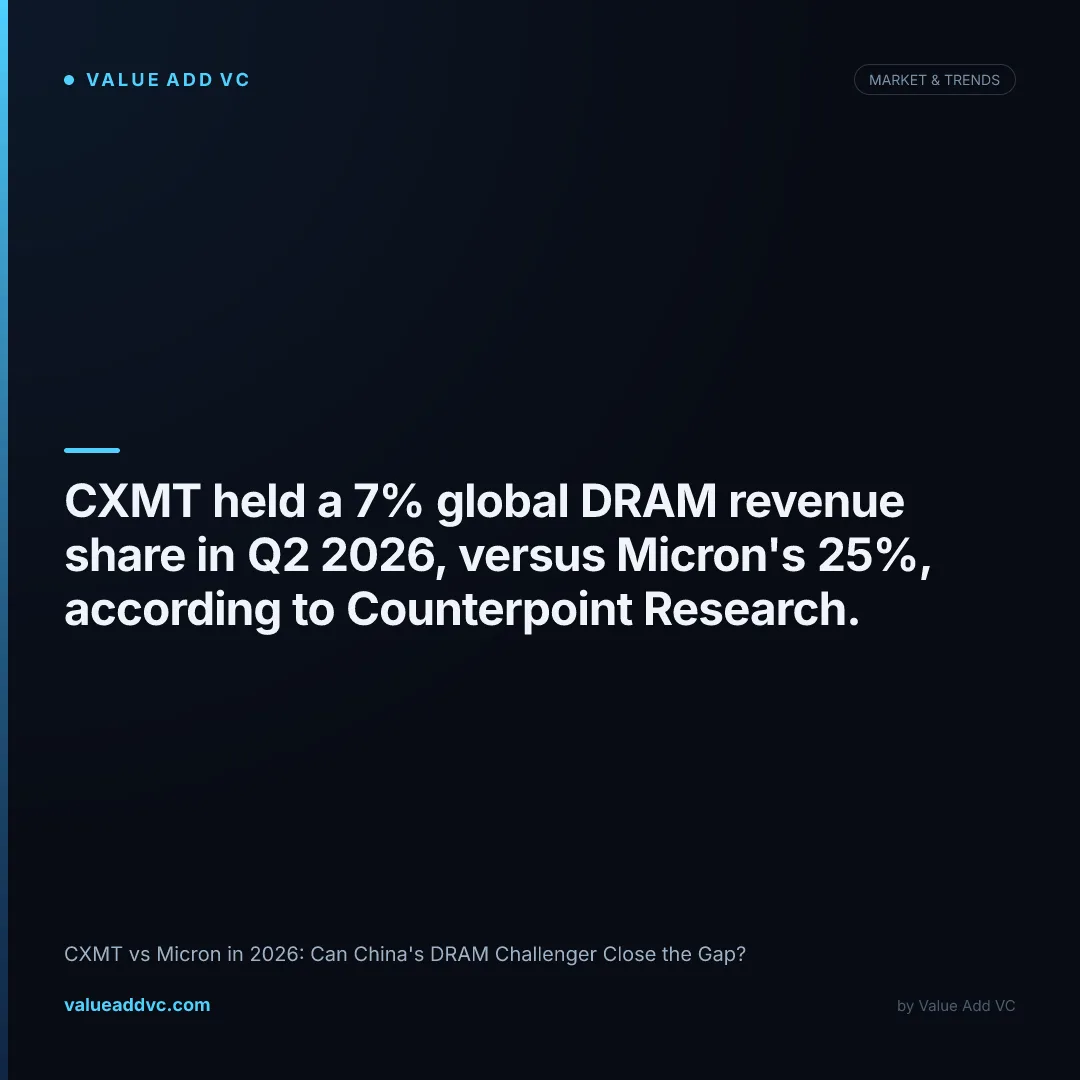
CXMT held a 7% global DRAM revenue share in Q2 2026 to Micron's 25%, per Counterpoint Research — but CXMT's production capacity has already climbed to roughly 91% of Micron's, after a Shanghai IPO that briefly made it mainland China's largest listed company.
CXMT (ChangXin Memory Technologies) is China's state-backed answer to the memory-chip duopoly of Micron, SK hynix, and Samsung — and in 2026, it stopped being a rounding error. Its revenue grew 716% year-over-year in the second quarter, according to Counterpoint Research data reported by Herald Business, the fastest growth of any major DRAM supplier, even as it still trails Micron badly on dollars of revenue per wafer.
Counterpoint Research (via Herald Business, Aug 4, 2026); Omdia capacity data (via Xenospectrum); CXMT IPO reporting (Xenospectrum).
Revenue Share: Micron Still Leads by a Wide Margin
By revenue, the DRAM market in 2026 still belongs to the three incumbents. Counterpoint Research's Q2 2026 data put Samsung Electronics first with 39% of global DRAM revenue, SK hynix second at 26% (down from 39% a year earlier, even as its revenue itself grew 214%), and Micron third at 25%. CXMT ranked fourth with 7%, up 716% year-over-year — growth that outpaces every incumbent, but off a base small enough that it still trails Micron by roughly 3.5x in revenue share.
A separate tracker, Omdia, put CXMT's Q1 2026 share at 7.6% (up from 4.7% the prior quarter) against Micron's 22.4%, in data reported by Xenospectrum's analysis of the capacity and share gap — a different quarter and a different methodology than Counterpoint's, so the two numbers aren't directly comparable, but both point the same direction: CXMT's share is growing fast but remains a fraction of Micron's.
CXMT vs Micron: Global DRAM Revenue Share (Q2 2026)
Counterpoint Research, via Herald Business, August 4, 2026.
Micron's revenue share was about 3.5x CXMT's in Q2 2026, even as CXMT's revenue grew far faster off a smaller base.
Capacity Tells a Different Story
Where CXMT has actually closed the gap is production capacity, not revenue. CXMT runs three 12-inch DRAM fabs — two in Hefei, one in Beijing — with roughly 300,000 wafers per month of combined capacity as of August 2026, per Reuters reporting carried by TrendForce, and is projected to reach about 350,000 wafers per month by the end of 2026. Micron's projected end-2026 capacity is about 385,000 wafers per month, per Omdia data cited by Xenospectrum — meaning CXMT's capacity is already around 91% of Micron's, even though its revenue share is roughly a third of Micron's.
That capacity-revenue mismatch is the core of the CXMT story: its fabs can produce almost as many wafers as Micron's, but most of that output goes into older DDR4 and DDR5 chips rather than the AI-driven HBM and LPDDR6 products commanding premium pricing — which is why Micron still earns far more per wafer. CXMT is reportedly weighing a second 12-inch fab in Beijing and has fabs under construction in Shanghai and Hefei that could eventually push its capacity past 600,000 wafers per month, according to Reuters reporting cited by TrendForce, though that expansion isn't fully funded or confirmed.
CXMT vs Micron: The Full Breakdown
| Metric | CXMT | Micron | Source |
|---|---|---|---|
| DRAM revenue share, Q2 2026 | 7% | 25% | Counterpoint / Herald |
| DRAM revenue share, Q1 2026 | 7.6% | 22.4% | Omdia / Xenospectrum |
| YoY DRAM revenue growth | +716% (Q2 '26) | Not disclosed in this data | Counterpoint / Herald |
| Projected capacity, end-2026 | ~350,000 wafers/mo | ~385,000 wafers/mo | Omdia / Xenospectrum |
| Current fab count (DRAM) | 3 (Hefei x2, Beijing) | Multiple global fabs | Reuters / TrendForce |
| Public listing | STAR Market, Shanghai (Jul 2026) | Nasdaq (MU) | Xenospectrum |
| Valuation / market cap | ~$85B at IPO; ~$487-489B after first-day pop | Not covered in this dataset | Xenospectrum |
| Primary customer base | China-concentrated (Huawei); early HP/Asus/Acer wins | Global, incl. AI data center / HBM customers | Nikkei / TrendForce |
How we counted: each row cites the specific tracker and quarter behind it; figures from different trackers are not averaged or combined. As of August-October 2026 reporting.
Which One Should You Be Watching?
For PC and server makers qualifying a second DRAM source: CXMT now has real capacity and reportedly prices on par with Samsung rather than at a discount, per Nikkei's sourcing — HP, Asus, and Acer have reportedly begun limited qualification, but its supply is still concentrated in China and carries geopolitical and export-control risk that Micron, as a US-based, Nasdaq-listed supplier, doesn't carry to the same degree.
For investors comparing memory-market exposure: Micron's edge is AI-driven demand for HBM and premium LPDDR, which is why its revenue share dwarfs its capacity share relative to CXMT — it earns more per wafer. CXMT's edge is growth-rate torque off a small base, now backed by an IPO that raised an estimated $8.6-9.8 billion, among the largest listings anywhere in 2026 according to Xenospectrum's reporting, funding further expansion alongside the strategic backing of Chinese state and private capital that insulates it from near-term profitability pressure.
Where we could be wrong
Different trackers (Counterpoint, Omdia, TrendForce) report meaningfully different share numbers for the same company in the same general period, which means any single data point here carries real measurement uncertainty — this is an evolving, fast-growing market where even the analysts disagree. CXMT's capacity figures are also forward projections for the end of 2026, not confirmed output, and its reported plans to exceed 600,000 wafers per month depend on fabs that aren't yet built or fully funded. A sharp swing in memory pricing, export-control policy, or Chinese state support could move either company's position faster than this snapshot suggests.
Bottom line: Micron still leads CXMT by roughly 3.5x on global DRAM revenue share, but CXMT's production capacity has closed to about 91% of Micron's, and its revenue is growing nearly 10x faster off a smaller base — backed by a $85 billion Shanghai IPO that raised up to $9.8 billion. The gap that remains is less about wafers than about what's on them: Micron's AI-era HBM and premium DRAM versus CXMT's still-dominant DDR4/DDR5 mix.
For more on the chip side of the AI buildout, see Value Add VC's coverage of export controls reshaping global chip competition and Big Tech's AI capex race.
Latest from the Pulse
Get VC data most people never see
— free to subscribe
Trace's notes on venture, AI and startups, a few times a week. Join 5,000+ subscribers. No spam.
No spam, unsubscribe anytime. Sent via Substack · Privacy · or subscribe on Substack ↗