In March 2023, founders with their entire operating runway at Silicon Valley Bank learned in 48 hours that bank selection is a survival decision. Three years later, the market has rebuilt around that lesson.
Some links on this site may earn us a commission — this never affects rankings. See our editorial standards.
The startup banking market consolidated around fintech-first platforms that offer free checking, yield on idle cash, expanded FDIC coverage through sweep networks, and integrations with the tools startups actually use (QuickBooks, Gusto, Stripe). Traditional banks still work — but they charge $15–30/month for business checking, offer 0.01% APY on deposits, and cap FDIC at the standard $250K. In 2026, there is no reason for a startup to accept those terms.
The Best Startup Banks in 2026, Ranked
How to Choose by Stage and Funding
Pre-seed / Bootstrapped
Relay or Mercury
If you run profit-first accounting with separate accounts for ops, taxes, and payroll, Relay's 20 free accounts are built for you. If you want yield on your cash and a more complete platform, Mercury is free and better. Either beats the $25/month Chase business checking your accountant will suggest.
Seed ($1M–$5M raised)
Mercury
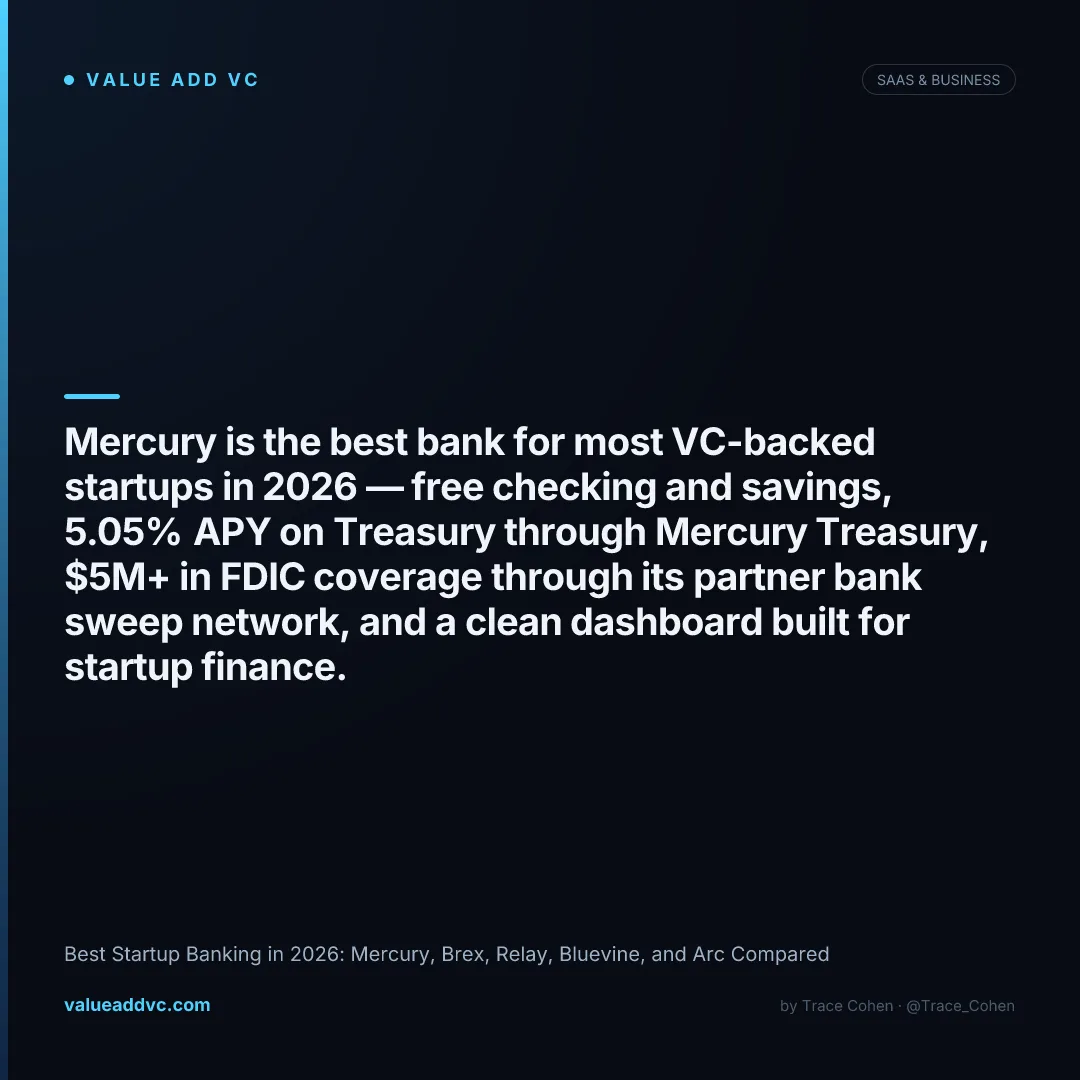
Free banking, 5.05% on your runway via Treasury, $5M+ FDIC through sweep, and integrations with Gusto and QuickBooks. At this stage your runway is your lifeline and the yield alone ($25K–50K/year on a $1M balance) pays for your bookkeeper.
Series A+ ($5M+ raised)
Mercury + Brex
Use Mercury as the primary operating account and Treasury for yield on idle capital. Add Brex for the corporate card — no personal guarantee, automated expense management, and category spend controls become essential when your team grows past 15. Consider Arc if you are sitting on $5M+ in idle cash and want diversified treasury management beyond just T-bills.
Need credit / lending
Bluevine or Mercury
Bluevine offers a $250K business line of credit alongside its checking account — useful for bridge financing or smoothing payroll. Mercury has launched venture debt and SAFE products through Mercury Raise. Traditional banks (Chase, BofA) still offer the best SBA loan rates if you qualify.
The Post-SVB Playbook: Diversify Your Cash
The lesson from Silicon Valley Bank is not “avoid tech-friendly banks” — it is “never keep more than FDIC limits at any single institution.” The modern playbook for a startup with $5M in the bank:
- •Primary operating account at Mercury — 2–3 months of runway for payroll and expenses
- •Mercury Treasury for the remaining cash — 5.05% APY on US T-bills, liquid within 1 business day
- •Brex card for all team spending — automated reconciliation, no personal guarantee
- •Second bank relationship (traditional or Relay) for backup payroll access — never have a single point of failure
This is not paranoia — it is the same advice every VC gave their portfolio companies the week SVB went down. Your funding round buys you runway, and your banking setup determines whether that runway is protected or concentrated in a single counterparty.
Your bank is not a commodity.
It is where your runway lives — and after SVB, the only responsible strategy is to spread it across institutions, earn yield on what you are not spending, and never assume any single bank is too big to fail.
Track startup funding data and VC benchmarks on Value Add VC. Follow @Trace_Cohen for more startup ops breakdowns. See the Mercury and Brex company profiles for full valuation and funding detail.
Latest from the Pulse
Get VC data most people never see
— free to subscribe
Trace's notes on venture, AI and startups, a few times a week. Join 5,000+ subscribers. No spam.