
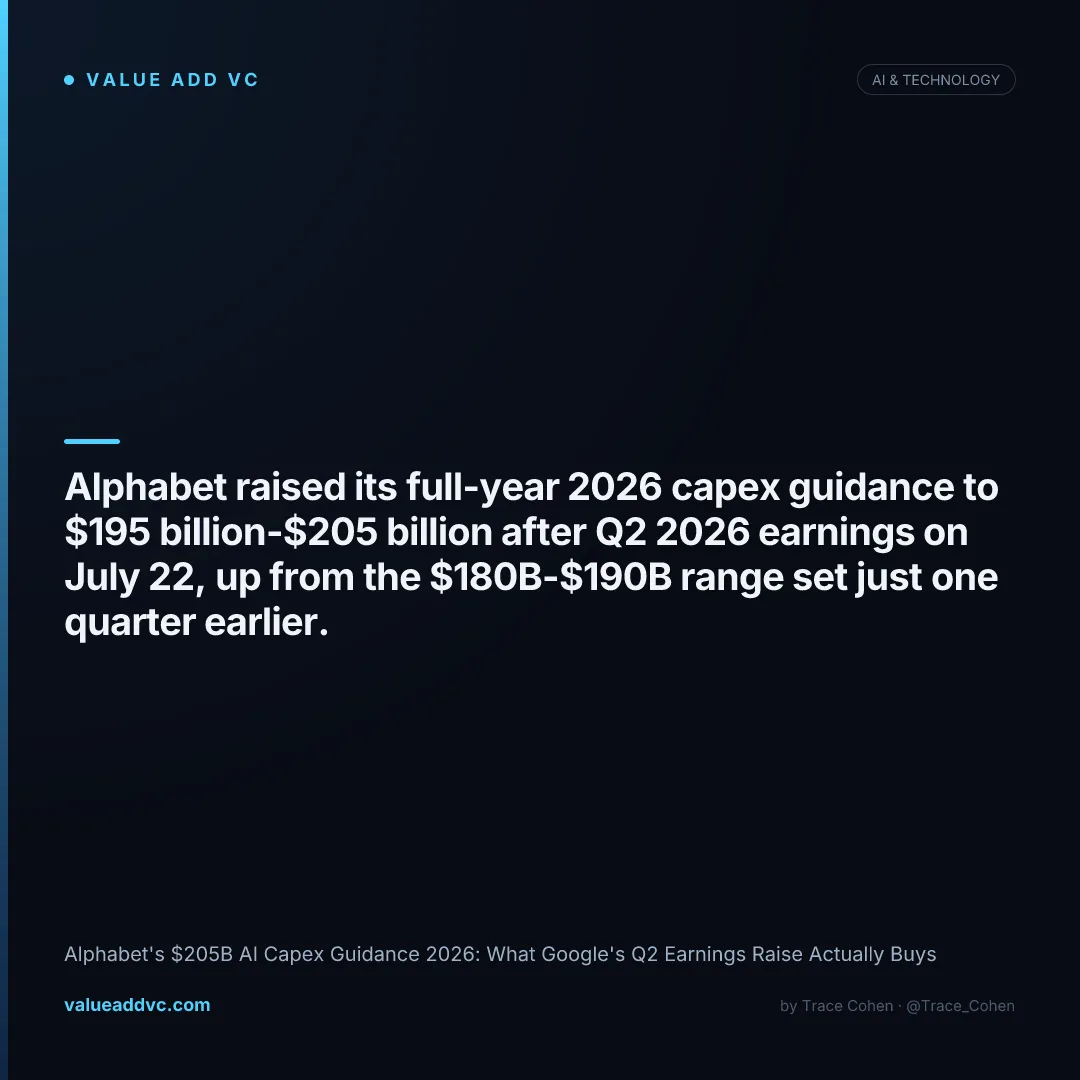
$205 billion is now the top end of Alphabet's 2026 capex guidance, raised from $190 billion just one quarter ago after Q2 earnings landed on July 22, 2026. A $15 billion guidance raise in ninety days deserves a line-item explanation.
Alphabet beat on revenue ($119.8 billion, up 24% year-over-year) and beat on earnings ($9.11 diluted EPS), then watched its stock fall anyway because the market cared more about the new spending number than the beat. That reaction is the real story: Wall Street is no longer just asking whether Google can grow — it's asking whether $205 billion a year is a rational bet or the top of an AI infrastructure bubble.
What Is Alphabet's Capex Guidance for 2026?
Alphabet's full-year 2026 capital expenditure guidance now sits at $195 billion to $205 billion, raised from the $180 billion-$190 billion range management set at Q1 earnings in April. The company reported the new number alongside Q2 results on July 22, 2026, citing an acceleration in AI infrastructure buildout needed to keep pace with cloud demand rather than a change in the demand itself.
| Guidance Checkpoint | 2026 Capex Range | Change |
|---|---|---|
| Initial 2026 outlook (early 2026) | $175B-$185B | baseline |
| Q1 2026 earnings (Apr 29) | $180B-$190B | +$5B midpoint |
| Q2 2026 earnings (Jul 22) | $195B-$205B | +$15B midpoint |
| Actual FY2025 capex | $80B | 2026 guide is ~2.5x |
| Q2 2026 actual quarterly spend | $44.9B | annualized run-rate below guide floor |
| 2027 outlook (preliminary) | expected to rise further | no formal range yet |
Figures are 2026 estimates and reported results blended from Alphabet's Q1 and Q2 2026 earnings calls, CNBC, Bloomberg, and Investing.com transcripts. FY2025 actual capex is from Alphabet's 10-K; 2027 guidance is directional management commentary, not a formal range.
Why Did Google Raise Its 2026 AI Infrastructure Spending?
The proximate cause is capacity, not demand uncertainty. Google Cloud revenue hit $24.8 billion in Q2 2026, up 82% year-over-year, and the backlog — contracted revenue not yet recognized — jumped $50 billion in a single quarter to $514 billion, with just over half expected to convert to revenue over the next 24 months. Management explicitly framed the higher guidance as an acceleration in delivering capacity to meet demand that already exists, which is a different story than spending ahead of uncertain future demand.
The company is also commercializing its own silicon rather than relying purely on third-party GPUs: Alphabet is selling TPU capacity directly to external cloud customers and is preparing a Blackstone-backed neo-cloud venture that will rent TPU compute to AI labs and enterprises starting in 2027. TPU system sales are a small share of 2026 revenue but are expected to ramp meaningfully in 2027, which is part of why management is comfortable front-loading capex now. See how this compares to the broader hyperscaler buildout on the Big Tech Earnings dashboard.
The TPU strategy also changes Alphabet's capex math relative to Microsoft and Amazon, both of which remain far more dependent on Nvidia GPUs for their own fleets. Every dollar Alphabet spends building TPU capacity for internal Gemini training doubles as a dollar it can later resell as external TPU cloud capacity once the Blackstone venture launches in 2027 — a vertical-integration advantage neither Microsoft's Azure nor Amazon's AWS can fully replicate without their own competitive silicon programs reaching similar maturity.
How Does Alphabet's Capex Compare to Amazon, Microsoft, and Meta in 2026?
Alphabet's newly raised range puts it at or near the top of the four largest US hyperscalers for the first time this cycle. Amazon raised its 2026 capex guidance to about $220 billion a week later, Microsoft puts calendar-2026 capex at roughly $175 billion including finance leases (down on paper from a widely cited ~$190 billion because more future data-center leases will be classified as operating rather than finance leases, which sit outside capex; Microsoft also extended data-center useful lives from 15 to 25 years), and Meta narrowed its range to $130 billion-$145 billion after its own upward revision earlier in 2026. Combined, the four companies are on pace to spend more than $700 billion on capex in 2026 alone, up sharply from about $410 billion in 2025.
2026 Full-Year Capex Guidance: Alphabet vs Amazon vs Microsoft vs Meta
Company earnings calls and guidance, CNBC, Sherwood News, July 2026. Alphabet and Meta figures reflect post-Q2 revisions.
What's notable is the direction of travel: three of the four raised guidance mid-year rather than holding steady, which means the $700 billion combined figure is itself likely to be revised higher again before year-end. Compare how this capex cycle is showing up in AI company valuations on the AI Valuations dashboard.
Where Does the $205 Billion Actually Go?
In Q2 2026, roughly 60% of Alphabet's $44.9 billion in technical infrastructure spend went to servers, with the remaining 40% split between data centers and networking equipment. That server-heavy mix reflects a company still buying GPU and TPU capacity aggressively rather than one that's finished building physical shells and is now filling them.
On the product side, that spend is feeding a Gemini app that now has 950 million monthly active users processing 22 billion tokens per minute. Gemini 3.6 Flash is currently the workhorse model absorbing most of that inference volume, while a more ambitious Gemini 4 is reportedly in training — meaning the current $205 billion guide funds both today's inference demand and the next model generation simultaneously, not one or the other. Beyond consumer and enterprise chat, DeepMind is also shipping specialized models: WeatherNext-3, an AI model for weather forecasting, is one of several proof points that Google's infrastructure spend is funding a broader portfolio of model research, not just LLM scale.
Why Did Alphabet Stock Fall on a Beat-and-Raise Quarter?
Alphabet shares fell roughly 3.65% to as much as 5% in after-hours trading on July 22 despite beating consensus on both revenue ($119.8 billion vs. $117.02 billion expected) and EPS ($9.11). The disconnect is straightforward: investors are increasingly pricing hyperscalers on free cash flow and capital discipline, not just top-line growth, and a $15 billion guidance raise in a single quarter reads as capex that's still accelerating rather than plateauing. Alphabet also reported negative free cash flow for the quarter, reportedly its first such quarter in roughly two decades, which sharpened the market's focus on when this spending cycle actually pays back.
The Bull Case for $205B
- ✓ $514B backlog means the spend is following contracted, not speculative, demand
- ✓ Cloud growing 82% YoY is accelerating, not decelerating
- ✓ TPU commercialization opens a second revenue line starting 2027
- ✓ Company is capacity-constrained, not demand-constrained
The Bear Case for $205B
- ✗ First negative free cash flow quarter in roughly 20 years
- ✗ Guidance has now been raised twice in two consecutive quarters
- ✗ 2027 capex is expected to rise further, with no ceiling given yet
- ✗ All four hyperscalers raising simultaneously raises industry-wide overbuild risk
What the $205 Billion Capex Guidance Means for the AI Investment Cycle
For venture investors, the signal isn't really about Alphabet specifically — it's that the four companies setting the price of AI compute are all still leaning in at the same time, which keeps GPU and TPU capacity expensive and keeps the infrastructure layer of the AI stack attractive relative to application-layer startups still fighting for differentiation. A hyperscaler with a $514 billion backlog isn't hedging; it's committing capital years out, which is the strongest signal available that enterprise AI demand is real rather than a pilot-project fad. Track how this capex cycle flows through to public and private valuations on the SaaS Valuations dashboard.
The risk sits on the other side of the ledger: with combined 2026 capex across the big four now tracking well past $700 billion and rising, any slowdown in enterprise AI adoption or a pause in the token-consumption growth curve would leave hundreds of billions of dollars in depreciating server and data center assets without the revenue to justify them. That's the bet Alphabet's board just doubled down on, and it's the same bet every LP with exposure to AI infrastructure funds is making by extension.
For founders building on top of this infrastructure, the practical takeaway is that GPU and TPU scarcity isn't easing in 2026 the way some forecasters expected a year ago — it's shifting shape. Capacity is still tight enough that hyperscalers are pre-committing capital years in advance rather than buying just-in-time, which keeps inference and training costs elevated for startups without direct cloud-credit deals. Any startup modeling its 2027 unit economics around falling compute costs should treat that assumption skeptically until at least one of the big four hyperscalers signals capex growth is actually decelerating rather than accelerating for a third straight quarter.
Alphabet just raised its 2026 capex guidance for the second consecutive quarter.
$180-190B in April. $195-205B in July. A $514B cloud backlog is why the number keeps climbing — and the stock fell on the news anyway.
The Marvell Warrant Deal: A New Data Point Since This Post First Published
On August 19, 2026, Marvell disclosed that it had granted Google a warrant to buy up to 58.97 million Marvell shares — worth as much as $12.2 billion — at an exercise price of $206.58, tied to a custom-silicon supply agreement the two companies signed on July 29. Shares vest as Google buys qualifying chips (roughly 240,000 shares per $500 million purchased), and the underlying agreement covers AI inference accelerators, storage controllers, and network- and memory-interface chips built for Google's TPU ecosystem. CNBC reported Marvell stock jumped more than 10% on the news.
Separately, Morgan Stanley reiterated an Overweight rating on Alphabet with a $400 price target after the August 21 close — implying roughly 15% upside — arguing the market is underestimating how large the TPU business could become now that Google Cloud has begun directly monetizing TPU system sales rather than only using TPUs internally.
This likely means the $205 billion capex figure understates Alphabet's total silicon commitment rather than overstates it: the Marvell warrant is compensation for chip-design and supply capacity that sits alongside, not inside, the capex line, and it signals Alphabet is locking in multiple custom-silicon suppliers rather than betting the TPU roadmap on a single partner.
The Bottom Line on Alphabet's 2026 Capex Guidance
Alphabet's $195 billion-$205 billion guidance is the clearest data point yet that the AI infrastructure buildout hasn't crested. Two consecutive quarterly raises, an 82% cloud growth rate, and a $514 billion backlog all point the same direction: demand is outrunning the capacity Alphabet can physically stand up, not the other way around. That's a genuinely different problem than the one investors feared a year ago, when the question was whether anyone would actually pay for all this compute.
What changed with this print is that "spend more, worry later" has visibly started to cost Alphabet at the stock level, even with a beat-and-raise quarter. Watch the Q3 2026 print for whether the backlog conversion rate holds and whether free cash flow returns positive — those two numbers, more than the headline capex figure, will determine whether $205 billion looks disciplined or excessive in hindsight.
See how Alphabet's capex compares in our $730B AI capex breakdown. Track live data on the AI Spending Tracker, AI Valuations dashboard, and Big Tech Earnings tracker at Value Add VC.
Latest from the Pulse
Get VC data most people never see
— free to subscribe
Trace's notes on venture, AI and startups, a few times a week. Join 5,000+ subscribers. No spam.
No spam, unsubscribe anytime. Sent via Substack · Privacy · or subscribe on Substack ↗