
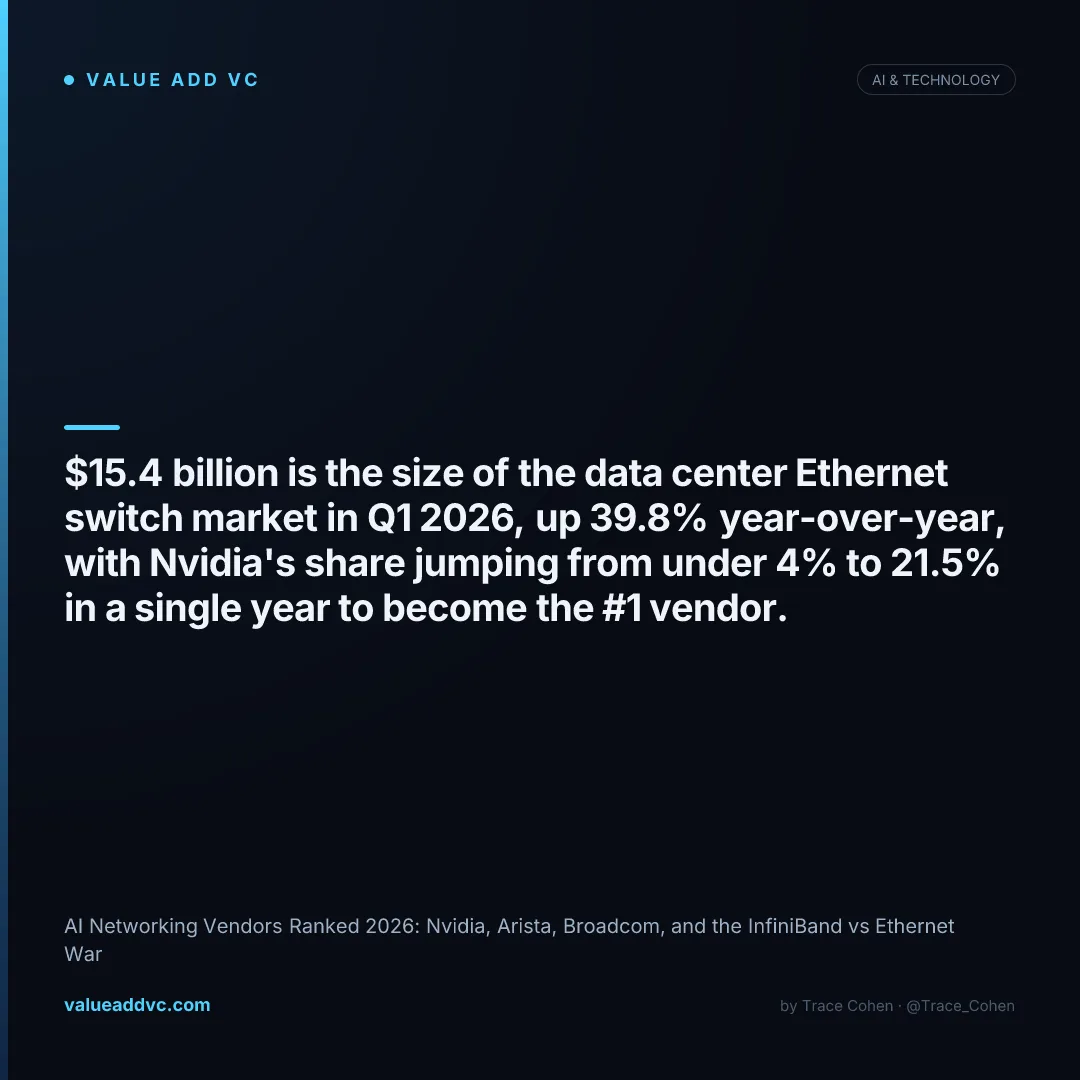
Nvidia's share of the data center Ethernet switch market jumped from under 4% two years ago to 21.5% in Q1 2026, making it the #1 vendor in a category it barely competed in before.
AI's real bottleneck has quietly shifted from GPU supply to the networking fabric that connects them — the data center Ethernet switch market hit $15.4 billion in Q1 2026 alone, up 39.8% year-over-year, and Nvidia's own networking business (InfiniBand plus its newer Spectrum-X Ethernet line) is now running at roughly $60 billion annualized. Below, the 7 vendors actually building this layer are ranked on real 2026 revenue and market-share data.
Nvidia networking, InfiniBand, and Ethernet AI infrastructure: who's winning in 2026?
Nvidia is winning the AI networking market in 2026 by revenue and growth rate, having taken the #1 spot in data center Ethernet switching with 21.5% share after generating $2.1 billion in Q1 2026 switch revenue, up 193% year-over-year. Ethernet is displacing InfiniBand as the default fabric for new AI clusters, with Nvidia's own Spectrum-X Ethernet demand now roughly matching its legacy InfiniBand base.
The 7 AI networking vendors, ranked by 2026 market position
Ranked by current revenue, market share, and how central each vendor is to the InfiniBand-vs-Ethernet transition actually reshaping AI data center buildouts this year.
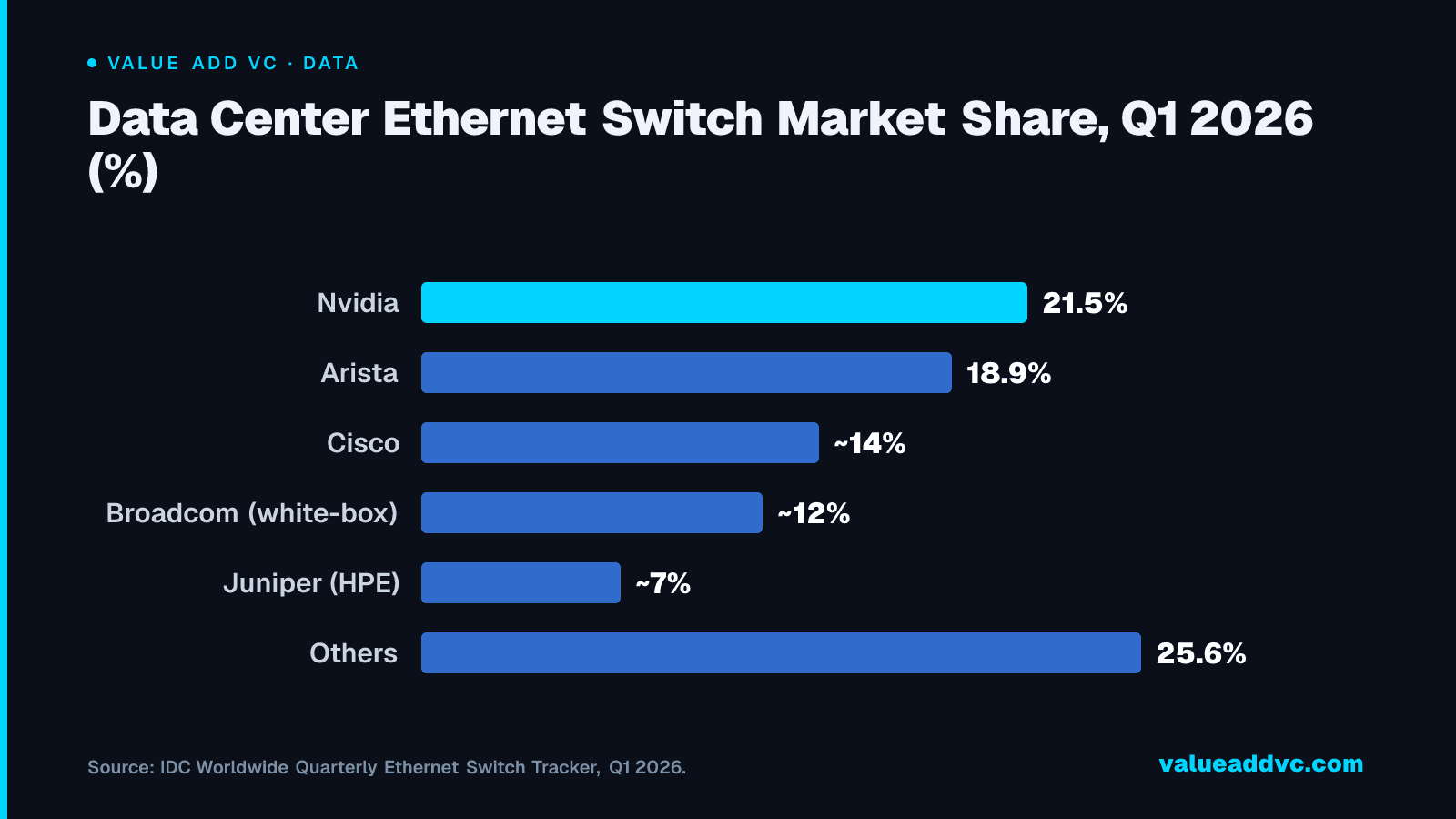
Data Center Ethernet Switch Market Share, Q1 2026 (%)
Source: IDC Worldwide Quarterly Ethernet Switch Tracker, Q1 2026.
Data
| Item | Value |
|---|---|
| Nvidia | 21.5% |
| Arista | 18.9% |
| Cisco | ~14% |
| Broadcom (white-box) | ~12% |
| Juniper (HPE) | ~7% |
| Others | 25.6% |
AI networking vendors compared: revenue, share, and technology bet
| Vendor | 2026 revenue / share | YoY growth | Primary technology | UEC member |
|---|---|---|---|---|
| Nvidia | 21.5% share / $2.1B (Q1 switches) | +193% | InfiniBand + Spectrum-X Ethernet | No |
| Arista Networks | 18.9% share / $10B+ (2026E) | +~20% | Ethernet (Broadcom silicon) | Yes, founding |
| Broadcom | ~12% share (via partners) | Not disclosed separately | Merchant silicon (Tomahawk/Jericho) | Yes, founding |
| Cisco | ~14% share | Low single digits | Ethernet, proprietary + merchant | Yes |
| AMD | Not broken out separately | n/a | Pensando DPUs, Ultra Ethernet silicon | Yes, founding |
| Juniper (HPE) | ~7% share | Low single digits | Ethernet, AI fabric software | No |
| White-box (Celestica, Accton) | Included in "Others" (~25.6%) | Fast-growing, undisclosed | Merchant silicon, no vendor stack | No |
Figures are Q1 2026 estimates blended from IDC's Worldwide Quarterly Ethernet Switch Tracker, company earnings disclosures, and Ultra Ethernet Consortium membership records. Share percentages are approximate and rounded; several vendors do not break out AI-specific networking revenue separately from total switching revenue.
Why Ethernet is winning the InfiniBand vs Ethernet war for AI infrastructure
InfiniBand was the default interconnect for GPU clusters for years because of its ultra-low latency, but it required specialized hardware, a narrower vendor ecosystem, and different operational expertise than the Ethernet gear most data center teams already ran. The Ultra Ethernet Consortium's 1.0 specification, finalized in June 2025, closed most of that latency gap — backed by a coalition that includes direct competitors Arista, Cisco, and Broadcom alongside major buyers Meta and Microsoft, all with a shared interest in not being locked into a single vendor's proprietary fabric.
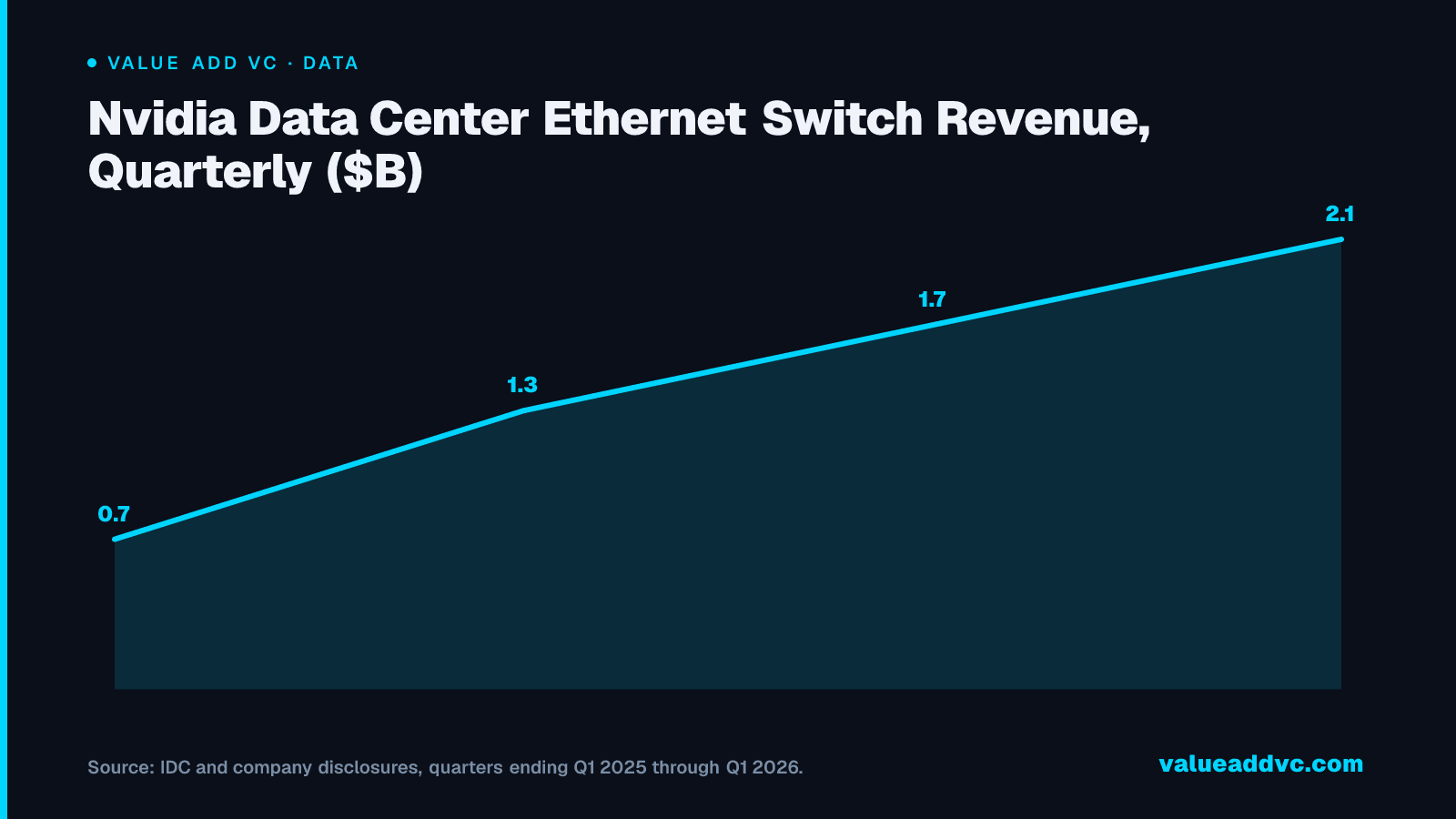
Nvidia Data Center Ethernet Switch Revenue, Quarterly ($B)
Source: IDC and company disclosures, quarters ending Q1 2025 through Q1 2026.
Data
| Item | Ethernet switch revenue ($B) |
|---|---|
| 0.7 | |
| 1.3 | |
| 1.7 | |
| 2.1 |
Arista's own CEO has publicly called Ethernet the "eventual winner and equalizer" for AI networking, which is a notable statement from the company that just lost the #1 overall market-share spot to Nvidia after years of steady share gains against Cisco. The practical result: Nvidia now sells both the GPU and a growing share of the network connecting it to other GPUs, a bundling advantage none of its networking-only competitors can fully replicate — we go deeper on how that networking arm became a core piece of Nvidia's AI infrastructure moat.
How the InfiniBand vs Ethernet AI infrastructure decision actually gets made
The decision isn't uniform across a data center — it splits by cluster function. For "scale-up" networking, where dozens of GPUs inside a single server rack need to talk to each other with sub-microsecond latency, InfiniBand and Nvidia's proprietary NVLink still hold a real technical edge, which is part of why InfiniBand hasn't disappeared even as its market share erodes. For "scale-out" networking, where thousands of servers across a data center need to coordinate on a training run, Ethernet's cost advantage and existing operational familiarity are winning almost every new deployment, which is the segment driving that 39.8% year-over-year market growth.
Cost is the practical driver underneath the technical argument. Ethernet switch ports typically run 20-40% cheaper per port than equivalent InfiniBand hardware, and because nearly every network engineer already knows Ethernet, hyperscalers avoid the specialized-staffing tax that came with running an InfiniBand-only fabric. That's the same economic logic playing out one layer down the stack from the GPU shortage story — just as buyers pushed hard on GPU pricing and availability once supply caught up with demand, they're now applying the same cost discipline to the networking gear connecting those GPUs together.
What the AI networking market shift means for buyers and investors
For hyperscalers and large AI labs, the practical question is no longer "InfiniBand or Ethernet" — it's how much vendor lock-in they're willing to accept in exchange for Nvidia's integrated compute-plus-networking performance versus a more open, UEC-standardized Ethernet stack from Arista, Cisco, or white-box vendors running Broadcom silicon. Meta and Microsoft's presence in the UEC as both customers and standard-setters signals the largest AI buyers want a credible alternative to single-vendor dependence, even while many of them still buy heavily from Nvidia today.
The networking layer is one of the more interesting derivative plays on the broader AI capex buildout tracked on our Big Tech Earnings dashboard — a $15.4 billion quarterly market growing at nearly 40% a year is a real business independent of which specific model wins, similar to how chip export controls reshaped Nvidia's China exposure without changing overall AI infrastructure demand. Watch Arista's next few quarters closely: if it holds share against Nvidia's networking push, that's real evidence the Ultra Ethernet Consortium's open-standard bet is working.
The pattern here has played out before in infrastructure categories: the incumbent with the most essential single component (the GPU, in this case) uses bundling to expand into adjacent layers faster than pure-play specialists can defend their turf. Arista, Cisco, and the merchant-silicon vendors underneath them are effectively betting that open standards and multi-vendor interoperability beat a single company's integrated stack over a long enough time horizon — the same bet that played out in favor of open standards in prior networking cycles, though never against a company with Nvidia's current balance sheet and customer leverage.
The Bottom Line:
AI's networking layer became a genuine standalone battleground in 2026, growing to a $15.4 billion quarterly market at nearly 40% year-over-year growth. Nvidia's jump from under 4% to 21.5% Ethernet switch share in two years shows how fast an incumbent can move when it bundles networking with the GPUs everyone already needs — but Arista, the Ultra Ethernet Consortium, and Broadcom's merchant silicon ecosystem are the check on that dominance actually playing out in real time.
Track AI infrastructure spending on the Big Tech Earnings Dashboard and see how AI-native companies are valued on the AI Valuations Dashboard at Value Add VC. Originally published in the Trace Cohen newsletter.
Latest from the Pulse
Get VC data most people never see
— free to subscribe
Trace's notes on venture, AI and startups, a few times a week. Join 5,000+ subscribers. No spam.
No spam, unsubscribe anytime. Sent via Substack · Privacy · or subscribe on Substack ↗