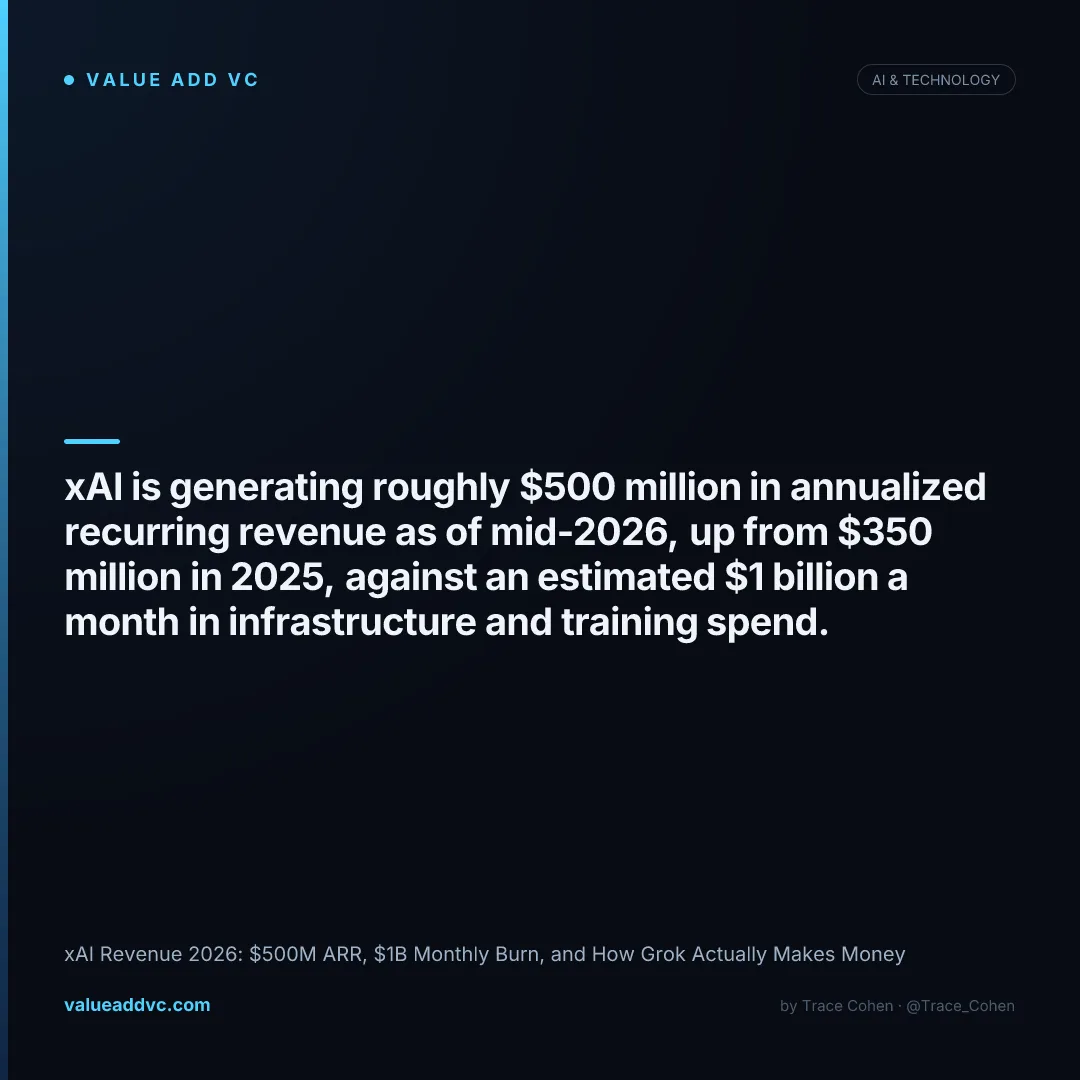
xAI — now folded into SpaceX and rebranded SpaceXAI — was generating roughly $500 million in Grok product ARR as of mid-2026, while the AI segment it belongs to reported $2.56 billion in Q2 2026 revenue after SpaceX went public.
That's the short answer, and it needs the qualifier because xAI stopped being a standalone company in 2026. SpaceX absorbed it in February, took the combined business public in June, and by September was disclosing xAI's numbers — Grok subscriptions and API tokens, plus a fast-growing business renting Colossus compute capacity to rival AI labs — inside its own quarterly SEC filings instead of through Bloomberg leaks.
Figures from SpaceX's SEC S-1 filing and August 4, 2026 Q2 earnings, Bloomberg (via Sacra), and CNBC/Benzinga reporting on SpaceX's compute-rental deals, 2026.
How Much Revenue Does xAI Actually Generate in 2026?
As of September 2026, xAI no longer files its own numbers — it reports as SpaceX's AI segment. That segment posted $2.56 billion in Q2 2026 revenue (up 247% year-over-year) and $3.2 billion for all of 2025, according to SpaceX's SEC filings. Grok's own product ARR, the figure most often quoted as "xAI revenue," was last independently pegged at roughly $500 million in mid-2026 by Bloomberg — a much smaller number, because it excludes the compute-rental deals now driving segment growth.
xAI's 2026 Business Snapshot: The Full Numbers
Different reports still measure different things — Grok-only product revenue, the full AI segment SpaceX now discloses, or the compute-rental contracts stacked on top of both. Here is every figure on the record, with what each one actually covers.
| Metric | Figure | Period / Note |
|---|---|---|
| Q2 2026 AI segment revenue (SpaceXAI) | $2.56B | +247% YoY from $737M; reported Aug 4, 2026 |
| Q2 2026 total SpaceX company revenue | $7.8B | +92% YoY, all segments |
| FY2025 AI segment revenue | $3.2B | Grok + X + compute, per SEC S-1 |
| FY2025 AI segment operating loss | $6.355B | ~$12.7B of 2025's $20.7B total capex |
| Grok product ARR (last standalone estimate) | ~$500M | Bloomberg via Sacra, mid-2026, pre-rebrand |
| Anthropic compute-rental deal | $1.25B/mo | Through May 2029 |
| Google Cloud compute-rental deal | $920M/mo | Oct 2026–June 2029, signed June 5, 2026 |
| New compute-rental deal (Sept 2026) | $1.11B/mo | Billing starts Dec 1, 2026 |
| Reflection AI compute-rental deal | $150M/mo | July 2026–end 2029, up to $6.3B total |
| Combined compute-deal ARR (4 deals) | ~$46.1B | Per CFO Bret Johnsen, Sept 17, 2026 |
| SpaceX company-wide ARR target | $100B+ | By December 2026, per CFO |
| SpaceX market cap | ~$2.0T | Sept 29, 2026; IPO'd June 12 at $135/share |
Source: SpaceX SEC S-1 filing and Q2 2026 earnings (Aug 4, 2026), Bloomberg (via Sacra), CNBC on the Google deal, and Benzinga/Motley Fool reporting on the September 2026 compute deal, all 2026.
How Grok Actually Makes Money: The Three Revenue Lines
Strip out the compute deals and SpaceXAI's core product business still runs on a fairly conventional AI-company playbook — subscriptions, a bundled distribution channel, and a metered API.
Consumer subscriptions
The lineup expanded this summer: SuperGrok Lite is $10/month, SuperGrok is $30/month, a new SuperGrok Plus tier sits at $100/month, and SuperGrok Heavy remains $300/month for the highest-compute tier. X Premium+ at $40/month still bundles Grok access into X's existing subscription base, the cheapest acquisition channel xAI has.
Developer API
Grok 4.7, xAI's flagship model, shipped September 21, 2026 and is priced at $2 per million input tokens and $6 per million output tokens for prompts under 200K tokens (rising to $4/$12 per million beyond that), up from Grok 4.5's $1.25/$2.50 in July — a real price increase alongside the capability jump. The model was live in GitHub Copilot immediately at launch, a distribution channel Grok didn't have in August.
Enterprise contracts
Grok Business runs $30 per seat per month for teams below enterprise scale. Grok Enterprise adds SSO, SCIM provisioning, audit logging, and the Vault private-data-storage layer. On the government side, the Pentagon has been rolling Grok out to millions of personnel alongside ChatGPT under a Department of War AI contract, a channel that didn't exist in this post's last version.
Where the Capital Actually Goes
The spending maps directly to the Colossus supercomputer campus in Memphis, Tennessee, plus the newer Southaven, Mississippi buildout xAI committed $20 billion to before the merger. SpaceX's SEC S-1 puts real numbers on it: the AI segment alone consumed $12.7 billion of the company's $20.7 billion in total 2025 capital expenditures, and Q2 2026 capex to that same segment ran close to $16 billion in a single quarter, according to SpaceX's August 4, 2026 earnings report.
That capital intensity is why SpaceX's own total revenue and balance sheet now matter as much for reading xAI as Grok's product metrics do. SpaceX's June 2026 IPO raised $75 billion, and its 2025 S-1 showed $18.7 billion in company-wide revenue against a $4.9 billion net loss — a business large enough to keep funding Colossus expansions that individual Grok subscriptions and API calls are nowhere close to covering on their own.
What Changed Since August: SpaceX Going Public Made xAI's Numbers Real
The single biggest shift since this post was last updated isn't a new revenue figure — it's where the figures come from. xAI completed its rebrand to SpaceXAI in July 2026, dissolving as a standalone corporate entity, and SpaceX priced its IPO at $135 a share on June 12, 2026, raising $75 billion in what TechCrunch called the largest IPO in history. That means xAI's financials are no longer Bloomberg estimates stitched together from leaks — they're audited figures inside SEC filings, reported every quarter alongside Starlink and launch revenue.
The first test of that came fast. In SpaceX's first earnings report as a public company on August 4, 2026, the AI segment reported $2.56 billion in quarterly revenue, up 247% from $737 million a year earlier, even as the same report showed AI capex outrunning the growth. Then, on September 17, 2026, CFO Bret Johnsen told a technology conference SpaceX had signed a fourth major compute-rental deal — $1.11 billion a month starting December 1, on top of existing agreements with Reflection AI, Google, and Anthropic — and reaffirmed the company's target of $100 billion-plus in annualized recurring revenue by December 2026.
xAI's own product launch cadence didn't stop either: Grok 4.7 shipped September 21, 2026 and was live in GitHub Copilot the same day, xAI's clearest new distribution channel since the Anthropic compute deal in May.
The Compute-Rental Business: Four Deals Deep
In May 2026, Anthropic agreed to pay xAI roughly $1.25 billion a month to rent capacity on the Colossus 1 cluster through May 2029. That deal is no longer alone. Google signed on for $920 million a month running October 2026 through June 2029, Reflection AI committed to $150 million a month through 2029, and in September 2026 SpaceX closed a fourth deal worth $1.11 billion a month with billing starting December 1 — its counterparty undisclosed as of this writing.
Anthropic, a direct model competitor, is by the numbers above xAI's largest disclosed compute customer as of this writing — a dynamic that only makes sense if you treat Colossus less as "the infrastructure behind Grok" and more as a neutral compute utility SpaceX happens to own. It says more about physical GPU scarcity in 2026 than about any alliance between the labs.
Monthly Product Revenue Run-Rate vs Monthly Burn
At a $500M ARR run-rate, Grok's product business alone generates roughly $42M a month — a fraction of what SpaceX now spends on AI infrastructure in a single quarter, even before compute-rental revenue is counted.
Implied from ~$500M Grok product ARR and SpaceX's ~$16B Q2 2026 AI-segment capex, 2026
xAI Revenue vs OpenAI and Anthropic: How Far Behind It Actually Is
xAI's $230 billion Series E valuation put it in the same conversation as OpenAI and Anthropic on paper. The revenue numbers tell a very different story, and xAI is no longer even a standalone stock to compare.
| Metric | xAI / SpaceXAI | OpenAI | Anthropic |
|---|---|---|---|
| Annualized revenue | $2.56B/qtr AI segment (Q2 2026, +247% YoY) | $41.3B (net, July 2026) | $74.1B (gross, July 2026) |
| Grok/product-only ARR | ~$500M (mid-2026 estimate) | n/a, bundled | n/a, bundled |
| Most recent valuation | ~$2.0T (SpaceX combined, Sept 29, 2026) | $852B (Mar 2026 raise) | $965B (May 2026) |
| Public market status | Public via SpaceX (NASDAQ: SPCX) | Private | Private |
| Total capital raised | ~$42B pre-merger + $75B SpaceX IPO | $130B+ | $100B+ |
| FY2025 segment/company loss | $6.355B operating loss (AI segment) | Undisclosed publicly | Undisclosed publicly |
| Primary revenue driver | Subscriptions + API + 4 compute-rental deals | ChatGPT subscriptions + API | Claude API + enterprise |
Source: SpaceX SEC S-1 and Q2 2026 earnings, Bloomberg/Sacra (xAI), CNBC, and Value Add VC's OpenAI vs Anthropic accounting breakdown, July–September 2026.
What the headline misses
"xAI revenue" now means at least three different numbers: Grok's product ARR (~$500M), the AI segment's quarterly total SpaceX now discloses ($2.56B in Q2 2026), and the annualized run-rate of its compute-rental contracts (~$46B by December). Treating any two of those as the same fact is the fastest way to misread this company — the segment figure includes X and compute revenue Grok subscribers never touch, and the compute-deal ARR is contracted future billing, not cash already collected.
The counterweight to the growth headlines is the loss column right next to them: the AI segment burned $6.355 billion from operations in 2025 and consumed nearly $16 billion in capex in a single quarter of 2026, per SpaceX's own S-1 and earnings report. Going public didn't make the business profitable — it just made the losses visible on a predictable quarterly schedule instead of via leaks.
Why This Matters for How You Price the Rest of the AI Market
xAI is the clearest 2026 example of a frontier lab whose economics got absorbed into a much larger, differently-priced public company rather than proving out on its own. Every other top-tier lab — Anthropic at roughly 13x revenue, OpenAI at roughly 21x — is still being priced as a stand-alone AI business. xAI isn't anymore; it's one segment of a public aerospace-and-AI conglomerate trading around $2 trillion, tracked on our AI Valuations Dashboard.
For founders and investors, the practical read hasn't changed: if you're competing with Grok on subscriptions or API pricing, you're fighting a balance sheet — now SpaceX's, not just xAI's — that can absorb years of product-market-fit misses because its investors are underwriting Colossus and Starlink together, not Grok's monthly active users. Our AI infrastructure spending tracker covers how far that capital keeps stretching.
Bottom line: xAI no longer reports its own numbers — as SpaceXAI, it's a segment of a public SpaceX, which posted $2.56 billion in Q2 2026 AI-segment revenue (up 247% year-over-year) against a $6.355 billion full-year 2025 operating loss. Grok's own product business is still roughly $500 million in ARR, dwarfed by four compute-rental deals now worth close to $46 billion annualized. Different numbers describe different businesses under the same roof, and conflating them is the fastest way to misread what SpaceX's roughly $2 trillion market cap is actually pricing.
Latest from the Pulse
Get VC data most people never see
— 100% free
Weekly benchmarks, valuations, and fund data. Join 5,000+ investors. No spam.