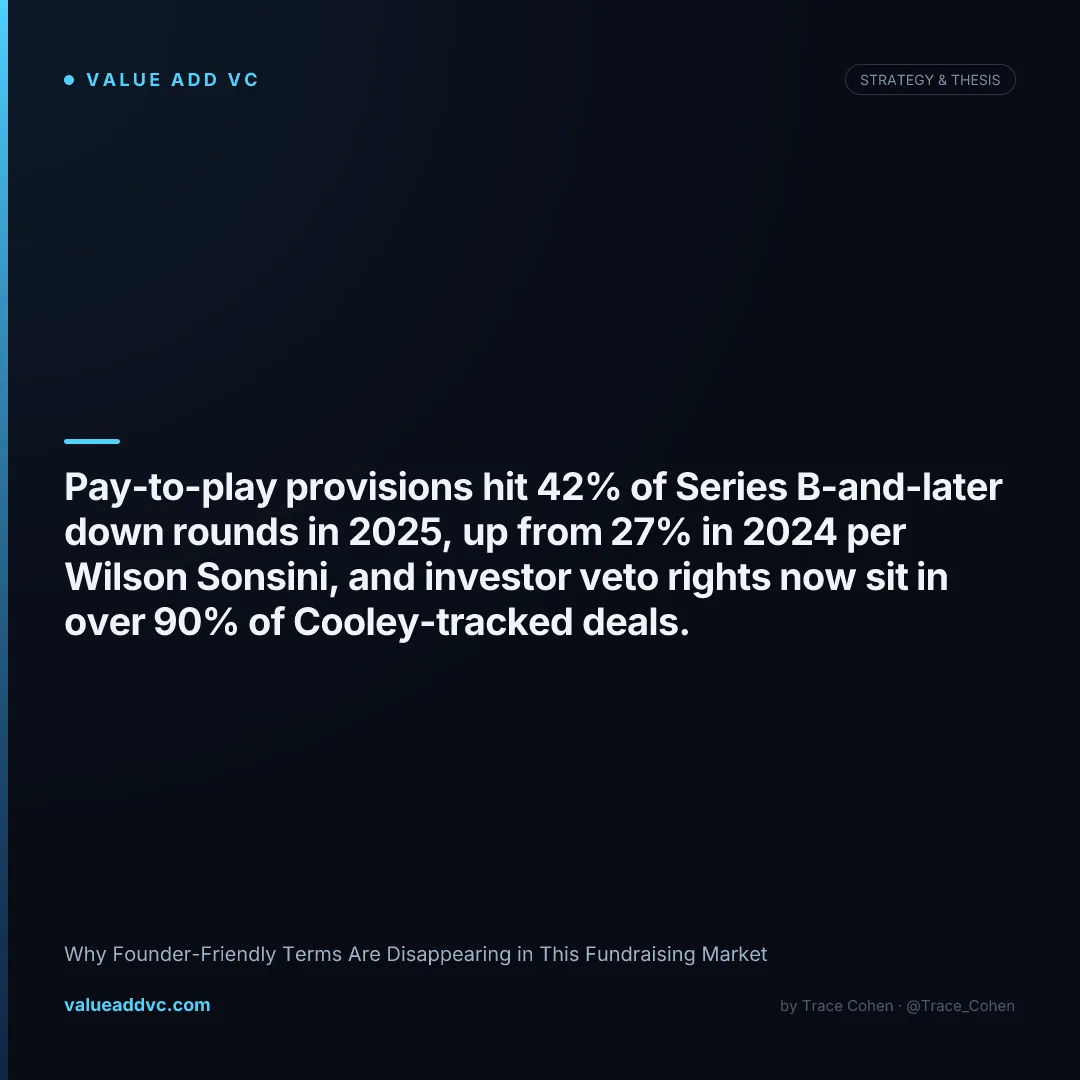
I think founder-friendly terms are disappearing in 2026, but not where most people are looking. The headline number everyone watches, the 1x non-participating liquidation preference, has barely budged: it sat at 98% of deals in both Q2 and Q4 2025. What's actually eroding is everything around it. Pay-to-play provisions climbed from 27% to 42% of Series B-and-later down rounds in a single year, and investor veto rights now show up in more than nine out of ten deals. Founders are winning the fight everyone talks about and quietly losing the ones that don't make it into a term sheet summary tweet.
Why founder-friendly terms disappearing 2026 is the wrong headline number
Ninety-eight percent of venture deals used a 1x liquidation preference in Q2 2025, with 95% non-participating, according to Cooley's Q2 2025 Venture Financing Report. By Q4 2025, that had ticked up slightly to 96% non-participating, per Cooley's Q4 2025 report. Fenwick's Q1 2026 Venture Beacon corroborates it: liquidation preference multiples above 1x "remained rare" entering the year. If you only track that one number, this reads like a founder-friendly market.
I don't think that reading survives a look at the rest of the term sheet. Protective provisions, the clauses giving investors veto power over new financings, a sale of the company, or charter amendments, sat in over 90% of Q2 2025 deals per the same Cooley data. Redemption rights, which let investors force a company to buy back their shares after a set period, moved from 2.7% of deals in Q1 2025 to 4.2% in Q2 and 4.3% in Q3, before Cooley's Q4 report showed them easing back to 1.8%. That's a bumpy line, not a clean trend, but it's a term that barely existed in 2021-era deals and now shows up regularly enough to track quarter over quarter.
Pay-to-play is the clearest evidence
Pay-to-play provisions require existing investors to keep investing pro-rata in future rounds or lose their preferred-stock protections, getting converted to common. Across all venture deals, Cooley tracked pay-to-play at 9.3% in Q4 2024, rising to 10.1% in Q2 2025 and holding there through Q3 2025. That's a modest move on the full dataset. But Wilson Sonsini's full-year 2025 Entrepreneurs Report narrows the lens to where it actually matters, Series B-and-later down rounds, and finds pay-to-play in 42% of those deals in 2025, up from 27% in 2024. That's the segment where a company genuinely needs the money and has the least leverage to say no.
Carta's data shows why that segment got bigger: down rounds reached roughly 24% of all US growth-stage financings in H1 2025, well above the 4% baseline Carta reported for 2021, though the overall down-round rate eased to 11.4% across all rounds by Q1 2026, back near 2019-2020 levels. Pay-to-play is a term that mostly lives inside down rounds and bridges, so as more companies went through a down round in 2025, more of them ran into it, and investors used the leverage those situations create to ask for something they wouldn't get in a clean up round.
Where the pressure is actually coming from
My read on why this is happening now: less capital is chasing more companies that still need a bridge or a reset, and the investors writing those checks increasingly come from growth-equity and crossover backgrounds where redemption rights, veto power, and pay-to-play are just how a deal gets structured, not a negotiating stretch. When a growth investor leads a Series B extension that's really a rescue financing, they bring the term sheet muscle memory of a later-stage investor to a round that, five years ago, would have looked like a standard venture deal.
There's a real, well-documented example of what this looks like from the founder's side. Eliza Bank, CEO of the plant company The Sill, told PitchBook that after receiving a term sheet with a 3x liquidation preference, she turned to equity crowdfunding instead, raising through Wefunder rather than accept the terms. That story predates this specific cycle, but it's the same mechanism at work: a company under time pressure gets offered aggressive terms, and the alternative to accepting them is finding capital somewhere the venture term sheet doesn't apply at all.
Where I could be wrong
The strongest counterargument is that I'm reading noise as signal on the terms that moved the least. Redemption rights swung from 2.7% to 4.3% and back down to 1.8% within a single year, per Cooley's own quarterly reports, that's a small base with a lot of volatility, not a stable multi-year trend the way the 22%-to-5% generalist-fund data I've written about elsewhere is. Pay-to-play across all deals moved from 9.3% to 10.1%, less than a single percentage point. If I'd only cited the all-deal averages instead of narrowing to Series B+ down rounds specifically, this piece wouldn't have much of a case.
There's also a real founder-friendly trend running in the opposite direction that undercuts a clean "everything is getting worse" story: post-termination option exercise windows are getting longer, not shorter. Cooley GO and equity-administration platforms both describe more companies extending the standard 90-day window, Pinterest gives departed employees up to seven years, and Carta's own policy matches exercise time to tenure. If founder-friendliness is genuinely retreating across the board, that shouldn't be the direction this particular term is moving.
And it's worth being honest that "founder-friendly terms are disappearing" is itself an oversimplification of a market that's bifurcating. AI and deeptech companies with real leverage are still getting close to 2021-era terms; everyone else is absorbing the pay-to-play and veto-rights pressure described above. The data I'm citing is an average across a market that increasingly has two very different experiences inside it, and a founder with real leverage right now may not recognize this post's thesis at all.
Bottom line: Founder-friendly terms aren't disappearing on the metric most people watch, the 1x non-participating liquidation preference held at roughly 98% of deals through 2025. They're disappearing on the metrics that don't get summarized in a tweet: pay-to-play nearly doubling in Series B+ down rounds, veto rights sitting above 90% of deals, and redemption clauses showing up in a market that barely used them a few years ago. If you're negotiating a term sheet in this market, the headline number is the one place you're least likely to get squeezed, and the governance and downside-protection clauses are where the real negotiation now happens.
Latest from the Pulse
Get VC data most people never see
— 100% free
Weekly benchmarks, valuations, and fund data. Join 5,000+ investors. No spam.