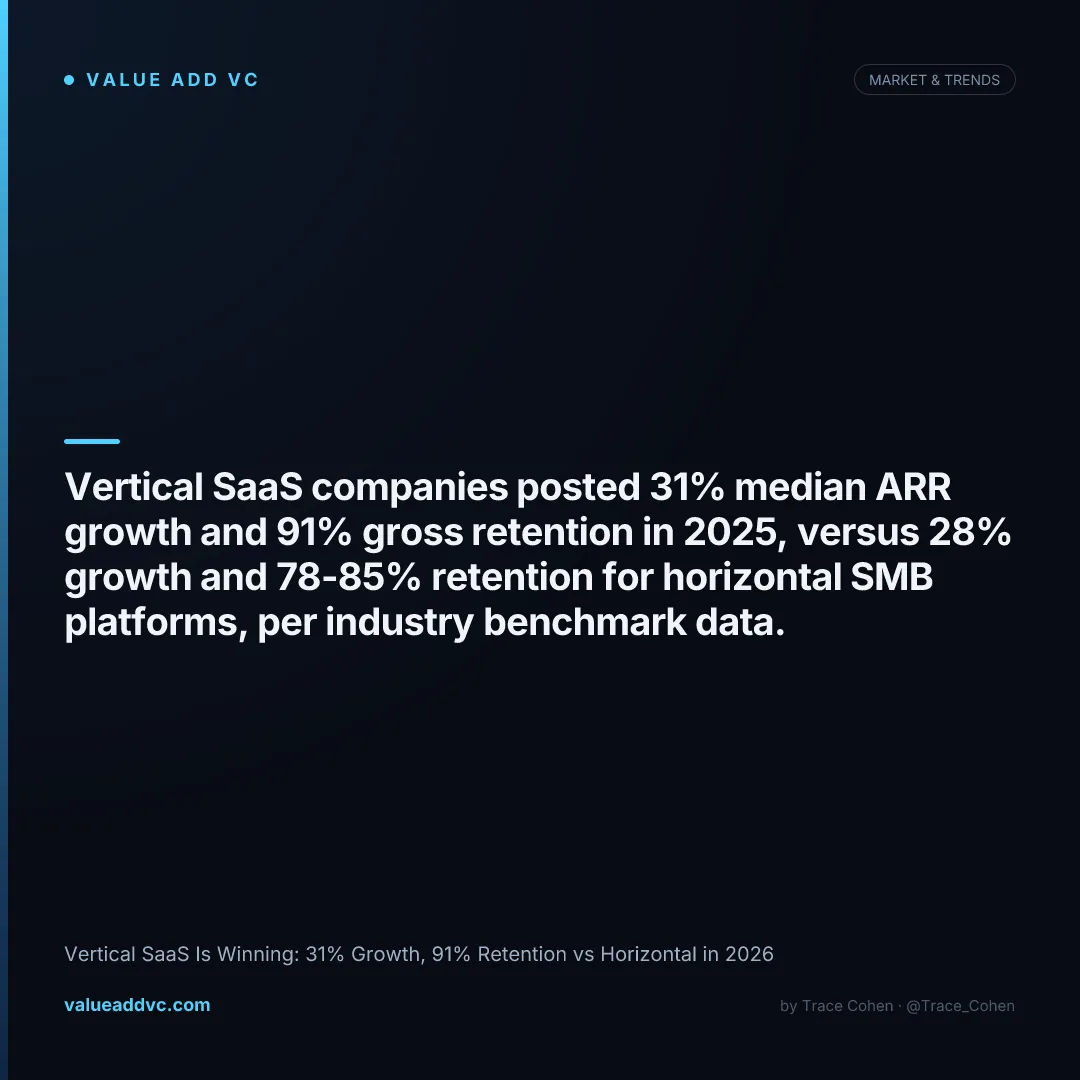
Vertical SaaS grew ARR a median 31% in 2025 with 91% gross retention, while horizontal SaaS grew 28% and retained only 78-85% of SMB customers. That's the short answer. The longer answer is why a smaller total addressable market keeps producing better businesses.
Every generalist SaaS pitch still leads with TAM slides — "every business needs a CRM, every business needs project management." But the public market and the retention data both say the opposite is happening: the companies compounding fastest right now are the ones that picked one industry, built the workflow no horizontal tool could replicate, and made switching cost more than the software itself. Here's the actual data behind that shift.
Figures are 2025-2026 blended estimates from SaaS Mag, GrowthSpree's B2B SaaS NRR/GRR benchmark report, and Optifai's 939-company retention dataset.
Is vertical SaaS actually winning in 2026?
Yes, on the two metrics that actually move a valuation: growth and retention. Vertical SaaS companies posted a median 31% ARR growth rate in 2025 against 28% for horizontal peers, and averaged 91% gross retention against 78-85% for horizontal SMB tools. The gap widens further at the top: fintech-focused vertical platforms hit 96% gross retention, while horizontal SMB SaaS still churns 3-7% of customers monthly. Purpose-built software isn't winning on growth alone — it's winning because it doesn't leak revenue the way generalist tools do.
That distinction matters more than it used to. In a market where fund performance is increasingly judged on DPI over paper markups, a company that retains 91 cents of every dollar is worth structurally more than one retaining 80 cents, even at an identical growth rate — the compounding math on retention dwarfs the compounding math on new-logo growth once a company is past $10M ARR.
Run the math on a simple cohort model: a company growing 28% a year but retaining only 80% of existing revenue is effectively re-selling 20% of its book every twelve months just to stand still, before a single new logo closes. A company growing 31% a year while retaining 91% only has to backfill 9% of its book. At scale, that gap is the difference between a sales team that spends most of its year on defense and one that spends most of its year on offense — which is also why vertical SaaS companies tend to run leaner go-to-market teams relative to revenue than horizontal peers chasing the same ARR number.
Vertical SaaS vs Horizontal SaaS: The Public Market Scoreboard
Public comps confirm the retention story shows up in valuation. Below are current market caps, trailing-twelve-month revenue, and the resulting revenue multiple for five vertical SaaS leaders against two horizontal incumbents, as of mid-July 2026.
| Company | Type / Industry | Market Cap | TTM Revenue | Revenue Multiple |
|---|---|---|---|---|
| Veeva Systems | Vertical — Life Sciences | ~$35B | ~$2.75B | ~12.7x |
| Guidewire | Vertical — Insurance | $11.7B | $1.42B | ~8.2x |
| Procore | Vertical — Construction | ~$12B | ~$1.2B | ~10x |
| ServiceTitan | Vertical — Field Service | $7.64B | $1.01B | ~7.6x |
| Toast | Vertical — Restaurants | $17.63B | $6.45B | ~2.7x |
| HubSpot | Horizontal — Marketing/CRM | ~$28B | $3.29B | ~8.5x |
| Salesforce | Horizontal — CRM | $153B | $43B | ~3.6x |
Figures are July 2026 market data from company 8-K filings, MacroTrends, and StockAnalysis.com. Revenue multiple = market cap / trailing-twelve-month revenue; not adjusted for growth rate or margin.
Why Purpose-Built Software Outperforms Horizontal Platforms
The multiple gap isn't random — it tracks switching cost almost exactly. Veeva sits inside FDA-regulated clinical trial and quality-management workflows at pharma companies; ripping it out risks a compliance audit failure, not just a migration headache. Guidewire runs claims and policy administration for insurers who can't tolerate downtime during a catastrophe event. That's why both trade at 8x-13x revenue while Salesforce, despite $43B in revenue and category dominance, trades at 3.6x — a CRM is replaceable in a way a claims engine is not.
Toast is the instructive exception. It has some of the deepest restaurant-industry lock-in of any company on this list — POS hardware, kitchen display systems, payroll, and payments all in one stack — yet trades at just 2.7x revenue because roughly two-thirds of its revenue comes from payment processing, a lower-margin, more commoditized line than pure software. The lesson for founders building vertical SaaS: the multiple rewards software revenue mix and retention, not just vertical focus alone.
Vertical SaaS vs Horizontal SaaS: Retention and Growth Compared
Retention is where the gap is starkest and most durable. Broad B2B SaaS net revenue retention benchmarks for 2026 sit at a median of 108%, with the top quartile above 125% and the bottom quartile under 95% — but vertical SaaS companies cluster disproportionately in that top quartile because expansion revenue (more locations, more seats within one operator, more modules) compounds inside a workflow customers can't easily leave.
Vertical SaaS vs Horizontal SaaS: 2025-2026 Benchmark Data
SaaS Mag, GrowthSpree B2B SaaS NRR/GRR Benchmarks 2026, and Optifai's 939-company retention dataset.
Figures are 2025-2026 blended estimates; individual company results vary widely by segment and go-to-market motion.
Where Horizontal SaaS Still Wins
None of this means horizontal SaaS is dying — HubSpot's 8.5x multiple on $3.29B of TTM revenue proves a horizontal platform can still command a premium if it owns enough of a workflow (marketing, sales, and service in one suite) to create its own switching cost. The pattern isn't "vertical always beats horizontal." It's that a horizontal platform needs either genuine network effects, a true platform ecosystem, or category-defining distribution to earn the multiple that a vertical company gets almost by default once it owns an industry's core workflow. Salesforce still generates $43B in revenue nobody else can touch, but its 3.6x multiple reflects a market that now assumes some of that revenue is contestable in a way Veeva's clinical trial software isn't.
The other honest caveat: vertical SaaS TAMs are smaller by definition, and not every industry supports a venture-scale outcome. A vertical SaaS company serving a $2B industry with 10,000 potential customers has a real ceiling that a horizontal CRM addressing every company on earth does not. The data above says the businesses are better on a per-dollar-of-revenue basis — it doesn't say every vertical is big enough to build a $10B company inside of. Picking the vertical matters as much as picking the strategy.
What This Means If You're Building or Investing in Vertical SaaS
The companies with the best unit economics are almost never the ones chasing the biggest TAM slide. They're the ones that picked a workflow specific enough that a competitor can't bolt on a "good enough" feature and win the deal on price. If you're a founder deciding between a horizontal wedge and a vertical one at seed, the data above should tilt you toward vertical unless you have a genuinely differentiated distribution advantage — network effects, a platform moat, or a founder-market fit story that horizontal alone can't replicate.
For investors, the multiple table is the more useful takeaway: don't discount a vertical SaaS company's valuation just because its TAM looks small on a slide. Track how that company's SaaS valuation compares to sector-adjusted multiples, not blanket SaaS benchmarks — Guidewire at 8.2x and Toast at 2.7x are both "vertical SaaS," but the revenue mix and switching-cost profile behind each number are completely different businesses in disguise.
The multi-product data point is worth sitting with too: vertical SaaS companies that expand into a second or third module for the same customer grow roughly 21% faster than single-product peers. That's the real playbook — win the first workflow, then expand horizontally within one vertical rather than trying to expand vertically across many horizontals. Toast followed almost exactly this path: POS first, then payments, payroll, and kitchen display systems layered onto the same restaurant customer base, which is why its revenue is six times ServiceTitan's despite operating in a comparably sized industry.
The diligence checklist changes accordingly. For a vertical SaaS deal, the two questions that matter more than growth rate are: how much would it cost a customer, in dollars and operational risk, to rip this out, and how many additional modules can this company sell into the same install base over the next three years. A company that scores well on both is the one that eventually shows up on a public comps table trading at 10x-plus revenue instead of 3x.
31% growth, 91% retention, and multiples up to 3.5x higher than horizontal peers.
Vertical SaaS isn't a smaller opportunity — it's a better business, and the public markets are pricing it that way.
The Bottom Line
Vertical SaaS is winning in 2026 on every metric that determines long-term enterprise value: 31% median growth against 28% for horizontal, 91% gross retention against 78-85%, and public multiples that run 2x-3.5x higher for the categories with the deepest workflow lock-in. Toast's 2.7x multiple is the caveat — being vertical isn't automatically a premium if your revenue mix is commoditized — but Veeva, Guidewire, Procore, and ServiceTitan all show that purpose-built software converts industry specificity directly into pricing power and retention that horizontal platforms structurally can't match.
Compare how vertical and horizontal SaaS companies are being priced right now on our SaaS Valuations dashboard, or check your own fund's exposure to this shift on VC Performance.
Follow VC and SaaS market data on Value Add VC. Reach out at t@nyvp.com or @Trace_Cohen.
Latest from the Pulse
Get VC data most people never see
— free to subscribe
Trace's notes on venture, AI and startups, a few times a week. Join 5,000+ subscribers. No spam.