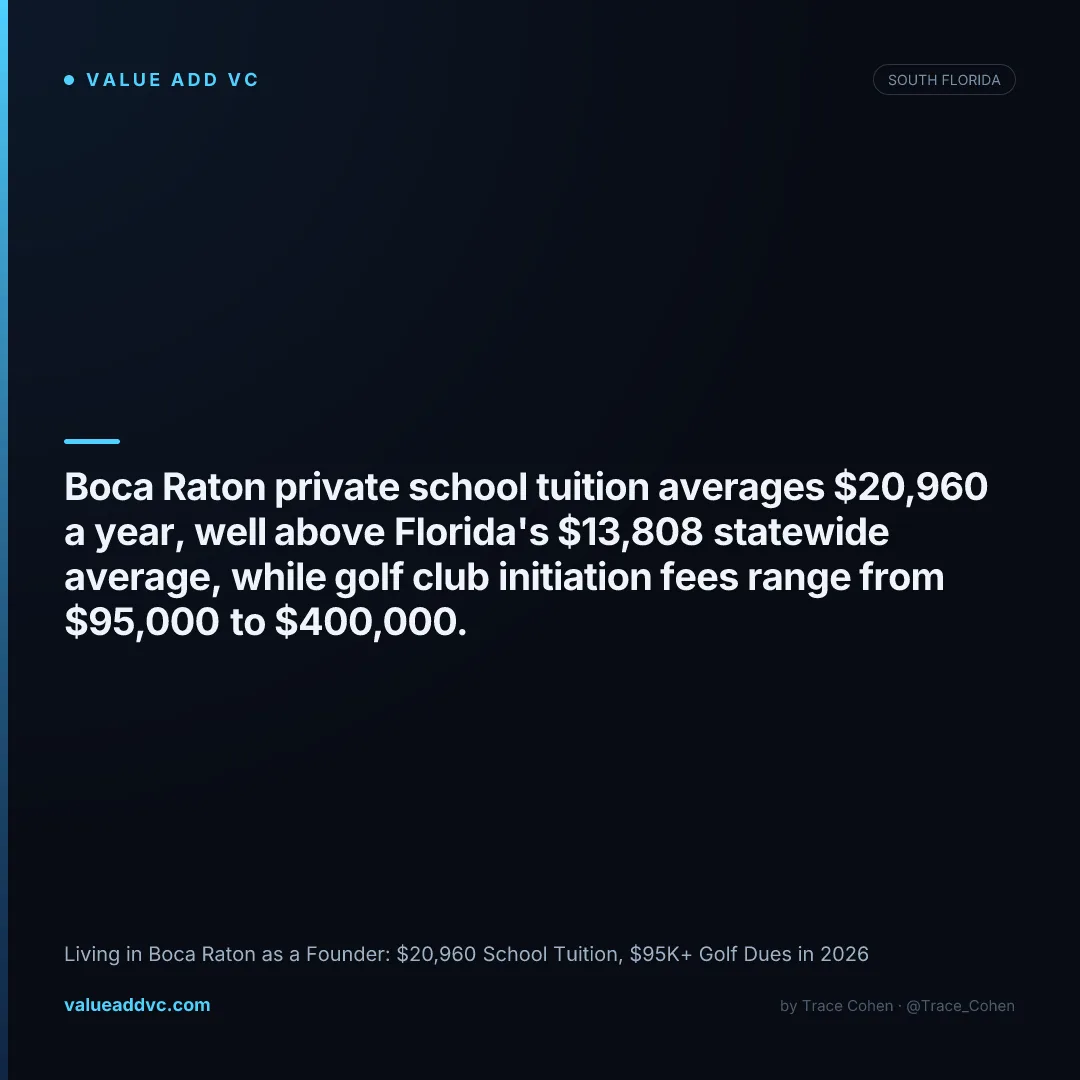
Private school tuition in Boca Raton averages $20,960 a year, and golf club initiation fees run $95,000 to $400,000 — but the city still pencils out cheaper than New York or San Francisco for most founders once you factor in a $685,000 median home price and zero state income tax. That's the short answer. The longer answer is what these costs actually buy you, and where the tradeoffs really bite.
The pitch founders hear — "no income tax, great weather, close to Miami" — is true but incomplete. The real cost structure has three components that determine whether the move works for your family and your company: schools, social infrastructure like golf and country clubs, and whether you can actually hire the talent you need.
Figures are 2026 estimates blended from Private School Review, Salary.com, Redfin, and ZipRecruiter. Cost-of-living figures assume a single-earner household at the city median.
What Is It Really Like Living in Boca Raton, Florida as a Founder?
Living in Boca Raton as a founder means trading a smaller in-person tech talent pool for a lower overall cost base and no state income tax, in a city of four universities and a fast-growing Innovation Campus. It works best for founders who can hire remotely, since local IT salaries average $104,108 versus far higher comparable figures in SF and NYC — the tradeoff shows up in schools and lifestyle costs, not in day-to-day operating expenses.
Florida's zero state income tax is the number every founder brings up first, and it's real — a founder earning $500,000 saves roughly $50,000+ a year versus California's top marginal rate alone. But that saving gets partially offset by two costs most relocation pitches skip: private school tuition and the country club memberships that function as unofficial local networking infrastructure. Both are covered below with real 2026 numbers.
Boca Raton Private School Costs: The Real Numbers for 2026
Boca Raton has 38 private schools serving 10,354 students in the 2026 school year, with average tuition of $20,960 — 52% above Florida's statewide private school average of $13,808. Elementary tuition averages $23,204 and high school tuition averages $22,689, with a wide spread: Boca Raton Christian School runs around $14,000, while Saint Andrew's School, the top-ranked option and one with boarding-eligible upper grades, tops out near $48,000.
Donna Klein Jewish Academy has built a K-12 STEAM curriculum that's a natural fit for founder families wanting an early technical track, and Boca Raton just approved Palm Beach International Academy, a new private school inside the Boca Raton Innovation Campus (BRIC) itself — a signal that the city is deliberately pairing its tech real estate with education infrastructure rather than treating them as separate problems.
Golf and Country Club Costs: The Unofficial Networking Layer
Country club membership is not optional social color in Boca Raton — it's where a meaningful share of local deal flow, banking relationships, and recruiting introductions actually happen, the same way certain SF coffee shops or NYC dinner circuits function elsewhere. Initiation fees in 2026 span an enormous range: Boca Woods Country Club sits around $95,000 total (roughly $75,000 initiation plus a $20,000 refundable equity bond), while Addison Reserve Country Club's Full Golf equity rises to $400,000 effective 2026.
St. Andrews Country Club moved its Full Golf equity to $275,000 in January 2026 with annual dues in the low-to-mid $40,000s, and Boca West Country Club's initiation rises from $150,000 to $215,000 in October 2026. Annual dues across these clubs generally run $18,000 to over $50,000 on top of the initiation fee, meaning a founder joining a top-tier club is committing $200,000-$450,000 in year-one costs alone.
| Club | Initiation / equity fee (2026) | Annual dues |
|---|---|---|
| Boca Woods Country Club | ~$95,000 total | Included in structure |
| Woodfield Country Club | $60,000 init + $38,000 equity | ~$18,000 |
| Boca West Country Club | $215,000 (Oct 2026) | Varies by tier |
| St. Andrews Country Club | $275,000 (Jan 2026) | $40,000-$45,000 |
| Broken Sound Club | $150,000-$300,000 | $25,000-$32,000 |
| Addison Reserve Country Club | $400,000 (2026) | Not disclosed |
Figures are 2026 estimates blended from privateIQ, agentboca.com, and isabellascott.com club membership reporting. Fees change annually and vary by membership category (golf vs. social).
The Real Cost of Living in Boca Raton for a Founder's Family
Boca Raton's overall cost of living runs about $2,896 a month for a single person and $6,376 a month for a family of four in 2026, roughly 17% above the US national average. Housing is the dominant driver: the median home price sits at $685,000 versus $403,700 nationally, with an effective property tax rate of 1.23% against a 1.02% national median, and homeowners insurance running $3,500 to $6,000 a year — high even by Florida standards because of hurricane exposure.
Run the math on a founder family with two kids in private school, a country club membership, and a $685,000 home: you're looking at roughly $42,000 in tuition, $15,000-$50,000 in annual club dues, $76,500 in mortgage-adjacent housing costs, and $4,500 in insurance — north of $135,000 a year before groceries, cars, or anything else. That's real money, but it's still frequently less than the equivalent NYC or SF setup once you net out the state income tax savings on founder-level equity comp and exit proceeds.
Living in Boca Raton, Florida as a Founder: Can You Actually Hire Here?
The honest answer is: partially. Average IT pay in Boca Raton is $104,108 a year, with most roles landing between $90,200 and $110,600 — solid but well below SF or NYC comp, which cuts both ways depending on whether you're hiring or being hired. The city is home to four universities and 17+ colleges and research institutions across the broader region, which feeds a steady junior-to-mid talent pipeline, especially as the FAU Research Park and BRIC tech cluster continue to mature.
What you won't find easily is a deep senior engineering bench sitting on the sidelines waiting for your Series A to open a req — that's still an SF, NYC, or Austin advantage. Most Boca Raton-based founders run a hybrid model: local ops, sales, and finance hires paired with a distributed engineering team, which is exactly the structure our VC performance benchmarks show working across most South Florida seed-to-Series-B companies today.
Boca Raton vs. NYC and SF: The Founder Math, Side by Side
Take a founder earning $600,000 in a liquidity year — salary plus a secondary sale or exit proceeds. In California, the top marginal state rate of 13.3% on that income alone is roughly $80,000. In New York, combined state and NYC city income tax pushes past 10% on top brackets, another $60,000-plus. In Florida, that entire line item is zero. Over a five-year build, that gap alone can fund several years of private school tuition and a full golf club initiation fee with room to spare.
Housing tells a similar story even after accounting for Boca Raton's own price growth — the average Boca Raton home price was up 20.7% year-over-year as of mid-2026, reaching roughly $905,000 in some reporting, yet that's still meaningfully below the $1.1 million-plus median for comparable single-family homes in SF's better school-zoned neighborhoods, and well below Manhattan or Brooklyn townhouse pricing for a family of four's space needs. The delta narrows every year as more relocating capital chases the same Boca Raton inventory, which is worth flagging to any founder assuming today's spread holds for a decade.
Where Boca Raton loses ground is comp-driven hiring leverage. A senior engineer commanding $220,000-$260,000 in SF will often take a Boca Raton offer in the $150,000-$180,000 range only if the equity story, remote flexibility, or personal relocation motivation (family, taxes, lifestyle) is strong enough — you're not simply arbitraging cost of living into cheaper headcount, you're recruiting against a smaller applicant pool that has to actively choose the market.
Should You Actually Move Your Startup to Boca Raton?
Move if: you're past Series A with a defined go-to-market that doesn't require daily in-person collaboration with a large local engineering team, your household benefits meaningfully from Florida's zero income tax on a coming liquidity event, and you value the school and country club infrastructure enough to pay the premium documented above. Founders relocating from New York or New Jersey specifically cite the tax delta and the direct flights back to their prior networks as the deciding factors more often than the tech ecosystem itself.
Don't move if: your company needs a large in-person senior engineering org today, your kids are mid-way through a public school track you're happy with, and you're not planning a near-term liquidity event that would make the tax savings material. Boca Raton is a genuinely good build environment in 2026, but it rewards founders who plan the full cost stack — tuition, club dues, housing, and hiring — rather than just chasing the headline "no state income tax" pitch.
Bottom line: Living in Boca Raton as a founder costs real money — $20,960 average private school tuition, $95,000 to $400,000 golf club initiation fees, and a $685,000 median home price add up fast. But between zero state income tax, a cost of living still below most of coastal California and Manhattan, and a tech ecosystem that's visibly building (four universities, FAU Research Park, BRIC), the math works for most founders who can hire a distributed engineering team and don't need daily proximity to a deep local senior talent bench.
Latest from the Pulse
Get VC data most people never see
— free to subscribe
Trace's notes on venture, AI and startups, a few times a week. Join 5,000+ subscribers. No spam.
No spam, unsubscribe anytime. Sent via Substack · Privacy · or subscribe on Substack ↗