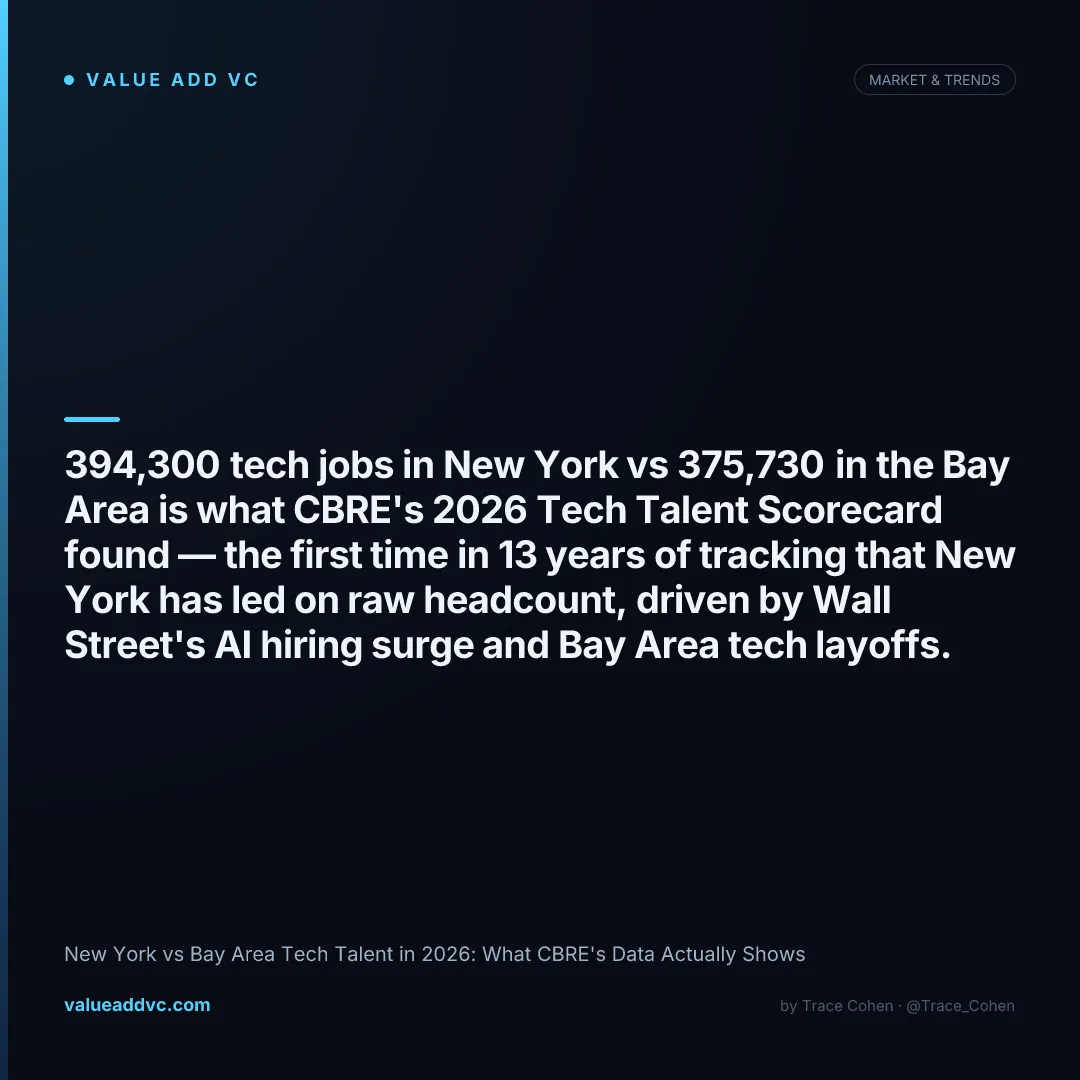
394,300 tech jobs in New York versus 375,730 in the San Francisco Bay Area: that's the headcount gap behind CBRE's finding that New York has overtaken the Bay Area as the largest US tech talent market, per CBRE's 2026 Tech Talent Scorecard, for the first time in the 13 years the commercial real estate firm has tracked the data.
The raw-count win is real, but it's not the whole story — on CBRE's own broader composite ranking, the Bay Area still comes out on top. Here's what actually moved, why, and which number matters more depending on what you're trying to answer.
Source: CBRE's 2026 Tech Talent Scorecard, as reported by CNBC, August 21, 2026.
New York vs Bay Area tech talent: the raw numbers
New York's office market now hosts 394,300 tech jobs against 375,730 in the Bay Area — a gap of roughly 18,500 jobs — according to CBRE's 2026 Tech Talent Scorecard, the commercial real estate firm's annual analysis, first reported by CNBC on August 21, 2026. It's the first time in the 13 years CBRE has run this analysis that New York has taken the raw-headcount lead over the Bay Area.
The shift is a two-sided move, not a one-directional New York boom. AI-specific hiring surged 45% year-over-year nationally, and both New York and the Bay Area each added more than 20,000 AI jobs since mid-2025 — so AI growth alone doesn't explain the gap, since both markets are capturing it. What does explain it is that Bay Area tech layoffs have contracted the region's overall job base even as its AI hiring grows, while New York's finance industry has ramped its own tech and AI hiring on top of an already-large existing base rather than working against a shrinking one.
| Metric | New York | Bay Area |
|---|---|---|
| Raw tech job count (2026) | 394,300 | 375,730 |
| Composite Scorecard score (13 metrics) | 70.38 | 81.98 (#1 overall) |
| AI jobs added since mid-2025 | 20,000+ | 20,000+ |
| Primary hiring driver | Wall Street AI/tech hiring | AI labs, amid broader layoffs |
| Overall job-count trend | Growing | Contracting outside AI roles |
| Years CBRE has tracked this data | 13 | 13 |
| Led on raw headcount before 2026 | No | Yes, every year |
Source: CBRE's 2026 Tech Talent Scorecard, as reported by CNBC, August 21, 2026.
New York vs Bay Area: CBRE's 2026 Tech Talent Scorecard
CBRE, 2026 Tech Talent Scorecard, via CNBC, August 21, 2026.
New York leads on raw headcount; the Bay Area still leads on CBRE's broader composite score, which weighs talent concentration, quality, and R&D investment alongside job totals.
Why Wall Street is now bidding against AI labs for engineers
New York's gains lean heavily on finance: Wall Street firms have significantly ramped hiring of AI and tech talent in 2026, a pattern visible in specific moves like UBS hiring away JPMorgan's chief analytics officer to lead its own AI strategy, while JPMorgan separately hired UBS's AI lab lead in the reverse direction. Neither bank is a traditional tech company, but CBRE's methodology counts that hiring toward New York's overall tech job total, which is part of why the raw-count gap moved as much as it did in a single year.
For founders and operators picking a second office or weighing where to compete for engineering talent, the practical signal isn't that New York out-competed the Bay Area for scarce frontier-AI researchers — the Bay Area's cluster of AI labs remains largely intact. This likely means the real shift is that Wall Street is now bidding directly against those AI labs for the same pool of engineers, which changes New York compensation benchmarks more than it changes where frontier AI research actually happens.
Where the Bay Area still wins
CBRE's broader Tech Talent Scorecard — which weighs job totals alongside talent concentration, worker quality, and regional R&D investment rather than headcount alone — still ranks the Bay Area first overall, at a score of 81.98 against New York's 70.38. That's a meaningful qualifier on the "New York overtakes" headline: New York's win is specifically in raw job count, the single most headline-friendly metric, while the Bay Area retains the lead on the composite measure CBRE itself treats as the more complete read of tech-market strength.
Concentration of specialized frontier-AI talent in particular still skews heavily toward Northern California's cluster of AI labs and the supporting ecosystem around them — the kind of density that a raw job-count comparison between two metro areas doesn't capture. Startup valuations still carry a geography premium tied to that concentration, which is a separate question from where raw tech headcount happens to sit in a given year.
What the headline misses
A single year of data is a leading indicator, not a verdict. If New York's finance-driven AI hiring continues at its current pace while Bay Area layoffs persist, this year's raw-count gap could widen into a durable trend rather than a one-year anomaly. But a single quarter of renewed Bay Area AI-lab hiring — plausible as firms like Anthropic and OpenAI keep scaling toward IPOs — could just as easily narrow the gap back, and CBRE's own composite score already shows the Bay Area holding a wide lead on every dimension besides raw headcount. Both readings are defensible from the same dataset; which one matters more depends on whether you're counting bodies or betting on where the next frontier AI lab gets built.
Bottom line: New York genuinely closed and reversed a 13-year gap on raw tech job count, per CBRE, driven mostly by Wall Street's AI-driven hiring surge colliding with Bay Area tech layoffs. But "New York dethroned the Bay Area" overstates what happened if the Bay Area still wins on every other dimension CBRE measures — its composite score of 81.98 against New York's 70.38 says the region still holds the deeper, more concentrated tech talent base, even in a year it lost the headline number.
Latest from the Pulse
Get VC data most people never see
— 100% free
Weekly benchmarks, valuations, and fund data. Join 5,000+ investors. No spam.