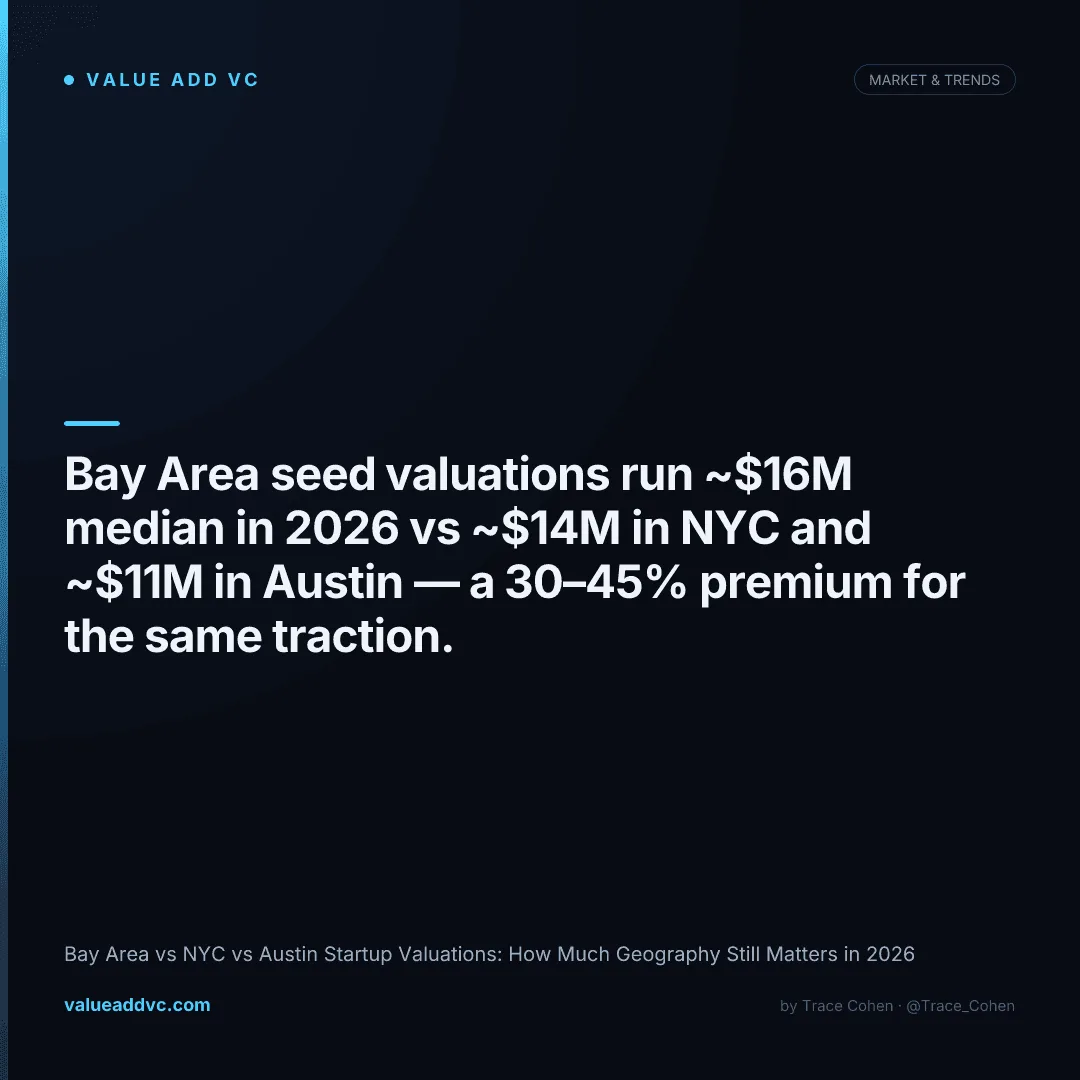
In 2026 the same seed-stage startup is worth ~$16M in the Bay Area, ~$14M in NYC, and ~$11M in Austin — a 30–45% premium for identical traction.
Geography has been declared dead for venture capital roughly once a year since 2020, and every year the data quietly disagrees. Remote work compressed the gap, distributed teams became normal, and Bay Area funds now write checks into companies they'll never visit. Yet when you line up seed and Series A medians city by city, San Francisco still prices at the top, New York sits a step below, and Austin offers a real discount. The premium is shrinking on traditional software and widening on AI. Here's exactly what the numbers say in 2026 — and how to use them whether you're raising or investing.
Bay Area vs NYC vs Austin Startup Valuation 2026: The Numbers
Bay Area startups command the highest valuations of the three cities in 2026: roughly $16M median post-money at seed and $55M at Series A, versus ~$14M and ~$48M in New York and ~$11M and ~$38M in Austin. That puts the San Francisco premium at about 14% over NYC and 45% over Austin at seed — a gap driven by investor density and the concentration of high-priced AI deals on the West Coast.
The table below compares the three markets across the attributes that actually move a priced round. These are blended medians synthesized from 2026 reporting; any individual deal can land well outside the range depending on sector, traction, and how competitive the round gets.
| Attribute | Bay Area | NYC | Austin |
|---|---|---|---|
| Seed median post-money | ~$16M | ~$14M | ~$11M |
| Series A median post-money | ~$55M | ~$48M | ~$38M |
| Typical seed round size | $3.0–4.0M | $2.5–3.5M | $2.0–3.0M |
| Dilution on a $3M seed | ~19% | ~21% | ~27% |
| Senior engineer base salary | $190–230K | $175–210K | $150–180K |
| Share of US AI venture $ | ~50% | ~12% | ~3% |
| State income tax | 13.3% top | 10.9% top | 0% |
| Local lead-investor depth | Deepest | Deep | Moderate |
Blended 2026 medians synthesized from Carta, PitchBook, and AngelList-style datasets; ranges are approximate and vary by sector. See the SaaS valuations dashboard for live multiples. Not investment advice.
Why the Bay Area Still Prices at the Top
The single biggest driver of the Bay Area premium is competition for deals. The region still hosts the densest concentration of seed funds, growth funds, and angels in the world, and valuation is ultimately a function of how many credible bidders show up. When three funds want to lead your seed, the price goes up; when one does, it doesn't. San Francisco simply produces more of those competitive dynamics per deal than anywhere else.
AI is the accelerant. Roughly half of all US AI venture dollars still landed in the Bay Area in 2026, and AI rounds are the highest-priced deals in the market — pre-seed AI companies have closed at $25M+ post-money on little more than a team and a demo. Because those deals are geographically concentrated, they pull the citywide median up in a way NYC and Austin can't match. Strip out AI and the Bay Area's edge over New York narrows to roughly 15%.
There's also a signaling effect. A round led by a brand-name Sand Hill Road firm carries a halo that supports the next round's valuation, independent of fundamentals. That compounding reputational premium is harder to manufacture in markets with fewer tier-1 anchors.
How NYC Startup Valuations Compare
New York is the clear number two and, for many sectors, a genuine peer to the Bay Area. NYC seed medians of ~$14M and Series A medians of ~$48M sit just below San Francisco, and in fintech, B2B SaaS, media, and commerce, New York routinely prices at or above West Coast levels. The city's proximity to enterprise buyers — banks, agencies, retailers, healthcare systems — gives B2B startups a credibility and revenue advantage that supports higher valuations, and the city now counts 173 unicorns, second only to the Bay Area.
Where NYC lags is frontier AI and deep tech, where the Bay Area's research talent and concentration of specialized investors remain dominant. The result is a market that's effectively tied with San Francisco on applied software but trails on the highest-multiple AI deals. For founders weighing the two, the practical read is that a strong B2B SaaS company will get a similar price in either city — the gap is real mainly if you're building at the AI frontier.
The Austin Discount — and Why It Can Still Win
Austin carries the largest discount of the three: ~$11M seed and ~$38M Series A medians, roughly 30% below the Bay Area. On paper that looks like a penalty, and for raising the maximum dollars at the highest price, it is. But the headline number misses the operating math. Salaries run 15–25% lower, office and living costs are dramatically cheaper, and Texas has no state income tax — so a dollar raised in Austin funds noticeably more runway than the same dollar in San Francisco.
For a capital-efficient startup, that trade can favor Austin outright. A company that raises $2.5M at an $11M valuation and burns 25% less per month can reach the same milestones as a Bay Area peer that raised $3.5M at $16M — with comparable founder ownership at the end. The valuation gap and the burn gap partially cancel out.
The real Austin weakness is lead-investor depth. There are fewer local funds able to anchor a priced round, so many Austin founders still raise their leads from coastal firms while keeping operations in Texas. That hybrid — coastal capital, central-time cost base — is increasingly the highest-return setup for founders who don't need to be physically inside the AI cluster.
How Geography Affects Your Dilution
Valuation directly sets how much of your company you sell. Raise a $3M seed at the Bay Area's ~$16M median and you part with about 19%. Raise the same $3M at Austin's ~$11M median and you sell roughly 27%. That 8-percentage-point swing on a single round compounds: after a Series A on top, the founder who raised at higher valuations can hold 10–15 points more of the company at exit.
This is exactly why the smartest move in 2026 is often to decouple where you raise from where you operate. Source your priced round from the market that will pay the highest valuation — frequently the Bay Area or NYC — then run the company from a lower-cost base. You capture the coastal valuation on dilution and the low-cost burn on runway. For a deeper look at how city choice changes the math, see our seed valuations by city breakdown.
Is the Gap Closing? What Changed Since 2020
For non-AI software, yes — meaningfully. A decade ago the Bay Area premium on a comparable SaaS company ran north of 40%. By 2026 it's closer to 15–20%. Three forces drove the compression: remote-first hiring let companies access top talent anywhere (tools like Deel made cross-state and international payroll frictionless), distributed cap tables made it normal for SF funds to lead deals nationwide, and the explosion of seed capital meant more dollars chasing deals in secondary markets. NYC closed most of the gap; Austin, Miami, and others closed part of it.
The stubborn exception is AI. Frontier and applied-AI rounds remain heavily Bay Area-priced because the talent, the compute relationships, and the specialist investors still cluster there. So the citywide median gap looks wider than the underlying software gap — it's being held open almost single-handedly by AI. For founders outside that category, geography matters less than it ever has. For founders inside it, San Francisco still pays the premium.
The Verdict: Bay Area Wins on Price, Austin Wins on Efficiency
If the only goal is the highest headline valuation, the Bay Area wins — its ~$16M seed and ~$55M Series A medians lead the three cities, and for AI companies the gap is decisive. New York is the close second and effectively a tie for B2B SaaS, fintech, and commerce, with the bonus of enterprise-buyer proximity. Austin trades ~30% on valuation for materially lower burn and zero state income tax, making it the best valuation-per-dollar-of-runway market for capital-efficient teams.
The winner depends on what you're optimizing. Building frontier AI and want top dollar? Raise in the Bay Area. Building enterprise software with customers on the East Coast? New York is a wash and may be better. Running lean and protecting runway? Austin's discount is a feature, not a bug — especially if you raise your lead from a coastal fund and keep the burn in Texas. Geography still matters in 2026; it just matters more for how you spend the money than for what you raise it at.
Related Resources
Geography didn't die — it just stopped mattering for everything except AI.
Raise where they pay the most, operate where it costs the least, and the city question takes care of itself.
Latest from the Pulse
Get VC data most people never see
— 100% free
Weekly benchmarks, valuations, and fund data. Join 5,000+ investors. No spam.