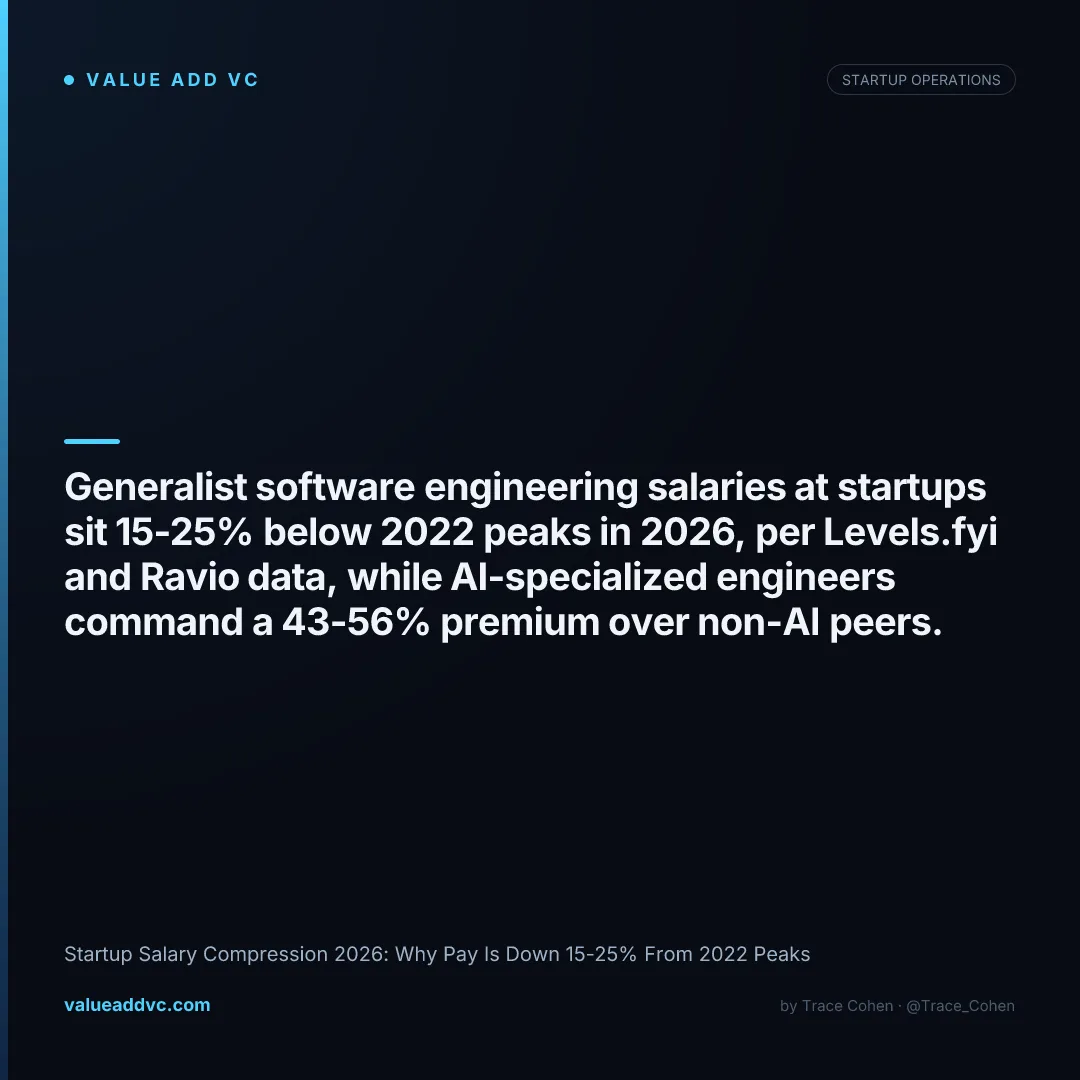
Generalist software engineering base pay at startups sits 15-25% below its 2022 peak in 2026, while AI-specialized engineers pull a 43-56% premium over their non-AI peers. That's the short answer. The longer answer is that this isn't one salary trend — it's two opposite trends happening in the same job market at the same time.
Base-pay increases across the tech industry have slowed to somewhere between 1.6% and 3.5% for 2026, down from roughly 4% in 2025. Meanwhile roughly 120,000 tech roles have been cut this year according to Layoffs.fyi, adding a surplus of experienced generalist talent to a market that's simultaneously trying to hire AI specialists at a premium it can barely afford. Both things are true, and understanding which bucket a given hire falls into is now the single most important variable in a startup's comp strategy.
Figures from Levels.fyi 2026 pay data, Robert Half 2026 Salary Guide, PwC Global AI Jobs Barometer, and Layoffs.fyi, as of July 2026.
What's Driving Startup Salary Compression in 2026
Startup salary compression in 2026 is being driven by a supply glut of generalist engineering talent — roughly 120,000 layoffs this year per Layoffs.fyi — colliding with AI coding tools that reduce headcount needs per project, while funding caution keeps base-pay budgets flat at most early and growth-stage companies. The net effect is generalist software engineering pay landing 15-25% below 2022 levels even as total compensation for AI-specialized roles keeps climbing.
| Metric | 2022 Peak | 2026 |
|---|---|---|
| Median generalist SWE base (national) | ~$225K-240K est. | $192,500 (Levels.fyi median) |
| Growth-stage startup SWE base | $130K-150K | $90K-120K |
| AI/ML engineer base range (Robert Half) | n/a — role barely existed | $134,000-$193,250 |
| General SWE base range (Robert Half) | n/a | $109,250-$175,500 |
| Annual base pay increase, tech industry | ~8-10% (2021-22 bidding wars) | 1.6-3.5% |
| ML engineer job postings vs Feb 2020 baseline | n/a | +59% |
| General SWE job postings vs Feb 2020 baseline | n/a | -49% |
| Tech layoffs, year to date | ~150,000 (2022 full year) | ~120,000 (2026 YTD) |
Figures blended from Levels.fyi 2026 pay data, Robert Half 2026 Salary Guide, Ravio startup compensation report, Layoffs.fyi, and job-posting trend data from Metaintro/JobsPikr. 2022 peak figures for AI/ML roles marked n/a where the role category was not yet a distinct market segment.
The Mid-Level Squeeze: Who's Actually Losing Ground
The pain isn't evenly distributed. Engineers with three to seven years of experience, a generalist track record, and no AI portfolio are the single hardest-hit segment in the 2026 market — the longest job searches, the most ghosting, and the steepest comp cuts when an offer finally lands. They're too senior to be hired cheap as a junior, too generalist to command the AI premium, and competing directly against a surplus of similarly-profiled candidates shaken loose by this year's roughly 120,000 layoffs.
Compare that to the AI-specialized segment: workers with multiple AI skills earn an estimated 43% premium over non-AI counterparts, and PwC's 2025 Global AI Jobs Barometer documented a 56% wage premium for AI skills — up sharply from just 25% the year before. AI engineer base salaries averaged roughly $206,000 in 2025 and climbed another 7% in Q1 2026 alone, even as general software engineering pay barely moved.
That divergence shows up cleanly in job postings too: machine learning engineer openings are up 59% versus the February 2020 baseline, while general software engineering postings are down 49% over the same stretch — a nearly 110-point spread between the two tracks inside one labor market.
Generalist vs AI-Specialized Engineering Pay (2026 Base Salary Range)
Robert Half 2026 Salary Guide, PwC Global AI Jobs Barometer
Is This Startup Salary Compression Actually About AI Replacing Engineers?
Only partly, and the data is clearer on this than the headlines suggest. Industry analysts tracking 2026 layoffs estimate that roughly 25% of March 2026 cuts traced directly to AI and automation, while the remaining 75% were attributable to ordinary cost discipline and restructuring — Microsoft's 9,000-person May 2026 cut, for instance, hit middle-management and customer-success layers more than engineering. AI is a real contributor to salary compression, but it's compounding a funding-and-margin story that predates ChatGPT, not single-handedly causing it.
Where AI is unambiguously reshaping the market is in headcount efficiency per dollar raised. Startups using AI coding tools are building smaller teams that ship more, which is part of why growth-stage companies can offer $90,000-$120,000 base salaries with more equity upside and still fill the role — the labor pool competing for that number is deeper than it was in 2022, and the team around that hire is smaller than it would have been three years ago. Track the headcount side of this on our Hiring dashboard and the layoff side on the Layoffs tracker.
Startup Salary Compression by Stage: Early vs Late
Stage matters as much as skill set. Late-stage startups pay 15-18% more than early-stage companies for mid-level roles across all functions, and that gap widens to 31-34% more for senior talent, per Ravio's 2026 startup compensation report. A Series C company with real revenue and runway can still pay close to big-tech rates; a seed or Series A company operating on a tighter burn multiple is the one actually driving the compression numbers that show up in aggregate salary data.
For founders setting comp bands right now, the practical read is this: a generalist mid-level hire in 2026 costs meaningfully less than the same hire cost in 2022, and the market will bear it because the labor supply is deep. An AI-specialized hire costs a real premium — 43-56% by the data above — and that premium is not negotiable away, because the labor supply for that segment is thin and every well-funded competitor is bidding for the same small pool. That scarcity is why the same talent war is now reaching all the way into venture capital — see Founders Fund hiring former OpenAI VP Ryan Beiermeister as a partner.
How Equity Is Absorbing Part of the Startup Salary Compression
Base salary is only half the compensation story, and it's the half that makes 2026 compression look worse than total compensation actually is. Growth-stage startups offering $90,000-$120,000 base salaries are, per Levels.fyi startup-stage data, pairing that with meaningfully larger equity grants than a company at the same stage offered in 2022 — a direct consequence of lower 409A valuations making the same dollar grant translate into more shares. A candidate comparing only base-salary line items across 2022 and 2026 offers is comparing an incomplete number both times.
This matters most at the senior end. Carta's compensation benchmarks show senior engineering total packages ranging from roughly $159,000 at the L2 level up to $445,000 at L7, with a median total package around $289,000 once equity and bonus are included — a spread that base salary alone dramatically understates. Late-stage companies paying 31-34% more than early-stage peers for senior talent are doing so with a mix of cash and equity that a pure base-pay comparison misses entirely, which is part of why senior hiring hasn't compressed nearly as visibly as mid-level generalist hiring.
The practical implication for candidates: a lower headline base number in 2026 doesn't necessarily mean a worse offer than 2022, if the equity component is priced against a startup that's further along and better capitalized than the average 2022-vintage company was. The practical implication for founders: leaning harder on equity to close the gap on cash comp only works if candidates believe the equity has a realistic path to liquidity — a much harder sell in 2026's slower IPO and M&A environment than it was during the 2021 boom.
What Founders Should Actually Do About Startup Salary Compression
Three things follow directly from the data above. First, stop budgeting one flat "engineering comp" number for the year — the market has split into two distinct pricing tracks, and blending them into an average base-pay assumption will make a founder overpay for generalist roles and underpay (and lose) AI-specialized candidates in the same hiring cycle. Second, treat the 43-56% AI premium as a real cost of doing business rather than something to negotiate down; the labor supply for genuinely AI-skilled engineers is thin enough that below-market offers simply don't get accepted, and the 59% year-over-year growth in ML engineer job postings shows every other funded startup is bidding for the same small pool.
Third, use the mid-level generalist surplus deliberately. With roughly 120,000 layoffs adding experienced three-to-seven-year engineers to the market and base pay 15-25% below 2022 levels, this is a genuinely good hiring window for non-AI-critical roles — infrastructure, internal tooling, quality engineering — where a startup can get more experience per dollar than at any point since before the 2021 bidding wars. The mistake we see most often in our portfolio conversations is founders applying 2022-era comp anxiety to a 2026 market that has moved in their favor for exactly this segment.
Bottom line: startup salary compression in 2026 isn't a single story — generalist engineering pay is down 15-25% from 2022 peaks because of layoff-driven oversupply and slower 3.5% (or less) base-pay growth, while AI-specialized talent is pulling a 43-56% premium in the opposite direction. Founders budgeting comp bands this year need two separate numbers, not one blended average. Track the hiring and layoff data behind both sides on Value Add VC.
Latest from the Pulse
Get VC data most people never see
— free to subscribe
Trace's notes on venture, AI and startups, a few times a week. Join 5,000+ subscribers. No spam.