
$1.3 billion is what Motive raised from General Catalyst on September 10, 2026 — and it used the same announcement to withdraw the S-1 it had filed for a New York Stock Exchange IPO, choosing to stay private at more than $600 million in annual recurring revenue instead.
Motive, the AI-driven fleet and physical-operations software company formerly known as KeepTruckin, had been on a path toward a public listing since filing its S-1 on December 23, 2025. On September 10, 2026, that path reversed: General Catalyst's Customer Value Fund committed more than $1.3 billion in growth financing, and Motive pulled its registration statement rather than proceed toward trading under the ticker MTVE.
Motive Valuation and Funding: Key Numbers (as of October 21, 2026)
| Date | Event | Amount / Valuation / Revenue | Source |
|---|---|---|---|
| May 25, 2022 | Series F co-led by Insight Partners and Kleiner Perkins (last disclosed valuation) | $150M at $2.85B | FreightWaves |
| Dec 23, 2025 | Public S-1 for NYSE listing (MTVE): ARR $501M as of Sep 30, 2025, up 27% | $501M ARR | SEC |
| Sep 10, 2026 | Growth financing from General Catalyst's Customer Value Fund | $1.3B+ | Motive; Business Wire via Yahoo |
| Sep 10, 2026 | ARR crossed $600M; growth accelerated to 30% YoY, per Motive | $600M+ ARR | Business Wire via Yahoo |
| Sep 10, 2026 | Registration withdrawal (Form RW) filed with the SEC | — | SEC EDGAR |
| Oct 21, 2026 | No new valuation disclosed or reported | $2.85B (2022) | Value Add VC news review |
The General Catalyst financing is revenue-linked growth capital, not a priced equity round, which is why it did not set a new valuation.
Figures blended from FreightWaves, TechFundingNews, and Motive's SEC S-1 filing, December 2025-September 2026.
Motive funding: what actually happened on September 10, 2026
Motive secured more than $1.3 billion in growth financing from General Catalyst's Customer Value Fund and simultaneously withdrew the S-1 registration statement it filed on December 23, 2025 for a proposed NYSE listing under the ticker MTVE, according to FreightWaves and TechFundingNews.
The structure matters: this was not a traditional priced equity round. General Catalyst's Customer Value Fund is a growth-capital vehicle that lends against sales-and-marketing spend, with repayment tied to the value of the customers those dollars help sign, rather than a straightforward preferred-stock issuance at a set price per share. That is the likely reason Motive did not publish a new headline valuation alongside the $1.3 billion figure — this type of financing does not necessarily require one the way a priced Series G would. Pranav Singhvi, a General Catalyst managing director, joined Motive's board as part of the deal, per CryptoBriefing.
Motive said the capital would fund additional AI investment across its platform and expand its sales, support, and service teams, according to FinSMEs. CEO Shoaib Makani has said the company remains positioned to pursue a public listing at a later date, framing the withdrawal as deferral rather than abandonment.
According to Value Add VC's ranking of Q3 2026's biggest enterprise software funding rounds, Motive's $1.3 billion-plus check was also the largest, ahead of Harvey's $550 million round and Clay's $115 million raise, though as a growth-financing deal it isn't directly comparable to those priced equity rounds.
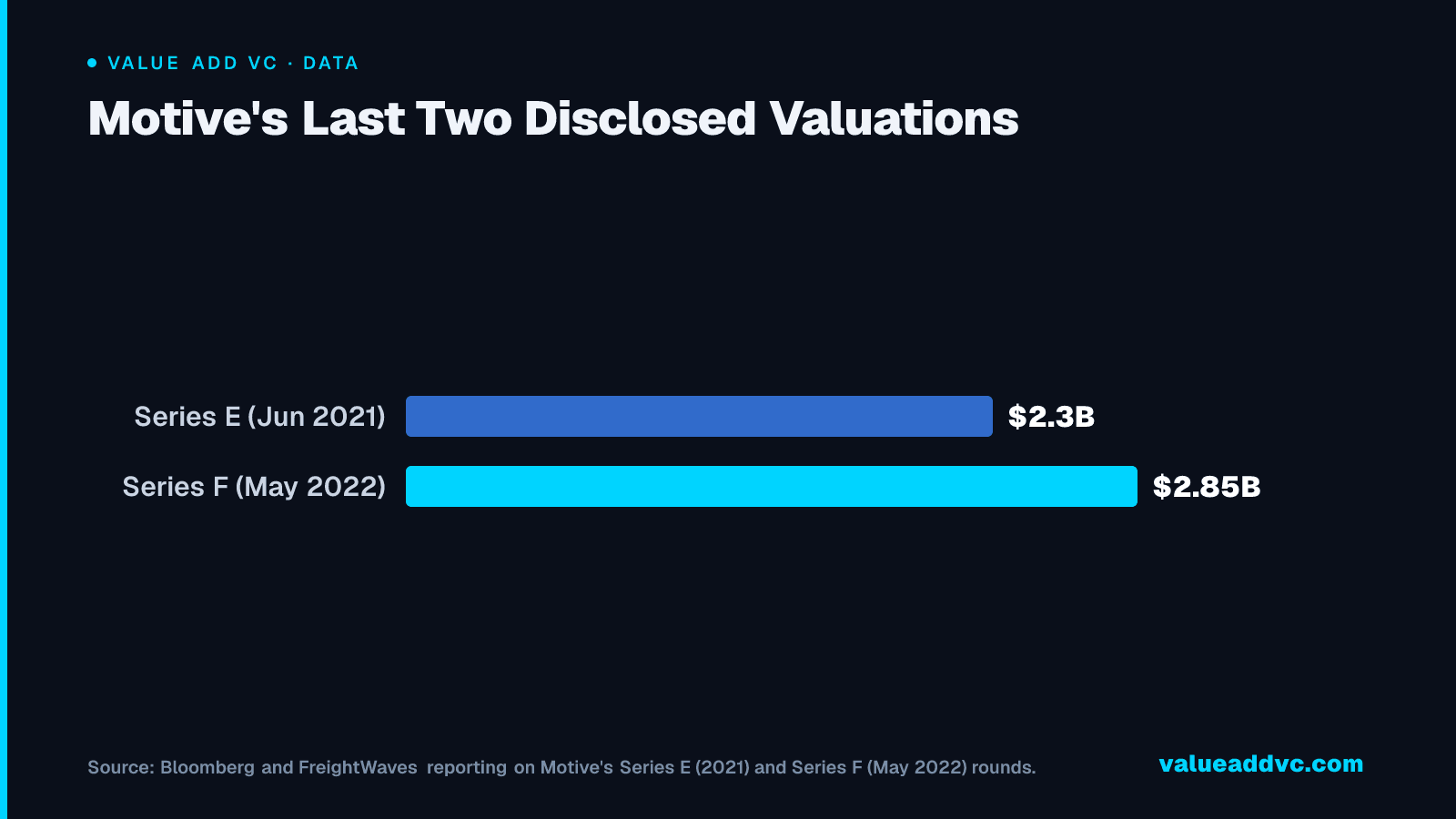
Motive's Last Two Disclosed Valuations
Motive's most recent publicly confirmed valuation is $2.85B, set in May 2022 — the September 2026 financing did not include a new disclosed valuation, so this figure is now more than four years stale.
Bloomberg and FreightWaves reporting on Motive's Series E (2021) and Series F (May 2022) rounds.
Data
| Item | Value |
|---|---|
| Series E (Jun 2021) | $2.3B |
| Series F (May 2022) | $2.85B |
Inside Motive's S-1: the numbers behind the withdrawn IPO
Motive's December 23, 2025 S-1, filed with the SEC, disclosed annual recurring revenue of $501 million as of September 30, 2025, growing 27% year-over-year, and revenue of $327.3 million for the nine months ended that date, up 22% year-over-year, at a 70% gross margin. The company reported 9,201 core customers paying more than $7,500 in annual recurring revenue at 110% net revenue retention, plus 494 large customers spending more than $100,000 annually — up 58% year-over-year — at 126% net revenue retention among that cohort, per analysis of the filing by Tomasz Tunguz.
By the time of the September 2026 financing, Motive reported ARR had crossed $600 million with growth accelerating to roughly 30% year-over-year — both the absolute number and the growth rate moved in Motive's favor in the eleven months since the S-1 was filed, per FreightWaves. J.P. Morgan, Citigroup, Barclays, and Jefferies had been lined up as lead underwriters for the now-withdrawn offering. For other companies navigating IPO timing decisions, check our tech IPO tracker.
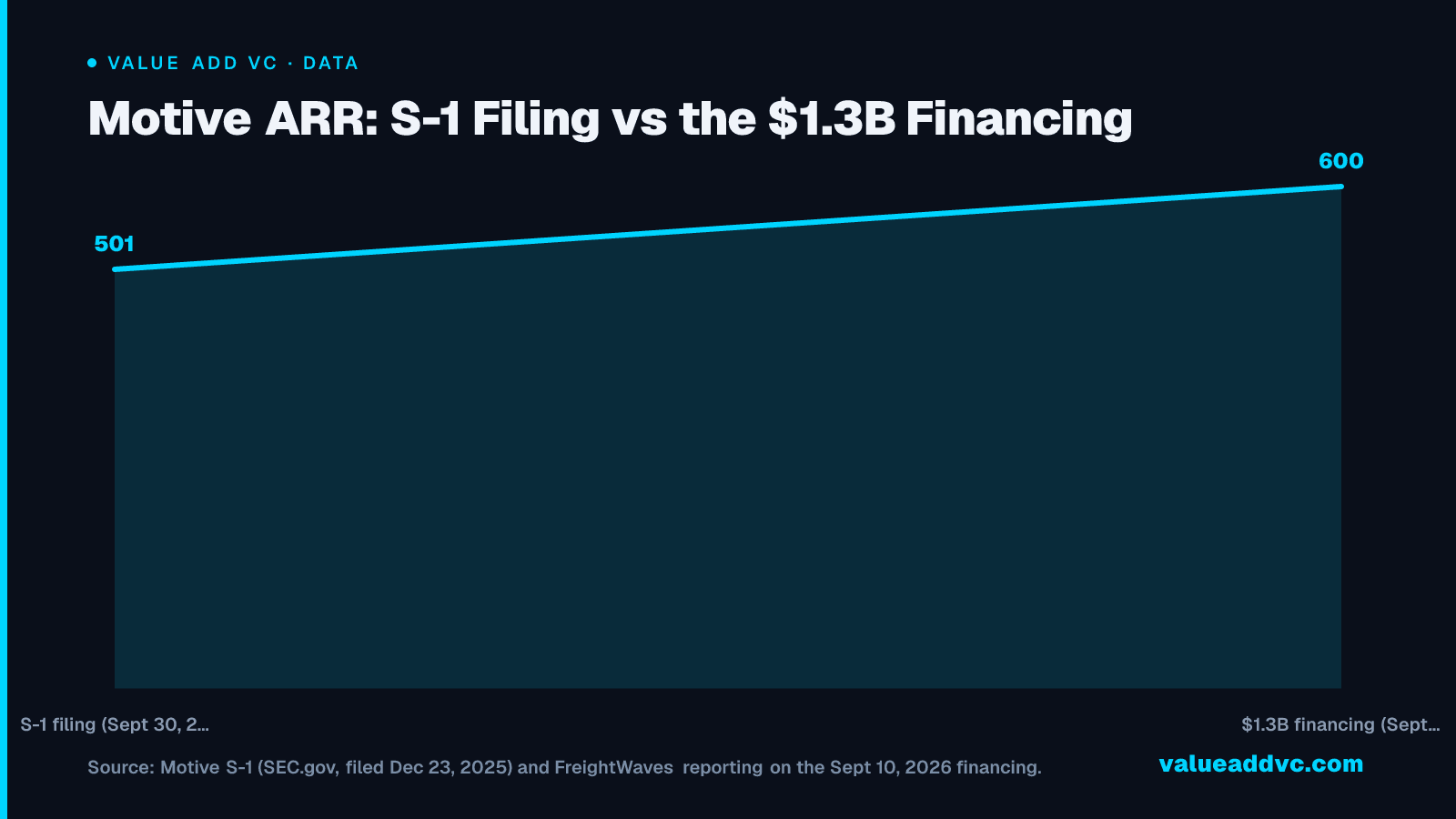
Motive ARR: S-1 Filing vs the $1.3B Financing
Motive's ARR grew from $501M at its December 2025 S-1 filing to more than $600M by the September 2026 financing, with the year-over-year growth rate accelerating from 27% to roughly 30% over that stretch.
Motive S-1 (SEC.gov, filed Dec 23, 2025) and FreightWaves reporting on the Sept 10, 2026 financing.
Data
| Item | ARR ($M) |
|---|---|
| S-1 filing (Sept 30, 2025) | 501 |
| $1.3B financing (Sept 2026) | 600 |
Motive's full funding history, from KeepTruckin to $1.3 billion
Motive was founded in 2013 as KeepTruckin by Shoaib Makani, Ryan Johns, and Obaid Khan, starting with a $2.3 million seed round led by Google Ventures. The company rebranded from KeepTruckin to Motive in 2022 as it expanded beyond electronic logging devices into a broader AI-powered operations platform now used by nearly 100,000 customers across trucking, construction, field service, agriculture, and utilities, according to Motive's own company blog.
| Round | Date | Amount / Valuation | Lead investors |
|---|---|---|---|
| Seed (as KeepTruckin) | 2013 | $2.3M raised | Google Ventures |
| Series A | 2015 | $8M raised | Index Ventures |
| Series E | Jun 17, 2021 | $190M raised at $2.3B valuation | G2 Venture Partners (with Index Ventures, Greenoaks, IVP, Scale Venture Partners) |
| Series F | May 25, 2022 | $150M raised at $2.85B valuation | Insight Partners, Kleiner Perkins |
| S-1 filed (NYSE: MTVE) | Dec 23, 2025 | $501M ARR disclosed | JPMorgan, Citi, Barclays, Jefferies (underwriters) |
| Customer Value Fund financing | Sept 10, 2026 | $1.3B+ raised; no new valuation | General Catalyst |
Sourced from Cooley LLP deal coverage, Bloomberg, FreightWaves, SEC.gov (Motive S-1), and TechFundingNews, 2013-2026. Motive's total funding raised across its 2013-2022 venture rounds was reported at roughly $567 million as of the May 2022 Series F, per FreightWaves — a figure that predates the 2026 Customer Value Fund financing and is not additive to it since the two are structurally different types of capital.
Motive vs Samsara: the public comparable
Samsara is the closest public comparable to Motive — both sell AI-powered telematics, driver-safety, and physical-operations software bundled with hardware, and both crossed roughly $500 million in ARR near the time of their own IPO filings. Samsara went public in December 2021 and trades on the NYSE under the ticker IOT, with a market capitalization around $22.6 billion and trailing-twelve-month revenue of roughly $1.85 billion as of early September 2026, up about 29.5% year-over-year.
The gap that stands out is growth rate at comparable scale: Samsara's ARR was growing roughly 76% year-over-year around its October 2021 IPO filing, more than double the 27% year-over-year growth Motive disclosed in its December 2025 S-1, according to comparisons by Tomasz Tunguz. Motive's large-account growth (customers spending more than $100,000 a year, up 58% year-over-year) actually outpaced Samsara's 48% growth in that same cohort at IPO, and Motive's overall ARR growth has since reaccelerated to about 30% by September 2026 — narrowing, though not closing, the growth gap with its most direct public peer.
Motive vs Samsara at ~$500M ARR Scale
Motive S-1 (SEC.gov, Dec 2025); Samsara S-1 and Q3 FY2022 metrics via Tomasz Tunguz analysis; stock data aggregators for Samsara's Sept 2026 market cap and TTM revenue.
Data
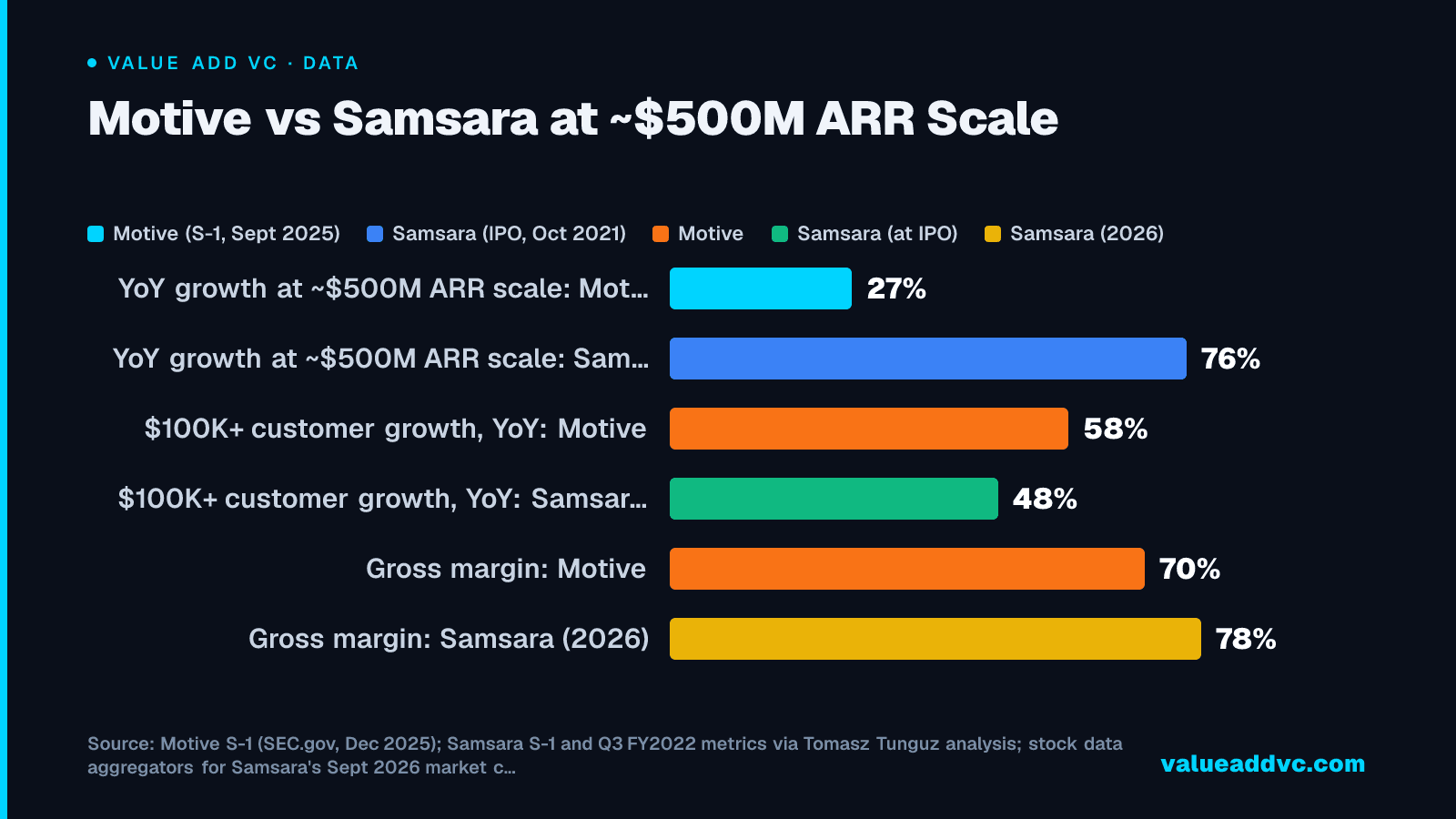
Motive's large-account growth beat Samsara's at a comparable ARR scale, but its overall top-line growth rate at S-1 filing was roughly a third of Samsara's at IPO.
What Motive actually sells
Motive markets itself as an "Integrated Operations Platform" rather than a single-product telematics vendor, bundling four categories: Driver Safety, Fleet Management, Spend Management, and Equipment Monitoring, unified under an AI layer the company calls AI Omnivision, according to Trucking Info. The Driver Safety product uses AI models trained to flag specific unsafe behaviors in real time — drowsiness, lane swerving, forward-collision risk, sideswipe events, blind-spot violations, and unsafe parking — feeding video and sensor data back to fleet safety teams rather than just logging hours of service, which was the company's original 2013-era ELD business as KeepTruckin.
Spend Management extends the platform into card and fuel-purchase controls, and Equipment Monitoring tracks non-vehicle assets like trailers, generators, and heavy machinery — the parts of the business that let Motive court construction and utility customers, not just long-haul trucking fleets. That product breadth is also the company's answer to the "physical operations" category Motive uses to describe its market, a framing that positions it against Samsara's own Connected Operations Cloud rather than against narrower point solutions.
The fleet-management market Motive is chasing
The fleet telematics market Motive and Samsara both compete in was valued at $10.42 billion in 2025 and is projected to reach $21.95 billion by 2032, a roughly 11.2% compound annual growth rate, according to MarketsandMarkets. Motive's pitch has broadened well beyond that telematics core into what it calls an "AI platform for physical operations" — spend management, equipment monitoring, and driver-safety AI sold as a bundle to the same construction, trucking, field-service, and utility customers, rather than a single-product telematics box.
That broader framing is also a competitive answer to Samsara, which built a multi-billion-dollar public company on largely the same expansion strategy — starting with vehicle tracking and layering on safety, compliance, and equipment software. With Motive now staying private and well-capitalized rather than facing quarterly public scrutiny, it can keep expanding that product surface without the growth-rate comparisons to Samsara showing up in a stock price every quarter.
Motive and Samsara are not the only names in this category — Verizon Connect, Geotab, and Trimble all sell competing fleet telematics products, and construction- and equipment-focused players compete for the non-vehicle-asset piece of Motive's platform. None of those competitors has disclosed 2026 ARR or growth figures comparable to what Motive and Samsara have published, which is one reason Samsara remains the most useful apples-to-apples benchmark for Motive's own numbers.
What the headline misses
Several qualifiers matter here that a "Motive raises $1.3B" headline can flatten. First, no new valuation was disclosed — any report or chart implying Motive is now worth a specific 2026 figure is going beyond what General Catalyst, Motive, or any of the outlets covering the deal has confirmed; the only hard number on record is the stale $2.85 billion mark from May 2022. Second, this was structured as Customer Value Fund financing rather than a standard priced equity round, meaning it is not directly comparable to a Series G in terms of dilution or governance.
Third, withdrawing an S-1 can be read two ways. Motive and its backers frame it as strength — a company well-capitalized enough to skip public-market scrutiny and reinvest instead. But an S-1 withdrawal, on its own, can also reflect a less favorable IPO window than the company hoped for when it filed in December 2025; Motive's 27% ARR growth in that filing was well below what growth investors have rewarded elsewhere in 2026, and a private mega-round sidesteps the question of how public markets would have priced that growth rate. Cerebras followed a similar sequence in 2025 — withdrawing its IPO in October 2025 after raising $1.1 billion at an $8.1 billion valuation led by Fidelity, per CNBC — before ultimately refiling and completing its IPO in 2026, which shows that a withdrawal is not necessarily permanent in either direction.
Fourth, Motive still ships hardware (ELDs, dash cameras, sensors) alongside its software, which caps gross margin at 70% versus Samsara's 78%, and its S-1 showed operating margins in the negative 20% range — meaning the company remains a meaningful cash burner even as ARR scales past $600 million. None of that makes the $1.3 billion raise less real; it just means the "stayed private on its own terms" framing and the "IPO market wasn't ready" framing can both be partially true at once.
This likely means Motive's board and underwriters concluded that a 27%-growth SaaS-plus-hardware business would have been priced conservatively in the 2026 public market relative to the growth multiples AI-native software companies were commanding, and that a large private check was the better near-term trade than testing that thesis in front of public investors. That is an inference, not a confirmed fact — Motive has not said this directly — but it is consistent with the sequence of events: file the S-1 in December 2025, watch growth reaccelerate to 30% through 2026, then take private capital instead of pricing the offering.
What this means for investors watching the fleet-AI category
For growth investors and LPs, Motive's raise is a reminder that a filed S-1 is not a commitment — companies can and do withdraw at any point before pricing, and a large enough private check can make that withdrawal painless from a cash perspective. Motive joins Cerebras as a 2025-2026 example of a company that filed, pulled back, and kept operating on private capital instead, though the two took different paths afterward: Cerebras eventually refiled and completed its IPO in 2026, while Motive's timeline for any future listing is unstated. Growth-stage companies across sectors — from health benefits like Thatch's $1B Series C to fleet AI like Motive — are raising mega-rounds without repricing before public entry.
It is also a data point on how growth-stage financing has diversified beyond the traditional priced equity round. General Catalyst's Customer Value Fund structure, built around repayment tied to new-customer value rather than a fixed valuation, gave Motive access to over $1.3 billion without forcing a price discovery event that a Series G or an IPO would have required — a structure worth watching alongside the rest of the 2026 IPO pipeline as more late-stage companies weigh public-market timing against private-capital alternatives.
Bottom line: Motive raised more than $1.3 billion from General Catalyst on September 10, 2026 and withdrew its NYSE-bound S-1 the same day, choosing to keep scaling as a private company past $600 million in ARR and roughly 30% year-over-year growth. What the deal did not do is set a new valuation — Motive's last confirmed number is still the $2.85 billion mark from May 2022, and until the company either discloses a fresh figure or refiles for an IPO the way Cerebras eventually did, every 2026 valuation claim about Motive should be read as an estimate, not a fact.
Latest from the Pulse
Get VC data most people never see
— free to subscribe
Trace's notes on venture, AI and startups, a few times a week. Join 5,000+ subscribers. No spam.
No spam, unsubscribe anytime. Sent via Substack · Privacy · or subscribe on Substack ↗