Every startup that has ever reached a million users, a hundred million in revenue, or a billion-dollar valuation started at the same place: zero. Zero customers, zero revenue, zero traction. The journey from zero to 100 customers is the most important phase of any startup, and it is the one that gets romanticized the least.
There are no viral growth hacks that will get you here. There are no shortcuts. The first 100 customers are acquired through sheer effort, creativity, and relentless hustle. As a 3x founder, I have done this grind three times. As an investor with 65+ investments, I have watched hundreds of founders navigate it. The playbook is remarkably consistent once you strip away the noise.
This guide is not theory. It is the channel-by-channel, step-by-step playbook that actually works. No fluff, no growth hacks, no "just go viral" advice. Just the real work that turns a product into a business.
1. Why the First 100 Matter More Than the Next 10,000
The first 100 customers are not just your first revenue. They are your product development team, your marketing department, your reference customers, and your moat โ all in one. Here is why they matter so much:
- Product-market fit signal: If you cannot convince 100 people to use (and ideally pay for) your product, you do not have product-market fit. Period. The first 100 customers are the ultimate validation โ or invalidation โ of your idea.
- Feedback loop: These early customers will tell you what is broken, what is missing, and what they actually value. That feedback is worth more than any amount of market research or user testing. They are co-building the product with you.
- Social proof: Customers 101 through 1,000 are dramatically easier to acquire when you can point to 100 happy users. Case studies, testimonials, logos on your website โ all of that starts here.
- Fundraising leverage: Every VC wants to see traction. 100 paying customers (or even 100 engaged free users) tells an investor that you can sell, that the market exists, and that the product works. Check out our guide on how to write a pitch deck to learn how to present this traction effectively.
- Repeatability: The process of acquiring your first 100 customers teaches you which channels work, what messaging resonates, and what your conversion funnel looks like. That knowledge is the foundation for scaling.
2. Channel 1: Your Personal Network
Your first 10-20 customers should come from your existing network. Friends, former colleagues, industry contacts, LinkedIn connections โ these are the easiest people to reach because they already know and trust you. This is not about exploiting relationships. It is about starting with the people who are most likely to give you honest feedback and help you iterate.
- Make a list of 100 people who might be potential users or who know potential users. Not everyone will convert, but the exercise forces you to think about who your customer actually is.
- Personalize every outreach. Do not blast a generic email to your entire contact list. Write individual messages explaining why you think this specific person would benefit from the product. Reference your relationship.
- Ask for feedback, not just sales. "I am building something and would love your honest opinion" is a much better opener than "Buy my product." People love to give advice. Many of those advice conversations will naturally convert to customers.
- Ask for introductions. Every person you talk to knows other people who might be good fits. "Who else do you know who deals with this problem?" is one of the most powerful questions in early-stage sales.
3. Channel 2: Cold Outreach
Once you exhaust your warm network, cold outreach becomes your best friend. Yes, it is uncomfortable. Yes, most people will ignore you. But done right, cold outreach is the most predictable and scalable way to acquire early customers.
The key is to make it not feel cold. That means research, personalization, and genuine value in every touchpoint.
- Build your prospect list. Use tools like Apollo to build targeted lists of potential customers based on company size, industry, job title, and technology stack. The more targeted your list, the higher your response rate.
- Write emails that get opened. Your subject line is everything. Keep it short, specific, and relevant. "Quick question about [their specific pain point]" outperforms "Introducing [Your Company]" every time. The body should be 3-5 sentences max โ who you are, what you noticed about their company, and a specific ask.
- Automate the follow-up. Most replies come on the second or third touch, not the first. Use tools like lemlist to set up multi-step sequences that follow up automatically. A good sequence includes 4-6 touches over 2-3 weeks, with each touch providing incremental value (a relevant case study, a data point, a specific insight about their business).
- Multi-channel is key. Do not rely on email alone. Combine email with LinkedIn messages, Twitter DMs, and even phone calls. The founders who are willing to pick up the phone have a massive advantage over those who only hide behind email.
- Email open rate: 40-60% (with good subject lines)
- Reply rate: 5-15% (with personalized messages)
- Meeting booking rate: 2-5% of total emails sent
- Meeting to customer conversion: 20-40% (if targeting is right)
4. Channel 3: Communities
Every industry, every niche, every customer segment has online communities where they gather, ask questions, and share recommendations. These communities are goldmines for early customer acquisition โ if you approach them the right way.
- Identify the right communities. Slack groups, Discord servers, Reddit subreddits, Facebook groups, industry forums, LinkedIn groups โ map out where your target customers spend time. Join them. Lurk for a week. Understand the culture and norms.
- Add value before you ask for anything. The fastest way to get banned from a community is to drop in and start promoting your product. Instead, answer questions. Share relevant insights. Help people solve problems โ even if the solution is not your product. Build credibility first.
- Share your building journey. People love following founders who are building in public. Share what you are working on, the problems you are solving, the lessons you are learning. This attracts early adopters who want to be part of something from the beginning.
- Create your own community. Once you have a handful of customers, create a community for them. A Slack channel, a Discord server, a simple email group. This creates a feedback loop, builds loyalty, and generates organic word of mouth.
5. Channel 4: Content
Content is a long game, but it is one of the most powerful customer acquisition channels โ especially for B2B. The idea is simple: create content that helps your target customer solve a problem, and naturally introduce your product as part of the solution.
- SEO-driven blog posts: Write about the problems your customers search for. If you are building an expense management tool, write the definitive guide on "how to manage startup expenses" or "best practices for expense reporting." These posts compound over time and drive inbound leads for years.
- Twitter and LinkedIn thought leadership: Share your domain expertise. Post insights about your industry. Engage with conversations happening in your space. This builds your personal brand and your company's brand simultaneously.
- Video and audio content: YouTube tutorials, podcast appearances, and short-form video on TikTok or Instagram can reach audiences that text content cannot. The bar for quality is lower than most people think โ value matters more than production quality.
- Case studies and testimonials: As soon as you have even a few happy customers, document their stories. A well-written case study is one of the most powerful sales tools you can have. It shows potential customers that people like them have already succeeded with your product.
6. Channel 5: Partnerships
Strategic partnerships can accelerate your customer acquisition by giving you access to someone else's audience and credibility. The key is to find partners where the relationship is genuinely win-win.
- Integration partnerships: If your product integrates with tools your customers already use, those tool companies are natural partners. Getting listed in an app marketplace or ecosystem can drive significant inbound leads.
- Complementary service providers: Consultants, agencies, and service providers who work with your target customer can be powerful referral partners. They get to recommend a helpful tool; you get warm introductions.
- Influencer and community partnerships: Industry influencers, newsletter authors, and community leaders can introduce your product to a highly targeted audience. Often, a single post from the right person can drive more qualified leads than months of cold outreach.
7. How to Convert Free Users to Paid Customers
If you are running a freemium or free trial model, getting sign-ups is only half the battle. Converting those free users to paying customers is where the real work begins.
- Deliver value fast. Your free trial or freemium experience needs to deliver an "aha moment" within the first session โ ideally the first few minutes. If users do not experience value quickly, they will not come back. Map out the shortest path to value and remove every obstacle in the way.
- Use onboarding emails. A well-crafted email sequence that guides new users through key features, shares tips, and highlights success stories can dramatically improve activation and conversion rates.
- Talk to your free users. This does not scale, and that is the point. In the early days, get on the phone with free users. Understand what they like, what they do not, and what would make them pay. Some of those conversations will convert them directly; all of them will make your product better.
- Create clear upgrade triggers. The moment a user hits a natural usage limit or needs a feature that requires the paid plan, make the upgrade path frictionless. Do not hide it, but do not gate value too aggressively either.
8. Tracking Your Funnel
You cannot improve what you do not measure. From day one, set up simple tracking for your customer acquisition funnel. It does not need to be sophisticated โ a spreadsheet works fine at this stage.
- Awareness: How many people hear about you? (website visits, social impressions)
- Interest: How many engage? (sign-ups, demo requests, email replies)
- Activation: How many experience value? (completed onboarding, key action taken)
- Conversion: How many become paying customers?
- Retention: How many stick around after month one?
- Referral: How many refer others?
Track these weekly. Know your conversion rates at each stage. When a number drops, dig into why. When a number spikes, figure out what caused it and double down. The best early-stage founders I have backed can recite their funnel metrics from memory. Understanding your burn rate alongside these metrics helps you understand your true customer acquisition economics.
9. Mistakes to Avoid
I have watched founders make these mistakes dozens of times. Do not be one of them:
- Building in a vacuum. Spending months perfecting the product before talking to a single potential customer. Launch ugly. Launch early. Get feedback. Iterate.
- Trying to scale before you have product-market fit. Pouring money into paid ads when you have not figured out your messaging, your target customer, or your conversion funnel is like pouring gasoline on a fire that has not started yet. You are just making a mess.
- Giving too many discounts. Discounting your product to acquire early customers sets a dangerous precedent. If customers are not willing to pay full price, that is a signal about your value proposition, not your pricing.
- Spreading too thin across channels. You do not need to be on every platform, in every community, and running every type of campaign simultaneously. Pick 2-3 channels, go deep, and do not move on until you have maxed them out or determined they do not work.
- Ignoring churn. Acquiring a customer and losing them a month later is a net negative. In the early days, retention matters more than acquisition. Every churned customer is a signal that something is broken.
- Not asking for referrals. Your happy customers are your best salespeople. But most founders never ask them for referrals. A simple "Who else do you know who would find this useful?" after a positive interaction can double your acquisition rate.
- Outsourcing sales too early. Founders need to do the selling themselves for the first 50-100 customers. You need to hear the objections, understand the buying process, and refine the pitch before you can hand it off to someone else. If you cannot sell it, neither can a hire.
The Bottom Line
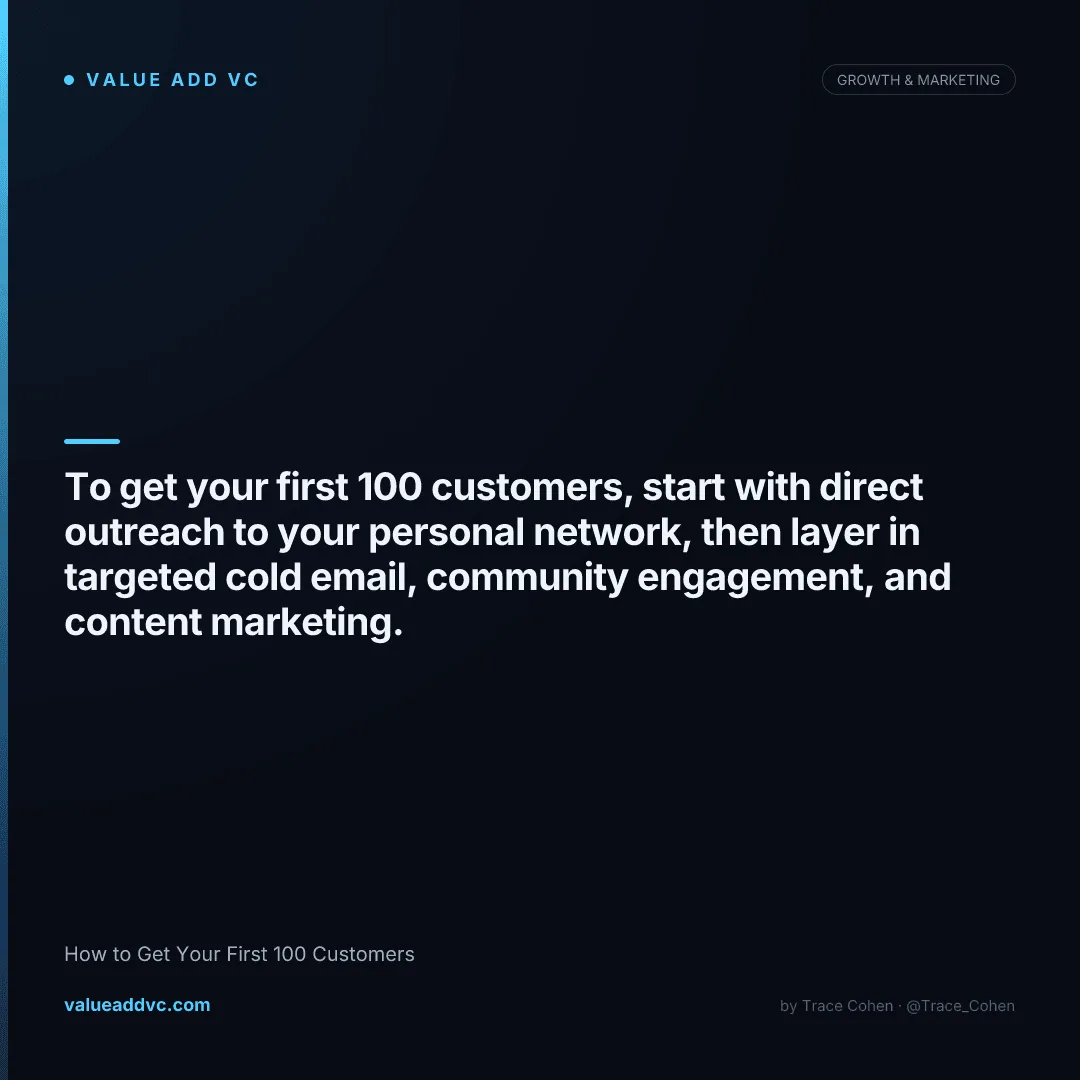
Getting your first 100 customers is the hardest, most important work you will do as a founder. It is not glamorous. It is not scalable. It is one conversation, one demo, one email at a time. But every one of those early customers teaches you something that makes the next 100 easier, and the 100 after that easier still.
Start with your network. Layer in cold outreach with tools like Apollo and lemlist. Show up in communities. Create content that positions you as an expert. Track your funnel religiously. Avoid the common mistakes. And above all, do the things that do not scale โ because at this stage, that is exactly what works.
The founders I back who reach 100 customers fastest all share one trait: they are relentless. Not reckless โ relentless. They treat every interaction as a learning opportunity. They iterate daily. They are not embarrassed by their early product. And they never, ever stop selling.
Your first 100 customers are out there. Go find them.