

Revolut made £4.5bn ($6.0bn) of revenue in 2025, up 46%, from five main lines: card payment fees, interest on balances and loans, monthly subscription plans, wealth and crypto trading, and currency exchange. As of November 21, 2026, it is profitable, with £1.7bn ($2.3bn) profit before tax and £1.3bn net profit in 2025, and it is still private.
Revolut is a useful counterexample to the idea that neobanks only live off card swipes. Its own results show five revenue lines each worth $800m or more, plus a business-accounts arm. The figures below are company-stated, from Revolut's FY2025 results announcement and Annual Report 2025, with the headline numbers confirmed by Reuters on March 24, 2026. For listing status and valuation history, see our Revolut IPO status page.
Revenue and profit: Revolut results announcement and Annual Report 2025, confirmed by Reuters (March 24, 2026). Valuation: Revolut and TechCrunch (November 4, 2026).
How does Revolut make money?
Revolut's FY2025 results break out five primary business lines. Revolut itself notes that these components "represent the primary business lines and do not sum to Total Group Revenue," so read them as the main engines rather than a complete split. All figures are company-stated for the year ended December 31, 2025.
| Revenue line | FY2025 | FY2024 | Growth |
|---|---|---|---|
| Card payments | $1.3bn (£1.0bn) | $887m (£694m) | +45% |
| Interest income | $1.3bn (£974m) | $1.0bn (£790m) | +23% |
| Subscriptions | $936m (£708m) | $541m (£423m) | +67% |
| Wealth | $876m (£663m) | $647m (£506m) | +31% |
| Foreign exchange | $800m (£606m) | $540m (£422m) | +43% |
| Group revenue | £4.5bn ($6.0bn) | £3.1bn ($4.0bn) | +46% |
Company-stated, from Revolut's FY2025 results announcement (March 24, 2026). Line items do not sum to group revenue, per Revolut.
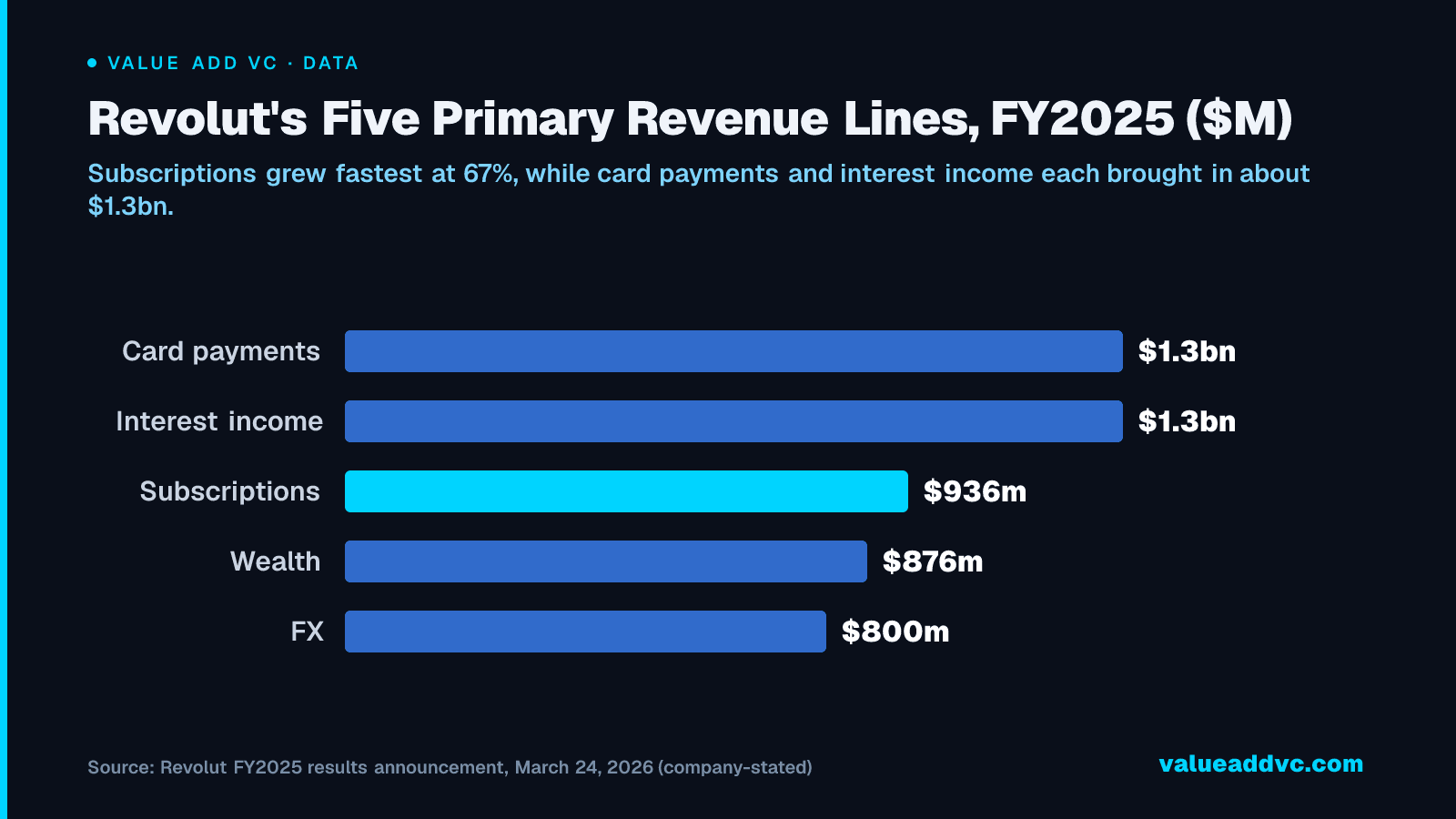
Revolut's Five Primary Revenue Lines, FY2025 ($M)
Subscriptions grew fastest at 67%, while card payments and interest income each brought in about $1.3bn.
Revolut FY2025 results announcement, March 24, 2026 (company-stated)
Data
| Item | Value |
|---|---|
| Card payments | $1.3bn |
| Interest income | $1.3bn |
| Subscriptions | $936m |
| Wealth | $876m |
| FX | $800m |
Card payments: $1.3bn
Revolut reported that "Card Payments grew 45% YoY to $1.3bn (£1.0bn), compared to $887m (£694m) in 2024." This is mostly interchange: when a customer pays with a Revolut card, a fee on the merchant's side of the transaction is shared with the card issuer. The customer does not pay it, which is why a free account can still earn money.
The driver is volume. Revolut said total transaction volume rose 65% to $1.7tn (£1.3tn) in 2025, confirmed by FinTech Magazine. Revolut does not disclose the interchange rate it earns per transaction, so we do not estimate one.
Interest income: $1.3bn
Revolut reported a "23% YoY increase in interest income of $1.3bn (£974m), compared to $1.0bn (£790m) in 2024." It earns interest on the money customers hold with it and on its loans. Revolut said customer balances grew 66% to $67.5bn (£50.2bn) and that its lending portfolio grew 120% to $2.9bn, mainly unsecured personal loans and credit cards, with a small mortgage book (company-stated). Interest income grew the slowest of the five lines, and it is the line most sensitive to where interest rates go.
Subscriptions: $936m, and what the plans cost
Revolut reported that "Subscriptions turnover reached $936m (£708m), a 67% YoY increase from $541m (£423m)." Customers pay a monthly fee for higher fee-free allowances on ATM withdrawals and currency exchange, insurance, and perks on the top tiers. UK personal plan prices on Revolut's plans page, checked November 21, 2026:
| UK plan | Monthly price |
|---|---|
| Standard | Free |
| Plus | £3.99 |
| Premium | £8.99 |
| Metal | £16.99 |
| Ultra | £60 |
Revolut raised UK plan prices in October 2026, so guides written before then show lower figures; Revolut's own page is the current source. Subscriptions grew 67%, more than any of the other four lines, and they are the most predictable revenue Revolut has, because they do not depend on how much customers spend or where interest rates go. Revolut does not disclose how many customers pay for a plan.
Wealth: $876m
Revolut reported that "Wealth increased 31% to $876m (£663m), up from $647m (£506m)." This line covers stock, crypto and commodities trading in the app, where Revolut earns commissions, spreads and fees. It is the line most tied to market sentiment: when crypto trading is busy, it grows fast, and when trading slows, it can shrink.
Foreign exchange: $800m
Revolut reported that "FX increased 43% to $800m (£606m), up from $540m (£422m)." Each plan includes a fee-free exchange allowance; exchanges above the allowance, and on weekends on lower plans, carry a markup, and higher plans raise or remove those limits. That design ties FX back to subscriptions: frequent travellers have a reason to upgrade.
Revolut Business
Alongside the five consumer lines, Revolut sells accounts to companies, earning from monthly plan fees and from payments, cards and multi-currency transfers. Revolut said business customers rose 33% to 767,000 in 2025 (Fintech Futures). It does not break out Business revenue in pounds or dollars in the results we cite, so we do not give a figure.
Is Revolut profitable?
Yes. Reuters reported on March 24, 2026 that Revolut "said its pre-tax profit hit a record 1.7 billion pounds ($2.3 billion) in 2025, up 57% from the year before," and that "its revenue was 4.5 billion pounds, and that it had 68.3 million retail customers in 2025, up from 52.5 million in 2024" (Reuters). Net profit was £1.3bn ($1.7bn), per Revolut, and Finance Magnates reported that the results marked the firm's fifth consecutive profitable year.
That profitability is the main difference between Revolut and a typical venture-backed fintech, and it is why Revolut can fund growth without raising new money. Its $115 billion valuation came from a secondary share sale completed on November 4, 2026, which TechCrunch reported "brought no new money into Revolut" (TechCrunch). Listing timing and the valuation history are on our Revolut IPO status page.
What Revolut discloses vs. what is not disclosed
Company-stated
FY2025 group revenue, profit before tax and net profit; the five primary revenue lines with growth rates; 68.3 million retail and 767,000 business customers; $1.7tn transaction volume; $67.5bn customer balances; UK plan prices.
Not disclosed (not estimated here)
The interchange rate per transaction, the number of paying subscribers, and FY2026 revenue, which has not been published yet. Third-party estimates of revenue mix exist but are not company figures.
Bottom line: Revolut makes money the way a full bank does, from spending, balances, subscriptions, trading and currency, and no single line dominates: card payments and interest each brought in about $1.3bn in 2025, and the other three lines $800m to $936m each. That spread is why £4.5bn of revenue turned into £1.7bn of pre-tax profit. For where an IPO stands, see the Revolut IPO status page.
Latest from the Pulse
Get VC data most people never see
— free to subscribe
Trace's notes on venture, AI and startups, a few times a week. Join 5,000+ subscribers. No spam.
No spam, unsubscribe anytime. Sent via Substack · Privacy · or subscribe on Substack ↗