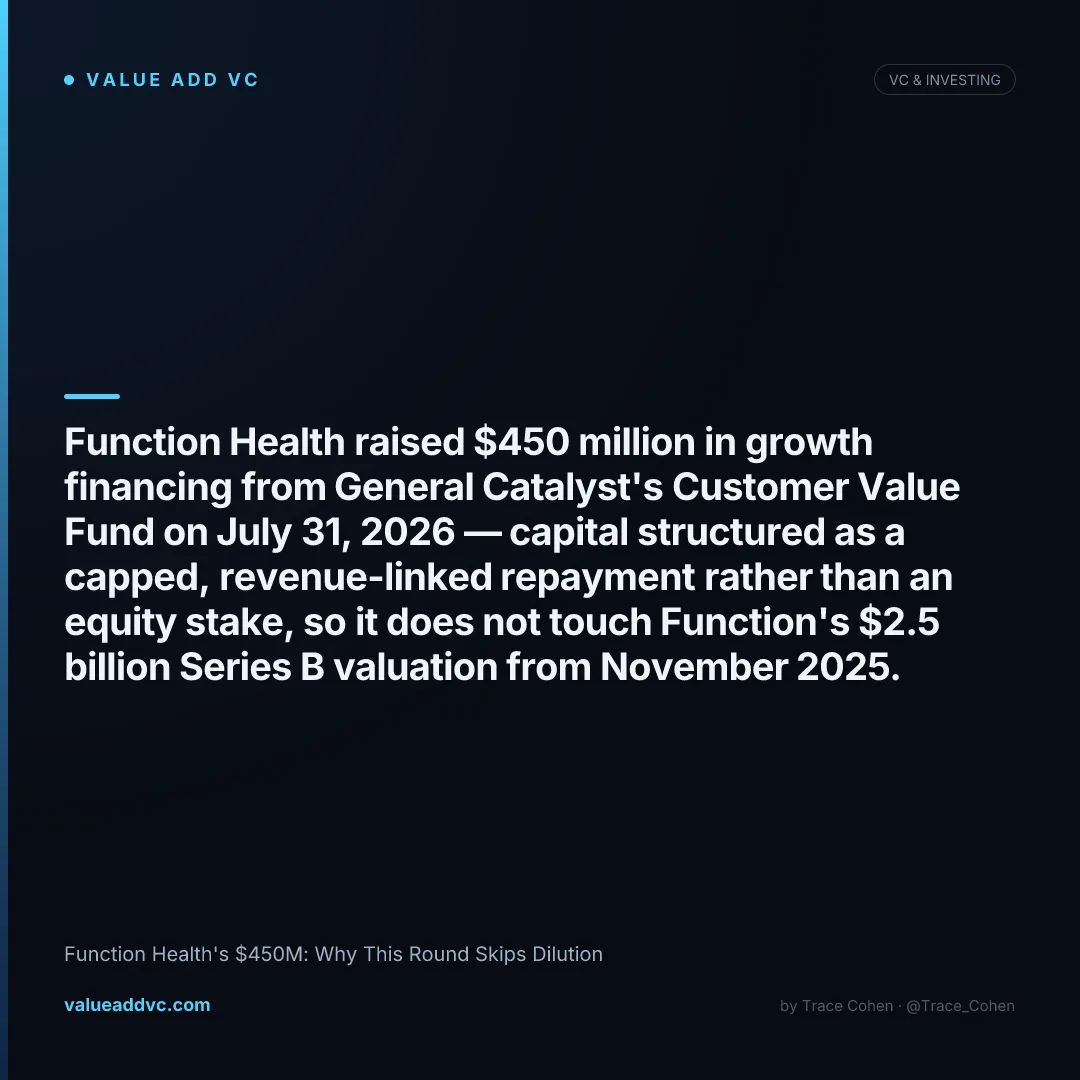
Function Health raised $450 million from General Catalyst's Customer Value Fund without touching its $2.5 billion valuation. The structure of the deal is the story.
Eight months after closing a $298 million Series B, Function Health just took another $450 million — nearly 50% more capital than its prior equity round — and its valuation didn't move. Not because investors think Function is worth less than $2.5 billion — we broke down why the deal didn't move that number at all. Because this isn't an equity round at all. It's a structured, revenue-linked financing that General Catalyst designed specifically so growth-stage companies can raise real money without asking a cap table to reprice itself. That structure is the story here, more than the dollar figure.

Function Health $450M Growth Financing: Round Terms and Structure
Function Health secured $450 million in growth financing from General Catalyst's Customer Value Fund (CVF), announced July 31, 2026. The capital is non-dilutive and revenue-linked rather than equity: General Catalyst takes no new ownership stake and the deal does not reprice Function's $2.5 billion valuation, set eight months earlier in its $298 million Series B. Total disclosed capital across both rounds now tops $748 million, on top of an earlier 2024 raise, bringing Function's lifetime funding north of $750 million since its 2022 founding by CEO Jonathan Swerdlin.
What General Catalyst's Customer Value Fund actually does
CVF is General Catalyst's answer to a problem every growth-stage company eventually runs into: you need capital to scale a proven, working motion — more lab capacity, more sales reps, more marketing spend — but raising another equity round means asking someone to price the whole business, board seat and liquidation preference included, just to fund something closer to working capital. CVF instead pre-funds the specific growth spend and gets repaid a capped, fixed share of the revenue that spend generates. No equity, no board seat, no new valuation mark. It's built for companies that already have product-market fit and predictable unit economics — Function's 160+ biomarker membership model, recurring by design, is close to a textbook fit.
Function isn't CVF's first health deal, and it isn't even July's largest. Earlier in the month, Prenetics' supplement brand IM8 secured a $1 billion CVF financing, and enterprise health-tech company Commure raised $200 million through the same vehicle to scale its AI-powered revenue-cycle platform. Grammarly used an earlier version of the structure to raise $1 billion without diluting its cap table. Four deals in roughly two months is a pattern, not a one-off — CVF has become a standing alternative to a traditional growth round for companies General Catalyst already has conviction on.
General Catalyst's Customer Value Fund: 2026 Deals
Company press releases and GlobeNewswire, July–August 2026
Figures from GlobeNewswire, PR Newswire, and company announcements as of August 2026.
What Function is actually buying with the money
Function's core product bundles more than 160 biomarker lab tests, imaging, and an AI "medical intelligence" layer that interprets results for members — the pitch is one membership replacing a scattered mess of annual physicals, specialist referrals, and DTC lab tests. In Q2, Function moved from organic growth into acquisition mode, buying Getlabs, a nationwide at-home and in-office blood-draw network, and SuppCo, a supplement platform. Both are logical bolt-ons: Getlabs removes the friction of getting members into a lab in the first place, and SuppCo turns "here's what your bloodwork says you're deficient in" into a same-platform purchase. CEO Jonathan Swerdlin has said more acquisitions are possible, which is exactly the kind of spend CVF financing is built to fund — buying and integrating companies rather than pure ad spend.
Function isn't the only body-scan-and-biomarker startup raising big in 2026
Function's raise lands in a crowded and well-capitalized preventive-health category. Daniel Ek's Neko Health closed a $700M Series C at a $7B valuation for its full-body scanning approach, a different modality (imaging-first vs. Function's lab-first model) chasing the same underlying thesis: consumers and now employers will pay recurring membership fees for continuous, data-rich health monitoring instead of an annual physical. Put the two rounds side by side and the category's aggregate 2026 capitalization is already north of $3 billion between just these two companies, before counting Whoop, Superpower, and the rest of the biomarker-testing wave covered in our 2026 digital health funding roundup.
Figures from TechCrunch, MedCity News, and company announcements as of August 2026.
Why this structure is spreading beyond General Catalyst's portfolio
The broader signal here is about deal structure, not just Function specifically. 2026 has been a year of stretched growth-stage valuations across health and consumer tech — plenty of companies are sitting on rich marks from 2025 rounds that a traditional Series C at current growth rates might not clear. Non-dilutive, revenue-capped financing lets those companies keep raising without forcing a flat or down round, which protects founders, employees, and existing investors from a repricing event nobody wants. The catch is that it isn't free capital — Function is on the hook for a fixed, capped repayment tied to the revenue this money generates, which behaves more like structured growth debt than a gift. Expect more growth-stage health, fintech, and consumer subscription companies to reach for this instrument in the back half of 2026, especially any that raised a rich Series B or C in the last 12–18 months and need capital to scale without a valuation conversation.
The Bottom Line:
Function Health's $450M is less about the number and more about the instrument — non-dilutive, revenue-capped financing from General Catalyst's Customer Value Fund is becoming growth-stage health tech's default way to raise without repricing.
Track rounds like this one on the Startup Funding Tracker and see how health-tech valuations stack up on the AI Valuations Dashboard at Value Add VC. Originally published in the Trace Cohen newsletter.
Latest from the Pulse
Get VC data most people never see
— 100% free
Weekly benchmarks, valuations, and fund data. Join 5,000+ investors. No spam.