Updated Oct 1, 2026
Earlier versions of this post put Decagon's ARR at $35M as of October 2025; we could not trace that figure to a source, so it has been removed. Decagon told Newcomer in August 2026 that annualized revenue had crossed $100 million, and Sacra estimates the company hit $100M in July 2026, up from $44M at the end of 2025. At $100M, the $4.5B valuation works out to about 45x annualized revenue. Added a valuation-history table covering Decagon's funding rounds back to its June 2024 seed, plus the November 2025 T.Capital strategic investment (size undisclosed).
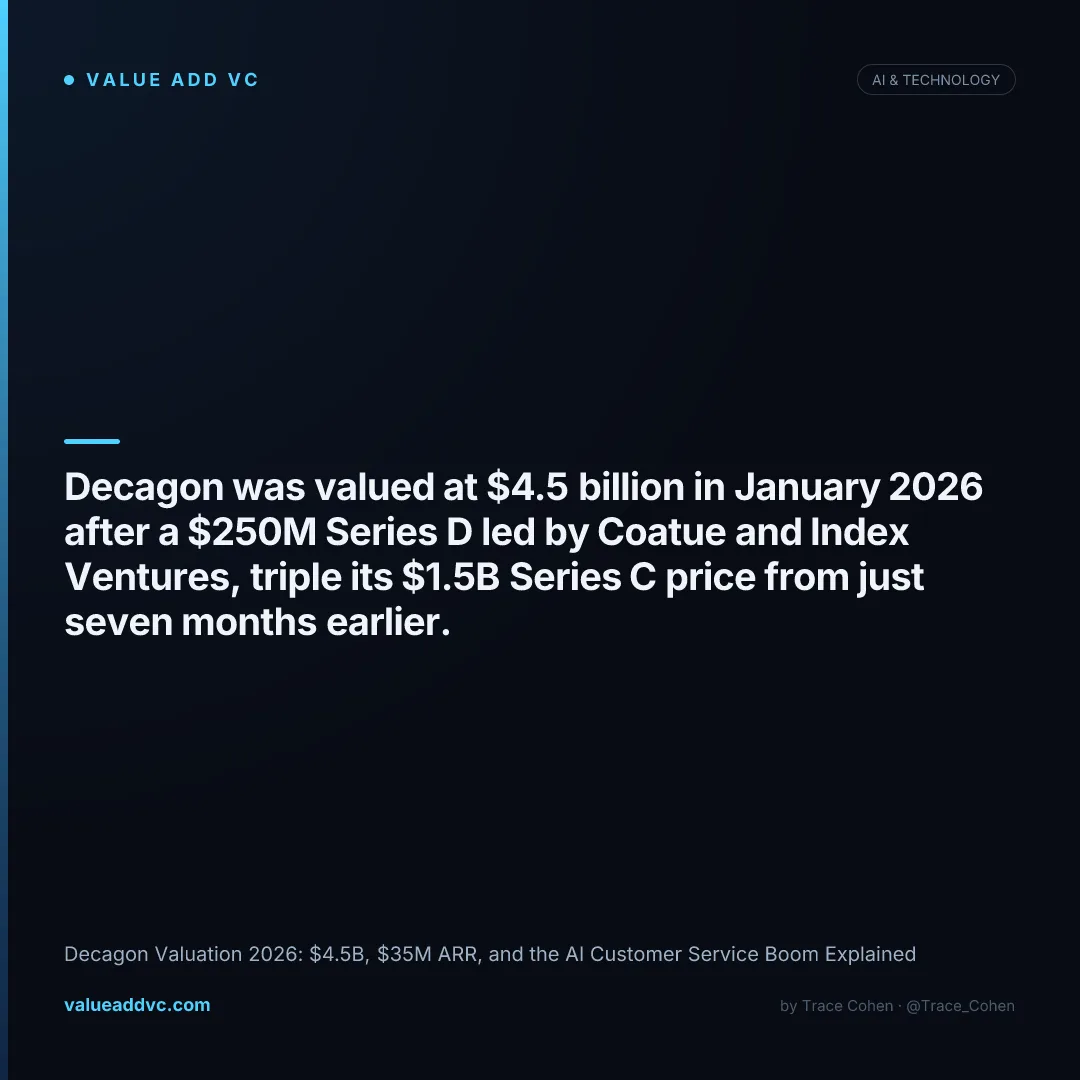
Decagon was valued at $4.5 billion in January 2026 — triple its $1.5 billion price tag from just seven months earlier — according to Bloomberg. Annualized revenue has since crossed $100 million as of August 2026, Decagon told Newcomer, up from an estimated $44 million at the end of 2025, per Sacra. That's the short answer. The gap between the current multiple and what a real exit just paid for a comparable business is the more interesting one.
A three-year-old AI customer-service startup tripling its valuation in under seven months isn't unusual in 2026 — it's close to the median for the category, and the same pattern shows up in other regulated or legacy-software verticals: Valon Technologies doubled to a $2.3 billion valuation in October 2026 on the same bet that AI-native software can displace decades-old incumbent systems, this time in mortgage servicing rather than customer support. What makes Decagon worth a closer look is how cleanly its numbers illustrate the gap between funding-round pricing and revenue reality across the entire AI-agent-for-CX space, and what Salesforce just told the market that gap is actually worth.
Decagon's valuation history
| Date | Round | Amount | Post-money valuation | Lead(s) | Source |
|---|---|---|---|---|---|
| Mar 4, 2026 | Tender offer | — | $4.5B (confirmed) | Coatue, Index, a16z, Definition, Forerunner, Ribbit | TechCrunch (via Yahoo Finance) |
| Jan 28, 2026 | Series D | $250M | $4.5B | Coatue Management, Index Ventures | CMSWire |
| Nov 10, 2025 | Strategic investment | Undisclosed | — | T.Capital (Deutsche Telekom's venture arm) | Business Wire (via Yahoo Finance) |
| Jun 22, 2025 | Series C | $131M | $1.5B | Accel, Andreessen Horowitz | Decagon |
| Oct 15, 2024 | Series B | $65M | Not disclosed (Sacra: $650M) | Bain Capital Ventures | Cooley |
| Jun 18, 2024 | Seed + Series A | $35M | — | a16z (seed), Accel (Series A) | Yahoo Finance |
Decagon's Series B announcement said only that the round quadrupled its valuation. Sacra reports that Decagon was valued at $650 million as of October 2024, but we could not fetch a press report or filing for that figure, so it is shown as Sacra's number, not a disclosed one. We found no disclosed valuation for the June 2024 Seed/Series A round or the T.Capital investment.
Figures from Bloomberg, Decagon's Series D announcement, Newcomer's August 2026 reporting, and Sacra's equity research on the company, 2026.
What Is Decagon's Valuation in 2026?
Decagon's valuation is $4.5 billion as of January 2026, set by a $250 million Series D led by Coatue Management and Index Ventures, with new investors ChemistryVC, Definition Capital, and Starwood Capital joining existing backers a16z, Accel, and Bain Capital Ventures. That figure was confirmed again in March 2026, when Decagon ran a tender offer at the same $4.5B mark to let employees cash out vested shares.
The Round Math: Three Valuations in Seven Months
Decagon has now raised money at three distinct valuations inside of a year. It closed a $131 million Series C in June 2025 at a $1.5 billion valuation, co-led by Accel and a16z's Growth Fund after drawing what the company described as 5x more investor demand than the round had capacity for. Seven months later, the $250 million Series D tripled that number to $4.5 billion. The pace is the story: most companies that triple in valuation do it across two or three years of compounding growth, not two quarters. Wonderful's enterprise AI OS has run an even faster version of the same playbook, pricing four rounds in roughly 14 months.
Founded in 2023 by CEO Jesse Zhang and CTO Ashwin Sreenivas, Decagon had more than 300 employees as of its March 2026 tender offer, across offices in San Francisco, New York, and London — still a founder-run company with a thin executive bench relative to its balance sheet.
The ARR the Valuation Is Actually Pricing
Decagon told Newcomer in August 2026 that its annualized revenue had crossed $100 million. Sacra separately estimates the company crossed $100 million in annualized revenue in July 2026, up from $44 million at the end of 2025, so the two sources agree. Neither source labels the $100 million figure ARR — both call it annualized revenue, a run-rate — and this post uses ARR as shorthand for that run-rate. Decagon's Series C announcement said it grew from zero to 8-figure ARR in 2024, and TechCrunch noted in March 2026 that the company had not disclosed revenue figures since late 2024, when its ARR passed eight figures.
At $4.5 billion against more than $100 million in annualized revenue, Decagon is now priced at roughly 45 times revenue or less — versus about 102 times on Sacra's $44 million end-of-2025 estimate, the closest figure to when the Series D priced. Its customer list explains why investors are willing to pay it: Notion, Duolingo, Rippling, Bilt, Eventbrite, Substack, Oura, Affirm, Chime, Figma, and Dropbox all run production AI agents through the platform. Named resolution rates back up the pitch — Duolingo reports 80% deflection, Substack hits 90% resolution without a human handoff, and Bilt Rewards cut costs by $1.75 million while resolving 75% of tickets through the agent alone.
Decagon vs Sierra AI: Two Very Different Growth Curves
Decagon isn't the only AI customer-service startup commanding an outsized multiple. Sierra, co-founded by former Salesforce co-CEO Bret Taylor, raised a $950 million Series E in May 2026 at a $15.8 billion valuation — more than 3x Decagon's price tag. Sierra announced it had hit $100 million in ARR in November 2025 and was over $150 million by February 2026, and Taylor, its CEO, posted on X on May 29, 2026 that Sierra had just hit $200 million in ARR. On a valuation-to-ARR basis, Decagon is now priced more conservatively than Sierra: about 45x ARR versus Sierra's 79x on that $200 million figure (about 105x or less on the more than $150 million ARR Sierra cited to CNBC when the round was announced), now that Decagon's annualized revenue has more than doubled from Sacra's $44 million end-of-2025 estimate.
Decagon vs Sierra AI: Valuation and ARR
Bloomberg, CNBC, Newcomer, Sacra, and company disclosures (Sierra ARR: Bret Taylor on X, May 29, 2026)
Decagon's annualized revenue ($100M+, August 2026) is roughly half of the $200M ARR Sierra disclosed in May 2026, on a valuation base that's less than a third as large — the reason Decagon's multiple now looks cheaper on paper than Sierra's despite the smaller sticker price.
Why the Category Is Hot: A $15B Market Growing 26% a Year
The AI customer-service software market is projected to reach roughly $15–19 billion globally in 2026, growing at a compound annual rate near 25.8%, and the broader agentic-AI submarket — projected at $9.14 billion in 2026 — counts customer service as its single largest segment at 32.2% of the total. Pricing across the category has converged on outcome-based models: Intercom's Fin charges $0.99 per resolved ticket, while Zendesk answers with $1.50–$2.00 per automated resolution on top of its per-seat fees, a structural shift that ties vendor revenue directly to how much of the support queue AI actually handles.
| Metric | Decagon | Sierra AI | Intercom Fin (acquired) |
|---|---|---|---|
| Latest valuation | $4.5B (Jan 2026) | $15.8B (May 2026) | ~$3.6B acquisition (Jun 2026) |
| Annualized revenue | $100M+ (Aug 2026) | $200M (May 2026, per Bret Taylor) | Folded into Salesforce, not disclosed separately |
| Founded | 2023 | 2023 | 2011 (as Intercom) |
| Lead investors | Coatue, Index Ventures | Tiger Global, GV | Salesforce (acquirer) |
| Total raised (pre-exit) | ~$481M | $1.6B+ | $240M+ (as Intercom) |
| Employees | 300+ (Mar 2026) | Not disclosed | ~1,300 (Intercom, pre-deal) |
| Notable customers | Notion, Duolingo, Chime, Affirm | 40%+ of Fortune 50 | Amplitude, Atlassian, Coda |
Figures blended from Bloomberg, CNBC, TechCrunch, Businesswire, Sierra (company blog and Bret Taylor on X), and Sacra equity research, 2026. Intercom/Fin figures reflect the company prior to Salesforce's announced acquisition; deal terms were not fully disclosed.
What the headline misses
A tripled valuation in seven months makes for a clean headline, but it obscures three things. First, private funding-round pricing isn't a market clearing price — it's set by a handful of growth investors competing for allocation in a hot category, not by a broad buyer pool. Second, Decagon's ARR has moved fast enough that any single figure goes stale within months — Sacra estimates it at $44M at the end of 2025, and Decagon says it had crossed $100M by August 2026, so the multiple quoted in any writeup depends heavily on when it was pulled. Third, and most important, Salesforce's ~$3.6 billion purchase of Intercom's Fin agent in June 2026 is the first real acquisition price the market has set for an AI customer-service business — and it landed well below what either Decagon or Sierra is currently valued at in a private round, despite Fin being a larger, more established product. Funding rounds and exits are pricing the same category very differently right now, and only one of those numbers involves someone actually writing a check to buy the whole company.
Decagon is worth $4.5 billion on roughly $100 million of revenue.
Whether that math holds depends on whether the next liquidity event is another markup — or an acquirer pricing it the way Salesforce just priced Fin.
Track private AI company valuations on the AI Valuations Dashboard at Value Add VC. Originally published in the Trace Cohen newsletter.
Latest from the Pulse
Get VC data most people never see
— free to subscribe
Trace's notes on venture, AI and startups, a few times a week. Join 5,000+ subscribers. No spam.