Over 40% of startups that face a lawsuit without D&O insurance shut down within 18 months. The average employment practices claim costs $125,000 to defend, and a single data breach runs $4.45 million on average, per IBM’s Cost of a Data Breach Report. Yet most seed-stage founders either skip insurance entirely or buy the wrong policies from legacy carriers that don’t understand venture-backed businesses.
Across 65+ angel investments, I’ve seen founders blindsided by IP lawsuits with no E&O coverage, watched a board member resign because D&O wasn’t in place before a Series A close, and helped a portfolio company navigate a cyber incident where the insurance provider’s response team showed up in hours instead of days. Insurance is the least glamorous line item on your burn table and the one that can save your company overnight. These six providers are the ones actually built for startups — not legacy carriers with a startup landing page bolted on.
What are the best insurance providers for startups in 2026?
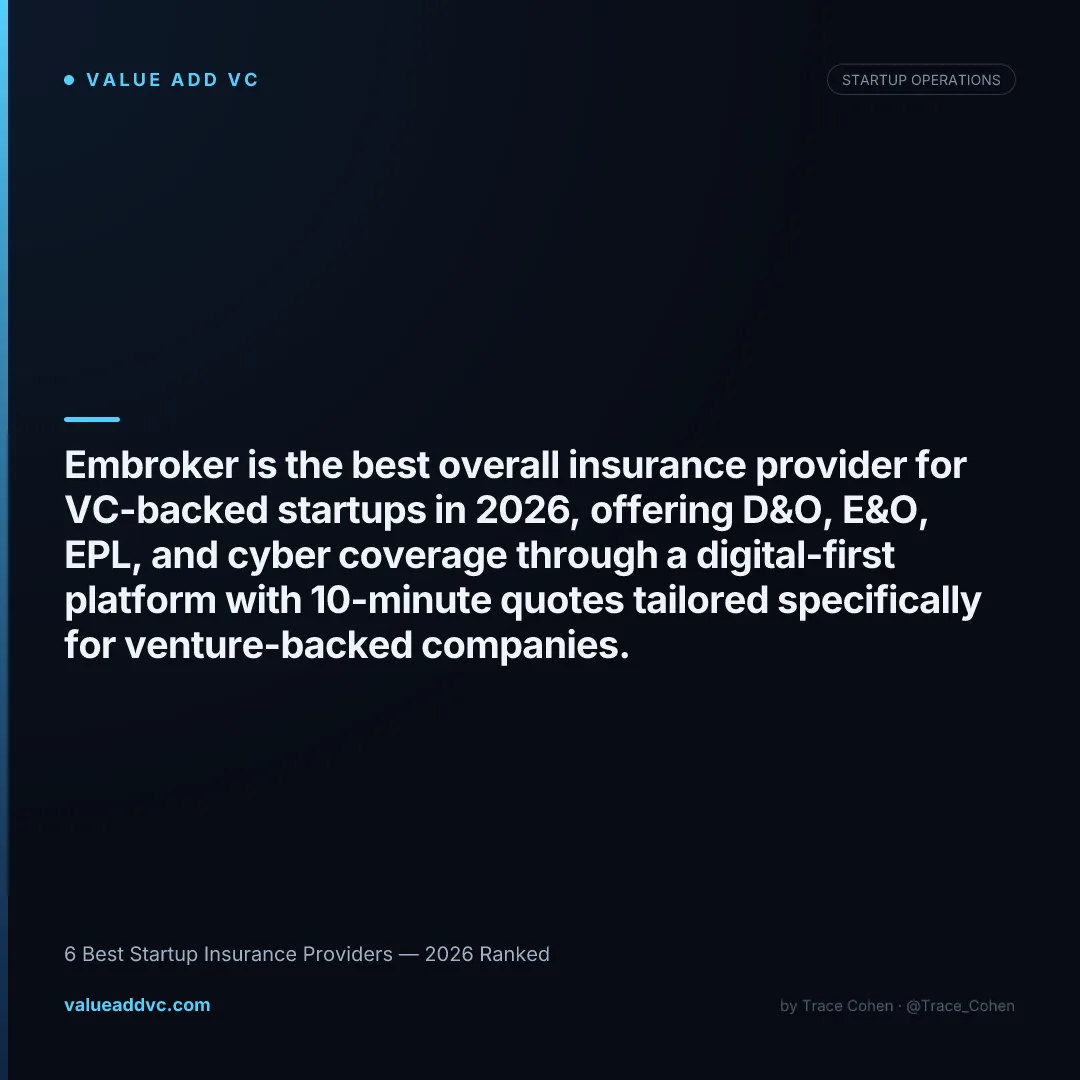
Embroker is the best overall insurance provider for VC-backed startups in 2026, offering the full coverage stack — D&O, E&O, EPL, and cyber — through a digital-first platform purpose-built for venture-backed companies. Vouch is the top pick for early-stage startups, especially those coming out of Y Combinator, with policies designed for pre-revenue companies that legacy carriers won’t touch. Coalition leads on cyber insurance specifically, bundling active security monitoring tools with every policy.
The key distinction in this category is specialization. Legacy carriers like Hartford, Travelers, and Chubb sell startup policies, but their underwriting models were built for established businesses — they penalize pre-revenue companies, thin operating histories, and rapid headcount growth. The six providers below were built from the ground up for exactly those conditions.
The 6 best startup insurance providers, ranked
Total funding raised: which providers have staying power
Insurance is a long-tail business — your policies need to be backed by solvent, stable carriers for years after you buy them. Funding is not the whole picture (underwriting profitability matters more), but the capitalization of these companies signals whether they can sustain claims payouts and product investment over time.
NEXT Insurance leads in total funding at $1B+, reflecting its broader small-business focus. Coalition’s $750M+ includes both equity and capacity from reinsurance partners. Embroker ranks lowest in funding but is the most focused on VC-backed startup coverage specifically.
Startup insurance providers compared: focus, pricing, and coverage
| Provider | Focus area | Starting price | Total funding | Best for |
|---|---|---|---|---|
| Embroker | D&O, E&O, EPL, cyber | ~$2,000/yr | $150M+ | Full-stack startup coverage |
| Vouch | D&O, E&O, cyber, BOP | ~$1,500/yr | $160M+ | Early-stage / YC startups |
| Coalition | Cyber insurance + security | Varies by risk | $750M+ | Cyber-first companies |
| NEXT Insurance | GL, WC, PL, auto | ~$300/yr | $1B+ | Small biz / solo founders |
| Pie Insurance | Workers' compensation | ~30% below legacy | $300M+ | Hourly / field workers |
| Newfront | Full-service brokerage | Broker commission | $200M+ | Complex growth-stage risk |
Pricing as of August 2026. Startup insurance pricing varies significantly based on revenue, headcount, industry, claims history, and coverage limits. Figures shown are approximate minimums for early-stage companies. All providers offer custom quotes.
How We Ranked These
The ranking weighs three factors: startup-specific fit (does the underwriting model understand pre-revenue companies, rapid growth, and venture-backed risk profiles — this is why Embroker and Vouch lead over larger competitors), coverage breadth (how many of the policies a VC-backed startup needs can you get from one provider), and speed of the buying experience (online quoting, same-day binding, digital certificates). Funding and carrier backing are secondary signals for solvency and staying power. No provider paid for placement or influenced rank — see our editorial standards.
What most founders get wrong about startup insurance
The most common mistake is treating insurance as a post-funding checkbox rather than a pre-funding requirement. D&O insurance is a closing condition for most institutional rounds — if you scramble to buy it during due diligence, you pay rush pricing and may end up with a policy that has exclusions your investors won’t accept. Buy D&O before you start fundraising, not after the term sheet arrives.
The second mistake is buying the cheapest policy without reading the exclusions. A $2,000/yr D&O policy with a prior-acts exclusion, a regulatory investigation carve-out, and a $500K sublimit on defense costs is not really D&O insurance — it is a piece of paper that will fail when you need it. The difference between a $2,000 policy and a $5,000 policy is often the difference between coverage that works and coverage that doesn’t. Embroker and Vouch both structure policies to avoid these common gaps.
The third mistake is ignoring EPL until after the first employment dispute. Employment practices liability covers wrongful termination claims, discrimination lawsuits, and harassment allegations. The median EPL claim costs $75,000 to settle and $125,000 to litigate. Once you have 5+ employees, EPL should be in your stack — and the first hire is not too early if you can bundle it affordably with your D&O.
How to choose by startup stage
Pre-seed with no employees: you probably do not need insurance yet unless your accelerator or investors require D&O. If they do, Vouch is the fastest path to a policy designed for pre-revenue companies. Seed stage with 1-5 employees: buy D&O before your round closes and add general liability if your lease requires it. Embroker or Vouch — either one handles this well. Series A with 10-30 employees: you need D&O, E&O, EPL, general liability, and workers' comp at minimum. Embroker’s bundled startup program is the most efficient way to get all five. Add Coalition for standalone cyber if you handle sensitive data. Series B and beyond: consider Newfront as a broker to manage a multi-carrier portfolio, especially if you have international operations or complex risk structures.
For the legal infrastructure around your startup — incorporation, equity management, and compliance tooling — see our ranking of the best e-signature tools for startups. For financial tooling that sits alongside insurance on your ops stack, see the best AI tools for finance teams. And for managing the projects and team that all these policies protect, see our project management tools ranking.
The Bottom Line
Startup insurance is not optional after your first fundraise — it is a closing condition, a fiduciary obligation, and a survival tool.
Embroker for the full stack. Vouch for early-stage. Coalition for cyber. NEXT for basic small-business coverage. Pie for the cheapest workers’ comp. Newfront when you need a broker.
Track the companies behind these tools and their valuations on the SaaS Valuations Dashboard at Value Add VC.
Latest from the Pulse
Get VC data most people never see
— free to subscribe
Trace's notes on venture, AI and startups, a few times a week. Join 5,000+ subscribers. No spam.